“Tiny Stones” – Leah Horlick

kaefig_cage

Whether or not it was you
who set off the firecracker in my backyard, all that matters
is that I thought
it was you,

writing to the landlords I’m just sending this to you now
so that in the morning
I don’t think that this was a dream.

I await the presence of someone who understands
the genetic impact of a siren. I pull a siren
around me and glow silent, I pull a web of nerve endings

over my own face and touch everything like it is covered in dust—
dust is a shawl, dust is a veil of static. I reach a hand through
thick white noise towards a feeling.

Everything you say sends me further into myself
whether you like it or not, whether you mean it.

I fell off the horse into a bush of thorns and it was a choice between
the thorns and the hooves—can you guess which I chose?

I overwhelm my house with peonies.
When I go home I shut the door and my

eyes and my phone in a drawer
and I sleep. In the morning I look at the Internet to remember

what I look like. I drink so much water
I boil everything—

basil and rose petals,
yarrow and chamomile,

eyeliner and sitting in the dark theatre.

I slowly weigh myself
down with tiny stones.

I hide another set
of eyes beneath my dress.

I slowly accept that this new scar will come out
every time I sit
in the sun.

Sometimes I call it having a flashback.

Other times I just
like to have everything
in one place to get a good hard look
at my life.


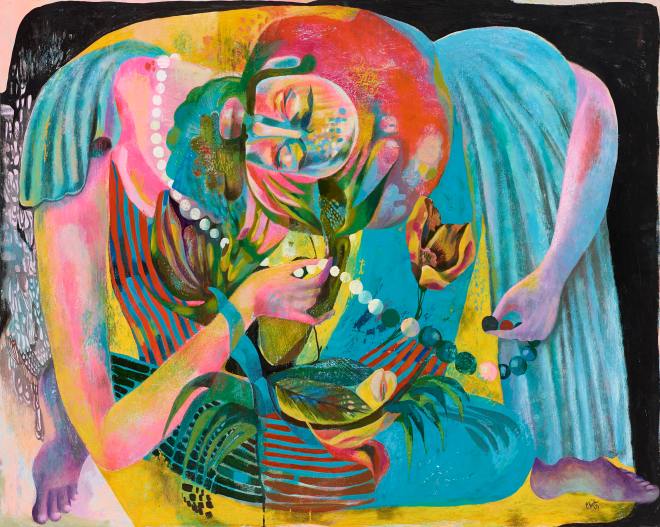
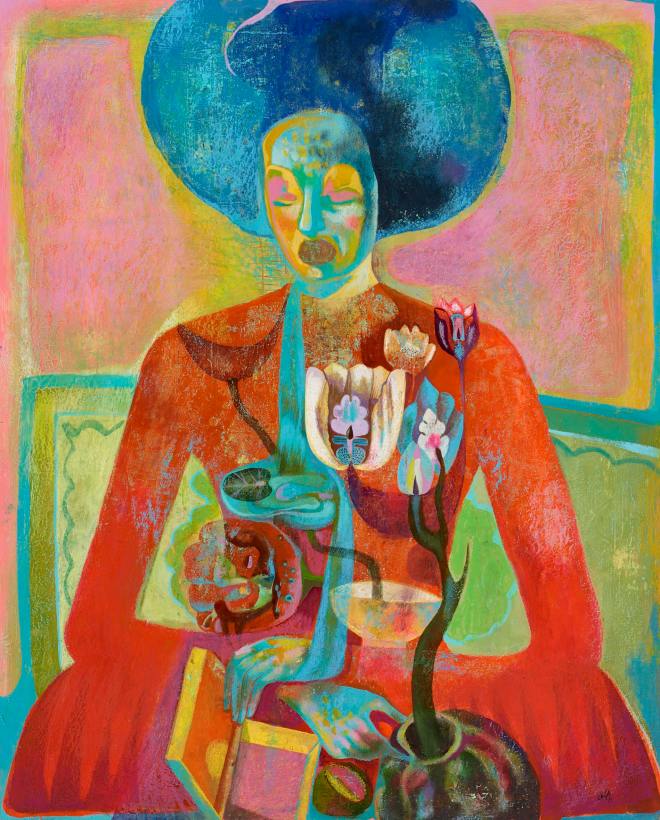
these words by Leah Horlick were inspired by the work of Olaf Hajek

“City” – Samantha Lapierre

ernte_beute

City, please be gentle with me. Be kind when I close my eyes and the pitch black becomes starry neon lights. Be sympathetic when I ride the streetcar alone, when I fall on the sidewalk and bust my knee open, when I descend wobbly stairs into basement bars illuminated with glowing red lights.

There are streets lined with Internet cafés, shadowy music halls and hole-in-the-walls that all house anonymity. I feel like a very small anonymous blip on your ever-growing radar.

Our necks twist and turn as we leer to recognize a familiar face. We pick fresh fruit from the market stands; cars whiz by and I hear a bicycle bell in the distance. Dead fish rest in storefront windows and people shuffle by. Everybody is hastily going about their own business.

I’ve given you a year of my life, and I’m not sure how much more I have left to give. City, please be gentle with me.


these words by Samantha Lapierre were inspired by the work of Olaf Hajek


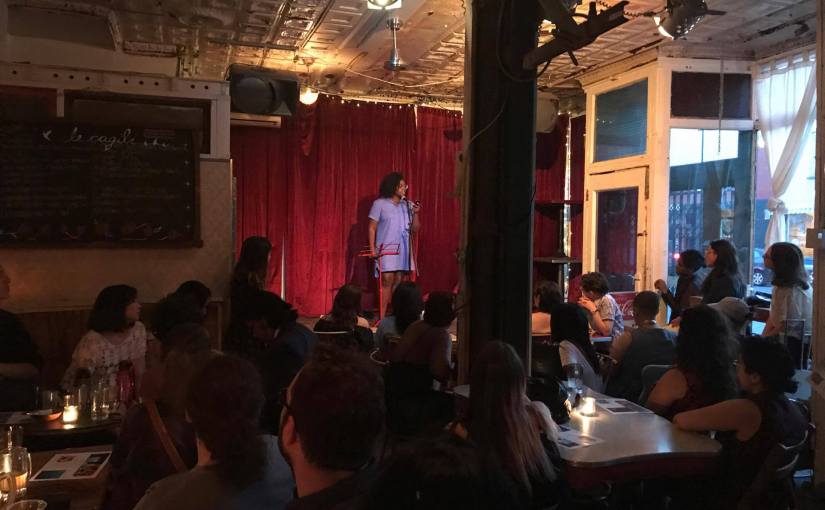
click here for the live audio of our Cagibi reading!

Audio of the first leg of Word and Colour’s Summer Reading Series at Cagibi on June 24th, MC’d by Dena Coffman!


Readers, in order of appearance:

Nailah King, a member of the Room editorial collective. She is also a writer, avid reader, and blogger. A UBC alumnae, she is currently working on completing a thus far untitled manuscript in prose fiction. Read King’s recent word and colour prose, “Diaspora Blues,” inspired by the art of Shanna Strauss

Taisha Cayard, a Social Services student at Dawson College who has recently found interest in writing poetry. She loves to sing and to socialize. Read Cayard’s recent wandc collaboration, “But What Can I Learn From You,” in dialogue with the poetry of Audre Lorde

Lily Chang, who writes, edits, and pays rent and hydro in Montreal. She is a recent graduate of Concordia University’s MA program in Creative Writing. Her work has appeared or is forthcoming in Headlight Anthology, Word and Colour, Voices Visible, and Frog Hollow Press’s City Series. Read Chang’s poetry, “White is Not My Colour,” inspired by the art of Tran Nguyen
wordandcolour
Oumy Dembele, a Professional Theater student from France. A scriptwriting graduate, her writing is mostly focused on fiction and scenes. She recently challenged herself to write prose in English. Her work, “Meiosis,” is forthcoming at Word and Colour.
wordandcolour
Tristen Sutherland, who studies English Literature and Political Science at McGill. When she’s not writing, she’s performing improv comedy or debating whether it’s safe to eat raw cookie dough. Read her recent Word and Colour piece, “Mango,” inspired by the art of Angela Pilgrim.


See more photos of the reading via @wordandcolour


“Seeds” – Erin Flegg

meditation

For two weeks straight we lay flagstone, my head emptied of any thought that isn’t engage your core, what happens when we’re married, lift from your legs, how do bodies shift, protect your wrists.

We work every day, more hours than we’re used to, to finish the job before a deadline imposed by a surgery that will change everything, but only a little.

When we finish you tell me you have a surprise for me. We get in the truck packed full with tools and gravel and lunch scraps and you drive me to the nearest nursery, tell me I can have any plant I want.

In my excitement I forget to lock the passenger door, drop dust and crumbs from my clothes as I touch dry hands to shelves of zinnias and calibrachoa, different colours than the ones already hanging in a pot on our deck. On the boulevard is a bed of poppies, paper thin and swaying yellow and orange. I’ve been trying for years to grow poppies but the morning glory always ravage them below ground. Shadowy invaders hide behind pale blooms and grow large on a diet of my tulip and crocus bulbs. Seeds and seeds and seeds and no fruit.

In the spring I planted seeds in plastic pots indoors, hoping to keep them safe on the second floor. I worry about them more than I did last year, probably something to do with turning 30, ticking clocks and revolution.

In the back of the nursery there are Icelandic poppies, big and showing pink at the tips of their pods, about to burst. I consider one, its stalk thick and hardy, its tallest pod independent but inviting. I imagine it in the backyard, then take a step back from the display. I think about my existing allegiances, the potential still buried in poor dirt and plastic. I want it, but I shouldn’t. Too much is already at stake, too much time spent comforting my own frilly green leaves as they attempt to sprout stalks and pods of their own. I have to give them a proper chance. They’re so delicate, the comparison might crush them, and I can’t sacrifice any more flowers.

One shelf over are the anemones, white with yellow centres. They’re nice but they’re not enough. Don’t fuck it up, you say, poking me gently in one rib and smiling. This is very important.

There’s a plant I don’t recognize. There are no flowers, just wide flat green leaves on narrow stems, fanned out like enormous nasturtiums. On the tag is a dark flower. It’s a hollyhock, or at least it will be. The tag says it will bloom deep burgundy and solid, almost black except for tiny yellow centres, by late summer. I pick it up and try not to imagine what it will look like, leave space in my mind for it’s unfurling.

I carry it on my lap in the passenger seat, dig a hole in the ground in front of our house and plant it. I press the dirt in with my hands and sit down next to it. Everything will change, but only a little.


these words by Erin Flegg were inspired by the work of Olaf Hajek
“Foxglove” – Keah Hansen

precious_collection

Foxglove
Rough hands
The open ended
Tending
For life
In this chalked over
Bite
Of soil
Worms and cat
Piss
Be damned
Ignored
Amidst
Packets of seeds
Dry
Expectant
In the barren
Echo chambers
Stained with
Small blight
Residue of last years
Failed perennials
Soils that seem
To collect rocks
Like rainwater
Save the draining.

Foxglove
I tend
To pull
This dirt up
In sparkles
And turn the stones
To mica
Splashed between
The sun and
Shadows
Looking damp
As if to quench
Though offering
Hope in
The cast-off shapes
Of stalks I
Pulled out
Piece by piece
Last year with my
Arms all crossed
To stop the flint
Caged inside
My ribs
From being sodden
By the storms
Some plant life
Seems to
Carry.

This year
Foxglove,
Is no different
My chin
A spade
I’m making
Place for you
By shaking my head yes
Or no
Learning how
To till the soils best
Most oxygenated
And minerals peopled
In healthy
Numbers
I’m counting
The hours
Until the bells
Ring
In your blooms
I think
They’d sound
Like milk drops
The dew
I taste
In new growth
Your petals
Cupped in joy
Like feet flexed
Dancing
With root systems
Made proverbs
Answering
My questions
In anachronisms.

The wind returned
Fibrous,
Vegetal
And familiar.


these words by Keah Hansen were inspired by the work of Olaf Hajek

“Breakfast” – Kate Shaw

Kevin Calixte-Sukhasana-Cel-1024x683

The views expressed in the texts do not necessarily represent the views of the artist.


She sipped her coffee soundlessly. It had always struck me, how little noise she could make over breakfast these days if left unprovoked. Her fork never plunged all the way through a waffle to clink! the plate, her knife never scraped or dinged! the fork. She drank her coffee, and the mug didn’t make a sound when placed back on the cork coaster.

“What time will you be home from work tonight?”

A guffaw during silent worship is more acceptable than words over breakfast with her. Startled eyes flashed at mine from over the orange juice. A silent sip. A hiss of a word, “Eight.”

I nodded, castigated. She deposited her dishes in the sink with a clank! that resounded as she exited the kitchen. There was shuffling in the den as she gathered her things, and soon the door closed behind her.

“Yes, this is Amadeo’s? I’ve got a reservation for tonight under Polowski. P-O-L…Exactly. I need to cancel.”


these words by Kate Shaw were inspired by the work of Kevin Calixte

“Star gazer” – Alex Leslie

Kevin Calixte-Garudâsana-Kay-1024x683

The views expressed in the texts do not necessarily represent the views of the artist.


In night, your strained vocal chords form a glowing band around the moon. You do not know what you are asking for this time. Shapes assemble at the perimeter and call themselves fingertips, cheeks, inkblot torsos. They have been here before. People you love are recycling names the way the world recycles seasons. Bees with frequency, voices turn on spokes, slow in the days, adrenal dive through the green substrata, decade roulette, but what is the true indicator of new life. The future sits across from you in the greasy spoon diner, saws into pancakes with ketchup on top, wields a steak knife, lectures you about making better choices, the long hall of unintended consequences. And if you can. If you looked harder it would come to you; if you could just focus for once, this wouldn’t be so hard. Clavicle and tracery of eyes would make themselves present, no diagnostic mist, this time. Shutters tumble around your fingers, rising in the darkness. You understand something about tone, about how to lie down in a throat and fall asleep like you own the place. You have always excelled at Rorschach tests, can read suggestion in the shift of shoulders, some air seeping from a mouth at a specific tilt, a thread you can grab and twist. A mimic fish spreading over eyes, cheeks, collarbones. Every face, a display plate on a simple white stand. Star gazer. When you were small, a big kid taught you to cut a slit down the luminous belly of a green blade of grass, break it open with your breath, and make music, and it was the first weapon you ever made. You aimed it at the sky, blasted an escape hatch. But now there is a shift, a settling. It’s dark. Portrait game. Voices turn on spokes, more slowly now. The faces carousel around the small hot triangle of your hands. Milky light seeps through the seams in commuter traffic. When you narrow your eyes, your fatigue blurs into the tactile future. Haloes, overexposures cast into the deep pools of other minds. Butterflies pressed behind eyelids. Drape all the mirrors. Learn how to pray.


these words by Alex Leslie were inspired by the work of Kevin Calixte

join our reading at Cagibi!

18424147_10101657462170225_9166966799463028244_n

“On How to Say No” – Annie Rubin

Kevin-Calixte-The-Black-Key-683x1024

The views expressed in the texts do not necessarily represent the views of the artist.


It was unsettling to be back there alone. An impulsive decision spurred by the phone call—or lack thereof—and now she was sitting in the square by her old apartment on a bench in the dark. She checked her phone—it was ten. Still no messages.

She’d taken a seat between the trees that shook gently in the wind, and a rain repeatedly sprinkled and let up as if on a loop. She figured it would be better to be out of the house if he did decide to ring. Public spaces always felt more manageable, controlled: don’t make a scene, Ma used to say; Dad followed her words like they were law.

He slammed the door when he left, causing the dishes to rattle on their shelves. She feared for the porcelain set of four plates and bowls—hand-painted from Sorrento—they’d bought together on holiday. One of them had chipped once and she’d read somewhere you were supposed to throw it away after that but she never did.

She was walking now, in circles up and down the block that smelled like home. Tomorrow she would change the locks. There was no guidebook on how to say no. Only repeated frustration, feigning forgiveness until she overflowed, erupting with all that was never said.

It came out as glitter, bursting into his crevices, filling him with remorse, and an anger as uncontrollable as the thundering laugh she was once able to evoke from him by singing his name. He used to call her his.

Now she wanted to be her own. Didn’t quite know how to do that either. She stared at the ground, hovering before the doorstep of their building. She ached to know what it takes to rebuild.


these words by Annie Rubin were inspired by the work of Kevin Calixte

“f e t u s” – Jo-Ann Zhou

Kevin-Calixte-Open-The-Door-683x1024

The views expressed in the texts do not necessarily represent the views of the artist.

The pounding was growing louder and louder, like the thump thump thump of an insipid beat on a dancefloor. It was closing in around her, pressing on her back, her temples, her chest. Breathing became difficult as the air around her thinned. Her body ached from exhaustion, as the walls—thick with red grime—loomed closer and closer.

“You’ll never make your way out.” The taunt seemed to come from all sides, echoing inside the dark sickly warm space.

“FIGHT BACK!” the voice inside her insisted.

“You won’t amount to anything substantial. You don’t have what it takes to make it out there.” The call reverberated, cutting through the hot dense air, ringing in her ears. It filled her heart with dread, punctuated by that incessant thump thump thump that echoed deep in her chest.

Maybe her captor was right, she thought. Maybe she was in safer in here, in these familiar red walls.

“NO! FIGHT BACK!”

She took a breath of precious, scarce air and reached out with her fists, hoping to face her tormentor, but her hands were met by thick red clots punctuated by a sweet metallic smell that was engulfing her nostrils.

“You clearly aren’t trying hard enough. You could do so much better than this. What is wrong with you?”

The little voice inside her head considered this. Was this true? Was she not trying hard enough?

“No,” she thought. She needed to get to the other side of the walls that were closing in around her; she needed to see her tormentor. “I will find a way out.”

Blindly, struggling through the darkness and the tightening space, she reached up above her, thrusting through the red mucous to grab hold of the wet spongy walls. The thumping continued to crescendo, reaching a feverish pitch that vibrated through her core as she hoisted herself up. The walls contracted, forcing her back, but she pushed upwards again, and the sheer effort of the movement was taxing with so little oxygen. Finally, her head pierced the pulpy membrane, bursting forward into a rush of cold fresh air.

As her shoulders, then arms emerged from the hole, she opened her eyes and looked out, ready to face her captor. It took a few moments for her eyes to adjust to the light, and when they focused she saw her at last—an anxious gaunt face covered in blood glancing at her through a single pane of reflective glass.


these words by Jo-Ann Zhou were inspired by the work of Kevin Calixte