How does social media define you?

giordano 2

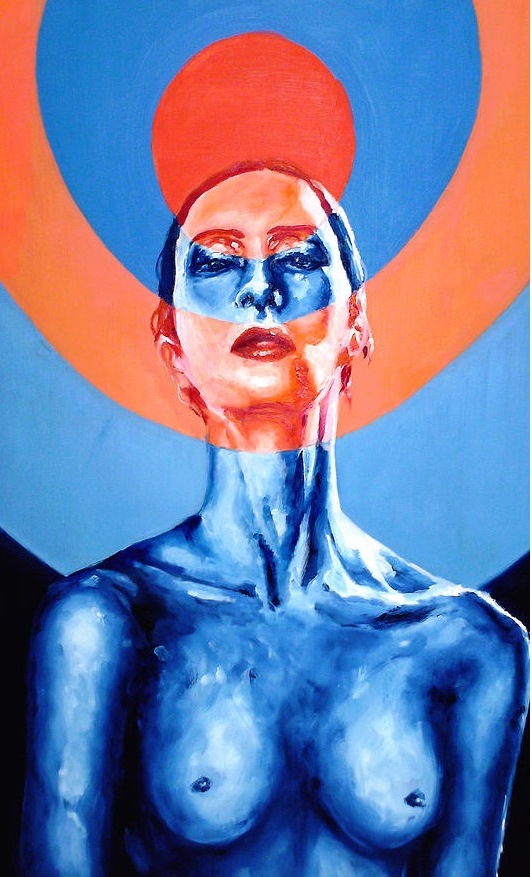
“A Millennial Diet”

word by Leah Mol

colour by Giordano Poloni

She came straight home after school and sat in the basement office where the computer was. She always had a couple hours before her parents got home. She didn’t want them to hear her printing everything off, because they’d just be upset about the ink—ink was expensive. She couldn’t expect them to understand why she needed more and more and more. Since they never heard the printing, they couldn’t understand where it was all going.

But still they bought more ink. Every couple weeks when the printer ran out, there would be questions. She’d say she was printing her homework, articles or stories to read for a class, pictures for presentations.

She hid the printing the way she hid her stomachaches, because she knew they’d take her to the doctor again. It wasn’t so bad, anyway. She just had to stay away from Facebook and Twitter for a while and things would be okay. The real problem was Instagram, but she just wasn’t willing to give that up, no matter how bad the cramps got. There were too many pictures to post. And once they were online everyone had something to say.

She wouldn’t have known what to tell her parents about the printing even if she could be honest. She knew only that when her stomach was full, she was better. Once everything was printed off and inside her, she could stop checking to see if anything new had been printed. She could finally stop thinking about all the things other people were thinking.

She loaded Instagram on her laptop and scrolled through the recent activity. Beatrice, a girl from school, had posted a photo of the two of them, so she printed it out. There were four comments about the photo, so she printed those as well. One of her photos had new likes and new comments, so she printed it all. Later, she sat in front of the computer, looking through old photos, old comments, old Facebook messages and Twitter posts, tearing each printed sheet into strips, rolling them around in her mouth until they were soft, chewing and swallowing until the whole mess was inside. As she slept her stomach ached and turned, filled with all the most important things, filled with everything anyone had ever said about her.*

word by Leah Mol

colour by Giordano Poloni

On Art and Relationships: “Extending the Pattern”

for josh

word by Josh Elyea 

colour by Mojo Wang

          Jane knows that compartmentalization is the key to a healthy relationship. She’s put all the little boxes where they belong, and for God’s sake, she’s going to leave them there.

          Jack says the simplest things in life are the most insidious. Comfort, for example. No good can come from comfort, he says. He’s speaking while deftly disassembling a French press that hasn’t been cleaned in months; Jane is only half listening, since she’s just put on Joe Strummer and the Mescaleros and is ruminating on the late singer’s post-Clash career with a keenness she’s not able to summon for the tired lecture aimed in her general direction. Rather, she’s enamoured with the sound quality pouring from their new BOSE Sound System. You really do pay for quality.

          It’s only after a large purchases, like a new BOSE Sound System, when Jack and Jane fight about money. It’s only in those moments that Jane’s chosen profession matters; only after the limited square footage of the apartment has been claimed, carefully cordoned off with a clear presence on either side does it matter what she does for a living. Jack wouldn’t go so far as to suggest she do something else with herself; no, he’s fairly certain art is where she belongs. He’d sure to like to see her make some money from it though, and he’ll be damned before he feels awful for saying so. Or, at least, that’s how this argument went the last time they had it, and the time before, and before…

          It’s not like Jane is overburdened; student loans notwithstanding, she owes a few hundred dollars on a VISA and has an unpaid cell phone bill in collections (she’s only recently stopped receiving calls where a bland, deathly voice asks “Hello, may I speak with Mrs. Jane _____ about an outstanding and quite frankly egregious debt…”). Other than that, she doesn’t owe a cent to anyone. So she’s just getting by right now – so what?   

          Often, Jane wished Jack would try and understand what it meant to be an artist, what it meant to try and create something from nothing. She wished he wouldn’t stare so obviously when she said she didn’t make much progress on her novel that day, and that he wouldn’t move with such reluctance when removing his credit card from his wallet to buy things like BOSE Sound Systems. Hell, she wished he’d stop buying things like BOSE Sound Systems so she didn’t feel so indebted to him, so she didn’t feel like she owed him anything.

          Jane looks towards Jack and sees there’s a torn piece of wallpaper where the counter-top ends; looking behind it, she can see that the little black and white boxes don’t end where they appear to, and the pattern extends far beyond her cursory understanding of it.


See more colour by Mojo Wang


on substance abuse: “after the nightmare”

rive t 2

word by Leah Mol

colour by Stephanie Rivet 

I used to have nightmares. The kind of nightmares you never really wake up from. The kind where you think you’re finally awake and then everything starts to melt. I started seeing a psychiatrist who asked me about work and relationships and my parents. I work a lot, I don’t have relationships, and my parents are divorced, which is just more work. The psychiatrist told me Relax, take a bath, have a glass of wine. I tried baths, but my nightmares were flooded. I spent my nights trudging through basements filled with water, swimming towards nothing at all, and I woke up soaked. The wine worked, so I don’t see the psychiatrist anymore.

The first night I drank, I finished two glasses and then passed out on the couch. I woke up with a headache and the vague feeling that I’d dreamed something terrible. But I couldn’t remember what terrible thing it was. The next night, I managed three glasses.

Now when I get home from work, I pull a bottle of wine from my purse and drink a glass while standing at the kitchen counter. The tile floor is cold on my bare feet, even in the summer. I refill the glass, leave my clothes in a pile, and shower until I’m done the second glass, which is when I stop thinking so much.

I grab the bottle of wine and place it beside my bed with my glass. I put on yoga pants and a sweatshirt many sizes too big, forgotten by someone I think I almost had a relationship with. I open Netflix and I watch a documentary about Mount Everest or a comedy about women who don’t know what they want.

I think about dinner but I’m not hungry for food.

I fall asleep quickly and I don’t dream about anything at all. When I wake up in the morning, I’ll know I’m awake and alive and I won’t be thinking about all the ways everything is horrible. I’ll think about drinking instead.


From the author: “This piece reminded me of these old drinking and driving commercials, where everything gets blurry as more and more glasses are placed in front of the driver. I think that’s such a perfect metaphor for addiction. Even as everything gets blurry— and often because everything is getting blurry—you keep going. And then finally, inevitably, you crash, but that can take forever.”

See more colour by Rivet

Hollywood, Heartbreak & Horsepower

ptb_Van

Alone in the mountains, a van sits idly as the sun rises. From the west comes a slight breeze, and were there any grass it would’ve rustled in the wind. As it is, there’s only the subtle sounds of the shifting sands to act as a soundtrack for this lonely scene.

Inside the van, a young man wakes up. He uses a worn French press to make a cup of coffee and then steps outside briefly to survey the landscape. Back indoors, he sits down at the folding kitchen table (it doubles as a bed and sleeps three, in a pinch) and inserts a tape into the video camera perched precariously on a makeshift tripod of books, tupperware and vinyl records. He holds up a sign that reads Day 155, P.B. (Post Bridgette) and begins to speak directly into the camera.

Fuck Hollywood, he says. And while we’re at it, fuck Bruce Springsteen too.

He doesn’t mean that last bit, of course. He loves Bruce Springsteen; he’s America’s most treasured songwriter. Speaks for the people, you know? But he was angry and felt betrayed by The Boss, and if you couldn’t trust Bruce Springsteen you couldn’t trust anyone.. All those stories on Born to Run, the ones about the good times with the fast cars and beautiful girls, they’d been a lie. There was no peace to be found on the open road, or perhaps there was no peace to be found in him. Either way, he could see now that you could never walk in the sun, and there was no gorgeous brunette putting the sunset to shame as you stare at her and press down on the gas pedal, just a little harder. 2,567 miles from New York to Nevada, and he didn’t feel any better than when he had left. He blamed Hollywood for the heartbreak, and Springsteen too; decades of bizarre and damaging genre clichés, of sitcom reruns and pop song replays had  codified romance as nothing more than a means to an end, a search for a simulated intimacy that taught people all the wrongs ways to find each other, to be together. People hate on Hallmark, but their cards are just the falsities of romance given physical form; it’s the movie studios who are to blame, and the music makers too, for the idea of romance, for that poisonous ideology which has become inescapable in our day to day lives. And he finally understood romance, or at least he thought he did. Standing alone in the desert, he knew what it meant to have been in love.*

word by Josh Elyea

“I’ve always been particularly susceptible to the allure of the open road, due in no small part to early exposure to Kerouac and a strong affinity for the Springsteen works mentioned in this piece. While I think these narratives are important for the ways in which they offer an escape from the mundane, it’s also important to look at the inconsistencies in these narratives; for example, while guys like Springsteen and Kerouac were the strongest proponents of the restorative powers of the open road, they rarely deal with what happens when you reach the end of your road. What happens after you drive off into the sunset? That’s what I wanted to look at with this piece.”

colour by Hey Studio

“Hey is a graphic design studio based in Barcelona, Spain.
We specialise in brand identity, editorial design and illustration.
We love geometry, color and direct typography.
This is the essence of who we are.
We take care of every single step of the design process and we always work closely with our clients, big or small, in one-to-one relationships.

We also undertake side projects. These activities aim to play with new ideas, push our creative boundaries and develop a passion that is then injected into client’s work.

In 2014, we opened an online shop, a place to share our passion for typography, illustration and bold graphics.

Hey was founded in 2007 with the idea of transforming ideas into communicative graphics.
Here is a selected list of projects crafted for our clients.
We would love to hear from you. Say hi here.”

On Spousal Abuse: “I Thought You Were Dead”

leah

Trigger warning: spousal abuse

When she got really angry, she’d throw anything in sight. Once she took a painting right off the wall and threw it and it hit me in the side of the head. I blacked out and when I woke up she was on top of me, covering me with her body, and crying. “I thought you were dead,” she said. “I thought you were dead and I was so lonely.”

She moved into my apartment a week after we met. We threw out all of my furniture and she filled the apartment with her couch and table and chairs and bed. The first month, we would sit on the porch sharing cigarettes and discuss what pieces of my furniture had been picked out of the pile, which pieces we thought were the saddest. The coffee table went quickly, but it seemed like no one wanted my old mattress. One night, we drank too much and she punched me in the jaw. It snowed that night and the leftover furniture disappeared.

Sometimes when she threw things, I would grab her wrists until they were raw and swollen. And then she’d kiss me and I would put my arms around her thin waist, hold her so tight she would ask me to stop. We’d sit in front of the television, her face covered in blue from the screen, and I’d bandage her wrists, burned from my skin on hers. We’d laugh that our love was so hot we could burn one another just with a touch.

When you fall in love, the end is never important. The end is another day.

word by Leah Mol

“I found it very intriguing that the woman in this piece seems so strong, and is also seemingly being targeted. She is perfectly in place to be ruined. Because this piece brought forth the theme of contradiction for me, I wanted to write about people who love one another and want to hurt each other all at the same time. People house so many contradictions.”

colour by Rebecca Proppe

“I’ve been making art my whole life, drawing story books and cartoons since I was a little kid. Now I’m an adult, and I still love to draw.

I’m currently studying art history mixed with some painting and drawing classes. Like most people I don’t know where my life will take me after graduation, all I know is I love art in all its forms and will be making it for the rest of my life 🙂

I hope some of you can enjoy my art as much as I did making it.”

On Persecution: “The Strangers”

5d36cf2748e179d7de3b18bdcd289c04

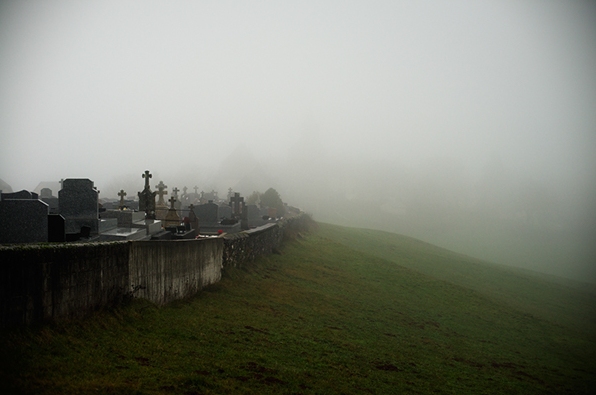
Noise noise noise noise noise.

A million million voices try to talk one on top of the other. It sounds like music. It sounds like the worst jazz you have ever heard.

The effect of all the voices is to make you feel screamed at, but no one is screaming. They are speaking with only a note of urgency. They are not shouting, but they know they should be heard. That you should hear them and that they must say their piece.

This is just when you first go through the gates. This is nothing yet.

The gates, by the way, are tall and iron and topped with diamond-shaped spikes. They are there for a very specific purpose: because the boys of the town will try to sneak in and put mirrors on the graves. The gates will not stop the boys from trying, but they will stop all but the most resourceful boys from getting into the graveyard. In the time before the gates, that everyone remembers but no one was alive for, there were shards of mirrors all over the graves like magpie confetti. No one remembers why, but the boys know that this is what they are supposed to do. The gates are especially needed at holidays.

After you have recovered from the shock of all the voices – because it will be a shock, even though I’ve told you about it now – you can start walking into the graveyard. If you step too close to someone’s grave, there will be a hush. This will be tempting. But you should be careful, because the longer you linger by any one grave, the harder it will be to go back into the fray. Once, a girl who was not prepared ran into the graveyard at night time. She was overwhelmed by the voices, and she sat down on a grave to rest in the peace. They found her the next morning, lying on the rectangle of grass as if it were a down mattress. They were never able to wake her. This is another of the stories – the ones that everyone will tell you.

If you listen carefully, you’ll start to pick individual voices from the noise. You should listen to them. It will be hard. It won’t be hard to catch the thread, to latch onto a voice and follow it. But it will be hard to stop yourself from shaking it off once you do catch it. They don’t scream, the voices, but they do not flinch from the truth.

These are the graves of the strangers. None of them exist anymore. If they do exist, in an outnumbered molecule of someone’s blood, someone is not telling. I doubt that anyone will ever tell.

You will make your recommendation to the town council by the third of November. We didn’t know these people. Their traditions were not ours, and they are gone now. The land could be put to good use.

word by Charlotte Joyce Kidd

“This story could be about anyone.

My own familial and ancestral background is Jewish, and it’s a group that has been dodging annihilation throughout history.

Religious, racial and ethnic persecution happens and has happened everywhere, and too often results in genocide.

I also wonder about the living’s obligation to the dead in regards to burial wishes and traditions, especially in cases where the desired ritual of the deceased seems obsolete or culturally irrelevant. I was a voracious reader of Egyptian mythology and history growing up, and I questioned the ethics of excavations and exhibitions as much as I revelled in seeing them. Although it was anthropologically exciting and potentially important to dig up a Pharaoh’s grave, what if he had been right to believe that he needed a pyramid of clay figurines to survive in the afterlife? Had we just destroyed his vision of paradise? We can dismiss the desires of the dead as quaint, erroneous, or even morally wrong, but we don’t get the opportunity to argue; we can only choose to refuse or honour them.

In this piece, I tried to create an image of a society that may no longer believe in traditional burial, that has no connection to the buried, that exists on land that has no meaning to them but is historically deeply significant, that perhaps is even responsible for the elimination of a certain group, and finds itself struggling with the presence of a vanished people.”

colour by Julien Coquentin

On child abuse: “Snow in the water”

Rondeau2

A small girl and a tall, middle-aged man eat lunch together at the local fast food restaurant. Both have sauce on their face: him on his chin, her just above her left eyebrow, and both eat the French fries between them with ferocity.

‘Can I have another burger?’ the small girl asks the middle-aged man.

‘No, you’ve had enough, little dumpling,’ the man replies.

The girl looks down at her white liquid thighs. There are delicate webs of blue vein just beneath the skin. She can almost see them wriggling.


The man and the girl go to see a film at the small cinema with the smell like neglected cupboard and forgotten jacket. They stand looking up at the posters.

‘What would you like to see?’ the man asks.

‘I don’t mind, Daddy,’ the girl replies.


The middle-aged man buys two tickets to Titanic and as the opening credits roll he reaches over and puts his hand in the small girl’s lap. She begins from one hundred in her head and pictures each number brightly coloured, flying free across the dark inside her skull.


word by Laura McPhee-Browne

“This piece of art is beautiful to me but it is also confusing, and I believe it is not what it seems. The title of the painting is ‘iceberg’, and I decided to write a little story about something that, like an iceberg, is almost never what it seems to be; child abuse.

When child abuse occurs between a parent and a child, it can easily be dismissed as imagination or exaggeration, but often what a child discloses about what has happened to them will be only the tip of the iceberg. It is important for us as adults to delve deeper—to dive down and find out what is really going on underneath the surface.”

colour by Emilie Rondeau

“My visual practice is a transgression and alteration of our perception of reality. I encourage free and intuitive interventions. Although abstract, my paintings carry the memories of atmospheric gardens, nebulous spaces, organic landscapes and architectures. Made of solid and bright colours, washes, painted and drawn marks, the compositions are reminiscent of complex and dreamlike environments. From the infinitely big to the infinitely small, cosmic or cellular spaces transport us with a strong impression of movement and energy.

The lines intersect and intertwine, linking shapes and colours together. Sometimes fast and agitated mark making succeeds to slow and smooth gesture. Colour is pure and vibrant. The harmony is rich and thoughtful within the limits of strangeness. A delicate balance takes place in this continual research for new visual forms. The eyes travel, search and rest. My paintings are an invitation for a trip in between the painting surface and your mind.”

On Sexual Abuse: “Sizzler”


unnamed (1)

‘Is that all you’re having?’ Phillip has looked over her meal and seen that she is starving. It is the peak of a Melbourne summer outside and Merry feels fat and tired and large enough as it is. He frowns and pushes the breadbasket towards her. ‘You don’t have to worry about your weight, you wouldn’t suit being skinny. Have some bread.’

‘I’ve always been fat.’

art fiction 

Suddenly she doesn’t care about anything except what this conversation could be. No one since her father has ever brought up her weight. She has never talked to anyone about it either but now she feels she might be able to tell Phillip something, something that could perhaps explain.

He doesn’t reply with anything, doesn’t deny her statement. Merry feels a little light-headed, though she has hardly touched her Amaretto Sour. She fishes around in the glass with her fingers and pulls out the cherry, dangling it above and then down into her mouth.

art fiction 

‘Don’t do that. Women shouldn’t eat with their fingers.’

art fiction 

She wipes hand on the paper napkin beside her plate, mouth slightly watering from the effort not to lick.

After Phillip has gone back for more veal schnitzel and duck gravy and they are lily-lipped and cloud-eyed, he asks her if she will take him home.

art fiction 

‘I live with this old woman who hates it if I have guests. I think she’s in love with me.’

art fiction 

He smiles a little and adjusts his sagging shirt collar. Merry feels that the woman is most certainly in love with him; she understands through the liquor that the woman flirts with Phillip in her tattered kimono over eggs and beans for breakfast and that she has a cat who curls often on Phillip’s knee.

art fiction 

‘What’s her name?’ she asks.

‘June. Why?’ His voice has coloured slightly—it is a storm in the distance, in the heavy clouds.

‘Oh, I just wondered. June is a nice name.’

art fiction 

He frowns, forcefully, as if it will help him to tolerate her stupidity.

art fiction 

‘She’s just my housemate. She’s old and sagging and pays most of the rent.’

art fiction 

There is a familiarity to Phillip’s forehead that she did not see before. It’s in his crooked eyebrows, the slight pouches of muscle above each one that move when he talks like they are his voice. It must be the reason why she feels a pulsing in her groin at every word he speaks—because she knows him.

      They have dessert, coffee, more sours, more smooth froth on lagers like chocolate milkshakes. It is Phillip that decides when they need to leave, and he doesn’t come back to her nervous, cluttered flat after all. He starts to eat at her neck and then her chin in the taxi on the way there and tells the driver to stop so that he can fuck her up against an alleyway brick wall that is sprayed in red and green and blue: coloured words she can’t read but that she thinks just might mean everything.

       Just as he pushes himself in she sees who his forehead is. Now it’s her father with his hand up under her dress, pulling at her nipple too hard. She closes her eyes and tries to remember the sound of Philip’s voice. She hears sirens and feels strangled breath heat the skin that covers her neck tendons.

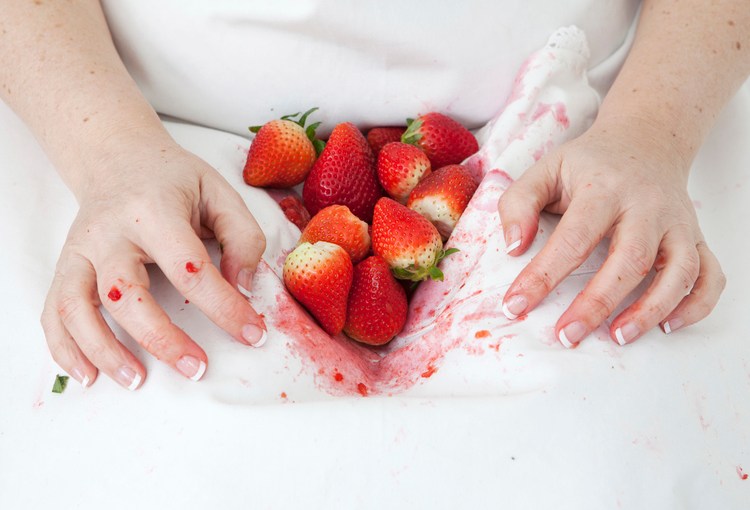
“When I saw this art piece by Fannie Gadouas, I immediately felt protective towards the woman with the blood and strawberries in her lap, with all her vulnerability so blatantly displayed. 
The character of Merry in my story ‘Sizzler’ is a vulnerable character because of her background, and the way her femininity and innocence was abused by those closest to her. Despite this trauma and vulnerability, Merry keeps living and trying to find something better for herself. The strawberries replacing most of the blood in Fannie Gadouas’ piece inspired the resilience inherent in the character of Merry, and reminded me of the resilience I have witnessed in so many (less fictional!) women I know and love.”

colour by Fannie Gadouas

“I am an interdisciplinary artist working with photography, fiber arts and performance. My work explores issues pertaining to femininity, identity and experience. By re-appropriating various traditional imagery, techniques and rituals, I question and challenge the way gendered identity is constructed, inherited and perceived in western society. Textiles is, and has traditionally been associated with the feminine realm. Critically engaging with techniques such as weaving, knitting and embroidery allows me to subvert and question my own role as both woman and artist. In this sense, my practice as a whole becomes a performance in which the process holds more relevance than the resulting objects. Informed and greatly influenced by feminist theory, the work I produce is a critical response to the social structure of western society.”

On Self-Doubt: “Weather”

unnamed

It’s been raining for days. The girl has just been feeling like rain lately. She’s not sure when it’ll stop, but she knows it can’t go on forever.

            She sits in the waiting room of the office and thinks about how boring it all is. The same magazines as always, the same water cooler across the room, the same assistant answering phone calls and shuffling papers.

            The doctor comes into the waiting room and says the girl’s name. He holds the door to his office open for her, and she gets up slowly, walks toward him past the painting of a horse, past the painting of a whale. When they’re both in the office, he closes the door behind them.

            “So,” he says, “how are we feeling today?”

            “How do you think?” she asks.

            “I thought we were past this.”

            “Apparently not.” The girl sits in the uncomfortable chair she always sits in. The doctor sits in the more comfortable chair, takes the lid of his pen off with his teeth. The girl leans back.

            There’s the sound of thunder and the doctor looks out the window.

            She saw the first doctor when she was eight. He called her problem an Extreme Emotional Response to Weather Patterns, but even then she knew it didn’t explain anything. What was inside her head matched the weather before she ever saw the rain or the sun or the tornado. She could always feel the truth of it.

            “What is good or bad weather anyway?” the doctor asks. She can tell he’s frustrated with her. They always get frustrated eventually. She gives this one another two weeks. “If you’d been feeling great for a month, say, so we desperately need rain, shouldn’t it rain then even if you’re feeling great, since rain would be the great weather?”

            “I don’t make the rules,” the girl says, crossing her arms.

            “Let’s try a visualization exercise.”

The girl knows how this goes; she closes her eyes.

            The doctor speaks slowly, confidently. “Think of a forest. You’re deep in the forest. So deep that nothing can come through the trees. It’s very, very dark. You’re feeling angry today, so let yourself really feel that. Stay there for a minute.

            “Now I want you to start walking. You’re walking through the forest and you come to a clearing, and the first thing you notice is that it’s sunny. You can smell it and feel it as you come to the clearing.”

            The girl feels her anger and she feels the sun on her shoulders and she opens her eyes.

            The doctor pulls his sweater a little tighter around his body.

            “It’s only going to get colder,” she says.

word by Leah Mol 

“The artwork reminded me so much of those moments when a storm is just beginning or just ending. My story is about a link between weather and emotion in the mind of a girl who nobody believes. She is, after years of trusting her own instincts, finally feeling the self-doubt creeping in, which could be the ending or just the beginning of the storm.”

colour by Nadoune Doune 

“Nadine est née à Montréal, d’une famille venant de s’installer d’Algérie. Elle grandit dans l’école buissonnière, une école dédiée à l’apprentissage par l’art. La musique et le visuel sont toujours présents dans sa vie, dès qu’elle le peut elle voyage avec son violon et ses poèmes/dessins au Mexique, dans l’ouest Canadien, et aux États-Unis où elle s’y installe un an. C’est une autodidacte qui apprend par les expériences, la rue est son terrain de jeu et où elle est le plus inspirée. Elle essaye de rendre la connaissance accessible en donnant plusieurs ateliers (notamment dans une coopérative d’art communautaire nommé le Milieu qu’elle essaye d’aider à bâtir). Elle est intervenante sociale, vend des popsicles artisanaux, et travaille présentement sur un projet de prise de parole chez les femmes immigrantes.”

“Nadine was born in Montréal to a family who arrived from Algeria. She grew up in the Buissonière School, where learning is achieved through art. Music and aesthetics are always present in her life, as she travels with her violin, her poems, and her drawings to Mexico, to Western Canada, and to the United States, punctually for years. The street and her experiences are her main sources of inspiration. She works to make education and art accessible by giving workshops – notably in Le Milieu, a community art cooperative that she’s involve in. She is currently working on a project that centers on the voices of immigrant women.”

On Memory: “A Kind of Red”

Josh - Marina Gonzaleseme

There was a point, close to the edge of my memory, when all my stories started sounding the same, rehearsed; a point when I found myself clicking on the same websites every day, brain rotting, literally rotting in my skull; a point where rage and riot and raucousness were replaced by routine. I’m vitriolic in the face of routine.

I can’t help but feel like I used to be a much more interesting person. And this feeling, it’s pulling me apart. I can’t even tell youwhen I was more interesting – I just was. I can’t tell you what it was.

I’ve often wondered what might happen to my record collection if I were to up and disappear, what’s left of me no more than a puff of smoke carried towards the horizon on a westerly wind. Most of my stuff is just that, stuff…but my records? That’s me, man. If there’s one interesting thing about me, it’s my record collection. 

Faces on album covers, track lists, liner notes, mix tapes, Motown, delta blues, the Clash (original U.K. pressings only, fuck those American re-releases) and Abbey Road and the more obscure stuff, The Gun Club and Captain Beefheart all blur together to form a comprehensive understanding of an individual. My autobiography. The legacy of a puff of smoke. A subject for future study.

Even just talking about this, I can feel an uneasy frustration settle so deep it’s sticking to my bones. I am entirely unable to glue the interesting bits of myself back together. I’m grinding my teeth as I drop the needle on the turntable. Miles Davis, Kind of Blue. It’s funny, because I feel red. 

word by Josh Elyea

From the author: “Perhaps more than ever, I find myself being pulled in multiple directions. I’m often disparate, distracted and unfocused in the face of constant stimulation (from a wide variety of sources and mediums). When I saw this piece, it spoke to that feeling in me, the idea of being pulled apart and never quite being put back together, of lusting after some evanescent sense of fulfillment that may or may not lie right around the corner. It was quite a visceral reaction, and it left me wondering if others experiences this sense of deconstruction as well, this feeling of not being whole.” 

colour by Marina Gonzalez Eme