colour

Montreal’s Tam Tams Is Textbook Cultural Appropriation

Montreal is known for its summer festivals, such as the weekly drum circle around Sir George-Étienne Cartier’s Monument that occurs every Sunday. Thousands of people gather on the park’s lawns to listen and dance to the rhythm of the hundreds of Tam Tam players gathering to form an incredible drum circle.

Drum circles have shamanic origins, and have been used for centuries by aboriginal peoples around the world in order to celebrate their connections with each other and the Earth.

The nature of the drum circle, with no head or tail, suggests inclusivity.

To witness the Tam Tam festival in Mont-Royal Park is to see solidarity within a group that in appearance has little in common, yet that has the desire to share rhythm and create a collective sound.

However, the fact that this circle takes place on unseeded Kanien’kéa:ka and Algonquin nations territory reminds us of the colonial components of the current festival.

Cultural appropriation takes place when a group of people belonging to a dominant culture adopts the traditions of a historically oppressed culture.

Though the participation of settlers in a drum circle or a potlatch may at first glance seem inoffensive, one must take note that these very traditions were outlawed by the Canadian government not so long ago in an effort to suppress the existence of aboriginal culture.

The appropriation of the drum circle by settlers is confirmation that colonization is an ongoing process in Canada. Attempting to conceive of white Europeans as apolitical participants in colonialist practices is impossible. Choosing to ignore settler impact mirrors the logic behind colorblind racism: ‘Race doesn’t matter, because thinking about my privilege makes me uncomfortable.’

Failing to recognize the appropriation of aboriginal culture during the weekly Tams festival is proof of the persistence of the settler colonization mentality – the same mentality that refuses to recognize the residential school system as a genocide.

Wayside crosses, like the one on Mont-Royal, are an important component of settler heritage: there are more than 3000 in the province. These crosses are not only proof of a material culture symbolizing religious belonging, but evidence of the first colonial occupations by the French, starting with the first cross planted by Jacques Cartier in 1534 – who was the first European to climb Mount-Royal and give it its name. Tams’ drum circles take place in a park footed by this cross.

Settler colonialism in Canada originates with the very same Jacques Cartier, who, in one of his most infamous interactions with the aboriginal peoples, went so far as to ruse and abduct Iroquoian Chief Donnacona and his sons, bringing them to France to serve as circus attractions.

The juxtaposition of the Mont-Royal’s wayside cross, a symbol directly linked to Jacques Cartier, above a dancing group that is formed by a majority of settlers is a textbook case for cultural appropriation in North America. If you are a settler show your solidarity by not participating in the drum circles at Tam Tams.* 

Jiliane Golczyk is originally from Red Deer, Alberta, but has lived in Belgium, Chile and Turkey. She will be beginning her Master’s in International Affairs at Sciences Po this fall. 

More: 

http://www.lemontroyal.qc.ca/en/learn-about-mount-royal/short-history-of-mount-royal.sn

http://www.lemontroyal.qc.ca/carte/fr/html/La-croix-du-mont-Royal-42.html

http://www.winnipegfreepress.com/opinion/analysis/will-truth-set-us-free-306094501.html

http://racerelations.about.com/od/diversitymatters/fl/What-Is-Cultural-Appropriation-and-Why-Is-It-Wrong.htm

http://mycultureisnotatrend.tumblr.com/

http://www.thecanadianencyclopedia.ca/en/article/donnacona/

http://www.umista.org/masks_story/en/ht/potlatch02.html

Issue 225: “At Daybreak”

For Jennifer 3 (1)

There is a room in the red house up the block that lets sound neither escape nor enter.  Its floor-to-ceiling window faces East.  The other walls are bare.  In the center of the room stands a canvassed easel off of which loosely hang a palette and brush.  But there are no colors to paint with.

At dawn, the woman who lives in the red house goes to the room and locks the door behind her.  She takes the palette and brush and settles in front of the canvas in a painterly posture.  The brow of the sun emerges from behind the buildings opposite her house.  The sun washes the room in the same hue as scrambled eggs.  She does not speak as she studies the canvas or the landscape in front of her.  She searches them with the intensity of one who is trying to pop her own pimples.

Her stomach’s growl sounds like someone squeezing an empty bottle of ketchup.  Every wall is a window.  The suck-suck of her heartbeat fills the room.  The woman dabs at the empty palette with the dry brush, which she holds the way you might imagine holding a wand.

The sun still rises. She runs the brush over the surface of the palette several times.  An inflating lung sounds like the hush when you go from out to inside a tunnel.   Her control of the brush for all intents and purposes seems limited to Mr. Miyagi’s recommendation to ‘paint the fence.’  The bristles on the brush appear frayed from overuse.  She has been doing this for a while.  Alive, she restores the palette and brush and leans on the wall adjacent to the window.

In this room, she is sound.

A crowd of boys on the street below walks hunched together.  One of them holds a baseball.  They can’t be older than fourteen.  The woman in the room smiles down on them as if they were her own children.  Her grin reveals that her 9th and 10th teeth have been badly broken.  The boys down below look up at her and mock her.  They pretend to paint.  The boys, they have all seen her before.  The woman’s expression, though, remains.

Her ears ring painfully as the glass shatters.  The room gasps for sound as would someone for air.  The baseball rolls across the ground and stops by the base of the easel.  The boys below laugh and walk away triumphantly.  The woman does not say anything but she has stopped smiling.  Their laughter hurts the way it hurts to have a snowball fight barehanded.  The woman wonders why they threw the ball through her window.  She spends the remainder of the morning picking up the glass shards and putting them in a recycling bag.

I wonder if she is a sad woman.

word by Jacob Goldberg

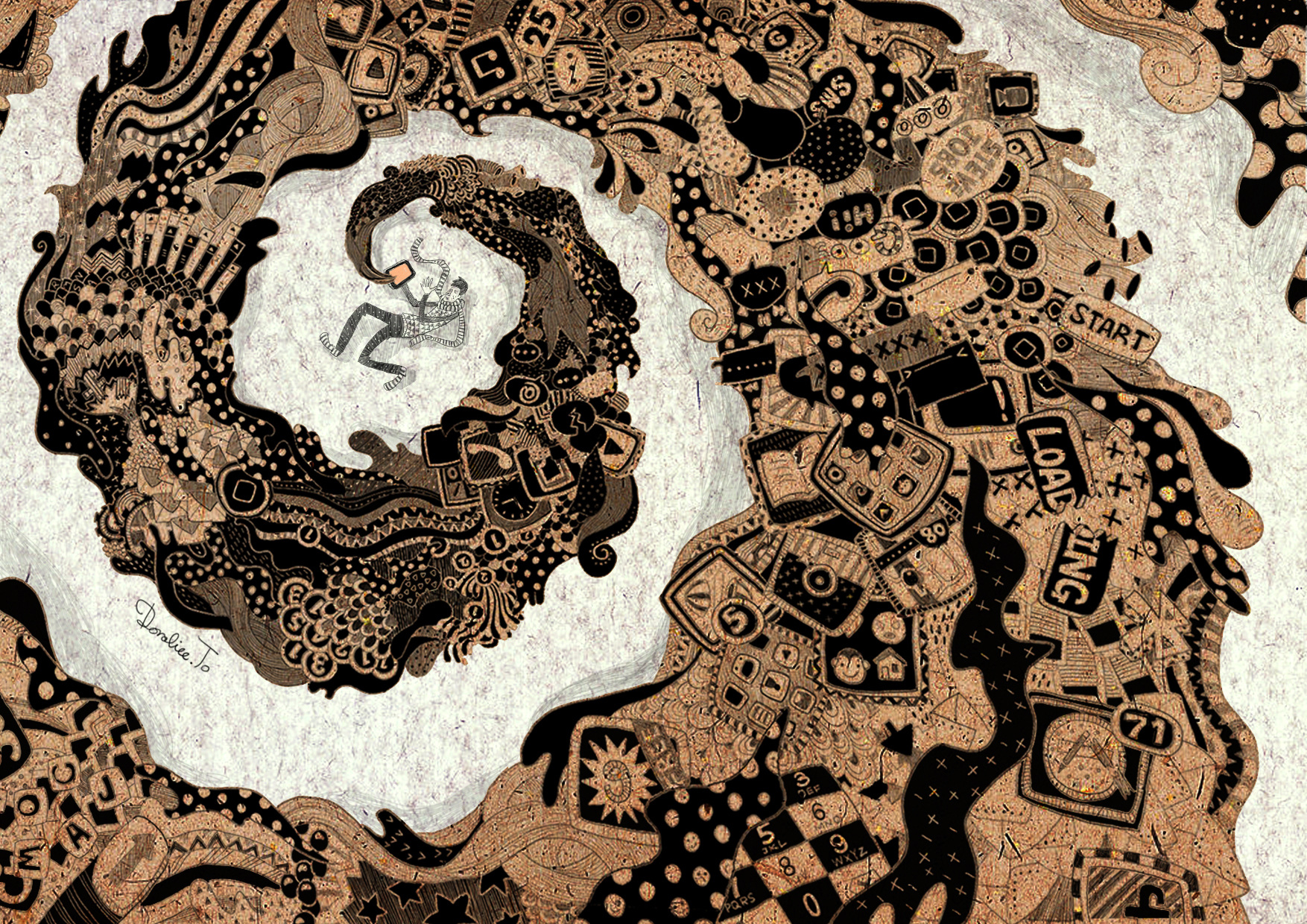
“The artwork that goes along with this painting gave me pause about how I can let technology control my life and consequently, forget to maintain focus and care about on what’s going on around me and inside me.  The woman in this story fights that as she is disciplined and compassionate – she just gets picked on for being different.” 

colour by Yukai Du, an illustrator and animator from Guangzhou, China, currently based in London.

“In 2012 I finished my BA Animation degree in Guangzhou Academy of Fine Arts, China.
‘Musical Chairs’ was my BA final project, also my first animation film.

Two years later I have received my MA degree in Central Saint Martins College in London.
I focused on research skills during my first year study in MA Communication Design
and then transferred to MA Animation in the second year for a more practical project ‘ Way Out’ – my second animation film.
Meanwhile, I have also been working as designer and animator in M-I-E studio, London.”

On Mental Illness: “Ag”

For Jennifer

I try to hold her hand and find that her nails are dug into her palm, so deep into her palm that I think they must have sunken into it, that they’re gone.

I try to touch her hair and I can tell that she doesn’t feel it.

“What are you thinking about?” I ask.

“I’m not,” she says.

“Then where are you?”

“I’m getting wrinkles in my forehead.”

“I don’t think so.”

She brings her forehead down to my eye level and zooms it in.

“There’s nothing there.”

“I can feel them,” she whines, and she puts her fingertips to her forehead.

“I promise,” I say.

“I scrunch my forehead when I worry. And I worry all day.” She breaks down, starts to cry on the subway, and I don’t know what to do.

Late, sitting in bed, she says, “It takes me so long to do anything. It takes me hours to clean the kitchen. How long does it take you to clean the kitchen?”

“It’s okay,” I say.

“I don’t have ideas anymore. It’s just a jumble of letters in my head. They’re all shaken up in there. Like Boggle.”

I don’t know what to say. “I’m sorry.”

“It’s okay. It’s not your fault. I’m sorry.”

She takes my hand. She strokes my palm.

“How was your day?”

“It was good,” I tell her. “I got a lot done at work.” It sounds inane.

She snuggles in close to me. She puts her nose in the crook of my neck.

“If it snowed for a week right now, what would you do?”

I laugh. “What do you mean?”

“It snows for a week, right now. It snows so badly that we can’t leave the house. We can’t do anything. We’re stuck here. What do you do?”

I put my arm around her. “I stay here.”

“Noooo,” she says. “Come on. You have to do something.”

“I rip up the carpet on the living room floor. I shred it into fluff. I turn the fan on and blow it around the apartment. It’s like a snow globe inside, but it’s warm.”

She laughs. “I coat myself in egg whites and then dance around the living room until I am covered in fluff. I am the beige abominable snowman.”

“Me too. Then we lie down on the floor. And we make love, two yetis who only know the cave that is this living room.”

“Nothing outside.”

“Just our furry bodies against each others’.”

“No job.”

“Just a wall of snow.”

“No hours ticking. No family calling.”

“Just snow.”

I reach for her hand, and it’s curled again.

“Is everything okay?”

“It is, it is, I don’t know.”

I try to do it. I try to close my eyes and fill my mind with letters, with nothing that means anything, with just the wheel that turns and never stops. She’s crying again. I love her.

word by Charlotte Joyce Kidd

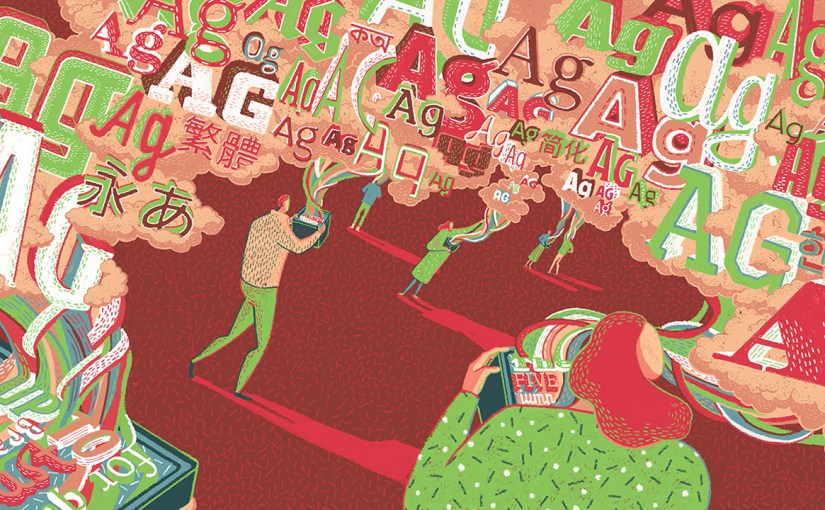
The repetitive letters and the feeling of people watching reminded me of the hyper-awareness, the externalization, that occurs in the throes of an anxiety attack. The thing about loving someone living with a mental illness is that there is nothing to do but encourage them to seek help and not stop loving them. Often, they know they are sick, but they don’t know how to fix it. Sometimes they want help and don’t know how to find it, or don’t have the resources to find it. I spent a lot of time on this piece, because the art resonated with the feeling of anxiety.

colour by Yukai Du

On Homophobia and Masculinity: “Shame”

front

We were the kind of drunk you can’t really get once you’re adult, once you have a job and pay rent. The kind of drunk only teenagers can achieve. Delirious to the sound of our own nonsense, K and I staggered back towards Jayne’s mum’s garage.

Pat and Jayne peeled away ahead of us. Their hazy dark shadows disappeared into the distance as we trailed behind.

*

       I fucking love you, K said to me with a smile- he laughed, his attention pulled away.

You too, bro… you’re obviously way more wasted than me,

Screw you-u-u


His last words struck with a hiccup, face turned up into a snarl. He shoved me hard just below the collar bone; unbalanced, I fell back.
What are you doing?


Don’t fucking laugh at m-m-e-e


Another shove to balance broken syllables, his face drove in close to mine.


What the fuck are you guys doing?


K’s older brother strode over – I hadn’t seen him until now – his presence shifted K’s attitude.

*

       Together, we poured into the garage. Weathered carpet cuts laid from wall to wall. Rushed graffiti and blinking fairy lights and a cheap cylindrical fold-out bed. Wasn’t much but it was enough to be ours. The only place we could smoke in ease and there was something in that.

The lights blew and K’s brother and Jayne seemed to be fucking each other; always Pat and Jayne. The music wasn’t as loud as their drunkness calculated.


What the fuck was that about before? I whispered to K.


I stared fiercely into the pitch black.


I love you


We were best friends. He had always been a better brother than any of mine had been. He and his dad only had each other, so I was always around. It just worked.


Stop fucking around

Is that wrong?


I staggered out into a wall; my head was spinning; I staggered out into the dark.

*

I didn’t talk to him. Years. When he came out I still didn’t talk to him. He never called. He could not be a real man. I was the last of our high school friends to reach out to him. Everyone knew I was last. He never answered. They stopped texting me- but I was a man. I am a man. I am a man.


word by Sam Fresco

colour by Fintan Magee

Born in Lismore NSW, Fintan Magee moved to Brisbane as a child and began drawing shortly after. In his early teens he was exposed to Brisbane’s graffiti culture and began painting on walls.

Moving away from traditional graffiti in recent years, his large-scale murals often inhabit the isolated, abandoned and broken corners of the city. Mixing surreal and figurative imagery his paintings are deeply integrated with the urban environment and explore themes of waste, consumption, loss and transition and contain a sentimentality and softness influenced by children’s books.

He has traveled extensively completing projects in Sydney, Melbourne, London, Vienna, Los Angeles, Miami, Atlanta, Bogota, Buenos Aires, Copenhagen, Moscow, New York, Oslo and Dublin amongst others. His diligence, technical skill and progressive approach to painting have solidified his reputation as one of the leading figures in Australia’s Street Art and Contemporary Mural movements.

On Memory: “A Kind of Red”

Josh - Marina Gonzaleseme

There was a point, close to the edge of my memory, when all my stories started sounding the same, rehearsed; a point when I found myself clicking on the same websites every day, brain rotting, literally rotting in my skull; a point where rage and riot and raucousness were replaced by routine. I’m vitriolic in the face of routine.

I can’t help but feel like I used to be a much more interesting person. And this feeling, it’s pulling me apart. I can’t even tell youwhen I was more interesting – I just was. I can’t tell you what it was.

I’ve often wondered what might happen to my record collection if I were to up and disappear, what’s left of me no more than a puff of smoke carried towards the horizon on a westerly wind. Most of my stuff is just that, stuff…but my records? That’s me, man. If there’s one interesting thing about me, it’s my record collection. 

Faces on album covers, track lists, liner notes, mix tapes, Motown, delta blues, the Clash (original U.K. pressings only, fuck those American re-releases) and Abbey Road and the more obscure stuff, The Gun Club and Captain Beefheart all blur together to form a comprehensive understanding of an individual. My autobiography. The legacy of a puff of smoke. A subject for future study.

Even just talking about this, I can feel an uneasy frustration settle so deep it’s sticking to my bones. I am entirely unable to glue the interesting bits of myself back together. I’m grinding my teeth as I drop the needle on the turntable. Miles Davis, Kind of Blue. It’s funny, because I feel red. 

word by Josh Elyea

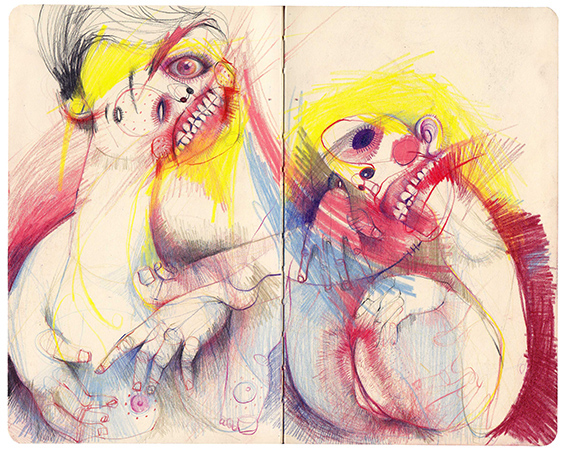
From the author: “Perhaps more than ever, I find myself being pulled in multiple directions. I’m often disparate, distracted and unfocused in the face of constant stimulation (from a wide variety of sources and mediums). When I saw this piece, it spoke to that feeling in me, the idea of being pulled apart and never quite being put back together, of lusting after some evanescent sense of fulfillment that may or may not lie right around the corner. It was quite a visceral reaction, and it left me wondering if others experiences this sense of deconstruction as well, this feeling of not being whole.” 

colour by Marina Gonzalez Eme 

On Mental Health: “Fight or Flight”

df168525400735.56344b22ee7be

It was an invisible voice, driving him onward.

“Run.”

He took comfort in knowing he wasn’t completely alone, but he paused, motionless, for someone else to lead the way.

“Hide,” the voice repeated, this time almost a shout.

Faint rustling, as someone else approached, were muffled through his own heavy breathing as he turned to stare, head on, into yellow evolving eyes. He was face to face with death.

He remained, unmoving, assessing what it would mean to his survival: the choice to fight.

He glanced behind his shoulder, out of options, as the eyes grew less distinct and he was forcefully pushed back into his helpless body, unable to run, no longer in time to hide.

Heart beating wildly, chest rising, yet he felt no air reach his lungs.

“Freeze.”

He opened his eyes and the room was no longer spinning—chest no longer growling. His stomach felt heavy, a bead of sweat meandered down his right cheek. He swiped at it, halfheartedly, with the back of his hand. There was no forest, no golden eyes staring him down, just a microphone in hand and an audience on looking, an uncomfortable pause between applause and speech, hanging in the air as they waited for him to begin.

“Yes-” he cleared his throat.

“Thank you all for coming out tonight.”

The hairs on his arm still stood on end. A shiver ran through his body. “Keep calm,” the voice now instructed.

He closed his eyes to shake himself of the attack, there was a bottle of Valium waiting for him at home, for now, the task at hand remained.

word by Annie Rubin 

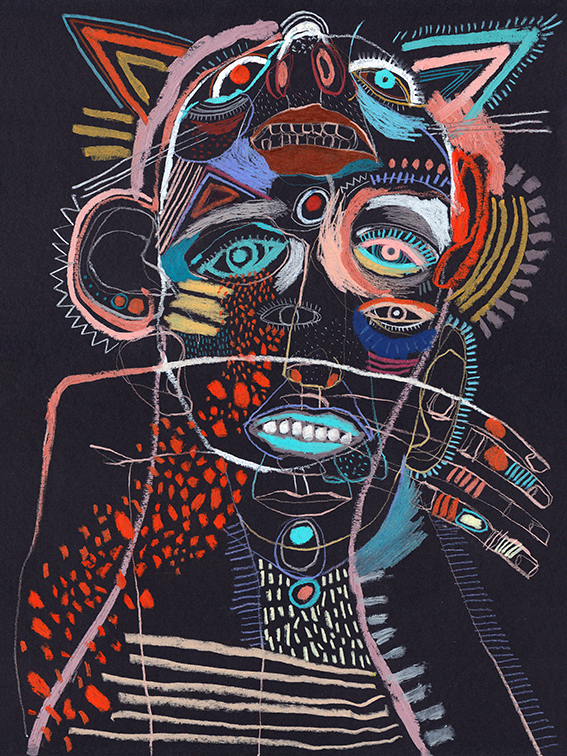
From the author: “The harsh edges, intensely vibrant colours, and the vivid animal-like quality of the artwork inspired an intensity motivated by animalistic instinct. The jagged edges and bright lines were reminiscent of a sense of anxiety, in this case manifested in the form of a panic attack. Such an episode takes place as the body’s natural “fight or flight” instinct to combat present danger replaces logic. While many people have suffered from panic, our society rewards silence around the issue, perpetuating a stigma around mental health.”

colour by Marina Gonzalez Eme

On Gender Roles: “I am an extra X”

image

Trigger warning: rape

I am the perpetual embodiment of two letters. I am an extra X, and that’s all I will ever be.

Before I even heard my name they saw me on a screen. They sang with joy because I had an X and not a Y and the spare bedroom was already painted a dusty rose. Dad’s heart sunk because I dashed his dreams of taking my team to state.

When I was born they cried and hugged and congratulations overflowed out of Hallmark cards. I got a card too. It noted my extra X. During my third month they called me beautiful and cradled me more gently than they did my brother because my X baptized me as a paper-doll.

They kissed my cheeks and tucked me into floral flannels grandma gave me when Mom had a party with pink paper plates from the dollar store.

When I was five every boy was my prince and I decided that my wedding would be on a white sand beach with lilies in my bouquet.

When I was seven I finally started to colour inside the lines and I hated subtraction but my teacher told me that that was okay because girls are better at art anyways.

When I was nine my mom caught me trying on her makeup and scolded me for using the wrong shades. When I was 12 I cried because the boys wouldn’t let me play soccer with them anymore.

When I was 13 I cried because my ex-teammate shattered my heart.

When I was 19 I dropped out of physics because my test sheets were covered in X’s and I figured I was better at English anyways.

When I was 23 my heart was broken for the fourth time and my friends told me to forget about the X’s on the back of my hand. He bought me a drink or maybe it was six and I let him taste the seventh one on my tongue even though I hated that song and his breath reeked of Jack Daniels.

When I was 24 they still told me I shouldn’t have worn that skirt that night.

When I was 27 I said I do and they called me beautiful and cried and hugged and gave me tips on how to please my prince.

When I was 28 they bought me pink paper plates at the dollar store.

When I was 30 I typed X’s and O’s into a dusty keyboard and my boss called me “doll” and I was in charge of the coffee machine and I called it my life.

When I was dead the obituaries read “daughter and mother and wife” and nothing more. X marked the spot and they dressed me in floral and kissed my cheeks and the Hallmark cards came pouring in.

Sometimes he brings me lilies.

Most times he forgets.

He tells them that I was beautiful. I suffocate. I am an extra X, and that’s all I will ever be.

word by Hannah Chubb

colour by Marina Gonzalez Eme

Issue #218: You’re Not Racist If You Find Me Pretty

wow okcupid

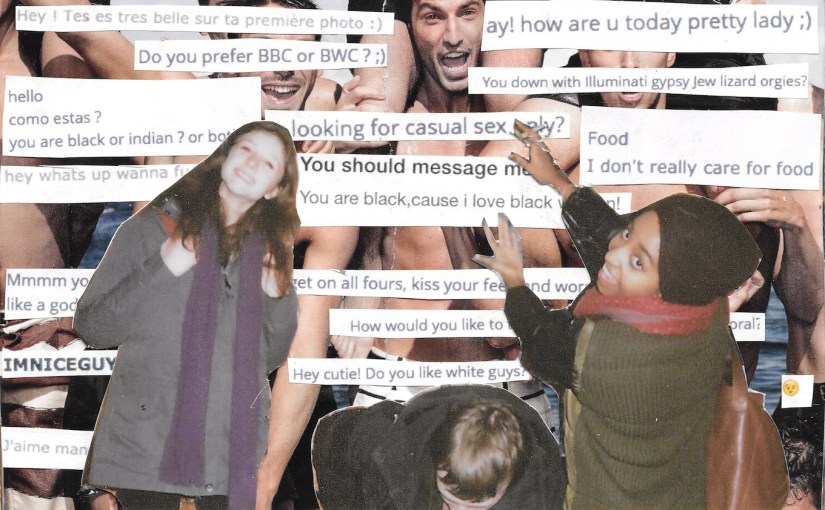
“You’re not racist if you find me pretty”

Sitting downtown Montreal, mid-afternoon spring, at the kind of booth that makes your pelvis sink, in the kind of café where you can stay for hours without buying a thing.

And no one has cleared the cups of soggy knotted teabags. The staff are wearing collared polyester and leaning against the display cooler. The windows are level with the sidewalk and people’s shoes and ankles and bicycle-wheels pass by our heads.

*

Earlier  I saw someone smoking under the awning in the rain and thought of you. I thought of how beautiful you are, and I don’t tell you this, but know that I could and that would be alright too. Tomorrow is your third date with someone more than cut and paste.

*

What do you do on a Friday night?
I wash my arms.
Oh.
And your life? What are you doing?
Nothing.
I love you.

*

Because she couldn’t hear past the barking anymore, the low growl and the hiss.


No, you’re not racist if you find me pretty.


Attends: tu penses que je suis raciste? ?
Je voulais juste savoir
 d’où tu viens
je te trouve          belle.

 *

Your curiosity tastes like vomit. Your curious  entitlement to interrogate my ancestral origins,  colonial narratives of migration, grief, diaspora that we have not unraveled and yet exist through—

to draw forth the accumulation of every other moment before this when a dark body has been a site of violent intrigue.

Because she looks exotic: sweetpotato caramel, something to bite into with pleasure.

Flesh beneath your tongue, your words are never innocent, loaded with power you may not have asked for, granted by default you entrench entitlement.

*

This is your responsibility, white man: swallow your tongue,

direct your gaze to what’s
charging your bark.


We are not laughing.

//

You say you’ve been watching men jogging and you’ll let me know how it goes.


word by Alisha Mascarenhas

colour by Jasmine Okorougo 


Issue 217 (Gender, Sexuality): “IN THE BATHROOM”

unnamed

“IN THE BATHROOM”

May and Silas lie on the bed. May knows that it would be worthwhile having sex right now—to feel close to him, to remind him that she is not ordinary. Right now she would rather have sex with her substitute science teacher (he had that hair that she liked, it licked up the back of his neck) or the butch woman who had stared at her in the waiting room at the dentist after school yesterday. The staring had made her go red in the face and her vagina spasm in a way that Silas’s gaze hadn’t in months.


Silas turns his slender frame towards her. He is fine and delicate. I’m bored, he grins, let’s cuddle. She grins back and stretches out her arms to pull him in—her arms over his shoulders as always, her body bigger and darker than his will ever be. They kiss and then she pulls back just enough for him to pull back too. Do you want to, he asks, hot breath smelling of closed rooms and wet toilet paper. She pauses. Yes. His eyes coat her in beauty—when he is aroused she feels like he sees her better. She can toss her head and whinny, like a mare, and he will kiss her pulsing veins. They help each other to pull off their clothes: her undies, his exhausted boxer briefs. There is always a laugh here, when her undies are down around her ankles and she is shifting and twisting to fling them off. Sexy, he says.


Moans. Noises she never makes at any other time but that she consciously makes now. Light, quick breaths on his collarbone and light, quick bites of his stretched out neck skin. She doesn’t feel like it until his penis goes in. Then it does feel good, good, like she tells him.


May rolls over, taking Silas with her until he is underneath. She can feel the sweats of each of them slipping and creaking against each other.  She is provocative up here. Silas is beaded lightly all over and his eyes bulge. May resists an urge to reach out and gently move his hair from out of his eyes. This must be over quickly before the sheen wears off and he starts to see the hair on her arms, her pores. Silas tells her he loves her. She feels the warmth of the words in her fingers and her vagina aches just behind and below the labia when she looks down to see his light tuft and her dark one, their tufts, bouncing against each other.


Silas pulls her hips tight in against his own and heaves at her, the sound a bath drain slurping. May breathes out and pulls the sheet across her shave-cut legs. She will bring herself to climax later, will run the tap to quiet her sounds, in the bathroom.

word by Laura McPhee-Browne

From the author: “I saw this art piece as the collage of a girl going through the emotions of becoming a young adult.

 
This art piece brought back to me the insecurities, anxieties and play-acting aspects of being a young woman, and I decided to write a story that delved into the mind of a young woman trying to be ‘normal’ and to do ‘normal’ things, such as having satisfying, meaningful sex with her boyfriend, despite the ambiguity and complexity of such an act.
 
Through my story, I also wanted to get across how much pressure there can be on young women to be ‘nice’, to be ready and willing, and to be relaxed, and to sacrifice their own pleasure and well-being for the sake of men, when this is an impossible and unrealistic expectation. I believe that the various slogans in the art piece, ‘BEING NICE IS COOL’ and ‘DON’T FRET’ are the slogans that young women chant inside themselves, when really it should be okay to not be okay.”

colour by Jasmine Okorougo

Issue #215: On memory and colour

OLYMPUS DIGITAL CAMERA

When I look at my hands I start to cry. Leathered and worn, dry skin flakes between my fingers and my lifelines seem etched into my palms, my hands are permanently stained; dark hues of purple and green crept below the surface, and stayed there. My life is on my hands and I can’t hide the fact that I have graced many a wall with my personal epithets. I staked my claim, marked my territory with a manifest destiny-type vengeance and sought out every clear space, every void, and every emptiness to fill it.
 art colour memory
My face is wet and I let the tears fall freely from my face. My hands lay in my lap, unmoving, poised for continued inspection. They tell every memory and moment and hurt with the knowledge of a past ached for.
  art colour memory
In the summer time heat, the humidity was thick and held the paint in the air around me. I searched the streets for new ground and found beautiful canvasses in the neatly tucked away spaces between buildings, inside dimly lit tunnels and parking lots; these were areas ripe for beautification. Can always at the ready, I would surveil the area and quickly throw up my tag. I would come home tinged in color, turned sepia, a danger to all white surfaces in my vicinity. I would take my black off, strip down bare, lay on my back, raise my arms in the air and look at my hands with intense interest. Color caked in the crevices of my cuticles and my knuckles darkened by the paint in the creases of my skin. I would lay there until my arms were tired, feeling the adrenaline leave the extremities of my body. Right index finger bent, I would practice above my head, my tag lines fluid, clean and quick. They littered the pages of my school books, and even now, the discarded envelopes that formerly housed my bills, bank statements and junk mail. I make my mark everywhere, although no one else sees it now.

word by Cora-Lee Conway

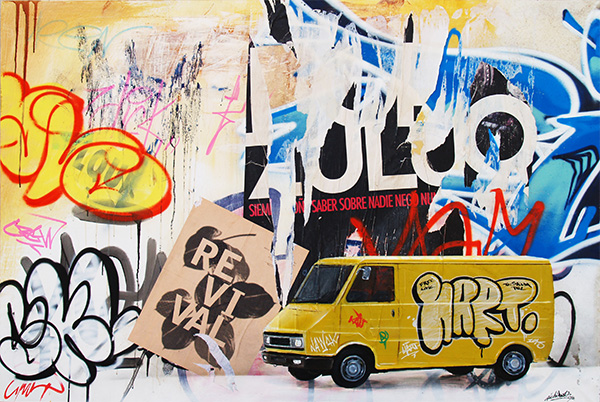
colour by Pichi&Avo