Depersonalization and the Effects of Medication

explorers_of_the_new_frontier_by_garryts-d9l17wz

word by Annie Rubin 

colour by Garry Tugwell Smith

She’s flying. In wisps of purple clouds, planets whizzing by, spinning and floating and falling. It was this chalky white pill, that kind of separated reality from the extra terrestrial. Worlds weaving in and out, setting apart the frenzied train ride from this spontaneous trip in vibrant flashes.

        The notion of the free-fall makes her jump with eyes fixated on the green circles of the metro line, they’re reading something altogether different than the weightlessness of her stomach or her fingers pressing onto what could only be hundreds of pins or the tightness in her chest: rising and falling in bursts of colour.

        The same five senses designed to orient are skewed. The scent of the subway, the burn of the wheels against the hot metal tracks, and the chorus of echoing voice, chanting something painfully inaccessible are present, distant.

        Fighting to define the boundaries of sobriety, she pieces together the images. There’s an empty seat beside her, she tries to listen to the silence. Wanting simultaneously to lie down and to break through the window of the train. 

        She’s watching herself hover above ground as the medication kicks in. Limbs go numb and the colours fade to a gentle hum of grey. Mood has been stabilized. The subway lurches to a stop and in the mass of bodies collecting at the doors, she makes her way onto the crowded street where her feet plant firmly into the concrete and her head feels lighter, less explosive.

        What is left to believe when perception becomes unreliable?*

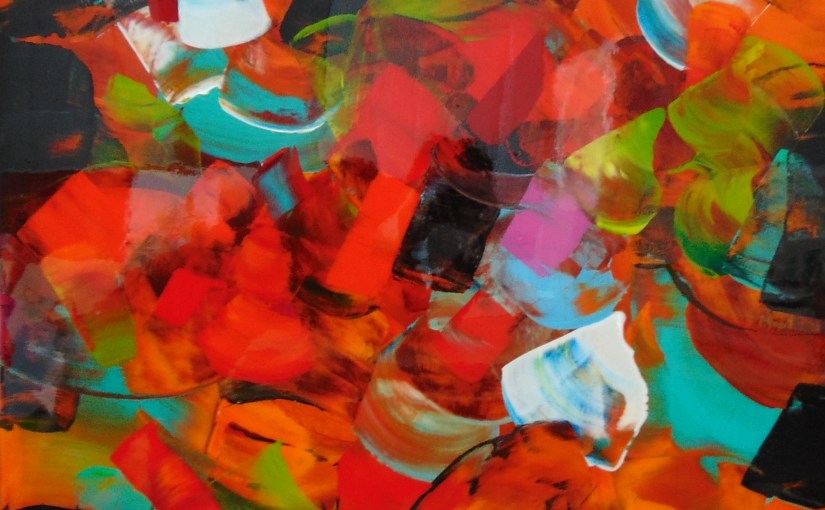
From the author: “This futuristic image depicts outer-worldly colours and objects. It inspired a piece that confronts mental health topics of perception, depersonalization and the effects of medication. The mixture of sensations represents the profundity of mental illness in its capacity to debilitate a person throughout daily life and the idiosyncratic experiences of depersonalization in a mental health crisis.”
 

Read more of Rubin’s words on mental health

See more of Smith’s colour

On Desensitized Violence: “Muted Colours”

95457a49689083.5608656ded9c8

word by Annie Rubin

colour by Mojo Wang

There was no one in Bill’s house to turn off the TV when channel four came on. We thought of him as some sort of guru: he told us of kidnappings; of guns and knives and fires and what it meant when there were people on roofs about to jump.

It happened when we were in our sevens and eights that we realized we could press play when mom was in the kitchen. Imaginations were running crazy and fueled by these wild images that kept flashing across the screen.

My brother always liked video games. There was this one where you got to steal cars and ride away, hair all wind-swept. It was cool to be able to drive a BMW even on a screen where his fingers turned the wheel with a flick of a button.

The rest of us were playing hide and seek where the floor was lava. No one ever found out what happened when you touched because maybe your shoes were fireproof, you grew wings, or we just didn’t want to think about the truth. Mom would be in the other room watching the news. We’d ask to sit on her lap and she’d usually put on PBS but that day she was in a trance, eyes fixated on the screen. The television was on mute but you could still hear shouting.

The walls were this grey even though I swear they were melting that day we couldn’t walk outside because of the smoke. They don’t give you a trigger warning on the streets of Manhattan. We were six and eight and felt too much older.

Close your eyes, she said to me, holding a cupped hand over my face to shield from the screen, the same way she had done at the movies when couples started kissing. I held my breath, too.


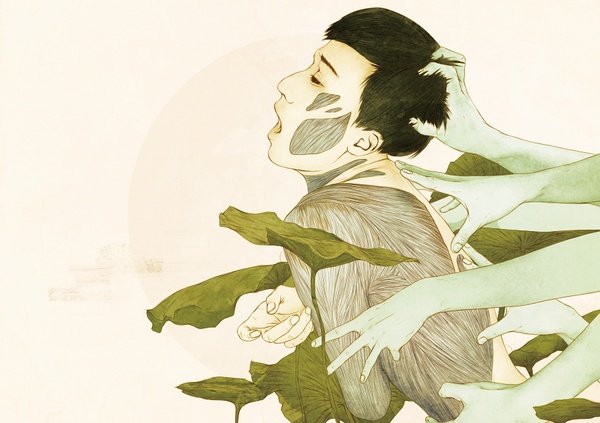
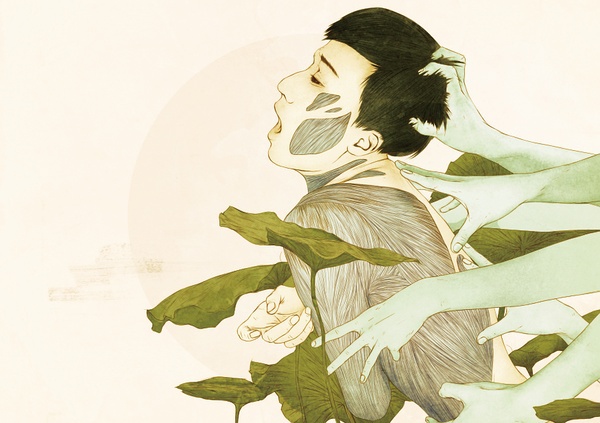
From the author: “This portrait of muted colours evoked desperation and frustration. The arms reaching out to grab hold of the figure whose muscles are exposed inspired a piece that targets vulnerability. The story tries to raise questions about exposure to graphic images, and question the idea of whether vulnerable children should be censored from the media. Ultimately, begging the question of whether striking headlines are desensitizing our population and how to cope with horror on the news.”

on depression: “the red door”

joehengst

word by Kate Shaw

colour by Joe Hengst

It has been several days since I’ve left the house. In a significant way, at least – I’ve left to take out the garbage, to buy eggs, to remember that I owned clothes that weren’t pajamas, but it has been several days since I’ve gone anywhere, done anything.

It’s cold. Not northeastern U.S. cold – worse. Wind chill down to thirty below zero. It’s amazing, how cold it can be. Every time I walk outside I re-hear those news broadcasts about Canadian citizens suffering severe skin injuries from five minutes of exposure to extreme cold. Is it cold enough to be dangerous right now? My cheeks feel like they’re turning to putty.

Hour after hour passes by and I pace, I sink into the torn, velvety couch, I heat oil in a skillet but forget what I was planning to make (did I have a plan?). I sit on the ledge by the window and look. See. It doesn’t look so cold out there, I think. There are people out there, walking around, and they’re not collapsed or clutching at their putty cheeks. They’re living despite all this, despite this unbelievably-wind-chilled air.

And then I pace again. Sometimes I pick up a book, but usually the words just end up dancing out of my consciousness before I can understand them and I just read the same lines over and over, absorbing nothing. As hard as I try to focus on the little letters, they blow away.

v

I haven’t been seeing anyone. My roommate is gone and I tell other people – friends, I guess – that I’m just overwhelmed with school, just trying to catch up on reading, thanks for saving me a seat but I’m actually not coming to campus today, oops!

v

It actually looks lovely outside. If I force my eyes through the grayish haze hanging over the street, I can nearly unearth the image of the bakery with its little orange sign, or the barbershop with its red front door. They were colored once, lovely shades, I know they were. The colors are distorted now. I hope the originals come back.

I’ve decided to start sitting on the floor instead of on the couch. From down here I feel small, and maybe that will make me feel overwhelmed by how big everything is around me, or amazed by how much this new apartment feels like home, or pitiful of what a pathetic spectacle I’m making of myself. Maybe sitting down here will make me feel something.

I lean back against the couch – I think it was green once, but the colors in here are distorted too. I don’t know how long I’ve been sitting, and now that it’s dark outside it could be 5:30 or 9 or 2 in the morning. Now, even if the colors hadn’t disappeared, I wouldn’t be able to see them anyway.


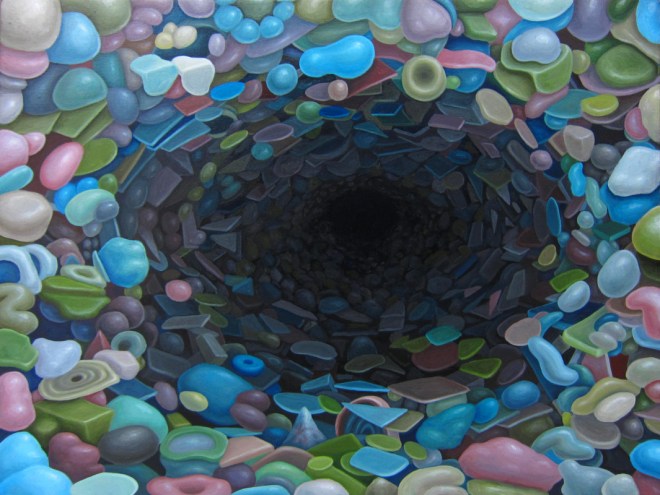
from the author: “The shades present in the visual art piece have an eerie tint to me, which is underscored by the dark tunnel in the center that disappears into nothingness. It made me think of the distorted way one sees the world through the lens of depression and other mental illnesses, so this piece deals with that distortion and the inability to pull oneself out of that dark space that burrows its way to the center of everything against your will.”

on substance abuse: “after the nightmare”

rive t 2

word by Leah Mol

colour by Stephanie Rivet 

I used to have nightmares. The kind of nightmares you never really wake up from. The kind where you think you’re finally awake and then everything starts to melt. I started seeing a psychiatrist who asked me about work and relationships and my parents. I work a lot, I don’t have relationships, and my parents are divorced, which is just more work. The psychiatrist told me Relax, take a bath, have a glass of wine. I tried baths, but my nightmares were flooded. I spent my nights trudging through basements filled with water, swimming towards nothing at all, and I woke up soaked. The wine worked, so I don’t see the psychiatrist anymore.

The first night I drank, I finished two glasses and then passed out on the couch. I woke up with a headache and the vague feeling that I’d dreamed something terrible. But I couldn’t remember what terrible thing it was. The next night, I managed three glasses.

Now when I get home from work, I pull a bottle of wine from my purse and drink a glass while standing at the kitchen counter. The tile floor is cold on my bare feet, even in the summer. I refill the glass, leave my clothes in a pile, and shower until I’m done the second glass, which is when I stop thinking so much.

I grab the bottle of wine and place it beside my bed with my glass. I put on yoga pants and a sweatshirt many sizes too big, forgotten by someone I think I almost had a relationship with. I open Netflix and I watch a documentary about Mount Everest or a comedy about women who don’t know what they want.

I think about dinner but I’m not hungry for food.

I fall asleep quickly and I don’t dream about anything at all. When I wake up in the morning, I’ll know I’m awake and alive and I won’t be thinking about all the ways everything is horrible. I’ll think about drinking instead.


From the author: “This piece reminded me of these old drinking and driving commercials, where everything gets blurry as more and more glasses are placed in front of the driver. I think that’s such a perfect metaphor for addiction. Even as everything gets blurry— and often because everything is getting blurry—you keep going. And then finally, inevitably, you crash, but that can take forever.”

See more colour by Rivet

On breakups: “Almost”

rivet 1
word by Hannah Chubb
colour by Stephanie Rivet 
 
I don’t care what anyone says, it’s the almosts that hurt the most.
breakups 
It kills me to watch this go down the drain.
 breakups 
You must have dipped your tongue in ink before you said those three words because I can’t find anything strong enough to erase those eight letters. My mind is black and blue with thoughts of you and my sclerae scream red because I can’t categorize these feelings I have for something I may have just created in my head.
 breakups 
You were almost there.
 breakups 
I have no label for you and it hurts because I need to know that I’m not delirious and that my feet were on the ground. I swear to god I remember yours being there next to mine because your shoes were too-white and the left one was always undone and I just wanted to tie it back together for you but I didn’t know how to say it.
 breakups 
I almost told you.
 breakups 
I swallowed a different brand of turquoise pill than you did and I never knew why but maybe that was the problem. Mine came on a shelf and killed the pain while yours was handled by grimy hands crusty with tangerine-tinted drugstore lipstick and made you feel anything at all. You always swallowed more than you should have but I let you because I didn’t even know that version of you and maybe you never wanted to know me anyways. I guess I’ll never know if you wanted me to stop you.
 breakups 
You almost felt like reality was enough.
 breakups 
We never held hands but we spoke in colours and sometimes you walked me home at night. Your mother never knew my name but your roommates sure did because your yellow walls were thin and your voice is loud when you drink enough to drown the monsters in your skull. I swear I could have slayed them but our time ran out too soon.
 breakups 
You almost asked me to stay.
 breakups 
I almost did.
 breakups 
Your mother should have named you Almost because I think that’s all you’ll ever be. I can’t stand you and your stupid razorblade tongue of promises slicing down my already raw throat. I think I belong up North because my head is a messy Aurora Borealis of the colours you used to turn my skin before you left and everything around me turned to black. I tried to be your fuchsia sky but you never told me you were colourblind.
 breakups 
I am a catastrophe of colour aching for the comfort of canvas, but darling, almost is just never enough.


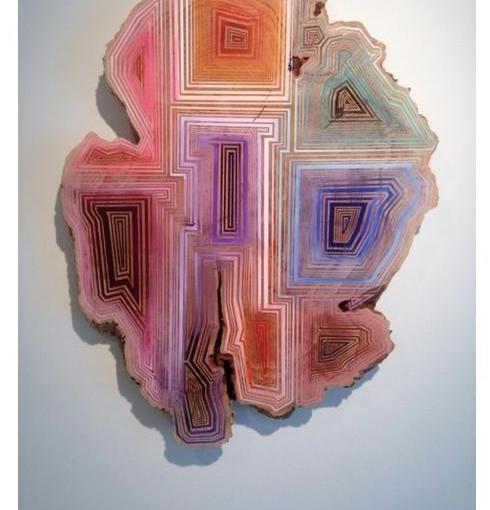
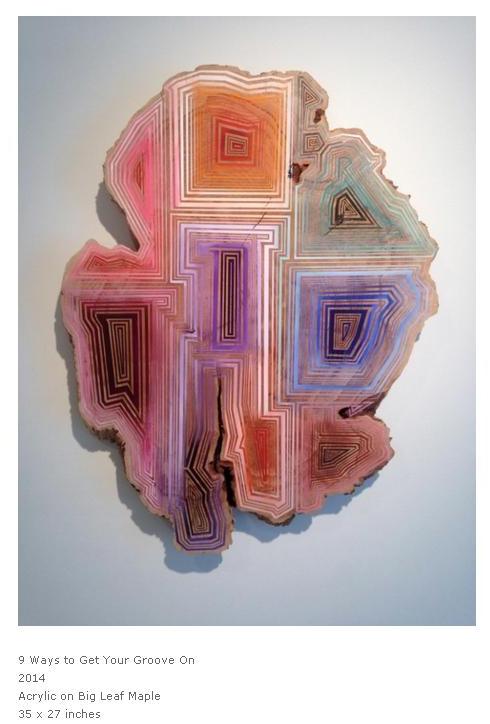
9 Ways To Get Your Groove On

middlebrook 2

word by Charlotte Kidd

colour by Jason Middlebrook

1. Meet a guy who builds things. It’s refreshing because he can get out of his head. Now, you can be in Sex and the City (rather than a looped Woody Allen movie, as has recently been the case).

2. Realize that refreshing is a reductive way to describe a person. On the second date, he takes you dancing. As if he existed in opposition to all previous men. As if he was made to fill a gap in your life, like water. Realize this when he is just as funny and charming and soft with you on the second date as the first. Realize that the way he handles the world is gentle, and kind, and generous.

3. Spend a day in bed with him. Listen to all the sad songs. Be cushioned by happiness, sensitive to the songs but never touched by them. Wonder why you’ve never listened to sad music when you felt light.

4. Ask him to build something. Not just dinner (he’s done that already) but one of the things he really makes. Something to hold.

5. Write him a song of gratitude for the thing he made; a perfect painting on an imperfect round of wood. And for the story he tells you, about recovery.

“Idle hands are the devil’s tools,” he says, in all seriousness. Where you would have once scoffed, you instead take his un-idle hands into your own.

6. Dance to your new story, dance to the details, get down to the grit. Marvel at how much you can enjoy something so pedestrian as a slow dance; you didn’t ever think you could love someone you weren’t competing with. Dance to nothing really being extraordinary and nothing being truly ordinary.

7. Keep grooving. Find that it’s easy to bring him flowers if he’s had a bad day. Make him laugh. Plan special things for his birthdays. Not so easy to wash his beard out of the sink, un-dog-ear the pages after he’s read your books. Hard to convince him, after another sale goes south and another one of his pieces ends up in a half-born graveyard, that he does not need to go out and find something to make it easier.

8. Dig out the thing he made. Blare music, emotions of the song intruding your feelings so that there isn’t enough space for them. You are not sure how big they could get if you let them expand. Wonder when he’s coming home. Wonder if he’s coming home. Say he is.

9. Dance to the sound of a door closing. Get down to his footsteps. Feel the rhythm of him coming back to your arms. Dance for the boy who makes things. Groove to the people whose lives are complicated but who touch the soft and fleshy walls of the world with the least pressure possible. Get down to him, in bliss and imperfection. 

When the lights go out

middlebrook

word by Josh Elyea

colour by Jason Middlebrook

What do you do when the lights have gone out? 

You take a walk. Not outside, where the autumn has turned leaves red and a familiar chill has crept into the Montreal wind, but rather inside: you take a walk through the desolate hallways of the mind. It’s best to ignore the part of your consciousness that tells you this is just your mind imagining itself – you can’t know what the inside of your head looks like – and continue to press deeper into the increasingly detailed world of your brain.

The further you walk, the more you notice the darkness; it’s not apparent at first, but before long you can’t help but see that in all these rooms, in all these wrinkles and rooms and chambers and palaces and dungeons that are dedicated to the things you cherish, the lights are out.

After wandering the halls for a while, you begin to wonder whether your brain works the way it used to; you find yourself pondering whether  these rooms can still light up in the way they did when you were young, when things were simple and you didn’t feel so used and so jaded.

You might make an effort to stop in each of these rooms and flick the small switch that hangs precariously on the darkly-papered walls; you might find yourself taking note of which lights shine bright and which bulbs now seem dim, and what this says about how you value the things stored in each room.

You’ll wonder what all this has to do with your addiction to entertainment, and whether there’s irony to be found in the fact that the room dedicated to Friends shines brighter than the room dedicated to your friends. This might be coincidental, but you can’t really know because you’ve never taken the time to understand irony.

You’ll begin to wonder where all the colours of your mind went, and what it says about you as a person that you don’t even have the requisite neuroelectricity to power the bulbs in the rooms you deem essential, those dedicated to creativity and personal fitness and Bob fucking Dylan.

You’ll ignore the advice of the people closest to you,  who tell you to pull yourself up by your bootstraps and focus on getting ahead by doing what you can. You’ll try and tell them it isn’t as simple as flicking a switch; by this point, you despise the colours of your mind, and you’re used to life without the lights on.

It’ll start small. You’ll find a room, somewhere deep in the right hemisphere of your brain, where a bright yellow light burns from behind a tightly locked door. Inside will be a book or a movie or a song, maybe even a person  or a pill that’ll walk with you, to remind you that there’s still vivid colour to be found, if you only take the time to turn on the lights.*


See more art by Jason Middlebrook


Motherhood, Work: “On Her Bike”

word by Cora-Lee Conway
colour by Michael Ward
michealward2

I watched the late afternoon sun cast shadows on the structures in my eye’s view. Dark, distorted silhouettes danced on the wall in front of me and I let myself be drawn into the hypnotizing sway and I closed my eyes. You know when you close your eyes and turn your face towards the sun, all the colors you see in the darkness? I closed my eyes for just a second.
  motherhood
I was so tired, physically and then some.  It was hard raising Maggie on my own, it was a constant struggle. Looking for free everywhere: food, clothes, programming… I worked so hard and it never seemed to be enough. I was determined that she would have everything she needed, I was just determined, period. She had just turned six and all she wanted was a bike.
  motherhood
After seven years of working in the increasingly defunct catalog department of Sears I saw children come in with their grandparents to order gifts of all sorts at all costs. Some of the kids were sweet, some were brats and some engaged in full body melt-down tactics of manipulation and subterfuge. So when my pudgy-fingered baby girl asked me for a pink bike for her birthday I was not inclined to refuse. I just didn’t know how I would make it happen.
  motherhood
I managed to get her into some religious charter school on a scholarship and that was no small feat, but then the uniform costs and the regulations about school lunches and books and extra-curricular activities all came fast and furious. I have a high-school education, but a PhD in working the system; I appealed on compassionate grounds for reprieve, looked for more funding and sometimes I just had to say no. Maggie never ever complained, she never made me feel bad; so when this issue of the bike came up I felt compelled, as a mother. I rarely succumbed to the pangs of consumerism but I was completely vulnerable here.
 motherhood
I worked a six am start shift in inventory and then nine to three on cash in order to pick Maggie up from school every day. One of the school’s resource teachers picked her up in the mornings and took her to school. It really takes a village. So after school, like every other day, I was inordinately tired. At the supposed to be tender age of 27 I had developed permanent bags under my eyes, and I hadn’t purchased a pair of shoes for myself in five years. Maggie wanted to ride her new bike after school. I picked her up from school and she had taken off her little short-sleeved button-up and a huge mustard stain graced her brand new tights. She was happy to see me and happier still to see the bike I picked up from home. I was late and all the other kids had long since gone. She peddled up and down, her gap toothed smile and loud giggle echoing in the street. I closed my eyes, heavy with exhaustion and lost myself for a just a second. 

Never been here before

joehengst 2

word by Jacob Goldberg

colour by Joe Hengst

The flight attendant looks at my carry-on like it’s got four heads. ‘It’ll fit,’ I tell her confidently as she lets me pass through jet bridge, windowless and quiet. A considerable gap between the walkway and cabin has me thinking that there should be a warning sign somewhere. So, I watch my step. The stewardess, black and shapely, smiles at me. I have to walk with my right shoulder toward the tail of the plane so I don’t hit those already settled with my bag.

            It fits in the overhead compartment above my seat, which I share with a woman of about 25. Her nail filing looks like she’s playing a small violin and we exchange smiles when I sit down. The stewardess over the intercom welcomes us to American Airlines and asks for our attention as we prepare for takeoff. I remove my headphones but mostly hear my neighbor and her nails. At the stewardess’ direction, I open the In Case of Emergency pamphlet located in the pouch in front of me. The pamphlet’s spine feels fresh. Inside, images accompany the text. One picture, detailing the protocol for a water landing, has people fastening their life jackets; their cheeks are loose, their eyebrows steady, and their mouths unopened. I quickly put the booklet back in the pouch.

            The plane stops at the takeoff hash. I look out the window and make eye contact with my neighbor.

            ‘Hi, I’m Calvin’ I say.

‘Stacey, sorry about the nail filing. It’s a bit of a nervous habit,’ she adds with an uncomfortable smile.

‘Don’t like flying?’

‘Rather be on the ground,’ she says as the engines crescendo.

‘I’ve never flown before, actually. Are you afraid of heights?’ I ask, immediately wishing I hadn’t.

‘Never?’ The plane jerks forward and she grabs the armrest between us. ‘I just don’t really like takeoff is all.  Why now?’

‘My brother lives out in Seattle and he’s getting married.’ Outside, I see LaGuardia flitting past us, and I wonder how long the runway is.

‘Oh, you’re getting married?’ She asks, her eyes closed, hands gripping both armrests, body frozen to the seat.

‘No, my brother is.’

When the back wheels come off the ground, I feel the plane’s tail swing underneath and Stacey says, ‘Oh.’

            Stacey is busy grabbing the back of the seat in front of her. We pass through some clouds, which from the ground I’d never imagine would be so dense and unwelcoming. The plane feels like a rickety train. Before this flight, I’d think of overcast, opaque skies in terms of an absence of sun. But on this side of the clouds you realize that it’s just the presence of clouds; the sun is always shining. The view from my window looks like what I was taught to believe Heaven looks like.

            And so the plane continues to climb, and the blue of the sky turns from baby to turquoise, climbing higher to navy, and now stars pepper the sky and I look at my watch and it’s only 3pm.

From the author: “I guess the question to ask is: How do you deal with people who are scared?  Do you let them fall deep into their phobias?  The artwork moves from mimetic to surreal, vertically, in the photo, and I thought it would be fitting if the plane that Calvin and Stacey were on flew right into space.”

See more colour by Joe Hengst 

“Everything Will Be Great”

michaelward2

word by Kate Shaw 

colour by Micheal Ward 

spinnign no, spinning how long have i been here thirty minutes? an hour? i think it’s been hours

Stop counting the seconds and try – just TRY – to act like a normal human being and enjoy yourself.

 it’s so loud here and i think i’m going to fall over why am i lauhging

That happens. Things are funnier when you’re drunk. Just calm down; most people take laughter as a good sign.

 i want to leave

            You’ll regret it as soon as you get to your room.

 but i’m not having fun i want to go tobed

It’s not even 1. Hayden won’t be home yet, and then how will you feel?

 i don’t um, it doesnt matter

You’ll feel like an idiot for leaving early and being home hours before your roommate. It does matter.

        Why didn’t you talk to her? She was being friendly.

i don’t…i can’t! i can’t think and it is is so loud

You don’t have to think, just talk to someone. Standing mute by the wall is a shitty way for you to start the best four years of your life.

i can’t do this alone

So find someone to talk to!

 no no i can’t be here alone, at this school

Well you are. And everyone else is dealing with it without any problems.

 i know

            Have another beer.

i dont want another i want to go

            You’re being ridiculous.


[At this point you push off the wall you’ve been clinging to for what has only been, in actuality, about forty minutes. Your senses are shocked by the rush of gravity that pulls you side to side, lower and lower; your body has become a pendulum and you have no control. Someone helps you stand and you just laugh. Once you’ve collected your swinging limbs and whatever scrap of composure you can find, you start a determined march out the door and down the stairs (you only trip once).]


[Getting across campus to your dorm takes five minutes or maybe thirty, and there are silly slobbering messes of students strewn across the paths like litter. You laugh at them too, although you don’t know why.]


[Climbing the stairs to your floor appears to be a seemingly insurmountable task, yet somehow you find yourself curled up (giggling) on your bed so you must have accomplished it somehow. It’s this moment when you finally stop laughing. In the dark, Hayden’s empty bed comes fuzzily into focus.]


i dont know how todo this

I don’t know how to do this.


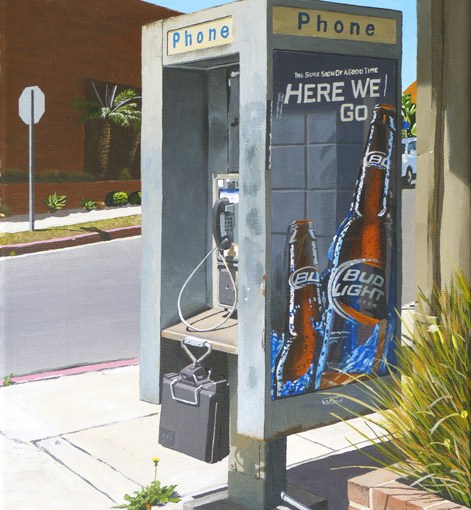
From the author: “There are two kinds of social messages I wanted to address with this piece: The belief that alcohol necessarily leads to “a good time,” as depicted by the artist, and the fallacy that everyone at university is adjusting to their new lifestyle immediately (and better than you). For me, the Bud Light ad on a random street corner spoke to the omnipresence of the belief that life is more fun when you’re drunk. I thought there was a dissonance to be captured here: the true experience of a first year student at university versus the societal messages he or she has internalized about what the experience should be, which ultimately break down.”


On the painter: “Phyllis Lutjeans, Museum Educator and former curator, has said of Ward’s work: “Although Michael Ward may be called a neo-realist painter his work can ultimately be described as abstract realism. The picture image is photographically realistic, but within the context of the painting his compositions are complex and almost abstract. Deciphering the work section by section one sees how a multitude of individual complete compositions are put together to form the entire work. For me the viewer is confronted by a realistic image that puzzles us and clearly tells the story simultaneously.”