on Nikoladze’s video: “Filling the Glass”

12:20pm

The glass stands tall. Still. Sure. A foil to the thundering chaos in your mind—crash. A few straggling fingers of feeble winter sun clamber through the window, bouncing delicately off the clear vessel. It is entirely transparent, down to the liquid within. Pure.


I.

12:22pm

A resigned hand stretches toward the glass, slipping effortlessly into an old action so long suppressed. Soft fingertips alight on flawless glass—how is it that the union of such smooth surfaces ends in such a crash?

1:37pm

You roll your head back. It lands heavily on the scratchy couch cushion. Your eyes are trained on the ceiling above, pocked with all sorts of nicks and notches. They’re multiplying as you watch, so you shut your eyes, allowing the third glass’s contents to trickle through your thoughts unimpeded. The sadness comes in crashing waves—you will the drink to hasten the ebb of the tide.

3:40pm

The slam of the front door tears you unceremoniously from a fitful doze. Your head swims thickly. The sea hasn’t ebbed; it’s just become murkier. You can no longer see the sand beneath. That used to be comforting—now it only adds to the chaos.

The sun is disappearing now, and none of its final rays manage to cross the threshold of the window. The glass looks different now, empty in the early wintertime twilight. Small. Weak.

You struggle to pull it all together—your disobedient limbs, your weak eyes and lips—to muster up an impression of control. But before you manage to focus your sight and orchestrate a warm smile, he’s already shutting the door to his bedroom. The only sign that he was there is the mail strewn on the doormat.

A new wave wells up, merciless, fueled by whatever placidity you mustered while you slept. You feel its crash resonate through every part of you. You fill the glass again.


II.

3:34pm

His tread is mechanical. His body could walk him home blindfolded. Music is playing loudly into his ears as he turns the corner onto his block, backpack swinging from one shoulder.

3:38pm

His hand reaches into the mailbox and meets several envelopes. He doesn’t have to look to know they’re bills, warnings, notices. His jaw tightens.

3:40pm

It smells like home: air freshener and gin, one a pathetic attempt to mask the other.

A drunken pile of limbs on the couch. Unsurprising. He drops the mail where he stands and shuts the door with a crash, much harder than necessary. He’s done being sympathetic.

much harder than necessary.

words by Kate Shaw, “Filling the Glass,” were inspired by Koka Nikoladze‘s “INFINITELY SUSTAINED GLASS BREAKING WITH GRANULAR SYNTHESIS” (shown above)

From the author: “Recording glass breaks creates the sensation of a process of shattering that doesn’t end. It defies time, moving backwards and forwards, generating a feeling of chaos that can’t be controlled. That feeling of a lack of agency in a situation spinning out of control spoke to me of alcoholism at its true root. The belief that there is agency in a case of alcoholism—depicted here by the son of an alcoholic parent figure—plays into a dangerous stereotype that allows alcoholics to be blamed for their “choices” instead of helped to overcome their addiction.”

new prose, inspired by sound: “The Trill”

Content Note/ Trigger Warning: Sexual assault, rape culture

They were jittering parallel, his leg and hers. They faced away from each other, tapping in terrified Morse code against the legs of the bed between them. He was shrinking and she was expanding. He was supposed to be the downbeat and she, the trill.

She recalled how his fingers had played her strings. How there was something so excruciatingly offbeat in the way that he’d sped up. He said he liked that sound; she said nothing. There was the pounding of their hearts and the curls of her hair. His hips were rhythmic. She counted to ten, holding onto nothing until he was empty and she was supposed to feel full.

She was his echo, the drum he hit against, a projection of his voice, and she convinced herself to feel empowered to exist solely in the glory of his smile. Too soon it became automatic: a euphoric cacophony of springs and curls.

In the climax, one of her strings snapped. She cried out, he froze. It was unlike her, he thought. She never asked to be hit, she thought. She removed herself from him, shaking, and perched on the edge of the bed.

words, “The Trill,” were written by Annie Rubin: “Koka’s electronic creation made automatic the emotive experience of producing music. This new system, mechanical and intricate, represents a structure of oppression we perpetuate through unawareness or indifference: one in which women are left voiceless and unquestioning. The moment of escape occurs when the woman rejects her role as a void (Cixous) and gains agency through expression.”

the colour and inspiration for Rubin’s work was inspired by Koka Nikoladze’s sound project, 

“Beat Machine No. 2”

Blueberry Leaves

blueberry-leaves-mi-ju

Those people who latch on
for stability.
What good is it to you
to bear the weight
of their despair?
Forced down
by the pressure of shared frustrations,
strapped to the same sinking ship.
Sure, blueberries can float in water…but can we?

word by Jessica Goldson

colour by Mi Ju


Magdalen Laundry

home (1)

The now empty halls
a Dublin asylum
on Lower Leeson Street
you did what they said
carry the “fallen”,
Keelia, birthing a daughter
treated as defiled.
1941, aged 16,
there was no time to say goodbye

behind monastic walls
a bedroom, a cell
iron-barred windows
in each dream walking along:
“Ma, where am I going?”
but always wake up crying
bear pages of thick ledgers:
“You disgraced us!”
Unpaid workhouse

shapeless, long brown dresses.
The sound of hand-scrubbed linens
if you listen you can hear
the abbess and the nuns

on cold winter mornings
face shrouded in black veils
girls marching to six o’clock Mass

beyond, the ordinary, everyday world.
Pruning of an old mulberry tree.
Shrews, and lizards,

the nameless.
I was known as number 26.


these words by Ilona Martonfi were inspired by the colour of Alison Gildersleeve

on park access in Calgary: “Green-Space”


00_4abandon36x36 (2)

1.5 million pounds of soil raised

to the 4th floor of Calgary’s CORE

shopping complex supports an inner-

city oasis. The Devonian Gardens

are open publically during mall hours.

Oil executives employed nearby

visit the green-space on lunchbreaks,

eluding the paupers of Stephen Ave.

in +15s returning to work.


As children we attended summer camp

at Lindsay Park Sports Centre,

belayed each other up its rock walls

shouted chicken on the high dive.

Kids today learn to play water polo

in a pool named by Talisman Energy.

Since 2002 the City of Calgary has

sold naming rights to the company,

20 years for 10 million dollars.


Fish Creek Provincial Park is the largest

urban park in Canada, abutting the

Tsuu T’ina reserve in the southwest.

Roughly 12% of the city is stewarded

by Parks Calgary, the highest ratio of

green-space per capita in Canada.

Rumors of a horse found dead

in Sikome Lake are merely rumors,

but a person did drown in its weeds.


Within the cemented waterways of

Century Gardens a man offers me

beans from an unlabeled can. He was

bitten on the leg by an unleashed dog

and chased into the park by police.

Concealed behind a bench and a

juniper bush, each donated by the

Devonian Group, we leave him sitting

in darkness atop the Brutalist landscape.


Later that year a decentralized dance-

party develops in Century Gardens,

culminating down the road under the

spotlights of Millennium Skate Park.

Despite the armed chaperones, shouts

emanate from a parking lot around

the corner at Mewatta Armoury. I try

to tell a girl she doesn’t have to go with

the guy gripping her by the shoulders.


Public gardens in Calgary are closed

from 11 pm until 5 in the morning.

When cops caught us hallucinating

after midnight in South Glenmore Park

(you in my driver’s seat, our drugs

on the passenger floor), they left

us with grins and a warning.

We were two blocks from where

I taught you how to drive a stick-shift.


After ditching my red Ford Ranger in

the grafittied enclosure for road debris,

we climb the dam on Elbow River. A

glassy reservoir reflects streetlamps

to the West as the artificial cliffs arc

down in the East. The capacity of these

sloping concrete channels have been

exceeded but twice, causing damage

to the riverfront properties.


All the black squirrels in Prince’s Island Park

will follow you along a path at dawn.

It must be a cold summer’s day

before cyclists and yoga seminars

arrive to claim the green-space.

Watch deer and geese retreat downriver

from a window of the Route 3 bus,

I’ll greet you soon in Votier’s Flats

with a cold 6-pack of beer.


these words by Kyle Flemmer were inspired by the art of Allison Gildersleeve 

Read, “I drifted with you”

owen gent 4
You took a piece of the sun and flew with daylight on your back. It was not heavy, but warm and you felt it there as you coursed through the skies, lighting my way down deep dark rivers. I did not know your people but I could see them flying with you above, in formation. I drifted with you, following your ways, assured that your pathway was right.
I drifted with you
We did not talk. You were too high and I was enamoured with the symphony of sounds coming from rushing waters beating against soft rock on the bottom of the riverbed.
 I drifted with you
We did not talk. I could feel you carrying the emotional burden of sunlight. You could not fade or falter and it was wearing on you, yet you remained steadfast.
 I drifted with you
We did not talk. I laid back, still, my head cradled in the mass of my thick dark woolly hair that hung well below my shoulders. Beneath the canopy of trees, underneath walkways and the shade cast by all manner of things, I acknowledged that the shadows separated me from you and the sunlight you carried. The shadows were dark and cold and I did not like even the briefest moment in their presence.
 I drifted with you
We did not talk. We did not need to.
 I drifted with you
I laid down in a vessel of my own making and followed you, laid underneath you and greeted you with my eyes. I stared straight at you despite the glare and the heat and consumed your every move. I measured your laboured breaths and dipped my hands in the cool rushing waters to remind myself that I was real. I was flanked by angels, dark and stoic, gliding alongside me and I felt safe.
 I drifted with you
You took a piece of the sun and flew with daylight on your back. You carried it for me during the darkest hours because I could not bear the burden of love and light. You held it there above me, out of arms reach so I could not pluck it out of the sky. You coursed a path for me to follow and allowed me to rest in the warm presence of peace and assuredness. You did not say words; there were none. You amassed an army of lovers just for me and when the shadows appeared I endured them knowing you were there on the other side of midnight. 
I drifted with you
these words by Cora-Lee Conway were inspired by the colour of Owen Gent 

following the toy

badiu 7

As Anne watches the toy spin slowly in the microwave, she thinks about where she and Augie will go. We could go to Vancouver, she thinks. Walk in Stanley Park and sit by the water. She’d been to Vancouver once, before she got married. She watches the toy spin and thinks about the ocean.

*

Their first night at the shelter, Anne woke up wet, Augie pressed into her side. “It’s too dark,” he said. They got up and Anne changed the sheets. She took the toy out of the backpack—it was one of only a couple Augie had been able to bring—and he clutched it to his chest as he fell asleep. Steven had given him the toy, not for a birthday or for Christmas; he just came home with it one day. It had been a good day.

The next morning, she found the tracker in her purse, in one of the side pockets she never opens. It was small, a little bigger than a dollar coin. Steven has touched this, she thought. He bought this little thing and turned it over in his hands and slipped it into her purse when she wasn’t there. She dropped it on the ground and smashed it with the heel of her shoe. She heard it crack, felt it flatten beneath her. She experienced a moment of relief before the panic—if there’s one, there will be others, she thought.

She dreams about the toy, but it looks different than it does in real life. She wakes up wet, with sweat in all the places. Augie is fast asleep beside her, a baby bird in a nest. She sees the toy in his arms and tries to think of how it looked in the dream, but all she can remember is that it wasn’t the same. And that’s the terrifying thing.

*

The fire isn’t huge, but it’s a fire. She thinks about how upset Augie will be. She’ll come up with an excuse. We’ll have to leave again, she thinks. The microwave sits on a wooden table, which is turning black as the flames eat. The microwave door hangs loose on a hinge. We’ll always be leaving, she thinks.

these words by Leah Mol were inspired by the colour of Teodoru Badiu

Love, left

badiu 6

Missed connections. Failed romances. Lost loved ones.

I’ve known too many people who’ve left.

Too many people who have been reduced to nothing but incoherent memories.

I have loved—deeply, intensely, purely;

these loves are now strangers.

– the many faces we wear

these words by Fiona Williams were inspired by the colour of Teodoru Badiu

25th edition of the First Peoples Festival

22
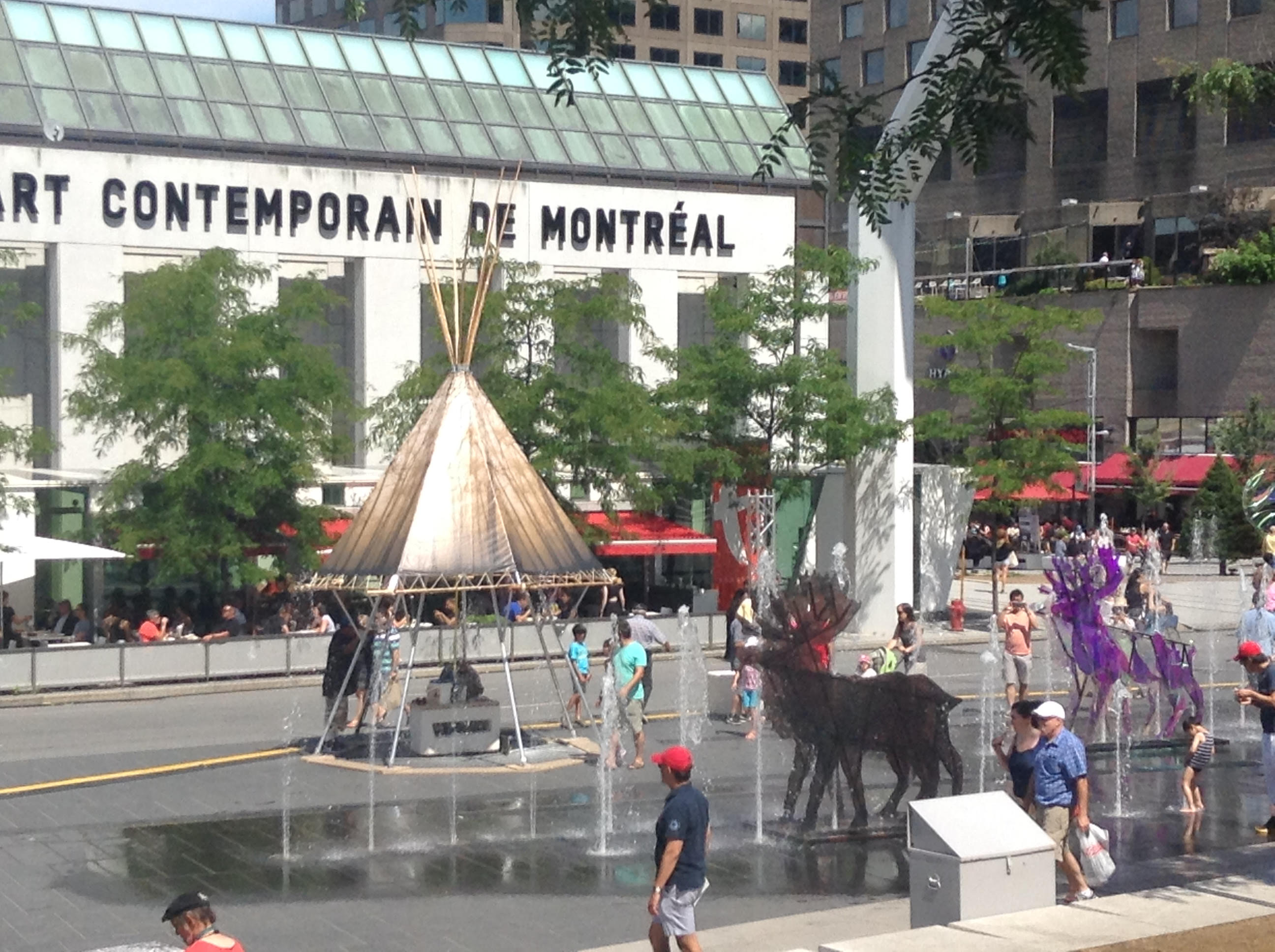
Présence autochtone, the 25th edition of the First Peoples Festival, is currently taking place at Place des Arts in Montréal, and is definitely worth checking out.

The festival features movies, concerts, readings, art, and more, celebrating aboriginal culture and its importance for Canadian identity.  Moreover, the festival highlights the evolution and adaptation of aboriginal music and art in a changing world.
Drumming circles and other forms of aboriginal traditional music, as well as new forms of aboriginal musical expression, such as DJ Psychogrid, Madekimo, Moe Clark, and Katia Makdissi Warren are featured every day on the big stage.
Additionally, many important aboriginal organizations like the APTN, the Makivik Corporation, Land Insights, and the AVATAQ Cultural Institute are using the festival to bring attention to the challenges that still remain within the aboriginal community, like the societal integration of First Nations and Inuit People who adapt to life in urban centres.
2
In response to this issue and others,  the First Peoples Festival promotes the use of art as a means of societal mobilization, identity building and cultural understanding.
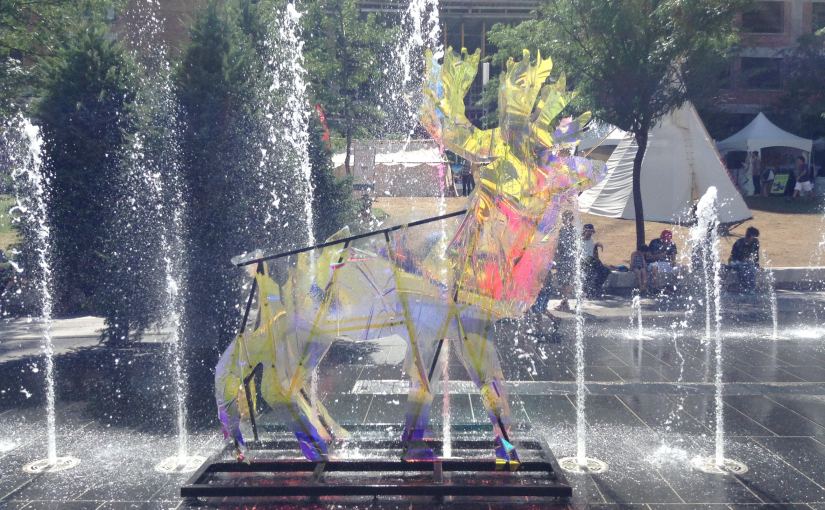
Inuit cultural expression using modern and non-traditional materials, including tepees and sacred animals like deer, turtles and moose, can be seen all over Place des Arts. In addition, the festival features First Nations artists like Jeffrey Veregge  of Port Gamble S’Klallam. Veregge’s art will be of particular interest to comic book fans, as it integrates traditional aboriginal artistic designs with popular culture icons like Iron Man and Buzz Lightyear.
Lastly, Parks Canada is giving out free airbrush tattoos of modern and traditional designs of aboriginal spiritual animals, each created by an aboriginal artist. With each tattoo comes a short explanation of the spiritual importance of each animal, and a description of the artist’s vision for the design.
The First Peoples Festival is not to be missed – check it out this week, until August 5, at Place des Arts!

On child abuse: “Snow in the water”

Rondeau2

A small girl and a tall, middle-aged man eat lunch together at the local fast food restaurant. Both have sauce on their face: him on his chin, her just above her left eyebrow, and both eat the French fries between them with ferocity.

‘Can I have another burger?’ the small girl asks the middle-aged man.

‘No, you’ve had enough, little dumpling,’ the man replies.

The girl looks down at her white liquid thighs. There are delicate webs of blue vein just beneath the skin. She can almost see them wriggling.


The man and the girl go to see a film at the small cinema with the smell like neglected cupboard and forgotten jacket. They stand looking up at the posters.

‘What would you like to see?’ the man asks.

‘I don’t mind, Daddy,’ the girl replies.


The middle-aged man buys two tickets to Titanic and as the opening credits roll he reaches over and puts his hand in the small girl’s lap. She begins from one hundred in her head and pictures each number brightly coloured, flying free across the dark inside her skull.


word by Laura McPhee-Browne

“This piece of art is beautiful to me but it is also confusing, and I believe it is not what it seems. The title of the painting is ‘iceberg’, and I decided to write a little story about something that, like an iceberg, is almost never what it seems to be; child abuse.

When child abuse occurs between a parent and a child, it can easily be dismissed as imagination or exaggeration, but often what a child discloses about what has happened to them will be only the tip of the iceberg. It is important for us as adults to delve deeper—to dive down and find out what is really going on underneath the surface.”

colour by Emilie Rondeau

“My visual practice is a transgression and alteration of our perception of reality. I encourage free and intuitive interventions. Although abstract, my paintings carry the memories of atmospheric gardens, nebulous spaces, organic landscapes and architectures. Made of solid and bright colours, washes, painted and drawn marks, the compositions are reminiscent of complex and dreamlike environments. From the infinitely big to the infinitely small, cosmic or cellular spaces transport us with a strong impression of movement and energy.

The lines intersect and intertwine, linking shapes and colours together. Sometimes fast and agitated mark making succeeds to slow and smooth gesture. Colour is pure and vibrant. The harmony is rich and thoughtful within the limits of strangeness. A delicate balance takes place in this continual research for new visual forms. The eyes travel, search and rest. My paintings are an invitation for a trip in between the painting surface and your mind.”