Not Afraid of Drowning

Rondeau

The first time they met was spectacular. She moved her hands across her body like breath, and told her every lurid detail of her dreams. She listened so hard and attentive as they untangled the depths, brushing pollen from her cheek and unfolding the bedsheets. She pulled the socks directly from her feet, insistent, and stood there naked and nauseated.

Her spit on her mouth like the milk at the broken stem of a fig pulled directly from the branch: these are soft, round fruit, weighty as organs. Fleshy and pink she carried them all day in the sun, stopping intermittently to adjust the sweater that cradled them in her bag. They bruised and split anyway.

Blackberries ripened in the hot field and along the train tracks and the only blank space was the white blue sky: asking no questions, reaching for nothing. She was having trouble looking at her hands, berries bleeding from small fists hanging at her sides.

What was soft at dawn had unfurled wicked and cheap. Every sentence was a scribble: unfinished and impossible to hear. The last time they met there was gravel underfoot and it was raining. She was indecisive and distracted by every turning head calling her name. They ate oysters and hard, ripe cheese. Green grapes.

When she turned the tap out poured rust and sediment, but they stepped in all the same to bathe in that murky swamp. She rubbed tea tree oil into her skin and ran a comb through knotted hair

When they made the bed that night every fold made her choke. She pulled the sheets taught and felt her body tense, muscles binding. Every sweeping gesture cut through the air, the blurred alarm clock’s blinking digits. It was not terrible, it was completely normal: the weight, the sinking feeling, the inability to remember what it was like to be awakened by her own vital breath.

She woke to the rain and the dampening of summer bush fires. The sharp smell of a half empty glass of red wine on the table reminded her of last night’s strain and she poured it down the sink.

She showered: clean, hard, spitting hot water, and sat at a single chair at an empty table in the kitchen and wrapped herself in a lavender bathrobe. She ate toast with warm blackberries, and the sugar hurt her mouth and the seeds lodged between her molars. She was not afraid of drowning in this rain, but only of slipping away.

word by Alisha Mascarenhas

“I wrote the piece as a documentation of tumultuous experiences occurring on several planes: fragments of dreams, fiction, and so-called reality that met or clashed in some way with the form and feeling of Rondeau’s work. The painting fed its form, and served to surface and to purge some previously unarticulated sensations and images.”  

colour by Emilie Rondeau

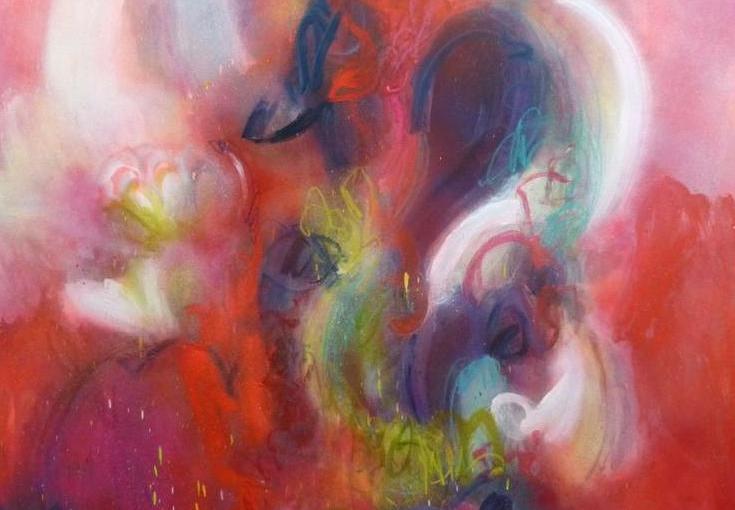
“My visual practice is a transgression and alteration of our perception of reality. I encourage free and intuitive interventions. Although abstract, my paintings carry the memories of atmospheric gardens, nebulous spaces, organic landscapes and architectures. Made of solid and bright colours, washes, painted and drawn marks, the compositions are reminiscent of complex and dreamlike environments. From the infinitely big to the infinitely small, cosmic or cellular spaces transport us with a strong impression of movement and energy.

The lines intersect and intertwine, linking shapes and colours together. Sometimes fast and agitated mark making succeeds to slow and smooth gesture. Colour is pure and vibrant. The harmony is rich and thoughtful within the limits of strangeness. A delicate balance takes place in this continual research for new visual forms. The eyes travel, search and rest. My paintings are an invitation for a trip in between the painting surface and your mind.”

On Mental Health: “blue”

Rondeau 3

She felt all sorts of colours, but she noticed blue the most.  Its thin translucent shade seemed to seep into the corners of her eyes, through her tear ducts, tainting everything in a filmy azure haze.  It was vague and arbitrary.  Resting above her heart, compressing the edges ever so slightly on good days, or sitting clammy and heavy (as a stiff tongue) on not-so-good days.  Such weight meant lengthy exhaling and slight inhaling, her chest exhumed its fire as the oxygen departed.  Her shoulders rolled forward, concave, curling inward.

The blue was pervasive.  It was a tinge with the boldness to disobey the doctors and smut her everyday life.  It was prescribed that she share sadness and cool shades with the therapist on Mondays, and reinvigorate her heart and head with pilates on Tuesdays and piano on Wednesdays.  Her room was painted yellow, an attempt to restrict pathetic fallacy.  From Thursday to Sunday she was unmoored.  In such barren gaps, she aimed for off-white and neutral shade.  A dank white was as martyred as it was innocent.  Shinning like an exemplary virgin untainted by any distressing moods, she perfected a bared-teeth smile and upturned eyes.  In the schoolyard and dining room such whiteness was encouraged by her mother’s wrinkled brow.  She floated down the sidewalk.  A wispy white cloud pulled through a royal-blue sky.

The abject arrival of the sadness dumbfounded the medical men.  No predicating calamity validated the diagnosis.  She was bred with a full palette.  Rosebud bushes and rose-rimmed eyelids.  Spinach salads and vitamins in colour-coded bottles.  It was juvenile and chaotic.

The flooding of blue necessitated a quarantine of colour.  Its existence was permissible, but in controlled segments.  She would be a swirling kaleidoscope.  In the turvy checkered shape, eyes would roam, seeing nothing lucidly.

But on Sundays, she found pleasure in evoking the hue.  Blue, cerulean, plum, indigo: she let her lips wander over their sounds.  Stepping out of the yellow rooms and white shrouds, she made her way to the seaside.  Alone at the cusp of this cumulative blueness, she could rest.  Other colours slipped off the edge and fell into its abyss.  Carmine reds, vivid greens and rusted oranges overpowered by the silver-blue mass.  She wouldn’t dive in- she was satisfied sitting on the shore.  Though comfort lie in this watery body, she held out for other colours to come through.

word by Keah Hansen

“I relate the colours of this piece to emotions.  The distinct yet blended shades symbolize the complexity of our moods, while the lines represent an artificial attempt to restrict or regulate feelings.  The prevalence of blue represents depression, and society’s discomfort with it.  While the protagonist tries to understand her mental state privately, she is subjected to regimented treatments.  Her accepting its existence is a cathartic step in recovering from it.” 

colour by Emilie Rondeau

“My visual practice is a transgression and alteration of our perception of reality. I encourage free and intuitive interventions. Although abstract, my paintings carry the memories of atmospheric gardens, nebulous spaces, organic landscapes and architectures. Made of solid and bright colours, washes, painted and drawn marks, the compositions are reminiscent of complex and dreamlike environments. From the infinitely big to the infinitely small, cosmic or cellular spaces transport us with a strong impression of movement and energy.

The lines intersect and intertwine, linking shapes and colours together. Sometimes fast and agitated mark making succeeds to slow and smooth gesture. Colour is pure and vibrant. The harmony is rich and thoughtful within the limits of strangeness. A delicate balance takes place in this continual research for new visual forms. The eyes travel, search and rest. My paintings are an invitation for a trip in between the painting surface and your mind.”

“

Is Mural Fest an Art Festival?

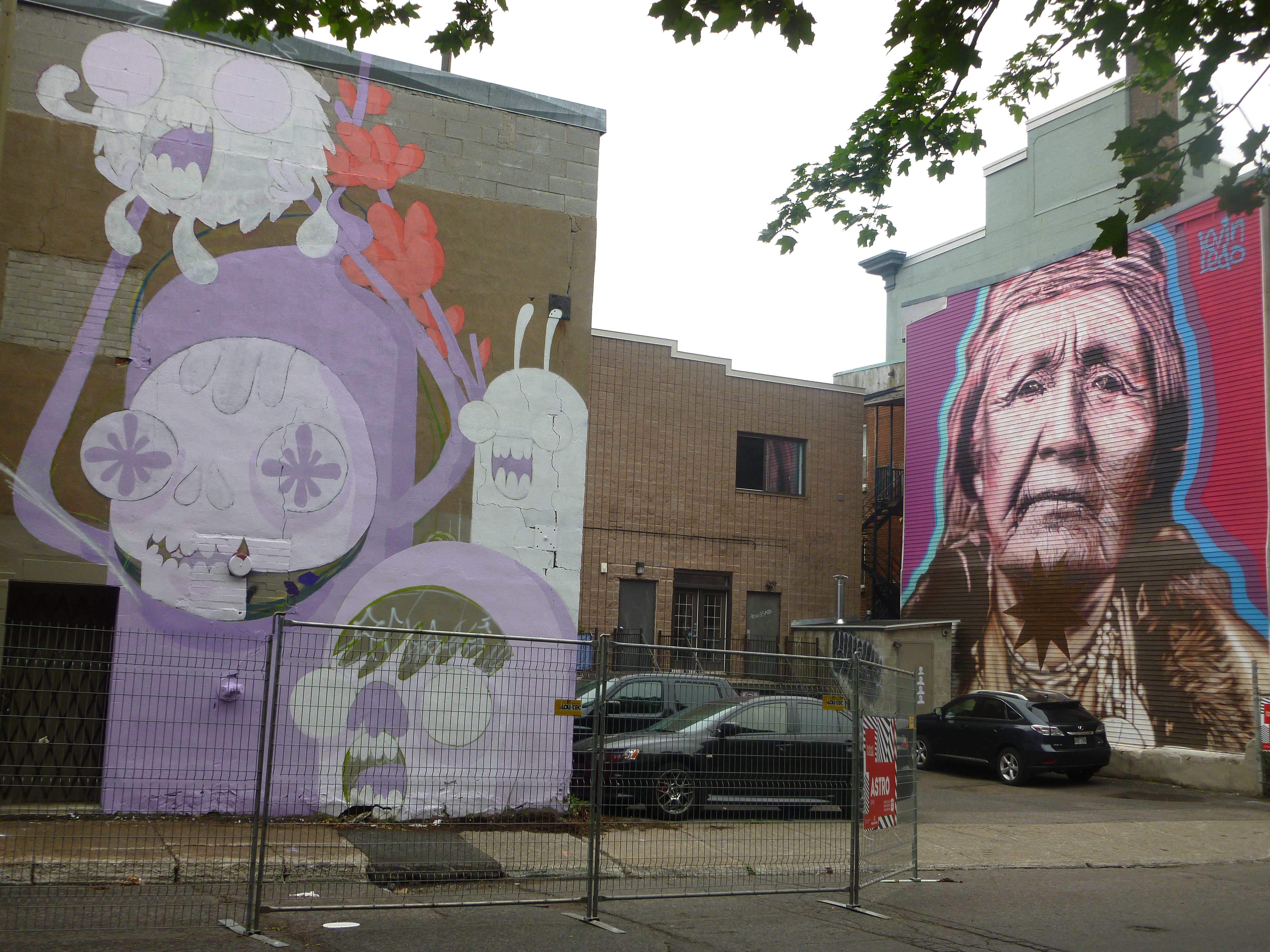
Montreal hosted its third annual Mural Festival this year on Saint Laurent Boulevard; lasting 11 days and featured 20 different artists from all over the world.

This year’s murals, in addition to the final products of the 2013 and 2014 festivals, certainly leave a feeling of awe – but street art does far more than add colour to a neighbourhood.

Most artists don’t create for the sake of creating.

The very nature of street art is accessible to all by being outdoors, free, and easy to appreciate, and there is a strong belief amid the street artist community that there is a certain degree of responsibility to criticize, to create debate, or to denounce injustice through murals and street art.

Namely, Spanish-American Axel Void is known for acting as a witness in depicting the homeless and the persecuted in order to create relatable symbols out of people who are generally discounted by the rest of society. As a part of his series titled “Nadie”, Axel Void painted a homeless man he met on Boulevard St. Laurent. The mural is called “Personne”, and the man in question is at first glance easy to miss, almost concealed, behind the white letters stamped over his face. His mural is a testimony and a criticism to the fact that itinerants are often seen as invisible in society.

P1060999Mural by Canada’s ASTRO

Mexico city based Curiot is known for blending animal forms in creations inspired by Aztec art and Mexican traditions. His Montreal mural is no exception, and his chalk looking figures call for a heightened connection to nature and between human beings and animals.
P1070002

Austria’s NYCHOS- read his Word and Colour collaboration 

Argentinian Jaz is known for his political graffiti, often depicting scenes of conflict, confrontations, or combats. In his contribution to this year’s Mural Festival, he created a scene depicting cultural and identity clashes between two bulls with human bodies. The bulls are covered in tattoos of maple leaves, fleur de lys, and other Canadian and Québecois symbols.

Another interesting facet of street art is in its reflection of globalization. In addition to their murals in Montreal, you can find Reka One’s aboriginal inspired art in Australia, Italy and Austria, Seth‘s outward looking children in France, Tahiti and China; Etam Cru’s scenes of young girls in Poland, Germany and the United States.

If the artists strive to denounce inequality or injustice through their murals, the process of commercializing said art may strip it of its very purpose.
P1070006A mural by Brazil’s Bicleta Sem Freio 

The nomadic nature of street art allows for a presence of these recognizable characters all over the world. This creates a certain “fil d’attache” between street artists and enthusiasts, as well as between different countries, each faced by their own societal issues.

While Inti‘s mural in Montreal warns that our greed in exploiting Canada’s natural resources will in turn leave us waterless, his mural in Istanbul, Turkey encourages resistance to the government’s austere policies in solidarity with the 2013 Gezi protests. Through their murals, street artists encourage global solidarity in facing world issues.
And yet, when artists are commissioned into creating murals during a festival that clearly has commercial goals – commercial goals that became quite obvious through the street shopping component of the festival – we are called to question the subversive impact of the presence of capitalism in such a festival. Can art be critical of capitalism if it is created by and for capitalism?

P1070001

Moreover, many artists criticize capitalism through their work, but also struggle to pay for the materials necessary to create their works of art. Benjamin Moore sponsored most of the paint used by the artists during Mural Festival. Does art play the same role and have the same mission when its creator was sponsored, or commissioned, by commercial entities?

Though the muralists themselves may want to create art that criticizes capitalism, injustice or austerity, the fact that there was no platform to for them to discuss such themes with the public testifies to the fact that the organizers of the festival are perhaps not as concerned by activism as they are by capital.

In response to the commercialization of art within Mural Festival, the Anticolonial Street Artists Convergence has created a grassroots festival promoting anti-capitalist street art; Unceded Voices will take place from August 14 to 23 with the goal of sharing anticolonial values and indigenous resistance. Unceded Voices brings attention to the fact that Mural Festival takes place on unceded Kanien’kéhá:ka and Algonquin territories.

Contrary to Mural Festival, Unceded Voices will create spaces for artists and members of the community to discuss political issues and how art can act as a platform for such debate.

Check out the murals on St. Laurent, and support Unceded Voices this August.

word by Jiliane Golczyk

Issue 217 (Gender, Sexuality): “IN THE BATHROOM”

unnamed

“IN THE BATHROOM”

May and Silas lie on the bed. May knows that it would be worthwhile having sex right now—to feel close to him, to remind him that she is not ordinary. Right now she would rather have sex with her substitute science teacher (he had that hair that she liked, it licked up the back of his neck) or the butch woman who had stared at her in the waiting room at the dentist after school yesterday. The staring had made her go red in the face and her vagina spasm in a way that Silas’s gaze hadn’t in months.


Silas turns his slender frame towards her. He is fine and delicate. I’m bored, he grins, let’s cuddle. She grins back and stretches out her arms to pull him in—her arms over his shoulders as always, her body bigger and darker than his will ever be. They kiss and then she pulls back just enough for him to pull back too. Do you want to, he asks, hot breath smelling of closed rooms and wet toilet paper. She pauses. Yes. His eyes coat her in beauty—when he is aroused she feels like he sees her better. She can toss her head and whinny, like a mare, and he will kiss her pulsing veins. They help each other to pull off their clothes: her undies, his exhausted boxer briefs. There is always a laugh here, when her undies are down around her ankles and she is shifting and twisting to fling them off. Sexy, he says.


Moans. Noises she never makes at any other time but that she consciously makes now. Light, quick breaths on his collarbone and light, quick bites of his stretched out neck skin. She doesn’t feel like it until his penis goes in. Then it does feel good, good, like she tells him.


May rolls over, taking Silas with her until he is underneath. She can feel the sweats of each of them slipping and creaking against each other.  She is provocative up here. Silas is beaded lightly all over and his eyes bulge. May resists an urge to reach out and gently move his hair from out of his eyes. This must be over quickly before the sheen wears off and he starts to see the hair on her arms, her pores. Silas tells her he loves her. She feels the warmth of the words in her fingers and her vagina aches just behind and below the labia when she looks down to see his light tuft and her dark one, their tufts, bouncing against each other.


Silas pulls her hips tight in against his own and heaves at her, the sound a bath drain slurping. May breathes out and pulls the sheet across her shave-cut legs. She will bring herself to climax later, will run the tap to quiet her sounds, in the bathroom.

word by Laura McPhee-Browne

From the author: “I saw this art piece as the collage of a girl going through the emotions of becoming a young adult.

 
This art piece brought back to me the insecurities, anxieties and play-acting aspects of being a young woman, and I decided to write a story that delved into the mind of a young woman trying to be ‘normal’ and to do ‘normal’ things, such as having satisfying, meaningful sex with her boyfriend, despite the ambiguity and complexity of such an act.
 
Through my story, I also wanted to get across how much pressure there can be on young women to be ‘nice’, to be ready and willing, and to be relaxed, and to sacrifice their own pleasure and well-being for the sake of men, when this is an impossible and unrealistic expectation. I believe that the various slogans in the art piece, ‘BEING NICE IS COOL’ and ‘DON’T FRET’ are the slogans that young women chant inside themselves, when really it should be okay to not be okay.”

colour by Jasmine Okorougo

Review: Justseeds Vernissage Confronts Injustice

support1

Justseeds’s artists Mary Tremonte & Jesse Purcell put up a wonderful exhibit last Friday – with Tremonte DJ-ing and Purcell showing off artwork from the thirty person collective, as part of the Howl! Arts Festival. Justseeds is a decentralized network of artists that produce pieces highlighting social, environmental and political injustices.

support

buy this print now by Jesse Purcell

One project, “Celebrate People’s History,” has been fifteen years in the making, and recognizes and commends ‘little people protesting big things’ through print art.

‘Big events’ include the Ejército Zapatista de Liberación Nacional (EZLN) in Chiapas, Mexico, protesting the American Free Trade Agreement in 1994, or the 2011 Wisconson protests that opposed the Wisconsin Budget Repair Bill.

02wisco_400.jpg


buy this print now by Sue Simensky Bietila

For those of you who missed Justseeds’s event last week, don’t worry! You can still check them out online at justseeds.org

Allison Kutcher, 28 Apr 2015

familyphoto2014.jpg

Support Word and Colour’s live art event!

Review: Howl! and CKUT host panel on austerity

image via Ecole De La Montagne Rouge

As part of the Howl Arts Collective Festival, CKUT FM invited four panelists to discuss artistic resistances to austerity in a live broadcast at Casa del Popolo. In discussing the relation between art and the movement against austerity in Montreal, the chief question was: What is the role of artists in the fight against austerity?

According to the panel – which included artists Edith Brunette and François Lemieux, graphic designer Kevin Yuen Kit Lo, and photojournalist Amru Salahuddien- artists have a choice: they can use their creativity to smooth over the bumps or they can reveal societal tensions through their creations.

However, if art can be used as a space where it is possible to dream, to envision a new future and to picture new social relations, then artists have not only the option, but the responsibility to define and depict an anti-oppressive future in order to raise awareness about austerity and engage discussion.

In addition to the discussion by the four panelists, La Chorale du Peuple, founded in 2011 during the occupation of Square Victoria, denounced neo-liberal policies and inequality through their songs: “Que la vie est belle” and “Ça fait rire les Libéraux.”

A problem underlined by Amru Salahuddien, an Egyptian photojournalist who was on the ground during the Egyptian uprising, was the lack of connections within the international anti-austerity movement. Though the fight against capitalism seems to be a fight that has a certain level of continuity across time and space, the lack of links, not only on an international level, but also within our own communities, has rendered the anti-austerity movement quasi-ineffective.

Salahuddien parallelled the Egyptian and Quebecois students, stating, “while in Egypt, bullets were used against the protesters, the weapon used by the government against Quebecois students was neglect.”

Despite the possibility of connections between these two groups of protesters, Salahuddien criticized the fact that very little support was given to either group by the other: that, though our world is said to be shrinking through technology and social media, there is little global awareness or concern for movements that do not affect us directly.

Concluding the discussion was a conversation about hope, where panelists suggested that if art is used as a tool in the fight against capitalism and the structures of power, it is because artists have hope for a better future, despite their use of seemingly sinister artistic tools, like irony or dystopia, in depicting their criticisms.

Thank you to Howl Arts Collective and to Casa del Popolo for hosting this interesting panel discussion- click here for more events happening this weekend!

Jiliane Golczyk, 23 Apr 2015, Montréal

Job opening: Head Of Colour

cropped-wqwww1.jpg

Job opening: Head of Colour

Word and Colour

Reports to Editor

The Art Director will curate the art for upcoming features at the magazine. After contacting artists, the Art Director will inform the Editor of upcoming features with all required information. Certain events in Montréal may require the attendance of the editor to represent our brand, and the Editor may also select artists to feature.

*An awareness or openness to social justice politics is essential as a representative of the Word and Colour brand. Word and Colour is a creative Non-Profit Organization of volunteers. This position will be paid when revenue streams are implemented according to workload, and requires minimal hours of commitment.

Our Ideal Candidate:

Reliable, organized, proactive

Education / Experience with visual art

Knowledge of social justice issues

Responsibilities:

Contacts artists for weekly features

Represents Word and Colour at art events

Responds to e-mail within the day

Is available for monthly meetings in Montréal


Please read over our mission statement before applying!

Application deadline:  Friday, May 1, 2015

Send CV to word@wordandcolour.com

Review: ASA’s Theatre of The Oppressed

10968503_1590582171177990_5645835069203416747_n

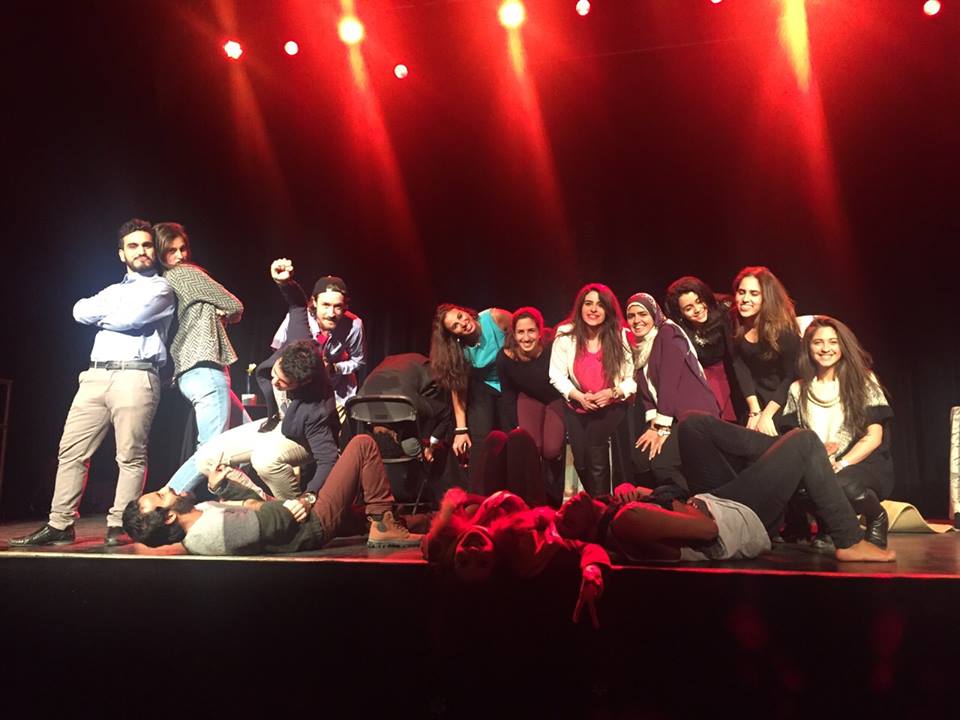
The Theatre of The Oppressed, put on by the Arab Students’ Association, was a two act show that served to ask important questions about interactions on oppression – without claiming to have the answers. The performance intertwined lives of the oppressed and their oppressors in an interactive way: upon closing, members of the audience were invited to recreate scenes where they felt harm could have been reduced by taking the place of an oppressed character.

The innovative technique – developed in 1971 by activist Augusto Boal – brought tangible excitement to the audience. The feeling seemed that these new interventions would make a significant change in the scenes on gender roles in the family, racial profiling, and street harassment.

Audience members brought new ways of interpreting the scene from the oppressed, although bringing little change to the treatment by the oppressor: street harassers went on harassing, regardless of new responses from the harassed. A police officer was confronted on the racial motives of a search. The officer’s response?

“So what?”

11081047_1608204596082414_887284934734218877_n

Valuable lessons come from the ASA’s decision to portray all characters in a multifacted perspective, each struggling to find a balance of peace in their home and public lives, raising many questions: is oppression simply ‘around’ the oppressed, or is everyone born with it? How do we reduce harm in oppressive situations, when it seems that, however the oppressed responds, the same treatment seems to occur?

As the group proposed, the Theatre of The Oppressed was not to provide prescriptive solutions for change, but rather to raise awareness and pose questions while ‘humanizing humanity.’ An important group doing important work in Montréal – we look forward to their next event.

Allison Kutcher, 23 March 2015, Montréal

Image credits: Arab Student Association of McGill