Lines & Anemones


word by Charlotte Joyce Kidd

colour by Burkhard Müller 

Every day that I leave the house I feel that I am leaving it wearing a sign (or maybe an expression? An outfit?) that says “here I am, world. Have at me.” I feel this way even though – when I do leave the house – I leave it also wearing the cozy winter coat of privilege, not to mention an actual, real winter coat. I can’t imagine how hard it must be without these things.

There are these little lines in between everyone’s lives, aren’t there? There’s this space in between everyone and it’s like we’re all just extending these tiny tendrils across it, these little, feeble gooey white groping things with suction cups on the ends, and sometimes we meet someone and we manage to say things that make sense and actually express anything that we really feel or mean, and if they do too and enough of our tendrils stick to enough of theirs, then we feel better for a bit, like someone actually knows us. But even if you do that for your whole life, your whole life with the same person (and that’s problematic, too, let’s talk about that) how many of your little limbs could you extend? How many of theirs could you touch?

I got on the streetcar after spending the night with a boy and on a cold corner I saw a couple walking by and I thought about how he would react if I suggested that we spend an entire day walking around and telling each other every single thing that passed through our minds. We could take turns, do an hour each and then switch. He’d told me in words that were decisive and made sense that we could never understand each other completely, because I’m white and he’s not and I’m a woman and he’s not. I agree. There’s something noble in the futility of trying to understand, though, isn’t there? There’s something beautiful about learning to replace understanding with empathy, about reaching out and touching the tendril even though you can’t stick to it.

Sometimes there are chasms between people. Sometimes the lines yawn. Sometimes two people have pushed enough times that their plates push further and further apart, sometimes one person has made a moat around themselves because of something that happened. Sometimes that moat is not a bad thing, sometimes it is not wrong to require someone to have very long limbs before we let them reach us. 

So we’re all alone, playing a giant game of tic tac toe, reaching out from our separate boxes with words written or spoken or felt, or with devices, these electronic arms with which we send cries into the ether and hope for ethereal responses, echoes in the chasm. And maybe some people are closer to the edges of their boxes than others. It’s all very lonely and very hopeful.*

word by Charlotte Joyce Kidd

colour by Burkhard Müller 

Incline

03f8b926526103.56356881684c7

word by David Fleming

colour by Burkhard Müller 

On the metro delivering the girls to my ex in a mall.

A young woman close by waves to them. She smiles her surprise at the sight of a man with children. I smile back, upholding her fantasy.

It’s alarming how the mechanics of a city collide and separate us. On the teeth of the upward escalator, I am holding my three year old. Her big sister wraps her limbs around my leg like a koala. I’m a little escalator, here for them to ride up and down.

Down a hallway, another escalator. I am sweating in rush hour.

I wonder how Sam’s managing. Trying to remember if I left her, or if she left us, and who the kids think left whom, and who they feel is still fully present.


Daddy, I STEAL YOUR NOSE! says the girl in my arms as she swats at my face.


Down a yellow hallway, offices curve into their little corners. We are in the space where underground becomes above-ground, where I sometimes feel myself gasping for air.

Don’t know why she wanted to meet here, this week.

A memory: eating in the food-court up the next escalator. J’adore la poutine? or la cheeseburger? I always goofed her with my fast food Franglish. 

Again, we escalate quietly, a few impatient people pass to the left. For some reason, the toddler shrieks Mommy’s house! in my ear.

A crazy idea: I could ask Sam to have dinner in the food-court. Family hour. Our future, joined somehow, could be pleasant. We’d exchange small talk, remind the girls to sit and eat. We could be like coworkers, sitting in a lunchroom, rolling our eyes at the orthodontist bill.

Can’t you love a person the same from a different building, a different room?

An excited shout from my side.


Jess!


Sam’s best friend. When we met in college, I liked her first, though she was always mean. I told her once, years later, when we were alone, in a season when we were getting along.

Wearing gym clothes, her hair in a tight bun, her glare scolds and scalds me.

I remember, now, Jess moved into a condo in this building last year, when it was ending.


Where’s Sam? I ask. I was hoping to speak with her.

She wanted me to pick them up today.

Oh, I said quietly. What’s she up to?

It’s not important. I’m in a rush, though.

I have some things to discuss with her, maybe I’ll just call.


A huff over her shoulder.


Look, I don’t know what you have in mind, but Sam’s busy.


She takes the girls, one on her hip, one by the hand, and gets on the elevator which, presumably, leads to her home.

Before the doors close, she leans forward intently.


Your choice, she whispers. Your choice.*

word by David Fleming

colour by Burkhard Müller 


On Art and Relationships: “Extending the Pattern”

for josh

word by Josh Elyea 

colour by Mojo Wang

          Jane knows that compartmentalization is the key to a healthy relationship. She’s put all the little boxes where they belong, and for God’s sake, she’s going to leave them there.

          Jack says the simplest things in life are the most insidious. Comfort, for example. No good can come from comfort, he says. He’s speaking while deftly disassembling a French press that hasn’t been cleaned in months; Jane is only half listening, since she’s just put on Joe Strummer and the Mescaleros and is ruminating on the late singer’s post-Clash career with a keenness she’s not able to summon for the tired lecture aimed in her general direction. Rather, she’s enamoured with the sound quality pouring from their new BOSE Sound System. You really do pay for quality.

          It’s only after a large purchases, like a new BOSE Sound System, when Jack and Jane fight about money. It’s only in those moments that Jane’s chosen profession matters; only after the limited square footage of the apartment has been claimed, carefully cordoned off with a clear presence on either side does it matter what she does for a living. Jack wouldn’t go so far as to suggest she do something else with herself; no, he’s fairly certain art is where she belongs. He’d sure to like to see her make some money from it though, and he’ll be damned before he feels awful for saying so. Or, at least, that’s how this argument went the last time they had it, and the time before, and before…

          It’s not like Jane is overburdened; student loans notwithstanding, she owes a few hundred dollars on a VISA and has an unpaid cell phone bill in collections (she’s only recently stopped receiving calls where a bland, deathly voice asks “Hello, may I speak with Mrs. Jane _____ about an outstanding and quite frankly egregious debt…”). Other than that, she doesn’t owe a cent to anyone. So she’s just getting by right now – so what?   

          Often, Jane wished Jack would try and understand what it meant to be an artist, what it meant to try and create something from nothing. She wished he wouldn’t stare so obviously when she said she didn’t make much progress on her novel that day, and that he wouldn’t move with such reluctance when removing his credit card from his wallet to buy things like BOSE Sound Systems. Hell, she wished he’d stop buying things like BOSE Sound Systems so she didn’t feel so indebted to him, so she didn’t feel like she owed him anything.

          Jane looks towards Jack and sees there’s a torn piece of wallpaper where the counter-top ends; looking behind it, she can see that the little black and white boxes don’t end where they appear to, and the pattern extends far beyond her cursory understanding of it.


See more colour by Mojo Wang


“Learning to stay gold”

rivet 3

word by Sean M. Hogan

colour by Stephanie Rivet 

I had just turned twenty-three when some friends introduced us at the drive in theater in the summer of 68. The book The Outsiders had just come out and you looked every part the greaser with your leather jacket and blue jeans. I was afraid. Not of you, but what you represented. What loving you meant about myself. When I told you this at the end of our fourth date, I had every intention of breaking things off. You just kissed me, gently, for the first time. You said that we were Ponyboys and we had to stay golden.

You called it, “a place for us,” when in 1976 we moved from our small town in Lancaster to the row house in the Washington Square West district of the city. Before, we had been out of place in those rural backwoods and farmlands. Philadelphia dubbed our neighborhood the red light district, a center for debauchery; but with your Midas touch, you made our run down house a home. The bed I ordered from the Sears catalogue hadn’t arrived in time, so we spent the first night painting the living room blue before making love on the tarp and falling asleep in each others arms.

In 2007, the city painted the street signs with rainbows. You were so happy; happy to be recognized and acknowledged. And we were recognized. When those young men saw us holding hands and their fear and ignorance turned their hands to fists the nurses wouldn’t let you visit me in the hospital because you weren’t family. I couldn’t see through swollen eyes, but I could cry. For nights I was alone until I felt your arms and heard your voice. “Stay golden,” you whispered through a kiss, words strained but forced through your own swollen lips. Through it all, you never lost hope. Even when the judge let our assailants off easy with time served. Even when someone threw a burning trashcan through our bay window, you merely knelt and swept up the broken glass and joked that they at least had given us a bin to place the trash. Then you knelt again and prayed. For them.

            In 2014, we were married in LOVE Park. The iconic statue above our heads could never truly represent how much I loved you. It was a clear day, and the green trees stood still in attendance with our closest friends and family. Beneath their shade, we took a photograph that shows your teary eyes looking into mine, capturing a moment I never want to fade from my aging memory. Today, fresh tears blur my sight as I stare up at the colored signs of the neighborhood you helped to build. The colors swirl, like my dancing memories, like leaves falling from the branches of our seasoned life. The cancer took you from me in June, and I do not want to say goodbye. Of all these colorful memories, I remember to stay gold.


See more colour by Rivet

On Desensitized Violence: “Muted Colours”

95457a49689083.5608656ded9c8

word by Annie Rubin

colour by Mojo Wang

There was no one in Bill’s house to turn off the TV when channel four came on. We thought of him as some sort of guru: he told us of kidnappings; of guns and knives and fires and what it meant when there were people on roofs about to jump.

It happened when we were in our sevens and eights that we realized we could press play when mom was in the kitchen. Imaginations were running crazy and fueled by these wild images that kept flashing across the screen.

My brother always liked video games. There was this one where you got to steal cars and ride away, hair all wind-swept. It was cool to be able to drive a BMW even on a screen where his fingers turned the wheel with a flick of a button.

The rest of us were playing hide and seek where the floor was lava. No one ever found out what happened when you touched because maybe your shoes were fireproof, you grew wings, or we just didn’t want to think about the truth. Mom would be in the other room watching the news. We’d ask to sit on her lap and she’d usually put on PBS but that day she was in a trance, eyes fixated on the screen. The television was on mute but you could still hear shouting.

The walls were this grey even though I swear they were melting that day we couldn’t walk outside because of the smoke. They don’t give you a trigger warning on the streets of Manhattan. We were six and eight and felt too much older.

Close your eyes, she said to me, holding a cupped hand over my face to shield from the screen, the same way she had done at the movies when couples started kissing. I held my breath, too.


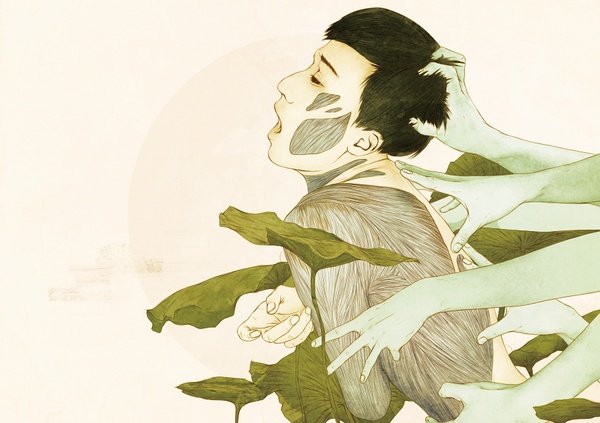
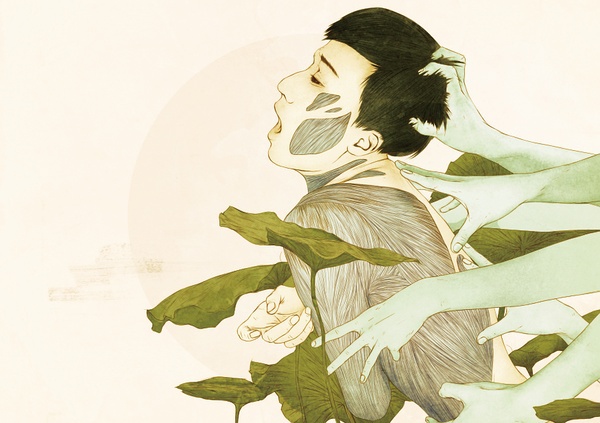
From the author: “This portrait of muted colours evoked desperation and frustration. The arms reaching out to grab hold of the figure whose muscles are exposed inspired a piece that targets vulnerability. The story tries to raise questions about exposure to graphic images, and question the idea of whether vulnerable children should be censored from the media. Ultimately, begging the question of whether striking headlines are desensitizing our population and how to cope with horror on the news.”

on depression: “the red door”

joehengst

word by Kate Shaw

colour by Joe Hengst

It has been several days since I’ve left the house. In a significant way, at least – I’ve left to take out the garbage, to buy eggs, to remember that I owned clothes that weren’t pajamas, but it has been several days since I’ve gone anywhere, done anything.

It’s cold. Not northeastern U.S. cold – worse. Wind chill down to thirty below zero. It’s amazing, how cold it can be. Every time I walk outside I re-hear those news broadcasts about Canadian citizens suffering severe skin injuries from five minutes of exposure to extreme cold. Is it cold enough to be dangerous right now? My cheeks feel like they’re turning to putty.

Hour after hour passes by and I pace, I sink into the torn, velvety couch, I heat oil in a skillet but forget what I was planning to make (did I have a plan?). I sit on the ledge by the window and look. See. It doesn’t look so cold out there, I think. There are people out there, walking around, and they’re not collapsed or clutching at their putty cheeks. They’re living despite all this, despite this unbelievably-wind-chilled air.

And then I pace again. Sometimes I pick up a book, but usually the words just end up dancing out of my consciousness before I can understand them and I just read the same lines over and over, absorbing nothing. As hard as I try to focus on the little letters, they blow away.

v

I haven’t been seeing anyone. My roommate is gone and I tell other people – friends, I guess – that I’m just overwhelmed with school, just trying to catch up on reading, thanks for saving me a seat but I’m actually not coming to campus today, oops!

v

It actually looks lovely outside. If I force my eyes through the grayish haze hanging over the street, I can nearly unearth the image of the bakery with its little orange sign, or the barbershop with its red front door. They were colored once, lovely shades, I know they were. The colors are distorted now. I hope the originals come back.

I’ve decided to start sitting on the floor instead of on the couch. From down here I feel small, and maybe that will make me feel overwhelmed by how big everything is around me, or amazed by how much this new apartment feels like home, or pitiful of what a pathetic spectacle I’m making of myself. Maybe sitting down here will make me feel something.

I lean back against the couch – I think it was green once, but the colors in here are distorted too. I don’t know how long I’ve been sitting, and now that it’s dark outside it could be 5:30 or 9 or 2 in the morning. Now, even if the colors hadn’t disappeared, I wouldn’t be able to see them anyway.


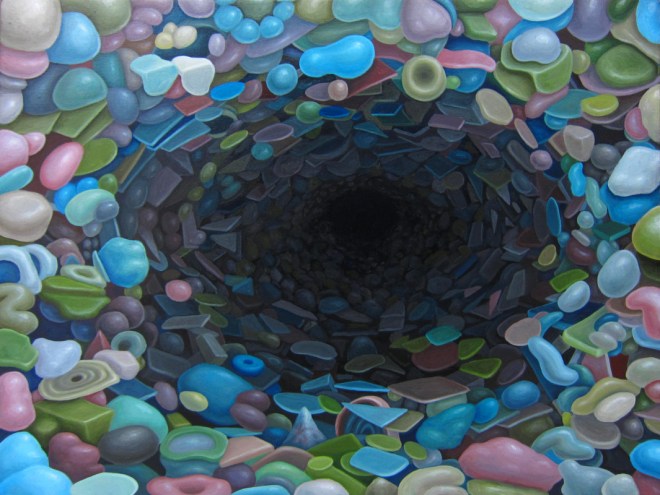
from the author: “The shades present in the visual art piece have an eerie tint to me, which is underscored by the dark tunnel in the center that disappears into nothingness. It made me think of the distorted way one sees the world through the lens of depression and other mental illnesses, so this piece deals with that distortion and the inability to pull oneself out of that dark space that burrows its way to the center of everything against your will.”

on substance abuse: “after the nightmare”

rive t 2

word by Leah Mol

colour by Stephanie Rivet 

I used to have nightmares. The kind of nightmares you never really wake up from. The kind where you think you’re finally awake and then everything starts to melt. I started seeing a psychiatrist who asked me about work and relationships and my parents. I work a lot, I don’t have relationships, and my parents are divorced, which is just more work. The psychiatrist told me Relax, take a bath, have a glass of wine. I tried baths, but my nightmares were flooded. I spent my nights trudging through basements filled with water, swimming towards nothing at all, and I woke up soaked. The wine worked, so I don’t see the psychiatrist anymore.

The first night I drank, I finished two glasses and then passed out on the couch. I woke up with a headache and the vague feeling that I’d dreamed something terrible. But I couldn’t remember what terrible thing it was. The next night, I managed three glasses.

Now when I get home from work, I pull a bottle of wine from my purse and drink a glass while standing at the kitchen counter. The tile floor is cold on my bare feet, even in the summer. I refill the glass, leave my clothes in a pile, and shower until I’m done the second glass, which is when I stop thinking so much.

I grab the bottle of wine and place it beside my bed with my glass. I put on yoga pants and a sweatshirt many sizes too big, forgotten by someone I think I almost had a relationship with. I open Netflix and I watch a documentary about Mount Everest or a comedy about women who don’t know what they want.

I think about dinner but I’m not hungry for food.

I fall asleep quickly and I don’t dream about anything at all. When I wake up in the morning, I’ll know I’m awake and alive and I won’t be thinking about all the ways everything is horrible. I’ll think about drinking instead.


From the author: “This piece reminded me of these old drinking and driving commercials, where everything gets blurry as more and more glasses are placed in front of the driver. I think that’s such a perfect metaphor for addiction. Even as everything gets blurry— and often because everything is getting blurry—you keep going. And then finally, inevitably, you crash, but that can take forever.”

See more colour by Rivet

On breakups: “Almost”

rivet 1
word by Hannah Chubb
colour by Stephanie Rivet 
 
I don’t care what anyone says, it’s the almosts that hurt the most.
breakups 
It kills me to watch this go down the drain.
 breakups 
You must have dipped your tongue in ink before you said those three words because I can’t find anything strong enough to erase those eight letters. My mind is black and blue with thoughts of you and my sclerae scream red because I can’t categorize these feelings I have for something I may have just created in my head.
 breakups 
You were almost there.
 breakups 
I have no label for you and it hurts because I need to know that I’m not delirious and that my feet were on the ground. I swear to god I remember yours being there next to mine because your shoes were too-white and the left one was always undone and I just wanted to tie it back together for you but I didn’t know how to say it.
 breakups 
I almost told you.
 breakups 
I swallowed a different brand of turquoise pill than you did and I never knew why but maybe that was the problem. Mine came on a shelf and killed the pain while yours was handled by grimy hands crusty with tangerine-tinted drugstore lipstick and made you feel anything at all. You always swallowed more than you should have but I let you because I didn’t even know that version of you and maybe you never wanted to know me anyways. I guess I’ll never know if you wanted me to stop you.
 breakups 
You almost felt like reality was enough.
 breakups 
We never held hands but we spoke in colours and sometimes you walked me home at night. Your mother never knew my name but your roommates sure did because your yellow walls were thin and your voice is loud when you drink enough to drown the monsters in your skull. I swear I could have slayed them but our time ran out too soon.
 breakups 
You almost asked me to stay.
 breakups 
I almost did.
 breakups 
Your mother should have named you Almost because I think that’s all you’ll ever be. I can’t stand you and your stupid razorblade tongue of promises slicing down my already raw throat. I think I belong up North because my head is a messy Aurora Borealis of the colours you used to turn my skin before you left and everything around me turned to black. I tried to be your fuchsia sky but you never told me you were colourblind.
 breakups 
I am a catastrophe of colour aching for the comfort of canvas, but darling, almost is just never enough.


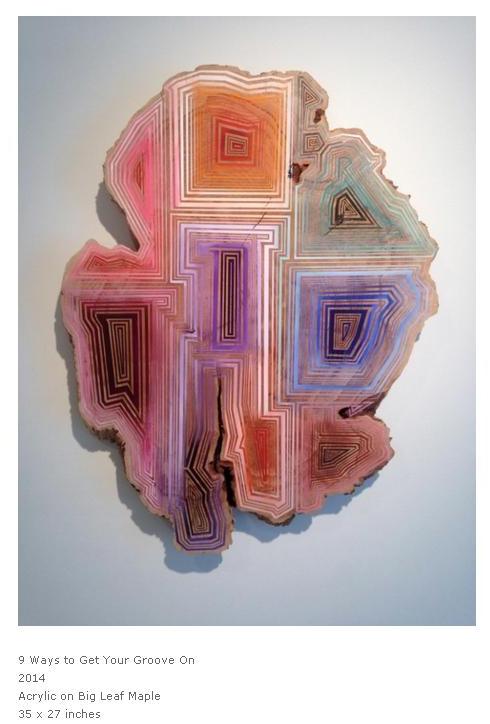
9 Ways To Get Your Groove On

middlebrook 2

word by Charlotte Kidd

colour by Jason Middlebrook

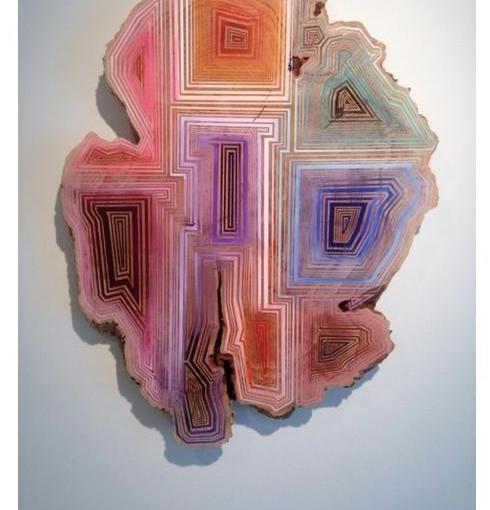
1. Meet a guy who builds things. It’s refreshing because he can get out of his head. Now, you can be in Sex and the City (rather than a looped Woody Allen movie, as has recently been the case).

2. Realize that refreshing is a reductive way to describe a person. On the second date, he takes you dancing. As if he existed in opposition to all previous men. As if he was made to fill a gap in your life, like water. Realize this when he is just as funny and charming and soft with you on the second date as the first. Realize that the way he handles the world is gentle, and kind, and generous.

3. Spend a day in bed with him. Listen to all the sad songs. Be cushioned by happiness, sensitive to the songs but never touched by them. Wonder why you’ve never listened to sad music when you felt light.

4. Ask him to build something. Not just dinner (he’s done that already) but one of the things he really makes. Something to hold.

5. Write him a song of gratitude for the thing he made; a perfect painting on an imperfect round of wood. And for the story he tells you, about recovery.

“Idle hands are the devil’s tools,” he says, in all seriousness. Where you would have once scoffed, you instead take his un-idle hands into your own.

6. Dance to your new story, dance to the details, get down to the grit. Marvel at how much you can enjoy something so pedestrian as a slow dance; you didn’t ever think you could love someone you weren’t competing with. Dance to nothing really being extraordinary and nothing being truly ordinary.

7. Keep grooving. Find that it’s easy to bring him flowers if he’s had a bad day. Make him laugh. Plan special things for his birthdays. Not so easy to wash his beard out of the sink, un-dog-ear the pages after he’s read your books. Hard to convince him, after another sale goes south and another one of his pieces ends up in a half-born graveyard, that he does not need to go out and find something to make it easier.

8. Dig out the thing he made. Blare music, emotions of the song intruding your feelings so that there isn’t enough space for them. You are not sure how big they could get if you let them expand. Wonder when he’s coming home. Wonder if he’s coming home. Say he is.

9. Dance to the sound of a door closing. Get down to his footsteps. Feel the rhythm of him coming back to your arms. Dance for the boy who makes things. Groove to the people whose lives are complicated but who touch the soft and fleshy walls of the world with the least pressure possible. Get down to him, in bliss and imperfection. 

When the lights go out

middlebrook

word by Josh Elyea

colour by Jason Middlebrook

What do you do when the lights have gone out? 

You take a walk. Not outside, where the autumn has turned leaves red and a familiar chill has crept into the Montreal wind, but rather inside: you take a walk through the desolate hallways of the mind. It’s best to ignore the part of your consciousness that tells you this is just your mind imagining itself – you can’t know what the inside of your head looks like – and continue to press deeper into the increasingly detailed world of your brain.

The further you walk, the more you notice the darkness; it’s not apparent at first, but before long you can’t help but see that in all these rooms, in all these wrinkles and rooms and chambers and palaces and dungeons that are dedicated to the things you cherish, the lights are out.

After wandering the halls for a while, you begin to wonder whether your brain works the way it used to; you find yourself pondering whether  these rooms can still light up in the way they did when you were young, when things were simple and you didn’t feel so used and so jaded.

You might make an effort to stop in each of these rooms and flick the small switch that hangs precariously on the darkly-papered walls; you might find yourself taking note of which lights shine bright and which bulbs now seem dim, and what this says about how you value the things stored in each room.

You’ll wonder what all this has to do with your addiction to entertainment, and whether there’s irony to be found in the fact that the room dedicated to Friends shines brighter than the room dedicated to your friends. This might be coincidental, but you can’t really know because you’ve never taken the time to understand irony.

You’ll begin to wonder where all the colours of your mind went, and what it says about you as a person that you don’t even have the requisite neuroelectricity to power the bulbs in the rooms you deem essential, those dedicated to creativity and personal fitness and Bob fucking Dylan.

You’ll ignore the advice of the people closest to you,  who tell you to pull yourself up by your bootstraps and focus on getting ahead by doing what you can. You’ll try and tell them it isn’t as simple as flicking a switch; by this point, you despise the colours of your mind, and you’re used to life without the lights on.

It’ll start small. You’ll find a room, somewhere deep in the right hemisphere of your brain, where a bright yellow light burns from behind a tightly locked door. Inside will be a book or a movie or a song, maybe even a person  or a pill that’ll walk with you, to remind you that there’s still vivid colour to be found, if you only take the time to turn on the lights.*


See more art by Jason Middlebrook