Tag: art
Blowing Smoke
word by Grant McLaughlin
colour by Michael Ward
Every time I see that sign, I can’t help but wonder what was the conversation behind that choice.
Could they honestly not come up with something better? In all their brainstorming sessions, was that really the best in show? No one involved thought for even a moment that maybe they should go with something more eye-catching?
‘Cause I’m not gonna lie. I can rattle of all kinds of better ideas. It feels like every time I’m there I come away having thought of yet another superior choice.
Is there honestly someone out there who grew up dreaming of the day they would be the proud proprietor of this: a tiny island of a shop amidst an ocean of parking lot swept up on the side of the latest superhighway. A forgettable piece of detritus that they could finally call their own.
Wouldn’t want to ruin that with a memorable moniker.
The lack of creativity is extremely galling. We already know that all we’ll find inside are shoddy sunglasses, miniature American flags, and a shit ton of cheapo cigarettes. That Family Feud list of things that no one needs.
The least they could do is dress it up with a better sign out front. A façade on the façade, if you will.
Are they describing the activity? What you’ll be buying? Just in case their patrons are so slack-jawed as to need the extra hint.
It could be a command. An imperative order to any who find themselves wondering what they should be doing with their lives.
Or maybe it’s simply old school arrogance. A belief that through their very existence they will be patronized.
“In my mind, it’s always been a concession. They know the tides of history have come out against them, the studies are damning, the fix is in.”
It’s a white flag. A desperate plea.
We don’t have a good reason to convince you, but we’re hoping you’ll do it anyways.
A discount name to match our discount product for you discount people and your discount dreams.
As rallying cries go, it isn’t terribly inspiring.
But I keep coming back, so I guess it doesn’t have to be.
“Everything Will Be Great”
word by Kate Shaw
colour by Micheal Ward
spinnign no, spinning how long have i been here thirty minutes? an hour? i think it’s been hours
Stop counting the seconds and try – just TRY – to act like a normal human being and enjoy yourself.
it’s so loud here and i think i’m going to fall over why am i lauhging
That happens. Things are funnier when you’re drunk. Just calm down; most people take laughter as a good sign.
i want to leave
You’ll regret it as soon as you get to your room.
but i’m not having fun i want to go tobed
It’s not even 1. Hayden won’t be home yet, and then how will you feel?
i don’t um, it doesnt matter
You’ll feel like an idiot for leaving early and being home hours before your roommate. It does matter.
Why didn’t you talk to her? She was being friendly.
i don’t…i can’t! i can’t think and it is – is so loud
You don’t have to think, just talk to someone. Standing mute by the wall is a shitty way for you to start the best four years of your life.
i can’t do this alone
So find someone to talk to!
no no i can’t be here alone, at this school
Well you are. And everyone else is dealing with it without any problems.
i know
Have another beer.
i dont want another i want to go
You’re being ridiculous.
[At this point you push off the wall you’ve been clinging to for what has only been, in actuality, about forty minutes. Your senses are shocked by the rush of gravity that pulls you side to side, lower and lower; your body has become a pendulum and you have no control. Someone helps you stand and you just laugh. Once you’ve collected your swinging limbs and whatever scrap of composure you can find, you start a determined march out the door and down the stairs (you only trip once).]
[Getting across campus to your dorm takes five minutes or maybe thirty, and there are silly slobbering messes of students strewn across the paths like litter. You laugh at them too, although you don’t know why.]
[Climbing the stairs to your floor appears to be a seemingly insurmountable task, yet somehow you find yourself curled up (giggling) on your bed so you must have accomplished it somehow. It’s this moment when you finally stop laughing. In the dark, Hayden’s empty bed comes fuzzily into focus.]
i dont know how todo this
I don’t know how to do this.
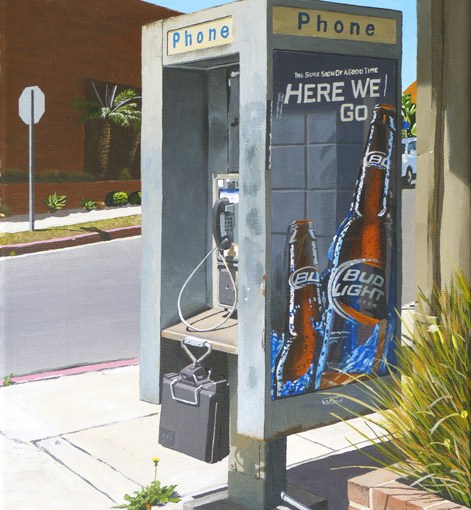
From the author: “There are two kinds of social messages I wanted to address with this piece: The belief that alcohol necessarily leads to “a good time,” as depicted by the artist, and the fallacy that everyone at university is adjusting to their new lifestyle immediately (and better than you). For me, the Bud Light ad on a random street corner spoke to the omnipresence of the belief that life is more fun when you’re drunk. I thought there was a dissonance to be captured here: the true experience of a first year student at university versus the societal messages he or she has internalized about what the experience should be, which ultimately break down.”
On the painter: “Phyllis Lutjeans, Museum Educator and former curator, has said of Ward’s work: “Although Michael Ward may be called a neo-realist painter his work can ultimately be described as abstract realism. The picture image is photographically realistic, but within the context of the painting his compositions are complex and almost abstract. Deciphering the work section by section one sees how a multitude of individual complete compositions are put together to form the entire work. For me the viewer is confronted by a realistic image that puzzles us and clearly tells the story simultaneously.”
On Travel, Identity: “Try being your own friend”
“Try being your own friend”
word by Annie Rubin
colour by Kosisochukwu Nnebe
“Try being your own friend.”
It was an exhausting job; he shook his head and hung up the phone.
The plane ride had felt long and treacherous, with each dip of the wing he was certain they would nose dive through the sky, be compelled to grab for their yellow life vests stored either directly beneath the seat or above you in the overhead compartment.
He would search frantically for the flight attendants out of the corner of his eye, secure. If they were still passing through the aisles with a variety of drinks and Skymall paraphernalia, he’d have no reason to panic.
The streets were shimmering with a blue-black slickness as he marched with conviction in the direction of the hotel.
The streetlights were flickering in and out of view. There was an unsettling echo of footsteps that he couldn’t swear were his own. Perhaps this was part of the adventure. Perhaps he was en route to be mugged. In either scenario, he found it best to focus his gaze on the road ahead, calculating the distance between fear and safety. Two hundred meters, now one-ninety…
In the lobby, he smoothed the lapel of his suit. It was one action in a whirlwind of unfamiliarity that brought him a moment closer to home. He couldn’t understand the startling sense of discomfort he experienced, surrounded in the idiosyncrasies of this place. The country felt oddly reminiscent of something he’d seen once in a dream, or maybe it was just that things felt so cartoonishly similar to images he’d stared at for months in preparation for the journey.
This recognition was stained by the fact that everything was just vaguely different than what he was used to. The water faucets, the scent of the stagnant air, the accents, of course a language he had never learned as his own.
Should this culture have been a piece of him, imparted by nature, somehow inherent in his blood? He wandered into a pizza joint out of habit or homesickness.
This was not his home. This did not remind him of the meals cooked by his grandmother; this was nothing reminiscent of his college chants or practiced habits or the inside jokes, memories collected into phrases and images that composed his true identity.
Maybe he was searching for something profound; maybe he wanted inspiration—confirmation that he had a home, a country, a culture that reflected his unique self. Instead, he was left in a state of flux: what was truly his? The room had fresh floral wallpaper and he felt nostalgic for a place that had until now, never truly understood him.
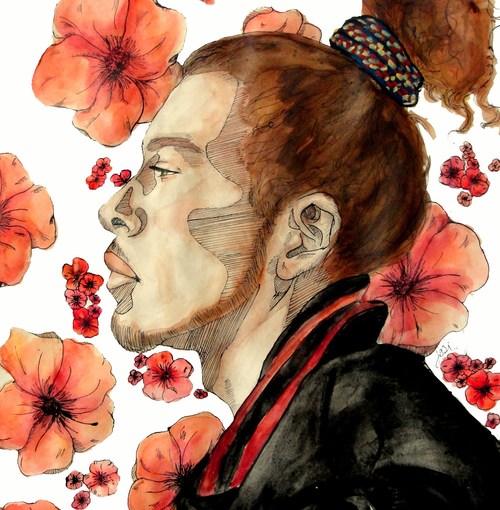
From the author: “I was inspired by the juxtaposition of the poised human look and the fragility of nature reflected in the vibrancy of the flowers. This led me to question identity, especially how to maintain a sense of self against a backdrop of an ever-fluid environment. The concept of identity raises questions about the significance of cultural background, and exposure, where the protagonist explores his familial history by visiting the country where his family comes from, realizing that he has little to no connection with a place he has never been, himself.”
Waterlogged Love
Waterlogged Love
word by Keah Hansen
colour by Tomasz Kartasinksi
16 minutes left of class. The seconds drift onto the floor, clustering like fallen leaves or crumpled love notes around her converse shoes. Laughter seeps sideways from her mouth – I inhale her sounds. Filling the blank spaces on the corners of my notebook with cryptic doodles. Inside jokes nestled on the pages, shading in the loopy curves with tenderness. She slips me a mint, like any other day, under the roaming eyes of the teacher and spinning discussion, which floats to the florescent lights in a hazy, vapid way. I follow the din upwards, over her curly hair and alight on the fire alarm, with vague notions of apprehension and pensive yearning.
Today, the mint is imbued with significations, defining our comfy closeness on her worn yellow couch and clandestine ice cream escapades (alternating spoons of chocolate ripple and gossip) with flaming gravity. We snicker together over something trivial, then with giddiness I alone levitate equidistant to her forehead. The bell sounds and the class streams out. We tumble to the water fountain together and pause. She splashes over me with her usual locutions while I take a long sip of water.
The water is icy and clarifies my thoughts. 6 months of uncertainty. 6 weeks of contemplation. I’m bobbing here, staring at the grandeur of the stars from this makeshift raft. Her crocked elbow is my mooring. The water ebbs unceasingly. I feel seasick (or is it butterflies?). She’s never had a boyfriend. We’ve held hands in the hallways. Oh to hell with it, I dive in.
My statement, a small confession of love, comes to her in small timid waves. We are the last ones in the building. I’m fixated on those worn converses again; her feet dance nervously while I’m a shipwrecked mess, letting the waves pass through my lips. The rocks hold me steadfast on the hopes for our relationship; they are sharp and make my voice waver more than I’d like.
Her features are catatonic. She contorts her face into a sympathetic smile. I surface into the glaring sunlight. Her face is burnt; she doesn’t understand my watery, viscous existence. These mermaid musings mean nothing to her. My ears are clogged. I feel the palpable pressure of her discomfort; my skin is cracking as impressions of my declaration sink into her body.
Another bell sounds. I slink back into the water, my element. Half coherent and murky, I don’t need to define myself or reveal my pinings to anyone. I’ll cry tonight, alone, but gather my tears as jewels. Later, I’ll string them together and wear them on my neck, something beautiful and brave.
For now, I drift away. A current pulls her brisk minty existence away from my waterlogged love.
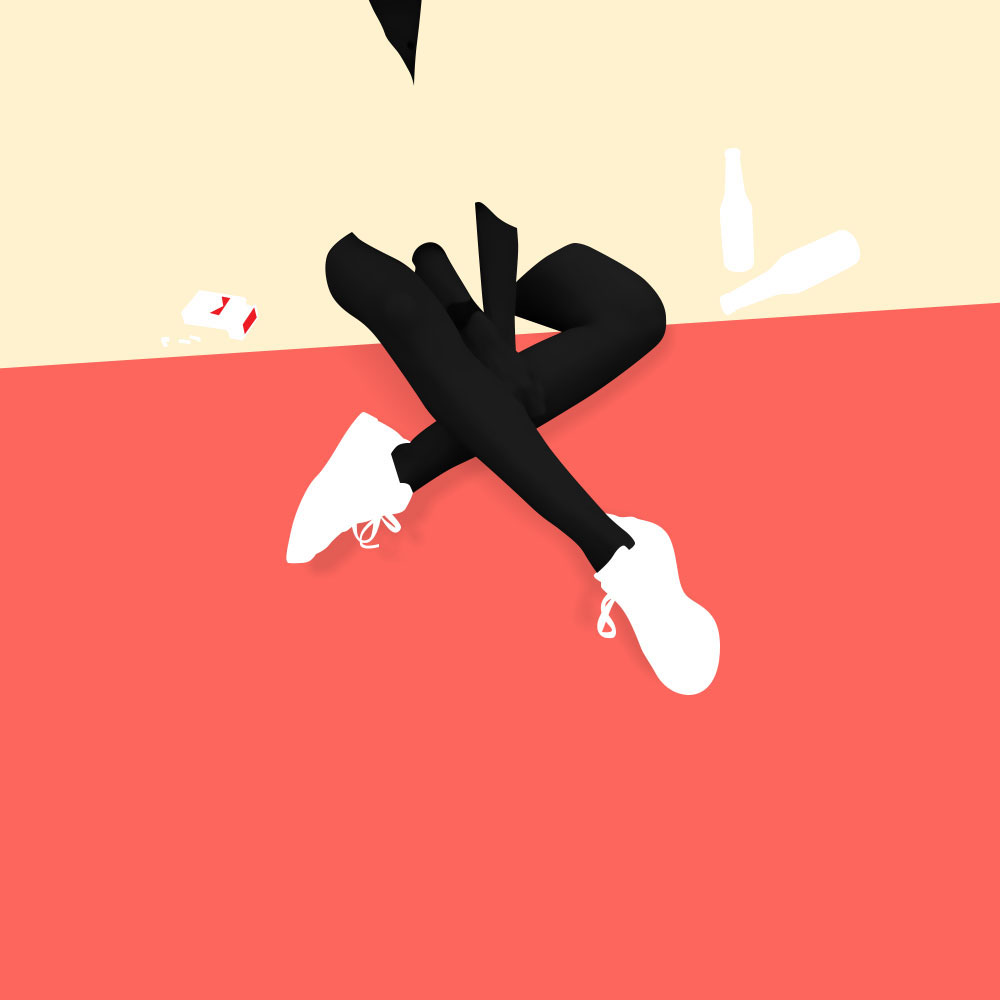
From the author: “I was inspired by this artwork to write a story about an experience of revealing your romantic affection to a friend of the same gender. The blue material at the bottom of the piece expressed to me both bed sheets and water. I interpreted the water as a symbol of renewal and rebirth, which I related to coming out with your sexual orientation.
The positioning of the legs also gave me the impression of figuratively “diving in” to a relationship or a new experience. The opaqueness of the blue inspired me to think of the colour as a form of protection, which I developed later in the story. Furthermore, the vertical tiered nature of the piece affected the progression of my story, while the Facebook friendship sign symbolized the ambiguities of relationships, especially during adolescence as we have a tendency to question our sexuality.”
On Heteronormativity, High School: “Easy”
word by Alisha Mascarenhas
colour by Tomasz Kartasinski
The bend in her legs is relaxed; easy.
She folds one beneath the other, waiting for the night to set in.
The loop in each clean, white hightop precise and dangling with that quiet anticipation that comes after sucking back the frenetic bubbling of the first beer. Giddy elation that rises to the sternum.
From where I stand in that hot pit of a parking lot all I can read on her body I feel in my hands: blunt fingers softening into the pinch of polyester jacket pockets.
All my life taught how to be seen by men, I don’t know what it is to look at a girl. I never gave myself permission. I want to know how to look without inhaling her; to let my gaze settle on her whole being; the space she inhabits and the retreat of a sleeve that licks her inner forearm.
She won’t look at me. At home with the other queers I’ve found ease in a different norm. Ambiguous friendships warmed by late night snuggles on that long, blue couch in my apartment, kisses on the mouth and other quiet affections. Sometimes sex.
But to her, I’ve decided, I’m someone to compare haircuts and outfit choices with. She might squeeze my hand later, or borrow my jacket as we walk home. We might share a cigarette and she won’t give a second thought to what’s passed between us. To her, I’ve decided, I’m another girl and she won’t ever look at our intimacies as anything other than sweet, dry and easy.
If she calls, it will be easy. The gesture only half thought through as she decides what to do with her Sunday afternoon. Not the tense thrill of an inhale that catches at the throat. Not the fleeting imagination of all the ways our bodies might move against one another. I’m a girl. We are girls. She’ll talk about boys. Girl talk. Girl love: not a boy-girl kind of a thing.
She won’t need to think about what to wear or how she smells. She might take a shower just to clear her head of the day; show up at my front door with her hair disheveled to eat ice cream at the kitchen table as I shrink into the wall across from her, afraid that if I get too close I might feel her breathing.
When we part, she’ll give me a little squeeze. Like a friend. Like girls do.
From the author: “I wrote this as a commentary on how systemic narratives of heteronormativity seep into the ways girls are taught to relate to one another and to their desiring selves. It is a response to how friendships between girls are mediated by romantic relationships with boys: constricting the kinds of intimacies that are permissible. I chose to use the words “girls” and “boys” to speak to a process of revisiting an adolescent self: a critical time during which heteronormative scripts can be particularly forceful.”
On Love: “Teach Me to Speak”
My apartment has the music of love in it. There is a row on my left and soupy breathing on my right. I hear “fuck you” and I hear “fuck me.” In love, someone is always getting fucked. The rain outside patters the windows like a bowl of milk being filled with Rice Krispies and these slow and then moderate and then fast percussive bangs mimic the action unfolding here and there. Snap crackle pop snap crackle pop snap crackle pop.
Behind the closed door to my right it sounds like my roommate and his girlfriend are hiccupping in harmony and it dawns on me there, wrapped in nothing but a towel, that this marked speechlessness seems more conversational and comprehensive and wholesome than the stuff going on to my left; but both still sound like love. These are but two of love’s many iterations.
When I was younger, I would tip toe from my room to the stairwell that led to the kitchen to sit there and listen to my parents disagree loudly, hurtfully. And I’d fear that the two people no longer loved each other. I might enter the kitchen, crying, and ask if everything was all right, if they weren’t going to get a divorce. It was in my kitchen that I learned that two people in love are allowed to fight. Love necessarily yields war but war does not necessarily yield love. And so back in my apartment, I feel like I’m seated again at the top of my staircase, all teary-eyed, only now I see that love can not only be scary, but that it is a choice.
Each of my roommates feels something in his heart if it is possible to feel there at all. Right now I feel something there too. Right now the Yankees are playing the Blue Jays and Lord knows a W for the Yanks here is huge. Right now I have an unwritten story that my publisher needs by Wednesday. Right now my English professor wants 500 words from me on the tension that Hemingway generates between language and experience. I like that writing prompt. It is worded beautifully. My publisher also wants 500 words from me. Twitter wants 40 characters. That last sentence was 36. Forty characters, 500 words: who cares? It’s as if I’m talking to you through a damn keyhole. Right now I have all this inside me but to you it’s only words and words and words. Right now I wish my heart could talk because it has so much it would say to you.
Love and conversation, though, aren’t characterized by words; it is me and it is you, bundled up for minus 50 degree cold, undressing one another without letting either of us freeze. My roommate engaged in the stuff at the end of the hall, you see, though, is freezing. He moved too fast. He inhabited himself without inhabiting his girlfriend. So that makes true love going up to someone and saying, “Let me thaw you out.”
Can I?
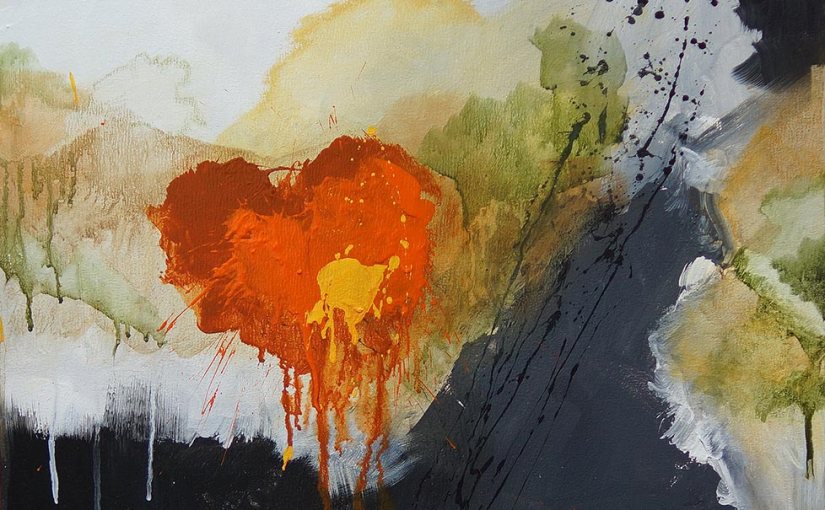
word by Jacob Goldberg: “The image has a heart in it. This all happened in my house the other night, and I thought it was fitting to write about love.”
colour by Sylvie Adams
“A native New-Brunswicker, Sylvie Adams has lived mostly in Montreal since the 1980s. She has travelled intensively throughout her life, residing for brief periods in Germany, England and France.
She obtained a Bachelor’s Degree in Fine Arts from Concordia University and a Master’s Degree in Applied Sciences (Architecture) from Université de Montréal. She worked in the design field for close to fifteen years in Canada, the United States and Europe. Her love of visual arts brought her back to painting and she now has her own studio in Montreal, where she paints.
Her work has been featured in solo exhibitions. She has also participated in numerous group exhibitions, nationally and internationally, in Quebec, Ontario and at the Affordable Art Fair in Seoul, South Korea (2015).
Her work can also be found in private and corporate collections, including the Permanent Art Collection of Rio Tinto Alcan.”
How To Dress Like An Activist
It was the yellowness of the room. Lead-paint-coated plaster. The way the sunlight streaked through the one window and splayed shadows on the yellow wall—flashing beige and grey.
He sat by her side, smoothing her hair and humming a song she recognized but couldn’t name. He had created her. He had brought her into the world and had shown her right from wrong. As far as she knew, his word was law, and she followed his advice as such.
The rulebook was constructed through mere preferential suggestion. He had always told her that women look better in heels, that “sensible” shoes were actually just self-indulgent. He told her that short dresses were sexy, that long hair was feminine and that women’s legs, when standing with feet parallel and together, should curve into three separate gaps: one at the ankle, one at the calf, and one at the thigh.
Of course, to her, it became implicit that all men would examine her as a specimen, analyzing her aesthetic relentlessly, adjudicating her body’s rights-from-wrongs. This overwhelming notion made her particularly conscious of any clear defiance of the rules.
When she left home for the first time, she discovered that hers wasn’t the only rulebook. There, in the depths of “Outer Comfort Zone” dwelled a population whose inhabitants challenged every norm she had grown to embrace.
She met The Photographer, whose unshaven legs protruded from scuffed Doc Martens, whose ripped jean shorts extended well past mid-thigh, whose hair was chopped short and who bore a spidery tattoo that trailed from her shoulder down to her wrist, circling her olive skin in place of jewelry. The offense struck severely. The Photographer did not have complete disregard for Law—she would often wear bright lipstick lips and dangling earrings, the kind that pulled at her earlobes, weighing heavily as she walked—it was that she chose her battles, maintain that this was what made her feel free.
It was a simple defiance, the regaining of autonomy over her body. Her legs, which in a month grew a shaded a chestnut brown with hair, itched when they rubbed together—but at least she was fighting the patriarchy? She felt less at home in her body, which, she convinced herself, was a stage closer to “figuring it out.”
One evening, sitting across from him at a booth, yellow-brown menus folded in their laps, she tried to find herself in the pale green. A woman approached. She was all bright-reds as he eyed the way her calves arced gracefully into suede stilettos, tight red dress wrapped around long torso. Maybe this was the kind of woman who without fail could obey The Law, who never thought to question whether they’d suited her, looking so thoroughly comfortable. She sneered, angrily—can’t you see that you’re putting our gender to shame?
She thought of the stinging red blisters, oppressive yellow rays of sun, and the blatant confidence that radiated from the woman’s blue-green eyes. She felt the warmth of his gaze, the hollowness of his affection, and the eternity that appeared within those who looked at her and see more than a “pretty woman.”
But what if she had simply appropriated The Photographer’s stark defiance of the mainstream—was it truly her own autonomous self-expression? In fact, she wondered, pressing down into the heels of her beaten Converse, whether she had become the same kind of analyst towards others that she’d despised, herself?
Yes, she was fighting objectification, but in doing so, had the movement taken on on a rulebook of its own?
It occurred to her, gazing at the woman, bathed in orange sunlight, what if this dress is just a dress? And what if, she thought, I prefer my legs to be bare?
***
words by Annie Rubin: “I was inspired by the merging of colours, the unsettling streaks, the abstract quality of, muted tones, and by the soft brushstrokes. This piece targets the objectification of femme beauty standards. As the protagonist is exposed to a counter-culture movement, she explores the dilemma of how or whether actively adhering to gender norms can be decisive and empowered. The stark difference between yellow and green represented the struggle against over-sexualization through counter-culture self-expression. I hoped to expose a systemic entitlement to harsh judgment, and to beg the question of how such assumptions work to keep the system alive.”
colour by Alexis Rourke
On unrequited love: “Turning Around Her”
“She was beautiful and so uninterested in me and all the things I thought I had to offer. I didn’t exist in her world.”
colour by Hey Studio
“Hey is a graphic design studio based in Barcelona, Spain.
We specialise in brand identity, editorial design and illustration.
We love geometry, color and direct typography.
This is the essence of who we are.
We take care of every single step of the design process and we always work closely with our clients, big or small, in one-to-one relationships.
We also undertake side projects. These activities aim to play with new ideas, push our creative boundaries and develop a passion that is then injected into client’s work.
In 2014, we opened an online shop, a place to share our passion for typography, illustration and bold graphics.
Hey was founded in 2007 with the idea of transforming ideas into communicative graphics.
Here is a selected list of projects crafted for our clients.
We would love to hear from you. Say hi here.”
Hollywood, Heartbreak & Horsepower
Alone in the mountains, a van sits idly as the sun rises. From the west comes a slight breeze, and were there any grass it would’ve rustled in the wind. As it is, there’s only the subtle sounds of the shifting sands to act as a soundtrack for this lonely scene.
Inside the van, a young man wakes up. He uses a worn French press to make a cup of coffee and then steps outside briefly to survey the landscape. Back indoors, he sits down at the folding kitchen table (it doubles as a bed and sleeps three, in a pinch) and inserts a tape into the video camera perched precariously on a makeshift tripod of books, tupperware and vinyl records. He holds up a sign that reads Day 155, P.B. (Post Bridgette) and begins to speak directly into the camera.
Fuck Hollywood, he says. And while we’re at it, fuck Bruce Springsteen too.
He doesn’t mean that last bit, of course. He loves Bruce Springsteen; he’s America’s most treasured songwriter. Speaks for the people, you know? But he was angry and felt betrayed by The Boss, and if you couldn’t trust Bruce Springsteen you couldn’t trust anyone.. All those stories on Born to Run, the ones about the good times with the fast cars and beautiful girls, they’d been a lie. There was no peace to be found on the open road, or perhaps there was no peace to be found in him. Either way, he could see now that you could never walk in the sun, and there was no gorgeous brunette putting the sunset to shame as you stare at her and press down on the gas pedal, just a little harder. 2,567 miles from New York to Nevada, and he didn’t feel any better than when he had left. He blamed Hollywood for the heartbreak, and Springsteen too; decades of bizarre and damaging genre clichés, of sitcom reruns and pop song replays had codified romance as nothing more than a means to an end, a search for a simulated intimacy that taught people all the wrongs ways to find each other, to be together. People hate on Hallmark, but their cards are just the falsities of romance given physical form; it’s the movie studios who are to blame, and the music makers too, for the idea of romance, for that poisonous ideology which has become inescapable in our day to day lives. And he finally understood romance, or at least he thought he did. Standing alone in the desert, he knew what it meant to have been in love.*
word by Josh Elyea
“I’ve always been particularly susceptible to the allure of the open road, due in no small part to early exposure to Kerouac and a strong affinity for the Springsteen works mentioned in this piece. While I think these narratives are important for the ways in which they offer an escape from the mundane, it’s also important to look at the inconsistencies in these narratives; for example, while guys like Springsteen and Kerouac were the strongest proponents of the restorative powers of the open road, they rarely deal with what happens when you reach the end of your road. What happens after you drive off into the sunset? That’s what I wanted to look at with this piece.”
colour by Hey Studio
“Hey is a graphic design studio based in Barcelona, Spain.
We specialise in brand identity, editorial design and illustration.
We love geometry, color and direct typography.
This is the essence of who we are.
We take care of every single step of the design process and we always work closely with our clients, big or small, in one-to-one relationships.
We also undertake side projects. These activities aim to play with new ideas, push our creative boundaries and develop a passion that is then injected into client’s work.
In 2014, we opened an online shop, a place to share our passion for typography, illustration and bold graphics.
Hey was founded in 2007 with the idea of transforming ideas into communicative graphics.
Here is a selected list of projects crafted for our clients.
We would love to hear from you. Say hi here.”


You must be logged in to post a comment.