“Unplugged” – Josh Elyea

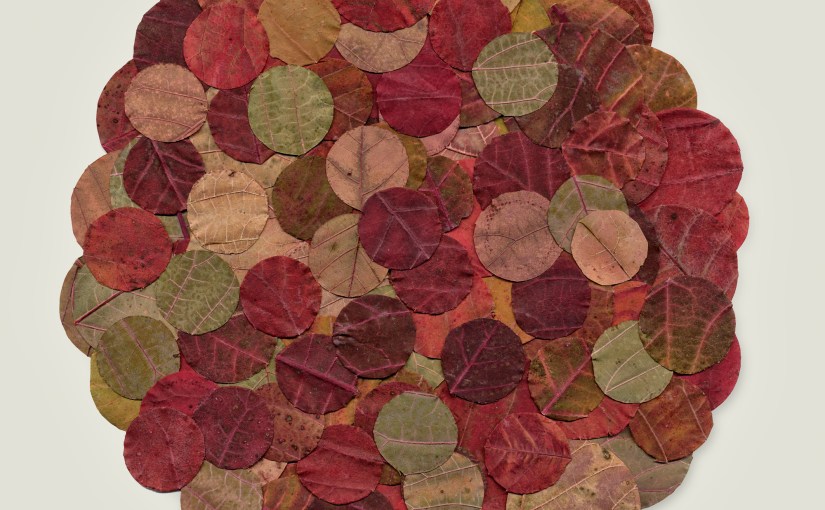
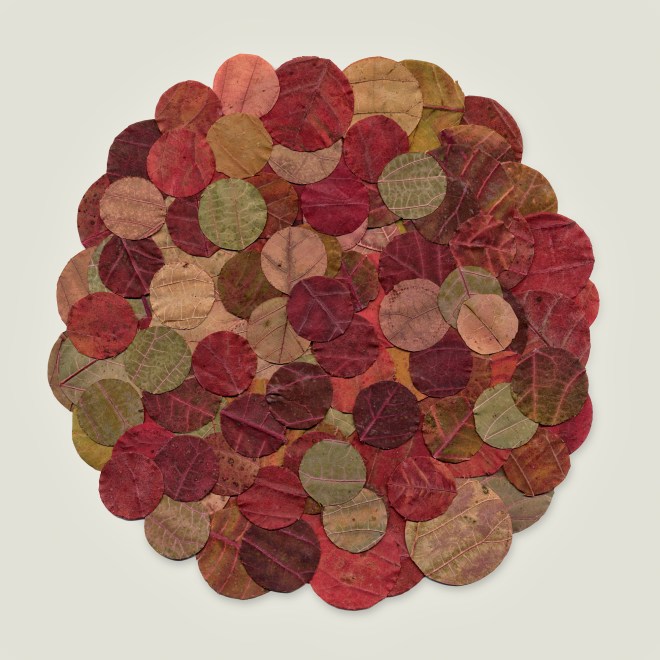
Smoke circle

When I was a child, my father would rake leaves in the front yard and when the pile was big enough, he’d pick me up and throw me (almost callously) into them. My father was wild in his younger days; he rode a motorcycle and played bass in an underground funk band. He settled down though, when he married my mother. He had a daughter, and found work as a cashier in a record store of dubious structural integrity but impeccable cultural acumen.

He killed himself when he was sixty-one.

***

There’s something slyly atavistic about the way the leaves, dried out now since they’ve fallen, feel against my hands as I rustle them gently. From behind the mountain, a small line of smoke stretches thin across the setting sun. Smoke signals at sunset, he says.

We’re quiet after that, for a long time. Uma Thurman had it right; you know you’ve found someone really special when you can just shut the fuck up and sit comfortably in silence, if only for a minute. Silence is a rare thing, and people don’t bother to make time for it anymore. How could they? There’s too many distractions, too many addictions. Screens everywhere, and sitcoms and internet dating websites, reality TV shows and political debate shows and the horrid, overwhelming cascade of contemporary pop music. There’s education and employment, no alternatives, and you’re left to choose between an outdated, meritocratic institution or the dreaded 9-5, an existence that’s so alarmingly mundane it’s turned an entire generation into alcoholics, assholes who waste their weekends on outrageously priced booze and horrific hangovers so as to forget that they owe their time, their lives, to companies who speak only in terms of profit. There’s internet pornography, advertisements and an endless supply of empty entertainment, assailing our senses and undermining our character, our concentration and our connections.

It’s all a joke, a joke with a vicious punch line that relies on the inherent irony of a situation whereby the most connected civilization in the history of humanity is destined to die alone, each and every one of us connected to the internet and nothing else. Where in this hilarious chaos can one be expected to sit and think on the endless potential of the universe, or even the endless potential of the self? I look again to the man beside me, and I tell him I’m afraid that not even the autumn leaves can save me from my vices, from my addictions both good and evil.

Don’t worry, he says. We’ll take refuge in the wilderness.

Don’t worry, he says. Once you’re unplugged, everything will be alright.

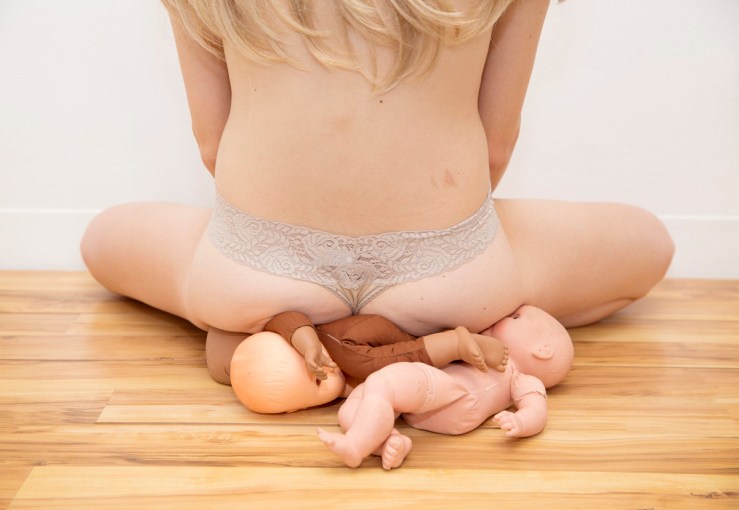
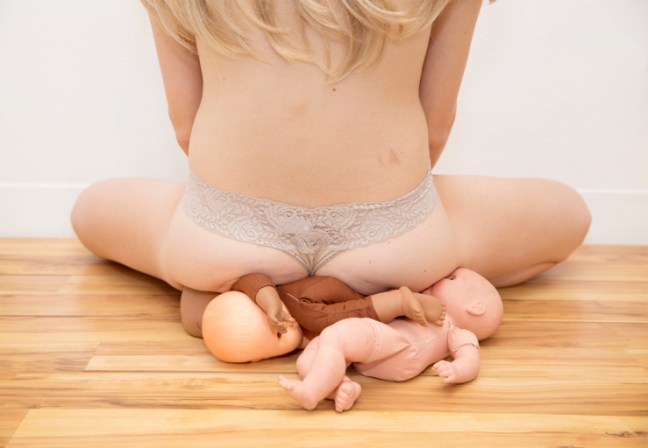
these words by Josh Elyea were inspired by the work of Daphne Boyer

“Basic Aid for Minor Scrapes,” by Finn Purcell

le_potager

CW: trauma, child abuse

The end of March smells like fresh wounds.
I wake up with wasps in my lungs, thorns at my feet,
the heat bleaches through my window
and I am back there but I am not back there.

It will take ten minutes of stillness
before the threat of the sting ceases,
before I can ease the air to my lungs.

In that nervous quiet,
I remember
I forget

I was born a week too soon, the only on-time I’ve ever been.
You are rushing down the hall to get this shoe and that card —
“Come on, can’t you help me here?!”
My small fingers stretch over the table, clamp around your purse strap, and I pull
until the sack lurches and thuds and spills.

You are in the doorway, noiseless and on fire,
I am on the floor, tangled in handles.

“Are you fucking kidding me? What the fuck are you doing?
Look at this fucking mess! I can always count on you!”

In my uncle’s car, he is laughing. “What took you so long?”
“Well, you know this one,” you say, waving at me.

I was fresh skin and tripping rocks,
wholly infant, tender and wild,
what did I know? what did I know?

A shower is just a shower until a shower is
a white noise sanctuary
to drown you out, to drown me

until you become thunder
banging at a cracking door,
muffling demands, shimmying
a steak knife through the lock mechanism
to get me, to get my attention
again and again

23, I forgot.
24, I remembered.

I am fourteen and I am asking why you hate me.

You are hurt, indignant, asking
“when am I so horrible to you?
when I buy you clothes? when I cook you dinner?
when I let you have friends over?”

I am fourteen and you are right
and it’s only me, ungrateful.
(I am ungrateful still
and maybe I should be better.)

and when we fight, you are saying “let me guess,
you’re going to make me the big bad wolf,
you’re going to twist me into a monster
when you’re the monster!”

so I am being quiet
and I am on the floor
and already my skull is a pulse in a spin cycle,
bleached for nine more years.

A recurring nightmare started at six:
me and several others, shadows creaking,
trapped in a house we couldn’t leave.
A monster slips and slithers the halls
while I hide in low corners.

Sometimes, someone disappeared
and the courtyard statue would bleed.
Sometimes, people would visit the outside
and I would scream from the upstairs window.
They never heard.

School pictures, grade four. I am ten.
You are showing me how to put on concealer
because this is what happens when I won’t stop crying.

I stop crying.

One of my exes stopped coming over the day you threw a plate at her.

“I was aiming for you” you told me,
and “What’s the big deal? It’s just a plate”
so I told her the same.

The ashes I have become
will carry, will scatter,
will soot all they touch.

I’d been moved for months before anything came out,
before “that’s just my mother”
became “oh” and “wait” and —

Now I am mechanisms, symptoms.
Now I am “what else have I forgotten to remember? what else have I? what else?”

Some scars have exact stories,
others appear in the morning, throbbing without explanation.

Do you remember the time
you and Dad removed the training wheels
and I, overexcited, took to the sidewalk,
sped up and down the street from one corner to another?
Hot July sweat tickled, stuck the hair to my neck.
Black leaves willowed against one another in the sun.
The spokes whizzed and my legs churned
until I hit the rock.

The handlebar seized, I flipped,
and you came running.
You cradled me
while I held my scraped palms to bleeding knee.
Soft, warm tears.
You rocked me back and forth, pet my hair, sang to me,
and Dad rummaged for the First Aid.
I wished I could scrape my knee every day.

If I remember you are my sunshine, my only sunshine,
will I forget the skies are grey?

The end of March smells like fresh wounds,
smells like eggs cracking and butter on toast.
In the midst of the spatter, I am shivering.
My hands are not my hands.
I am the nest, the keeper of the wasps, only the container,
the bodily visceral memory
that I can’t remember,
I can’t forget.

I am crying over eggs and I don’t know why.


these words by Finn Purcell were inspired by the work of Daphne Boyer

New Poetry by Francine Cunningham: “Whales can’t save us all—but they try”

blue_bird

The child waits,

drawn with shaky fingers
the thick lines of a blue whale’s eyes come into focus
out of the abyss of the great white ocean
the form is coaxed into being
and with the life ink has given stretches its fins

scratchy and ruthless the strokes of the pen dig into the paper
tearing tiny holes into the surface of the water
but nonetheless,
the whale grins as bubbles tickle its thick heavy body

the sound of thudding boots on carpet makes its thunderous arrival outside the door
and still the child waits
shoulders hunched around ears
eyes trained on the figure
silent in the middle of the page

a splinter of sound against the door
the pen lifts, the child listens
thrashing in the stagnant water
the whale gasps for the breath of true life
follicled mouth
begging for movement

the pen smashes down against the eye
and in desperation, blots more black against it
willing it to see, to see, to see
to witness
and for a moment out of the blackness
there is a hazy figure, blue paint, red carpet, pictures shaking against the wall

but then suddenly the pen digs too deep
crashes through
and the whale sinks
deeper, deeper, deeper
until neither can see
only wait


these words by Francine Cunningham were inspired by the work of Daphne Boyer
New Poetry by Jeff Blackman: “Client-facing”

blow_13x9

Today called myself an idiot a lot.
It’s fine. I’m fine. They and we’re fine.

When wise, I delete my posts
but generally settle for clever. At work

I’m perpetually perfecting an expression
that affirms I had nothing to add. I joke,

“Whaddya mean end-of-fiscal? My
calendar says it’s March thirty-fourth.”

I colour code what’s to be done.
My white noise play list skips.

“Whaddya mean end-of-fiscal? My
calendar says it’s March thirty-sixth.”


these words by Jeff Blackman were inspired by the work of Kelsy Gossett

New Prose: “Broken Eggs,” by Charlotte Joyce Kidd

03eggs

I used to be very sad. Even just a few weeks ago, I couldn’t get out of bed for days at a time and once I didn’t brush my teeth for a month. Yes, I used to be sad, but now I am goooood. I have been okay for three weeks and that’s the longest it’s been in a while.

I’m running a bit late for a thing I’m supposed to go to and I have $12.23 (Canadian) in my bank account, but I’m trying to go easy on myself and think about the big picture. I was hungry when I woke up so I bought myself eggs (because I’m trying to take care of myself, even though I’m late for a thing).

Now I’m biking home and I keep thinking this phrase over and over. I wonder what it’s from. “Girls with kind eyes who talk too fast, girls with kind eyes who…”

Oh. Whoa. Oh. Yep.

Now I’ve fallen over. That makes sense. I wasn’t looking where I was going. My knee is a bit scraped and my eyes are burning (am I going to cry?) but still (in the big picture) this is fine.

The egg carton looks squished. I open it to check and then the carton rips and eggs start tumbling out, as if in slow motion, every single egg until they’re all on the sidewalk. This isn’t so bad, though. Some of these eggs look like they could be salvaged. I pick one up and the clear mucus, the uncooked egg white, slides out onto my fingers. The yolk plops to the sidewalk. This happens with a second egg and then a third, and I want to say damn it and go home, but I am not a person who gives up on herself, not anymore. Maybe I can pick up some of these yolks and just put them back in the shells.

I slide my fingers under the first yolk, feeling my nails chip against the sidewalk, and I manage to grab it, whole, globular and slippery. Ha! I am like a surgeon. I have million dollar fingers. I put the yolk back in its casing and then put the egg back in the carton.

“Hey, are you okay?” says a stranger whose sneakers are in front of me.

I look up and smile very wide. I can’t see their eyes. “Yes! I am fine.”

“Okay,” they say, and their sneakers leave.

I hope it’s not anyone I know, because I guess I look pretty crazy.

I start to feel frantic for a minute or two, when it looks like the next egg won’t come off the pavement, when it’s sliding around in my hand like a baby who can’t hold its head up yet, but then there you go, got em all.

There will be a few bits of rock in my scrambled eggs (Just the yolks. Is this healthy, like eating just the whites?) but that’s okay. Could be much worse.


these words by Charlotte Joyce Kidd were inspired by the work of Kelsy Gossett

“The Ice Show” by Erin Flegg

smother_13x9.jpg

The vet only had two appointments for the day, morning or afternoon, so I took the 3:45. It didn’t seem like the sort of thing I could handle until after the ice show was done.

When I arrived at the rink it was full of parents stringing twinkle lights and plastering the boards with black paper and clear hockey tape, setting the scene, and by 2 p.m. when the lights went down the place was packed. The first small group teetered out onto the ice and I was suddenly emotional, my eyes misting over. It happened again as I watched my oldest senior skater perform, in a dress that clearly wasn’t made for her, a routine we finished three days ago. The salty intrusion confused me for a minute. I had been so relieved to be done with the season, my official ties with this town dissolved, that it was unexpected. They’re good kids. I didn’t want them to think I was abandoning them.

When the final number was over the other coach and I were called to center ice. I didn’t listen to what the announcer said and instead spent my last few minutes on the ice looking at each kid. All winter, so many hours spent just keeping track of them all. The announcer had to call Ava’s name several times before she heard it and rushed over to grab two bouquets and skate them over to us. Lisa hugged her so I hugged her too, but I worried it was the wrong thing to do. I had spent more time shouting across the rink at her than saying nice things when she was close by. Pay attention, stay in your position, leave that other kid alone. But maybe she felt just as strange, had shot her hand up in the air when whatever parent bought the flowers asked who wanted to present them, eager as usual for any chance to stand out, forgetting for a moment that she didn’t actually like me very much. We assembled for a group photo and I squatted next to one of the smallest kids, holding one hand while she used the other to snake broken bits of Doritos through the cage on her helmet and into her stained mouth.

I told Lisa I had to go, grabbed my backpack and walked across the street to the vet. It was just a small white house with a sandwich board out front on the weekends when they were in town. I walked in still holding the bouquet of flowers and worried the vet tech would think I’d got them for the cat. I didn’t want her to think I was the kind of person who would buy a bouquet of flowers and bring them with me to put down my cat. I tried to hold on to the flat, easy feeling from the end of the show, skip like a stone over this part, but my partner arrived with eyes swollen and the cat in his plastic crate and I sank back down. I lifted him onto the exam table and he flopped to one side, too weak to be either curious or upset. The vet shaved a small patch on his front paw, slid the needle in and he was gone.

these words by Erin Flegg were inspired by the work of Kelsy Gossett

“Ode to Being 24” by Samantha Lapierre

01duster

I used to get angry with myself for getting drunk at bars, in dimly lit clubs, at bad house parties.

I was 21 the first time my drink was spiked. I threw up in front of Tequila Jacks while my friends complained that the bouncers would never let them in as long as I was with them. I went home alone in a cab.

I would rip my tights from falling down on concrete, throw up in hotel bathrooms with pristine white floors, cry in groups of friends I’ve since unfriended, and have a smoke outside for good measure.

I’m so much more careful now with the company I keep, the liquor I avoid, the bars I go to.

DJ Emmett plays the Spice Girls for me on request. Winston buys us tequila shots at Babylon. We down Jägerbombs at Zaphod’s and regret it, but not too much.


these words by Samantha Lapierre were inspired by the work of Kelsy Gossett

“Still gaze,” by Khatira Mahdavi

angela pilgrim_kinky hair cantu butter wonders
We are standing at bay
with a curtain drawn across the sea
from here, the sunset is only half as beautiful as it could be 
and the moon has lost its grip on the waves
but I am still standing here 
drowning in your eyes
wholly enamoured by that gaze


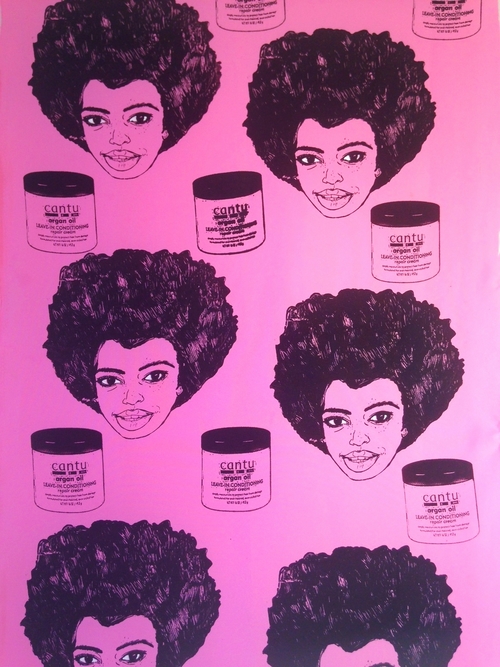
these words by Khatira Mahdavi were inspired by the work of Angela Pilgrim

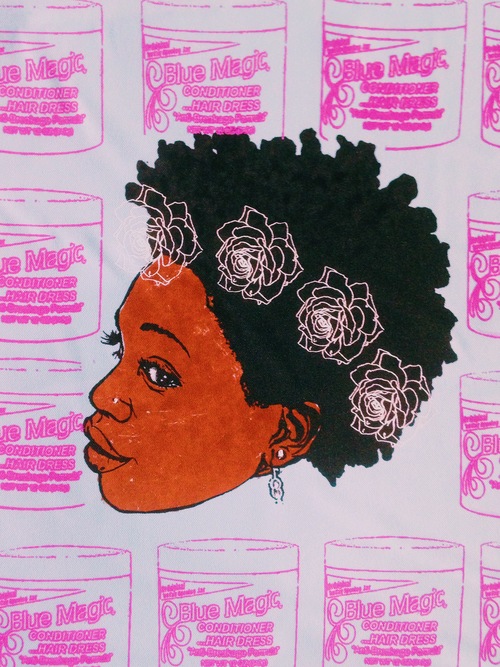
“Balanced,” New Poetry by Ivana Velickovic

Processed with VSCOcam with c1 preset

You asked me if I thought
you were pretty.
Pretty is relative only to
everything besides oneself.
When I stare deeply into the mirror
I become confused.
There are two versions,
one always melting into
the other.

The first: a goddess,
black magic turned blue.
A garland of roses
atop my head,
pure and perfumed.

The second: relative.
A wise aunt who shares dark eyes.
A brave father who shares resilient,
smooth skin.

You liked the idea that beauty
is ancestral and proud.
You asked how you could come to wear
a garland made of roses.
Together we looked in the mirror
and I removed my garland,
delicate as a newborn.

I let it settle on your head.
I let it bring you balance.


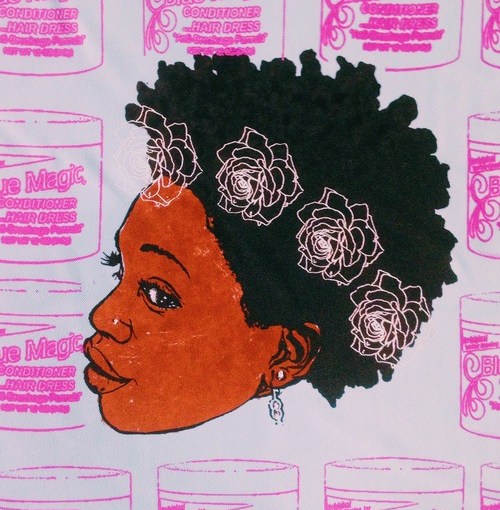
these words by Ivana Velickovic were inspired by the work of Angela Pilgrim

“Mango” by Tristen Sutherland

Processed with VSCOcam with c1 preset Processed with VSCOcam with c1 preset

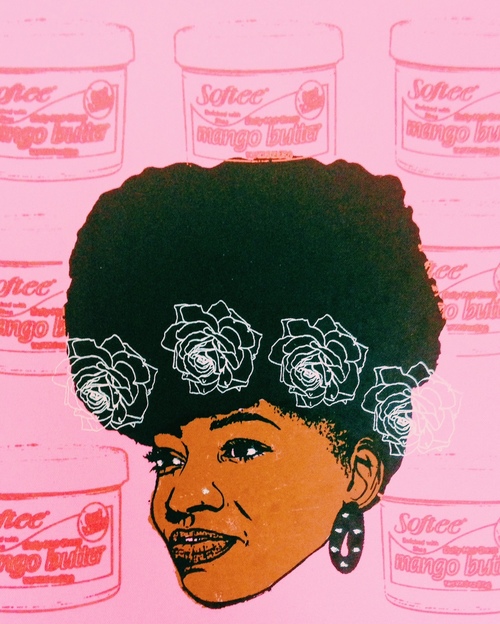
I didn’t taste a mango until early adulthood. Don’t get me wrong, it wasn’t a problem of mango availability; I just didn’t like the idea of them. They were messy and sticky and watching someone eat that orange flesh was grotesque enough to put me off it entirely. Juice would dribble down their chin and then the sucking and slurping would commence. As a child, I couldn’t bring myself to do it. My mother, long and sinewy, with skin as dark as polished wood, would offer me half of her mango. Usually, this would happen when she was barefoot in our garden, patterned fabric draped over her shoulders, a look that was very unusual in our Canadian suburb. Each time she offered I would shake my head no. I would feel a pang of embarrassment in my gut, even if no one was there to see. Over the years, she persisted despite my resistance. By my teenage years, all she had to do was reach for a mango for me to dismissively utter No thanks. I now recognize the sadness that would cross her eyes each time I would refuse a piece of her fruit, requesting an apple instead. My mother loved when mangos became available in stores, they were the only product she would splurge on because they reminded her of home.

I first visited my mother’s home, Martinique, when I was in my early twenties. It was strange seeing her in her element like that. She seemed to glide across the sand, her luminous hair flecked with silvery strands, fastened with a flower. I tried to mimic her, but my feet weren’t used to the uneven terrain of sand and my hair seemed to reject every flower that tried to nestle between its curls. When I tripped for the fifth time, my mother smiled and sat down next to me. I was clearly frustrated with my lack of grace and I think my mother sensed that. We sat in silence for a moment watching the waves. My mother reached into her tote bag and extracted a mango. Carefully, she sliced it into halves. Tentatively, she offered me a half. For the first time I accepted, happy to share something with my mother.

these words by Tristen Sutherland were inspired by the work of Angela Pilgrim