New Poetry by Annie Rubin: “You tasted safe”

Processed with VSCOcam with c1 preset

Someone once told me not to make homes out of human beings but with you I
couldn’t help it—

your body cradled perfectly against mine,
as if we were built to rest with our limbs intertwined.

We forged space for each other where there was none to be made.
I’d feel your heart as you held my head to your chest
I wanted to merge your body with mine.
But you were indestructibly you.

You lingered in the air, irresistible.
Exquisite, as you lay back, stretching out
beneath the sunlight of your bedroom window that splayed sparkles upon your cheeks.
As you unequivocally made yourself a part of my world.


these words by Annie Rubin were inspired by the work of Angela Pilgrim

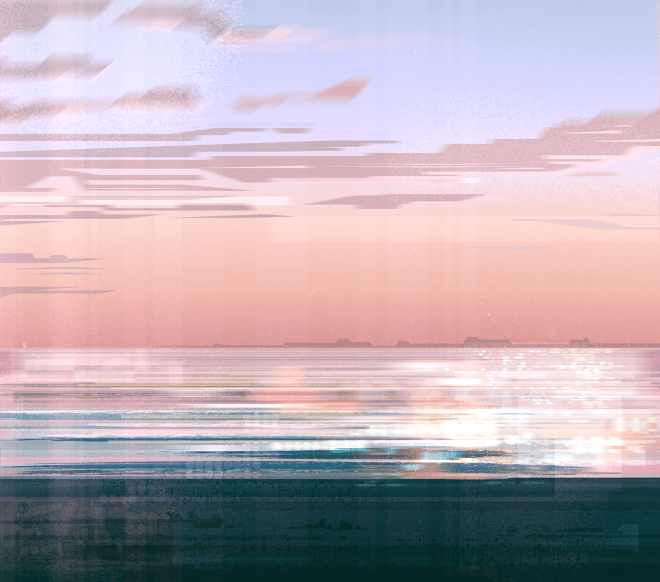
“The Pink Sea” by Jo-Ann Zhou

James Gilleard_4

For three days we have stared at the sea.

For three days we have watched its changing moods and colours, from turbulent grey to blue-green, to this ephemeral pink at sunset.

Tonight the pink is particularly brilliant, the calm lapping sounds like small reassurances of “everything is going to be all right.”

Having observed the sea, I know these reassurances are fickle. Poseidon is tempestuous, and the pinks could turn to angry storms of steel grey just as easily as they could fade to sunset’s late indigo.

We are, in fact, waiting for the sea to turn black. Not just twilight blue, or the deep navy in the hours after the lingering sun fades. We wait for blackest black, when no lights save for the moon and stars shine upon its still surface. We can only hope to encounter no searchlights, no vessels that claim to help but are really meant to keep us from reaching our objective.

When the pinks complete their inky transformation, we will enter the darkness. We pray that when we greet the sea at last, it will be more cool smooth onyx than roiling tar soup. We know there is a chance that we too could become one with the sea, could become part of its spectacular colours, like many of our brothers and sisters before us. 

Despite this risk, we wait for darkness, watching the colours of this great obstacle to what we can only hope is our new home. As we wish away the sparkling pinks for dull blackness, we hope to one day look back at this sea with no fears and see nothing but calm pink water.

these words by Jo-Ann Zhou were inspired by the work of James Gilleard

New Poetry by Nahomi Amberber: “When It Hurts to Stand Next to Him”

james-gilleard_2

Forgive me

For not coming any closer.

You remind me too much of my father,

And the type of men

Who destroy

Women like me.


these words by Nahomi Amberber were inspired by the work of James Gilleard

“There Must Be A Name For This,” by Leah Horlick

james-gilleard_3

How to feel like how you imagined the city? A blur of light steps out of a cab. Stem of a glass in a ring on a wet table. Slink, slink. Would it have been better if you had moved into that little beehive level with the SkyTrain, whoosh all day, glow all night, little hexagram. One stool, one door, two windows at an angle with the tracks, tracks, track. Two windows! Rattle rattle goodnight all day. You imagined glass and water, heels and click, the film of alcohol across everything, city city. Little dots of light, little swipes. A secret: Vancouver is actually a series of small caves, mould like a dust of sugar powder, did you know? Saturday night aesthetic: the Chevron station for yachts in Coal Harbour, hovered out in the water, glossy black, little ring, orange light. How long did it take me to realize the white-hot squares at the top of downtown are penthouses? How long did it take me to realize those very regular fireworks are private planes? Why can’t I have, why can’t I have, why can’t I? What if we just kept living together, what if I just tried harder, what if I had moved to Toronto? All the women in this city say I love you, they say centered, we say seawall, we go home and murmur Toronto Toronto Seattle Toronto in our sleep. You don’t understand. I have an obligation to a girl in a barn, to a girl in a car, to a girl in the forest; she says Get Me Out Of Here, she says My Own Apartment. Is it possible to be dissociated not from me but the city. Like here I am arms and legs, here I am oh New York.

these words by Leah Horlick were inspired by the work of James Gilleard

Taisha Cayard in Dialogue with Audre Lorde, “But What Can I Learn From You”

poem

This poem by Taisha Cayard was inspired by Audre Lorde’s “But What Can You Teach My Daughter,” published in Lorde’s 1978 collection, The Black Unicorn 

New Prose: “Bystander,” by Nailah King

overnight-and-unknown-20x20cm-2015-mixed-media

The little boy screamed when he heard the sound of smashing glass. He crept carefully, his tiny hands grazing the hallway walls. He was petrified, but more scared that he would make a ruckus and make his mother angry.

He knocked on the door.

“Mama?”

“Come in,” said the raspy voice behind the door.

The door creaked as he pushed it open. There, sitting by the window, was his mother. The white illuminating her dark brown body, her eyes seemed to glow in the dark.

“I heard a scary sound, Mama.”

She turned to him, all of her warmth filling him like a cup that runneth over. She gestured for him to sit near her. He climbed into her lap. She kissed his head and wrapped her frail arms around him.

“Did you hear it too?”

Her arms relaxed, she patted him gently on the knee.

“Yes, baby”

“What happened, Mama?”

He hopped off her lap, sitting closer to the window, peering out of it intensely, his eyes stirring.

“Where are they taking Daddy?” he shrieked.

She looked at him, sad for her child. Sad that he didn’t yet understand.

They looked down together at a man who had skin like their own. He stood planted, firm, bruises forming. The flashing light of the cop car cast an eerie blanket on the street, covered in red.

The boy whirled around, angry. He didn’t understand.

His mother turned away from the window.

“Mama! What are we going to do?”

She pointed at the cop car.

“Open your eyes, Charlie, and look,” she hissed.

The boy planted his palms against the window, his nose touching the glass, and he stared. The cop car windshield was broken. A bat, discarded, lay on the asphalt.

“It’s not Daddy’s fault,” he murmured, tears stinging his eyes.

His mother merely nodded.

“He did say, if they came back…something would happen,” she said in a sibilant, almost to herself.

He looked out again. There was a woman in a hat staring back at them. He burst out of the room.

“Charlie! Where are you going?” she asked.

But, he was gone.

He struggled to push the heavy building door. Then, he saw her.

He stood there, staring as her blonde hair rustled in the icy wind. Goose bumps dotted his arms. He forgot to bring a jacket.

The cop car was long gone. He didn’t know if he’d ever see his father again.

The woman kneeled, still facing him.

“Did you know the man they took away?”

“You saw it! Why didn’t you help?”

He pushed her and watched her fall to the ground, as if in slow motion. He watched her tumble, instantly regretting what he’d done. Still, he stood with his tiny frame, chest rising and falling with anger. He said nothing, as she had done.

He walked back to the building and reached for the correct buzzer.

Above, a woman in all white looked out the window.

these words by Nailah King were inspired by the work of Mairi Timoney

New Poetry: “Later,” by Jess Goldson

later-30x30cm-2014

‘See you later,’
I say to you
as I leave you for the last time.
I do not know it yet, but when I return
our pool will be dry.
There will be no evidence
of our glorious summer days
soaking in the sun;
nor remnants of our gin-soaked laughter,
as we trudge through the snow in the winter.
You are gone; I wish I were.
I see telephone lines as they reach through the countryside,
searching for you,
and I feel your voice vibrate through your body,
while I rest my head on your chest.
I see the curve of an arch,
and I remember how miraculously our bodies fit together.

these words by Jess Goldson were inspired by the work of Mairi Timoney

New Prose by Josh Elyea: “On Punching a Nazi”

Passing Through


He had a habit where he’d slowly and meticulously pull the hairs out of his beard and pile them, as though they were kindling to start a fire, on whatever surface lay in front of him. It was a disgusting habit, one he was not fond of and one he would’ve judged others for having, and despite his most earnest and steadfast attempts, he was simply unable to quit it.

He wondered if that’s how Trump supporters felt about their casual racism, about their callous disregard for their neighbours. Maybe they wanted to stop, he said. Maybe they were aware of the shame of their habit, maybe they knew what they were doing was wrong. Maybe they just couldn’t stop.

Who cares whether it’s conscious or not, she says. This is the 21st century—we have Google and Wikipedia, for chrissake—and you’ve got the totality of human knowledge at your fingertips. There’s no excuse for ignorance, she says, and he knows she’s right. She’s cool, of the old-school variety. Think Dana Scully, but with more heart. When she speaks, it’s with a sort of callous candor, a ruggedness of speech that only works when underscored by a passionate sincerity. She listens to old jazz records and calls Louis Armstrong by his proper name (Satchmo, she says with love, and she blows him a kiss across the time-space continuum). As he stares, it seems as though she’s blurred into the landscape, a variety store Venus on the warpath, ready to lay waste to the barbaric conservative politics that have, almost overnight, eclipsed the American consciousness.

The future is female, she tells him, and he knows that she’s right. How could it not be, with an arbiter like this?

Maybe it’s time to take off the kiddie gloves, she says. Maybe, just maybe, the left has been playing nice for too long, and it’s time to stop rolling around in the mud with the GOP.

It’s time to call alternative facts what they are: propaganda.

It’s time to call Trump’s Muslim ban what it is: racism.

It’s time to call the alt-right exactly what they are: Nazis.

Maybe it’s time to stop giving credence to the idea that we’re all entitled to an opinion, regardless of whether that opinion is right. You’ve got the right to an informed opinion, but fuck those people who choose ignorance over equality. Maybe we need to stop playing to our slowest members, and maybe we need to grab these petulant, misinformed, archaic relics of a bygone era by the scruff of their hypocritical necks and smack them until they realize that the only ones who don’t deserve a place in the world we’re building is them.

Of course we ought to strive to live in harmony, of course. In fact, that’s exactly what most of us are trying to do. But there comes a time when punching a Nazi isn’t just the right thing to do, it’s the only thing to do.


these words by Josh Elyea were inspired by the work of Mairi Timoney

New Prose by David Emery

Dimension

A house is not the same twice. Even if I stare long and hard and try not to blink and let the breeze distract, the house changes right in front of me. That was and was not my room. That was and was not the crooked porch roof. Was that wall always that short? It’s not the way I remember it and can’t be. How dare the house change? How dare it bend time and space? A person can’t be prepared to expect that. It used to be simple to start at the mouth of a neighbourhood and make your way to the belly. When you’ve been gone from a neighbourhood for twenty years, and you make your way back to that neighbourhood, that neighbourhood tries to throw you up.

Some neighbour I don’t recognize gives me a dirty look from two doors down, watching me to see what I’ll do. She’s tired of watching kids break through the plywood planks, carrying spray cans in their backpacks; when she calls them out they laugh at her wrinkled face and toss rocks at her Oldsmobile. You can’t blame a woman like that for being suspicious. I don’t half believe I’m standing here myself. Down the road, kids play ball hockey, treading new marks into freshly seeded grass, thrashing their sticks against the concrete curbside, taking chips out of something that always kidded me into seeming permanent. It would always be the same street and the same sun and the same gardens and trees, but at some point it stopped being the same. Now it stands here like a forgetful elderly relative, politely asking for a reminder, some flicker of a memory I can lay before it to make the house say, “Yes, I am the house you remember; you have all my love, you always have and always will.”

You don’t grow in a house. The house shrinks around you, becoming too small for your body until you have to escape through a front window before it splinters and cracks from clenching at your waist. Mostly they don’t bother to knock houses down. Curious. They stay standing and you keep growing and before you know it everything is in bits and pieces. This house is a standing nightmare. I wish I had the guts to step inside and reclaim that bedroom that was and was not mine. I’d yank the plywood out of the window and stay looking out at the streets until the sun went down, and the kids playing ball hockey were called in to eat, and the falling sun spread rays through the branches of the trees that have also changed, and the woman eyeing me suspiciously called the police on me.

If I’d been dragged out of here by force twenty years ago, that might have killed the urge to come back. I wouldn’t be standing in front of this house, watching it change, feeling myself shrink, feeling digested.

these words by David Emery were inspired by the work of Mairi Timoney