High School Visionaries

randeecrudo2

Rebecca Platt is and continues to be a member of an unrecognized but nonetheless elite club: Senior Superlative Actualization.  Rebecca Platt’s Willstown High School Class of ‘12 voted her Most Likely to Find The Meaning of Life.  As senior superlatives go, Ms. Platt’s was considered one of the more unachievable ones, along with Most Likely to Steal the Statue of Liberty, which Damon Quinn has still had no luck with.

The Class of ’12 had no good reason to believe that Rebecca was going to Find The Meaning of Life.  This is because Ms. Platt is as dumb as a doornail.  For example, she is known around Willstown High as the girl who infamously commented, ‘Is this Pennsylvania?’ on Hank Wiley’s photo in front of the Eiffel Tower.  She has regrettable tattoos.  E.g., a trail of generic lips runs down her oblique and beneath them reads, “Christ Was Here.”  Her fridge is empty because she spent her $300 monthly allowance on a Sun Conure, which she named JFK.  And with no additional money for a cage, JFK has been shitting everywhere.

It’s a boring story of how Rebecca Platt came upon The Meaning of Life.  She didn’t have a vision; there was no beam of light.  What it was was a series of mundane events that gave her some insight into the way the world is.  It happened on her 22nd birthday.

Rebbeca Platt was on the subway to work.  She sat across from a woman whose triceps were loose flaps of fat.  The man next her said, ‘Happy Birthday, Beth.’  ‘What?’ Beth said, leaning closer; she couldn’t hear him.  Beth was a mirror for Ms. Platt that day.  Fifty or some odd years separated them.  Beth’s arms were in some metaphorical sense a signpost of what Rebecca had to look forward to.   Ms. Platt imagined herself with her own flaps of fat, her own hearing aids, and sensed that she was deteriorating, nearing the end of her visit here.  Everyone has a Beth, and Rebecca observed that she could either neglect her eventual decay or accept it.  So she decided to bow to her mortality instead of avoiding it.

The subway stopped.  ‘Someone on the train needs medical attention.  We appreciate your patience.’  Work started in ten minutes and if Ms. Platt were late again she’d be fired.  Surprisingly, she didn’t get irritated.  Other people on the train are probably in similar or worse conditions than I am, she thought.  Rebecca didn’t know what to call it, but what she understood there on the stalled train was the importance of compassion.

Ms. Platt then learned about forgiveness.  ‘I’m sorry I always said that your brother was the smarter one,’ Rebecca Platt’s mom said through a teary happy-birthday call.  For most of her childhood, Rebecca was blue.  But daughter forgives mother, and by waiving her inner rage toward her mom, Rebecca relieved herself of a lot of psychic pain, and grew steady.

When Rebecca Platt got home from work later that day, though, she was unemployed and hungry, and still had to clean up all of JFK’s shit.

word by Jacob Goldberg

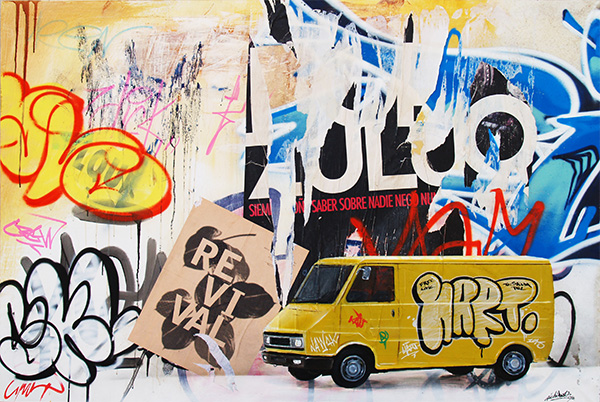
“If there is a meaning to life, I think it has to do with the stuff in the story.  And if you were to come across it, I imagine that a palette of colors might merge as they do in the artwork, and people would realize that deep down we can blend, too.  It’s important to always keep in mind that even if you think someone is stupid, they might in fact be worlds smarter and more capable than you think they are.  People are mirrors, and we shouldn’t miss out on opportunities to see ourselves in them.”

Issue #215: On memory and colour

OLYMPUS DIGITAL CAMERA

When I look at my hands I start to cry. Leathered and worn, dry skin flakes between my fingers and my lifelines seem etched into my palms, my hands are permanently stained; dark hues of purple and green crept below the surface, and stayed there. My life is on my hands and I can’t hide the fact that I have graced many a wall with my personal epithets. I staked my claim, marked my territory with a manifest destiny-type vengeance and sought out every clear space, every void, and every emptiness to fill it.
 art colour memory
My face is wet and I let the tears fall freely from my face. My hands lay in my lap, unmoving, poised for continued inspection. They tell every memory and moment and hurt with the knowledge of a past ached for.
  art colour memory
In the summer time heat, the humidity was thick and held the paint in the air around me. I searched the streets for new ground and found beautiful canvasses in the neatly tucked away spaces between buildings, inside dimly lit tunnels and parking lots; these were areas ripe for beautification. Can always at the ready, I would surveil the area and quickly throw up my tag. I would come home tinged in color, turned sepia, a danger to all white surfaces in my vicinity. I would take my black off, strip down bare, lay on my back, raise my arms in the air and look at my hands with intense interest. Color caked in the crevices of my cuticles and my knuckles darkened by the paint in the creases of my skin. I would lay there until my arms were tired, feeling the adrenaline leave the extremities of my body. Right index finger bent, I would practice above my head, my tag lines fluid, clean and quick. They littered the pages of my school books, and even now, the discarded envelopes that formerly housed my bills, bank statements and junk mail. I make my mark everywhere, although no one else sees it now.

word by Cora-Lee Conway

colour by Pichi&Avo

the world can come to you

3

There’s a now-redundant wall outside the (currently unsponsored) stadium, on which someone has scrawled a strange, pseudo-cubist bird. It’s bulging, ever-watchful eye was painted at some point before tech made that kind of old-school social mischief – the real good stuff – obsolete. Graffiti doesn’t give you the same rush as virtual reality, ya dig?

The stadium hasn’t been used in years. I’d venture to say that the bird is the only one watching sports in person. People can’t be bothered to leave their houses for anything, let alone sports, since the nationwide rollout of the Microsoft Xperience Holographic Immersion Throne v.2.1 ™ and its accompanying Virtual Reality processes.

Why go out into the world when the world can come to you?

The tagline from the commercials was secured with some science gibberish, something about how a series of small pulses from the throne’s electromagnetic halo could be delivered to the part of the brain responsible for…whatever…and a neurological substitute for an external stimuli could be produced… all very sci-fi, except, you know…it was real.

The Microsoft Xperience Holographic Immersion Throne v.2.1 ™ was real. It was here, in America, and it was addictive. Look on a long enough timeline and you’ll see abuse follows the distribution of any groundbreaking technology. Most of the time, this abuse stands to exacerbate some mental burden, some level of active participation that can easily transition to passive consumption. That’s not marketing: it’s a fact.

Passivity became the norm. Of course, some people will argue that it was status quo long before Microsoft (hell, I might even be one of ’em) but something just clicked in the American psyche when that fucking chair came out.

It was like all the little bits and pieces of the broken people of America were glued back together as soon as the electromagnetic halo, like a scorpion’s tail ready to sting, fired that first electric shock straight into the brain. The MXHIT v.2.1.

External stimuli are irrelevant once you figure how to manipulate intra-neural connections. There’s no reason to trudge all the way to a stadium to watch a football game when you can download a bioprog that makes your brain think you’re there, eating nachos and drinking beer with all your famous friends (Scarlett Johansson’s been the most downloaded bioprog three years running). All of this from the comfort of your own living room.

What hard-working, overeducated, underpaid American could resist that?

Could you?

Some days I sneak past the bird and into the stadium. I sit way up high, in the nosebleeds. I can’t imagine being able to afford ones close to the field. I breathe deep and picture tiny players scrambling around the dilapidated field far below. The stadium seat isn’t as warm as the one I’ve got at home.

word by Josh Elyea

colour by Mark McClure

From the author: “When writing this piece, I really wanted to ponder what it was about the contemporary moment that’s so threatening to “the real” (I know that’s vague…bear with me). I’m often distracted by questions of authenticity; authenticity of art, authenticity of experience, anything. This piece gave me the opportunity to analyze some of those questions through the technological filter that’s omnipresent in our everyday lives. It’s overwhelming to think of the sheer speed of technological advancement these days, and it begs the question; how does technology affect our understanding of authenticity? Is there something to be said for genuine experience? Hell, if that’s your argument, does technology diminish an experience at all? Or does it enhance it? Life’s not as simple as sitting in a chair anymore, and I really wanted to take a look at why.”