Magdalen Laundry

home (1)

The now empty halls
a Dublin asylum
on Lower Leeson Street
you did what they said
carry the “fallen”,
Keelia, birthing a daughter
treated as defiled.
1941, aged 16,
there was no time to say goodbye

behind monastic walls
a bedroom, a cell
iron-barred windows
in each dream walking along:
“Ma, where am I going?”
but always wake up crying
bear pages of thick ledgers:
“You disgraced us!”
Unpaid workhouse

shapeless, long brown dresses.
The sound of hand-scrubbed linens
if you listen you can hear
the abbess and the nuns

on cold winter mornings
face shrouded in black veils
girls marching to six o’clock Mass

beyond, the ordinary, everyday world.
Pruning of an old mulberry tree.
Shrews, and lizards,

the nameless.
I was known as number 26.


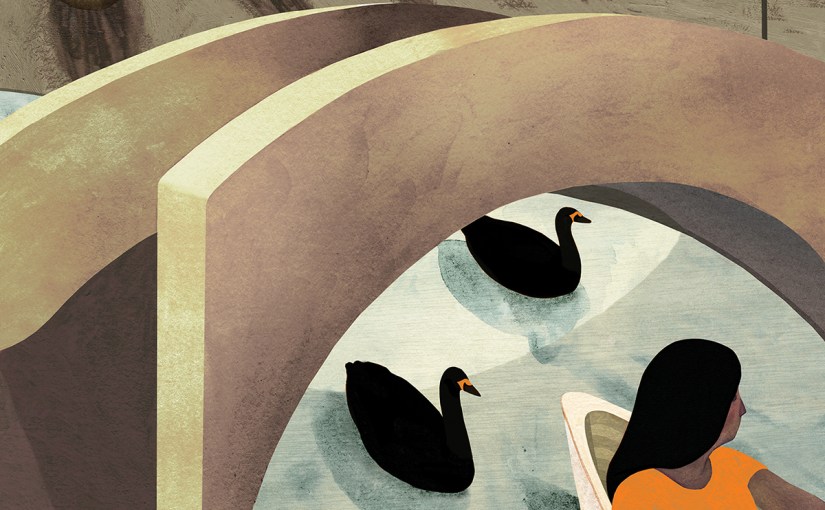
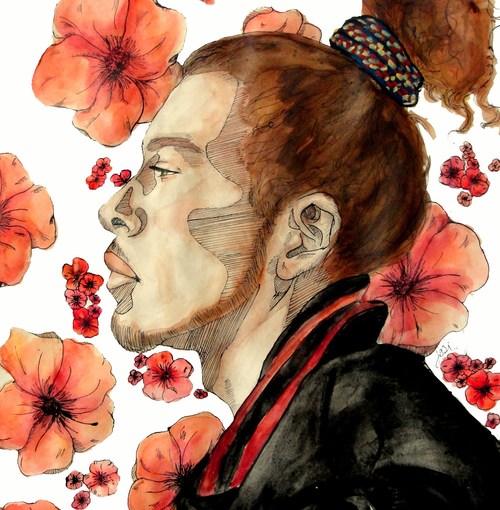
these words by Ilona Martonfi were inspired by the colour of Alison Gildersleeve

Read, “I drifted with you”

owen gent 4
You took a piece of the sun and flew with daylight on your back. It was not heavy, but warm and you felt it there as you coursed through the skies, lighting my way down deep dark rivers. I did not know your people but I could see them flying with you above, in formation. I drifted with you, following your ways, assured that your pathway was right.
I drifted with you
We did not talk. You were too high and I was enamoured with the symphony of sounds coming from rushing waters beating against soft rock on the bottom of the riverbed.
 I drifted with you
We did not talk. I could feel you carrying the emotional burden of sunlight. You could not fade or falter and it was wearing on you, yet you remained steadfast.
 I drifted with you
We did not talk. I laid back, still, my head cradled in the mass of my thick dark woolly hair that hung well below my shoulders. Beneath the canopy of trees, underneath walkways and the shade cast by all manner of things, I acknowledged that the shadows separated me from you and the sunlight you carried. The shadows were dark and cold and I did not like even the briefest moment in their presence.
 I drifted with you
We did not talk. We did not need to.
 I drifted with you
I laid down in a vessel of my own making and followed you, laid underneath you and greeted you with my eyes. I stared straight at you despite the glare and the heat and consumed your every move. I measured your laboured breaths and dipped my hands in the cool rushing waters to remind myself that I was real. I was flanked by angels, dark and stoic, gliding alongside me and I felt safe.
 I drifted with you
You took a piece of the sun and flew with daylight on your back. You carried it for me during the darkest hours because I could not bear the burden of love and light. You held it there above me, out of arms reach so I could not pluck it out of the sky. You coursed a path for me to follow and allowed me to rest in the warm presence of peace and assuredness. You did not say words; there were none. You amassed an army of lovers just for me and when the shadows appeared I endured them knowing you were there on the other side of midnight
I drifted with you
these words by Cora-Lee Conway were inspired by the colour of Owen Gent 

following the toy

badiu 7

As Anne watches the toy spin slowly in the microwave, she thinks about where she and Augie will go. We could go to Vancouver, she thinks. Walk in Stanley Park and sit by the water. She’d been to Vancouver once, before she got married. She watches the toy spin and thinks about the ocean.

*

Their first night at the shelter, Anne woke up wet, Augie pressed into her side. “It’s too dark,” he said. They got up and Anne changed the sheets. She took the toy out of the backpack—it was one of only a couple Augie had been able to bring—and he clutched it to his chest as he fell asleep. Steven had given him the toy, not for a birthday or for Christmas; he just came home with it one day. It had been a good day.

The next morning, she found the tracker in her purse, in one of the side pockets she never opens. It was small, a little bigger than a dollar coin. Steven has touched this, she thought. He bought this little thing and turned it over in his hands and slipped it into her purse when she wasn’t there. She dropped it on the ground and smashed it with the heel of her shoe. She heard it crack, felt it flatten beneath her. She experienced a moment of relief before the panic—if there’s one, there will be others, she thought.

She dreams about the toy, but it looks different than it does in real life. She wakes up wet, with sweat in all the places. Augie is fast asleep beside her, a baby bird in a nest. She sees the toy in his arms and tries to think of how it looked in the dream, but all she can remember is that it wasn’t the same. And that’s the terrifying thing.

*

The fire isn’t huge, but it’s a fire. She thinks about how upset Augie will be. She’ll come up with an excuse. We’ll have to leave again, she thinks. The microwave sits on a wooden table, which is turning black as the flames eat. The microwave door hangs loose on a hinge. We’ll always be leaving, she thinks.

these words by Leah Mol were inspired by the colour of Teodoru Badiu

on self-harm: “other bodies”

owen gent 5

TW: Self-harm

The feeling that precedes it is a quiet panic: the sense that she is not feeling enough, or feeling too much the wrong way.

Safety pins and tacks do the job sometimes. The marks they leave are an irritated red. They heal like cat scratches, but too straight to fit the lie. It takes a lot of pressure to draw blood.

Sometimes, she can stave off the urge with the drag of her thumbnail down her forearm, or the center of her throat. This leaves a mark, too, but it’s faint enough that people don’t ask.

Sometimes other people’s bodies will do the job. His fingers are clumsy, floundering. She wakes up in a panic the next morning when she remembers what she’s done but not what his name is. She regains the knowledge via text from a friend: Hudson, like the Bay.

His fingers are slick when he enters her. He puts them in his mouth and sucks on them first, maintaining eye contact the entire time. His fingers jab into her in the general direction of where they both assume her g-spot is. They are rigid and insistent, maintaining the ruthless pace of a second-hand jackhammer.

Metal is different. When she uses scissors — knives and razors seem too dangerous — she expects to see the flesh part red and wet, revealing complex patterns inside, like a pomegranate, or the little teardrops inside an orange slice.

(She looks them up later: they are called vesicles. She repeats the word to herself: vesicles.)

Instead, there is just blood. Not a lot of blood. She thinks there are some major veins on the inside of your thighs or something; she keeps this in mind when she drags the scissor blade over the muscle there, flinching. The metal is not the problem: it is her own wavering grip, too afraid to push too deep, of blooming more pain than she’s bargained for. She knows people have cut through muscles down to the bone. She knows people who have ended up in the hospital for it. She knows she is supposed to feel comforted that she’s not part of this dysfunctional elite, but mostly the knowledge makes her feel like she’s not trying hard enough.

She tries to keep them even in length and depth. They never are. The blood pools in straight lines. She wipes it away; it blossoms again, a thin line interrupted by sluggish beads, a delicate filament made of nothing but her.

When she was little, she always ran her baths too hot. She would sit on the edge, naked flesh pricked with goosebumps, running cold water in and stirring it, flinching at the hot current that made her hand flush. She acclimatized to heat in increments, trained herself over time to embrace water that makes her feel raw all over, makes her body breathe plumes of steam when she rises.

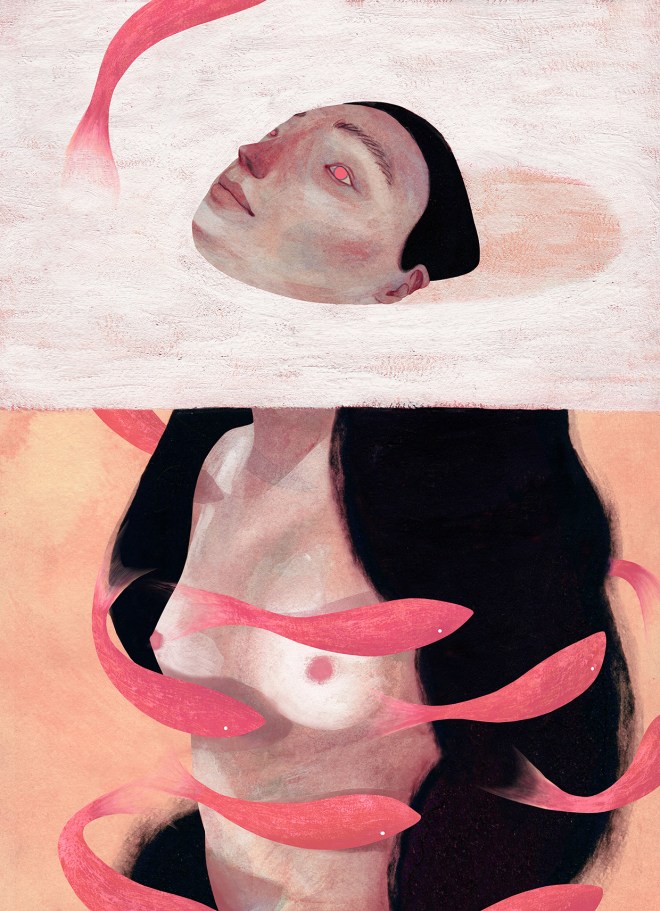
these words by Caitlyn Spencer were inspired by the colour of Owen Gent 


Incline

03f8b926526103.56356881684c7

word by David Fleming

colour by Burkhard ller 

On the metro delivering the girls to my ex in a mall.

A young woman close by waves to them. She smiles her surprise at the sight of a man with children. I smile back, upholding her fantasy.

It’s alarming how the mechanics of a city collide and separate us. On the teeth of the upward escalator, I am holding my three year old. Her big sister wraps her limbs around my leg like a koala. I’m a little escalator, here for them to ride up and down.

Down a hallway, another escalator. I am sweating in rush hour.

I wonder how Sam’s managing. Trying to remember if I left her, or if she left us, and who the kids think left whom, and who they feel is still fully present.


Daddy, I STEAL YOUR NOSE! says the girl in my arms as she swats at my face.


Down a yellow hallway, offices curve into their little corners. We are in the space where underground becomes above-ground, where I sometimes feel myself gasping for air.

Don’t know why she wanted to meet here, this week.

A memory: eating in the food-court up the next escalator. J’adore la poutine? or la cheeseburger? I always goofed her with my fast food Franglish. 

Again, we escalate quietly, a few impatient people pass to the left. For some reason, the toddler shrieks Mommy’s house! in my ear.

A crazy idea: I could ask Sam to have dinner in the food-court. Family hour. Our future, joined somehow, could be pleasant. We’d exchange small talk, remind the girls to sit and eat. We could be like coworkers, sitting in a lunchroom, rolling our eyes at the orthodontist bill.

Can’t you love a person the same from a different building, a different room?

An excited shout from my side.


Jess!


Sam’s best friend. When we met in college, I liked her first, though she was always mean. I told her once, years later, when we were alone, in a season when we were getting along.

Wearing gym clothes, her hair in a tight bun, her glare scolds and scalds me.

I remember, now, Jess moved into a condo in this building last year, when it was ending.


Where’s Sam? I ask. I was hoping to speak with her.

She wanted me to pick them up today.

Oh, I said quietly. What’s she up to?

It’s not important. I’m in a rush, though.

I have some things to discuss with her, maybe I’ll just call.


A huff over her shoulder.


Look, I don’t know what you have in mind, but Sam’s busy.


She takes the girls, one on her hip, one by the hand, and gets on the elevator which, presumably, leads to her home.

Before the doors close, she leans forward intently.


Your choice, she whispers. Your choice.*

word by David Fleming

colour by Burkhard Müller 


On Desensitized Violence: “Muted Colours”

95457a49689083.5608656ded9c8

word by Annie Rubin

colour by Mojo Wang

There was no one in Bill’s house to turn off the TV when channel four came on. We thought of him as some sort of guru: he told us of kidnappings; of guns and knives and fires and what it meant when there were people on roofs about to jump.

It happened when we were in our sevens and eights that we realized we could press play when mom was in the kitchen. Imaginations were running crazy and fueled by these wild images that kept flashing across the screen.

My brother always liked video games. There was this one where you got to steal cars and ride away, hair all wind-swept. It was cool to be able to drive a BMW even on a screen where his fingers turned the wheel with a flick of a button.

The rest of us were playing hide and seek where the floor was lava. No one ever found out what happened when you touched because maybe your shoes were fireproof, you grew wings, or we just didn’t want to think about the truth. Mom would be in the other room watching the news. We’d ask to sit on her lap and she’d usually put on PBS but that day she was in a trance, eyes fixated on the screen. The television was on mute but you could still hear shouting.

The walls were this grey even though I swear they were melting that day we couldn’t walk outside because of the smoke. They don’t give you a trigger warning on the streets of Manhattan. We were six and eight and felt too much older.

Close your eyes, she said to me, holding a cupped hand over my face to shield from the screen, the same way she had done at the movies when couples started kissing. I held my breath, too.


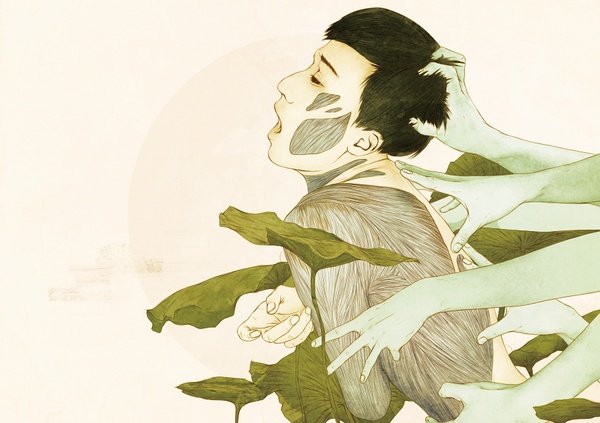
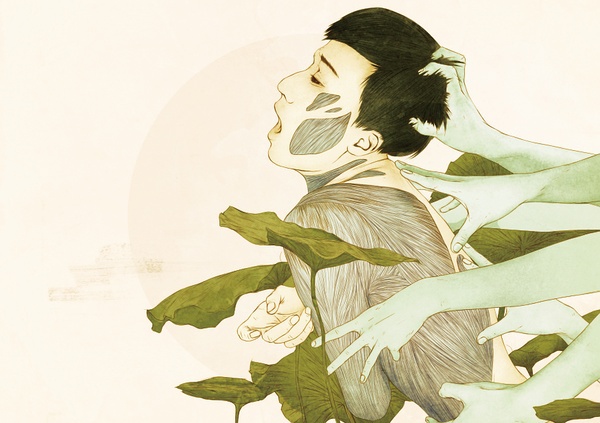
From the author: “This portrait of muted colours evoked desperation and frustration. The arms reaching out to grab hold of the figure whose muscles are exposed inspired a piece that targets vulnerability. The story tries to raise questions about exposure to graphic images, and question the idea of whether vulnerable children should be censored from the media. Ultimately, begging the question of whether striking headlines are desensitizing our population and how to cope with horror on the news.”

On Travel, Identity: “Try being your own friend”

kosi3

“Try being your own friend”

word by Annie Rubin

colour by Kosisochukwu Nnebe

“Try being your own friend.”

It was an exhausting job; he shook his head and hung up the phone.

The plane ride had felt long and treacherous, with each dip of the wing he was certain they would nose dive through the sky, be compelled to grab for their yellow life vests stored either directly beneath the seat or above you in the overhead compartment.

He would search frantically for the flight attendants out of the corner of his eye, secure. If they were still passing through the aisles with a variety of drinks and Skymall paraphernalia, he’d have no reason to panic.

The streets were shimmering with a blue-black slickness as he marched with conviction in the direction of the hotel.

The streetlights were flickering in and out of view. There was an unsettling echo of footsteps that he couldn’t swear were his own. Perhaps this was part of the adventure. Perhaps he was en route to be mugged. In either scenario, he found it best to focus his gaze on the road ahead, calculating the distance between fear and safety. Two hundred meters, now one-ninety…

In the lobby, he smoothed the lapel of his suit. It was one action in a whirlwind of unfamiliarity that brought him a moment closer to home. He couldn’t understand the startling sense of discomfort he experienced, surrounded in the idiosyncrasies of this place. The country felt oddly reminiscent of something he’d seen once in a dream, or maybe it was just that things felt so cartoonishly similar to images he’d stared at for months in preparation for the journey.

This recognition was stained by the fact that everything was just vaguely different than what he was used to. The water faucets, the scent of the stagnant air, the accents, of course a language he had never learned as his own.

Should this culture have been a piece of him, imparted by nature, somehow inherent in his blood? He wandered into a pizza joint out of habit or homesickness.

This was not his home. This did not remind him of the meals cooked by his grandmother; this was nothing reminiscent of his college chants or practiced habits or the inside jokes, memories collected into phrases and images that composed his true identity.

Maybe he was searching for something profound; maybe he wanted inspiration—confirmation that he had a home, a country, a culture that reflected his unique self. Instead, he was left in a state of flux: what was truly his? The room had fresh floral wallpaper and he felt nostalgic for a place that had until now, never truly understood him.


From the author: “I was inspired by the juxtaposition of the poised human look and the fragility of nature reflected in the vibrancy of the flowers. This led me to question identity, especially how to maintain a sense of self against a backdrop of an ever-fluid environment. The concept of identity raises questions about the significance of cultural background, and exposure, where the protagonist explores his familial history by visiting the country where his family comes from, realizing that he has little to no connection with a place he has never been, himself.”

“Two Faced: On the Consequences of Beauty Standards”

proppe

“Two Faced”

The secrets of a woman’s mind are written in the details of her face.

Look closely.

Every expression, every line, and every crease has a tale to tell. They grow and change and multiply, just as the years do. Then, why is it that when I look in the mirror, I am consistently dissatisfied with what I see?

The root of my dissatisfaction lies in a variety of pubescent acne scars that have yet to fade; in the darkened circles under already dark, deep set eyes; in the thin but unmistakeable wisps of hair, around the corners of my lips and at the base of my nose, that bridge my eyebrows together.

I look in the mirror and I see an amalgamation of imperfections arbitrarily plastered together.

But there is a rawness in the way I choose to present myself. This amalgamation of imperfections is unassuming, unforgiving, and unafraid.
This is how I present myself to the world—this is how my story takes shape.

Why, then, is this what I am taught to dislike about myself? Why is this what I am taught to find fault with?

Every expression, every line, and every crease has its own tale to tell:

These acne scars are battle scars. My skin is my armor; tattered and trampled on, it shields my inner vulnerabilities and insecurities. These scars represent the years I spent hiding, covered in layers of foundation and concealer, failing to realize that beauty is more than skin deep.  These scars represent my development and growth, on both a physical and psychological level. While it is still imperfect, I’ve grown comfortable with my skin, in my skin.

It is often said that one’s eyes are the windows of the soul. Well, my soul shines out through them—they open wide, and bright, with excitement. Other times, these eyes are tired, showing exhaustion from late nights and sleep deprivation.
They crinkle when I laugh, just as tears pour out of them when I cry.

Hair grows relentlessly and freely all over my body—and, why wouldn’t it? Am I not human? Am I not alive and healthy?
Hair is the not-so-subtle reminder of my humanity, of my autonomy and my ability to choose. It can be both liberating and restricting, depending on how I choose to tame it.

My mouth is the vessel through which I articulate my thoughts; it is the vessel through which I express my emotions. The corners of my mouth curl up when I smile, and turn downwards when I am unhappy. It is with this mouth that I say, I love you, and with these lips that I let you feel and believe it.

The secrets of a woman’s mind are written in the details of her face.

Look closer.

Look deeper.

word by Fiona Williams

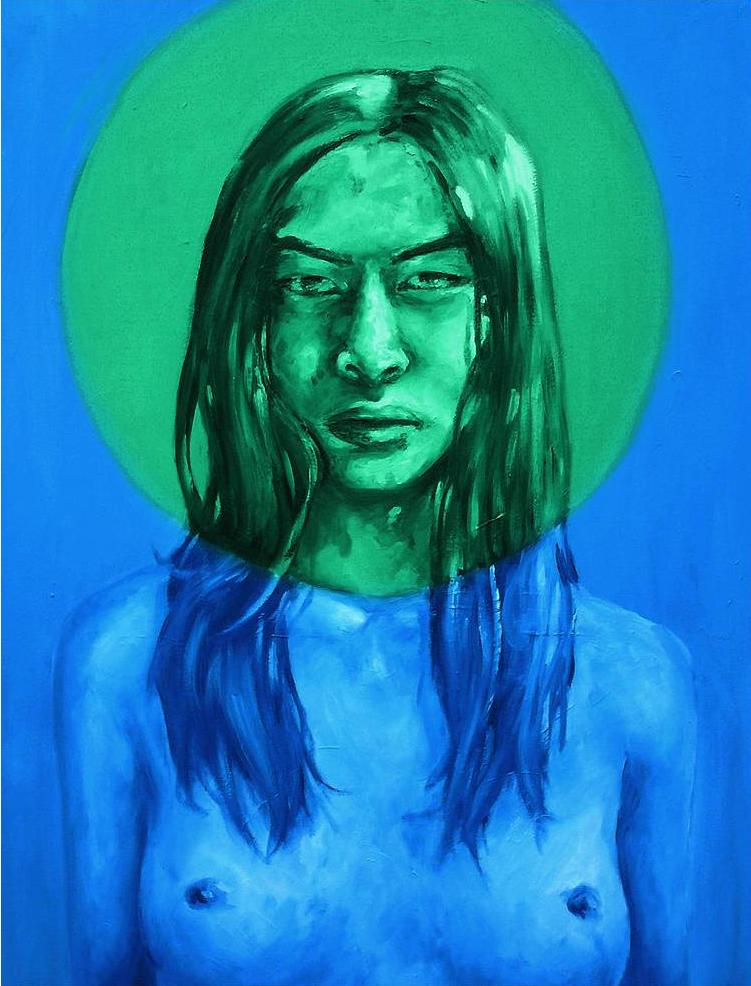
“The rawness of the artwork by Proppe caused me to reflect on how I view myself, particularly in light of the beauty standards perpetuated in the mainstream media. Whereas the female figure in Proppe’s art is depicted without inhibitions, I reflected on what I constantly find unsatisfactory, and then why I am unsatisfied with what I see: the immense amount of pressure we feel to be beautiful.” 

colour by Rebecca Proppe

“I’ve been making art my whole life, drawing story books and cartoons since I was a little kid. Now I’m an adult, and I still love to draw.

I’m currently studying art history mixed with some painting and drawing classes. Like most people I don’t know where my life will take me after graduation, all I know is I love art in all its forms and will be making it for the rest of my life 🙂

I hope some of you can enjoy my art as much as I did making it.”


25th edition of the First Peoples Festival

22
Présence autochtone, the 25th edition of the First Peoples Festival, is currently taking place at Place des Arts in Montréal, and is definitely worth checking out.

The festival features movies, concerts, readings, art, and more, celebrating aboriginal culture and its importance for Canadian identity.  Moreover, the festival highlights the evolution and adaptation of aboriginal music and art in a changing world.
Drumming circles and other forms of aboriginal traditional music, as well as new forms of aboriginal musical expression, such as DJ Psychogrid, Madekimo, Moe Clark, and Katia Makdissi Warren are featured every day on the big stage.
Additionally, many important aboriginal organizations like the APTN, the Makivik Corporation, Land Insights, and the AVATAQ Cultural Institute are using the festival to bring attention to the challenges that still remain within the aboriginal community, like the societal integration of First Nations and Inuit People who adapt to life in urban centres.
2
In response to this issue and others,  the First Peoples Festival promotes the use of art as a means of societal mobilization, identity building and cultural understanding.
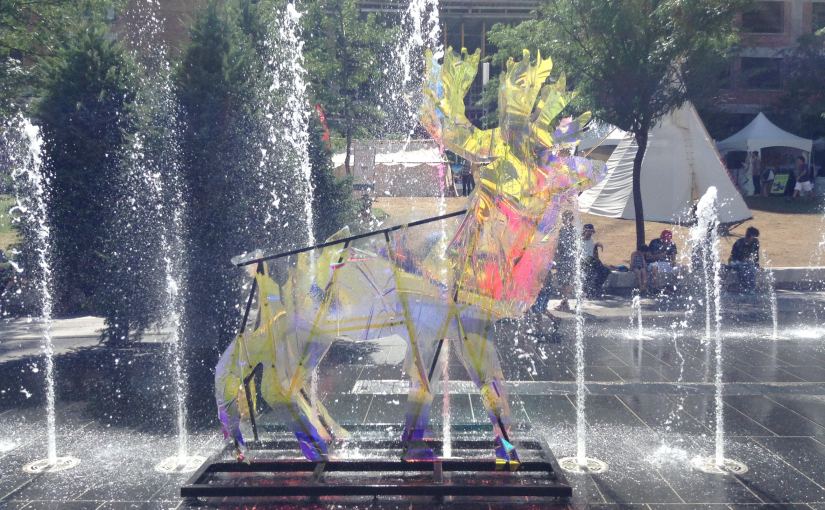
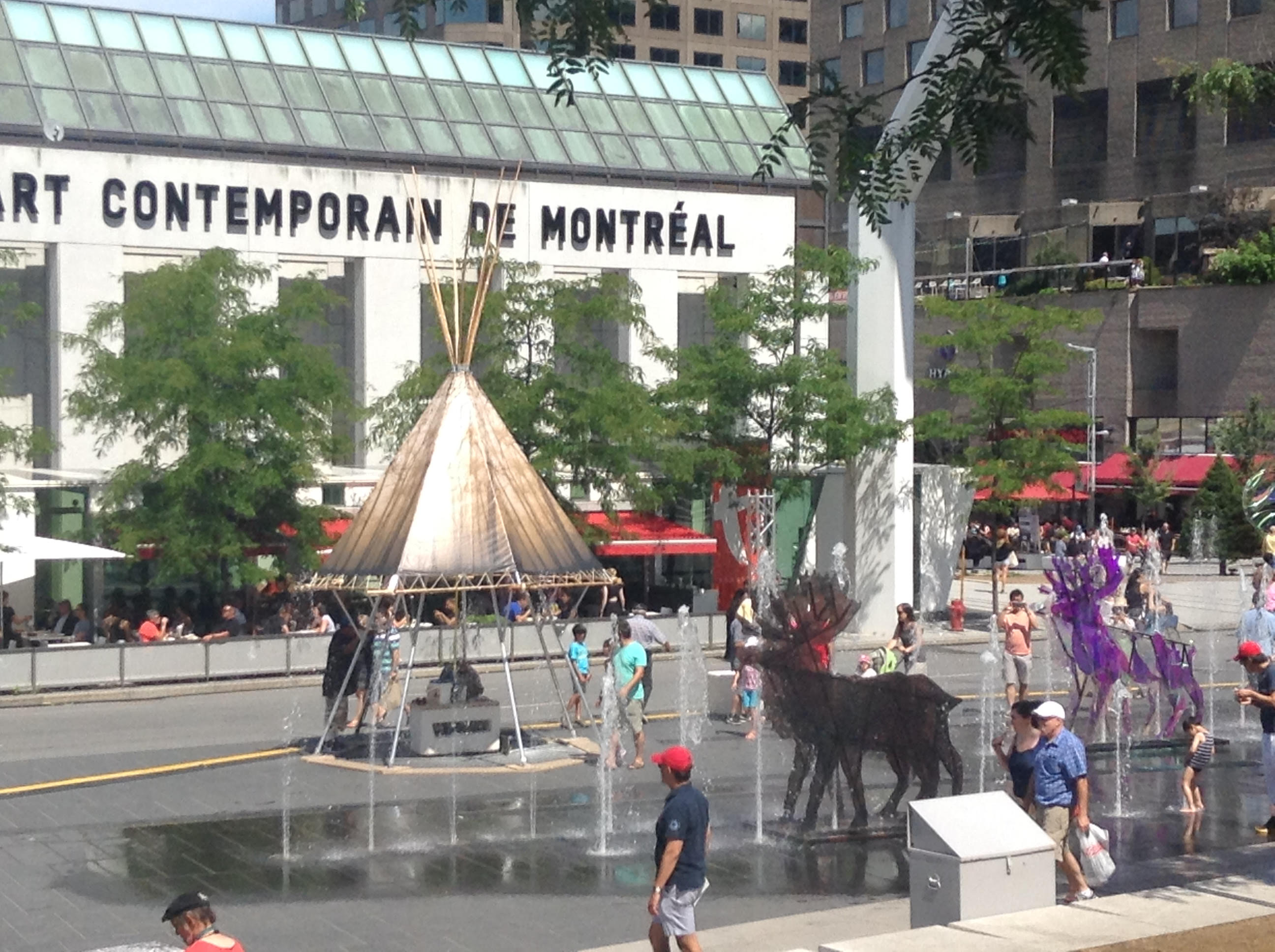
Inuit cultural expression using modern and non-traditional materials, including tepees and sacred animals like deer, turtles and moose, can be seen all over Place des Arts. In addition, the festival features First Nations artists like Jeffrey Veregge  of Port Gamble S’Klallam. Veregge’s art will be of particular interest to comic book fans, as it integrates traditional aboriginal artistic designs with popular culture icons like Iron Man and Buzz Lightyear.
Lastly, Parks Canada is giving out free airbrush tattoos of modern and traditional designs of aboriginal spiritual animals, each created by an aboriginal artist. With each tattoo comes a short explanation of the spiritual importance of each animal, and a description of the artist’s vision for the design.
The First Peoples Festival is not to be missed – check it out this week, until August 5, at Place des Arts!

High School Visionaries

randeecrudo2

Rebecca Platt is and continues to be a member of an unrecognized but nonetheless elite club: Senior Superlative Actualization.  Rebecca Platt’s Willstown High School Class of ‘12 voted her Most Likely to Find The Meaning of Life.  As senior superlatives go, Ms. Platt’s was considered one of the more unachievable ones, along with Most Likely to Steal the Statue of Liberty, which Damon Quinn has still had no luck with.

The Class of ’12 had no good reason to believe that Rebecca was going to Find The Meaning of Life.  This is because Ms. Platt is as dumb as a doornail.  For example, she is known around Willstown High as the girl who infamously commented, ‘Is this Pennsylvania?’ on Hank Wiley’s photo in front of the Eiffel Tower.  She has regrettable tattoos.  E.g., a trail of generic lips runs down her oblique and beneath them reads, “Christ Was Here.”  Her fridge is empty because she spent her $300 monthly allowance on a Sun Conure, which she named JFK.  And with no additional money for a cage, JFK has been shitting everywhere.

It’s a boring story of how Rebecca Platt came upon The Meaning of Life.  She didn’t have a vision; there was no beam of light.  What it was was a series of mundane events that gave her some insight into the way the world is.  It happened on her 22nd birthday.

Rebbeca Platt was on the subway to work.  She sat across from a woman whose triceps were loose flaps of fat.  The man next her said, ‘Happy Birthday, Beth.’  ‘What?’ Beth said, leaning closer; she couldn’t hear him.  Beth was a mirror for Ms. Platt that day.  Fifty or some odd years separated them.  Beth’s arms were in some metaphorical sense a signpost of what Rebecca had to look forward to.   Ms. Platt imagined herself with her own flaps of fat, her own hearing aids, and sensed that she was deteriorating, nearing the end of her visit here.  Everyone has a Beth, and Rebecca observed that she could either neglect her eventual decay or accept it.  So she decided to bow to her mortality instead of avoiding it.

The subway stopped.  ‘Someone on the train needs medical attention.  We appreciate your patience.’  Work started in ten minutes and if Ms. Platt were late again she’d be fired.  Surprisingly, she didn’t get irritated.  Other people on the train are probably in similar or worse conditions than I am, she thought.  Rebecca didn’t know what to call it, but what she understood there on the stalled train was the importance of compassion.

Ms. Platt then learned about forgiveness.  ‘I’m sorry I always said that your brother was the smarter one,’ Rebecca Platt’s mom said through a teary happy-birthday call.  For most of her childhood, Rebecca was blue.  But daughter forgives mother, and by waiving her inner rage toward her mom, Rebecca relieved herself of a lot of psychic pain, and grew steady.

When Rebecca Platt got home from work later that day, though, she was unemployed and hungry, and still had to clean up all of JFK’s shit.

word by Jacob Goldberg

“If there is a meaning to life, I think it has to do with the stuff in the story.  And if you were to come across it, I imagine that a palette of colors might merge as they do in the artwork, and people would realize that deep down we can blend, too.  It’s important to always keep in mind that even if you think someone is stupid, they might in fact be worlds smarter and more capable than you think they are.  People are mirrors, and we shouldn’t miss out on opportunities to see ourselves in them.”