“The Final Transmission,” by Erika Thorkelson

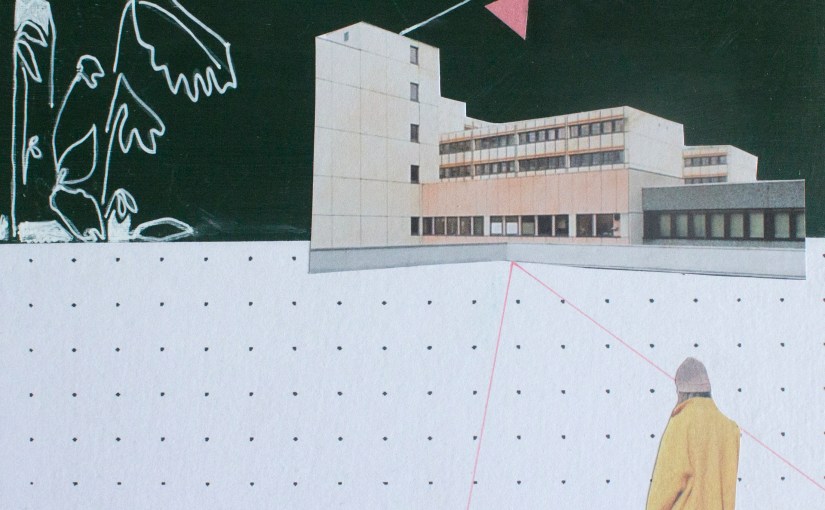
james-gilleard_1

The final transmission from Station Alpha came from General Watkins himself, who had gone to inspect the new device just two days before. Right up until the moment of the explosion, there had been hope that the device, a single man’s dream realized through unprecedented international cooperation, was the solution everyone had been hoping for.

There was no picture in the final transmission. Cloaked in static, Watkins’ voice was thick, moaning even. “The Earth’s heart is heavy.” He sighed. “So much heavier than we could even have imagined…” Then the whole facility evaporated.

Marcella Watkins, the General’s wife and special envoy to the United Nations, knew the voice well. It was the one he used when he wanted her to move closer, toward his side of the bed. It was the voice he used for quiet, reflective thoughts he could only express near sleep.

“Something is coming,” Marcella Watkins told her twin sister while the two drank whiskey on her back porch.

Aurelia nodded, watching the branches of the fruit trees rustle in the hot breeze. She didn’t want to say anything that would add to her sister’s burden, but since the explosion there had been a haze in the air that she didn’t like at all, an unnatural chemical sweetness, like bubblegum air freshener in a smoky truck.

“Is there anything I can do for you?” Aurelia asked for the seventeenth time. “Can I make you some dinner?”

Marcella shook her head, loose bits of her silver chignon swaying side to side. She was still wearing her office clothes—a sleeveless white blouse and green wool slacks that must have been far too warm in this unexpected weather. The matching blazer was somewhere in the house.

Even in this state and at their age, Aurelia couldn’t help admiring her sister’s figure—heavy breasts, narrow waist, round hips. She was the shorter of the two, but certainly the better looking. No wonder her life had gone so well—until now at least.

“All those petty skirmishes,” Marcella said, her voice just above a whisper. “All those years of worrying, and in the end, it’s some damned mad scientist scheme.”

Aurelia looked at the lines on her own hands as if they would tell her what to say. “Life will go on,” she murmured, gathering a smile for her sister. “You’ll see.”

Marcella gazed at her twin, admiring how life had spared her the wrinkles that dug valleys in her own skin. She took Aurelia’s hand in both her own and shook her head lightly. “I don’t think it will,” she said.

Aurelia nodded and the two sat on her porch, hand in hand, sipping their whiskeys and breathing the lavender air until the sun went away.


these words by Erika Thorkelson were inspired by the work of James Gilleard

Taisha Cayard in Dialogue with Audre Lorde, “But What Can I Learn From You”

poem

This poem by Taisha Cayard was inspired by Audre Lorde’s “But What Can You Teach My Daughter,” published in Lorde’s 1978 collection, The Black Unicorn 

New Prose: “Bystander,” by Nailah King

overnight-and-unknown-20x20cm-2015-mixed-media

The little boy screamed when he heard the sound of smashing glass. He crept carefully, his tiny hands grazing the hallway walls. He was petrified, but more scared that he would make a ruckus and make his mother angry.

He knocked on the door.

“Mama?”

“Come in,” said the raspy voice behind the door.

The door creaked as he pushed it open. There, sitting by the window, was his mother. The white illuminating her dark brown body, her eyes seemed to glow in the dark.

“I heard a scary sound, Mama.”

She turned to him, all of her warmth filling him like a cup that runneth over. She gestured for him to sit near her. He climbed into her lap. She kissed his head and wrapped her frail arms around him.

“Did you hear it too?”

Her arms relaxed, she patted him gently on the knee.

“Yes, baby”

“What happened, Mama?”

He hopped off her lap, sitting closer to the window, peering out of it intensely, his eyes stirring.

“Where are they taking Daddy?” he shrieked.

She looked at him, sad for her child. Sad that he didn’t yet understand.

They looked down together at a man who had skin like their own. He stood planted, firm, bruises forming. The flashing light of the cop car cast an eerie blanket on the street, covered in red.

The boy whirled around, angry. He didn’t understand.

His mother turned away from the window.

“Mama! What are we going to do?”

She pointed at the cop car.

“Open your eyes, Charlie, and look,” she hissed.

The boy planted his palms against the window, his nose touching the glass, and he stared. The cop car windshield was broken. A bat, discarded, lay on the asphalt.

“It’s not Daddy’s fault,” he murmured, tears stinging his eyes.

His mother merely nodded.

“He did say, if they came back…something would happen,” she said in a sibilant, almost to herself.

He looked out again. There was a woman in a hat staring back at them. He burst out of the room.

“Charlie! Where are you going?” she asked.

But, he was gone.

He struggled to push the heavy building door. Then, he saw her.

He stood there, staring as her blonde hair rustled in the icy wind. Goose bumps dotted his arms. He forgot to bring a jacket.

The cop car was long gone. He didn’t know if he’d ever see his father again.

The woman kneeled, still facing him.

“Did you know the man they took away?”

“You saw it! Why didn’t you help?”

He pushed her and watched her fall to the ground, as if in slow motion. He watched her tumble, instantly regretting what he’d done. Still, he stood with his tiny frame, chest rising and falling with anger. He said nothing, as she had done.

He walked back to the building and reached for the correct buzzer.

Above, a woman in all white looked out the window.

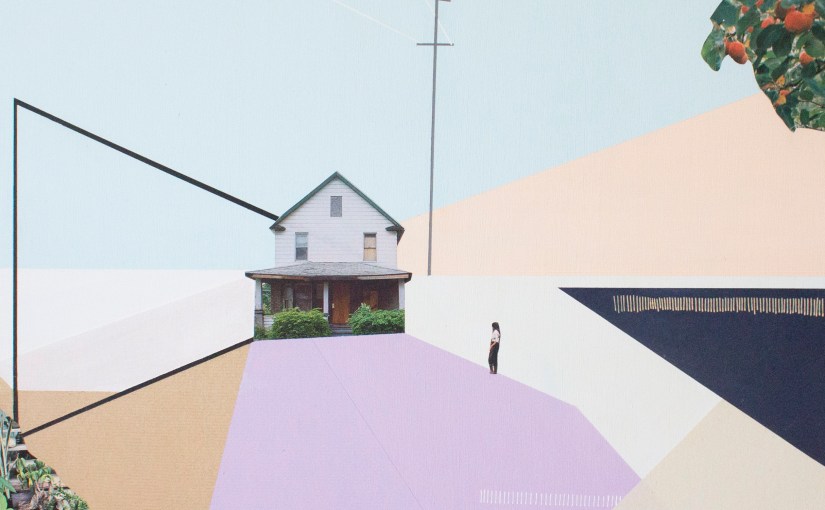
these words by Nailah King were inspired by the work of Mairi Timoney

New Poetry: “Later,” by Jess Goldson

later-30x30cm-2014

‘See you later,’
I say to you
as I leave you for the last time.
I do not know it yet, but when I return
our pool will be dry.
There will be no evidence
of our glorious summer days
soaking in the sun;
nor remnants of our gin-soaked laughter,
as we trudge through the snow in the winter.
You are gone; I wish I were.
I see telephone lines as they reach through the countryside,
searching for you,
and I feel your voice vibrate through your body,
while I rest my head on your chest.
I see the curve of an arch,
and I remember how miraculously our bodies fit together.

these words by Jess Goldson were inspired by the work of Mairi Timoney

New Prose by Josh Elyea: “On Punching a Nazi”

Passing Through


He had a habit where he’d slowly and meticulously pull the hairs out of his beard and pile them, as though they were kindling to start a fire, on whatever surface lay in front of him. It was a disgusting habit, one he was not fond of and one he would’ve judged others for having, and despite his most earnest and steadfast attempts, he was simply unable to quit it.

He wondered if that’s how Trump supporters felt about their casual racism, about their callous disregard for their neighbours. Maybe they wanted to stop, he said. Maybe they were aware of the shame of their habit, maybe they knew what they were doing was wrong. Maybe they just couldn’t stop.

Who cares whether it’s conscious or not, she says. This is the 21st century—we have Google and Wikipedia, for chrissake—and you’ve got the totality of human knowledge at your fingertips. There’s no excuse for ignorance, she says, and he knows she’s right. She’s cool, of the old-school variety. Think Dana Scully, but with more heart. When she speaks, it’s with a sort of callous candor, a ruggedness of speech that only works when underscored by a passionate sincerity. She listens to old jazz records and calls Louis Armstrong by his proper name (Satchmo, she says with love, and she blows him a kiss across the time-space continuum). As he stares, it seems as though she’s blurred into the landscape, a variety store Venus on the warpath, ready to lay waste to the barbaric conservative politics that have, almost overnight, eclipsed the American consciousness.

The future is female, she tells him, and he knows that she’s right. How could it not be, with an arbiter like this?

Maybe it’s time to take off the kiddie gloves, she says. Maybe, just maybe, the left has been playing nice for too long, and it’s time to stop rolling around in the mud with the GOP.

It’s time to call alternative facts what they are: propaganda.

It’s time to call Trump’s Muslim ban what it is: racism.

It’s time to call the alt-right exactly what they are: Nazis.

Maybe it’s time to stop giving credence to the idea that we’re all entitled to an opinion, regardless of whether that opinion is right. You’ve got the right to an informed opinion, but fuck those people who choose ignorance over equality. Maybe we need to stop playing to our slowest members, and maybe we need to grab these petulant, misinformed, archaic relics of a bygone era by the scruff of their hypocritical necks and smack them until they realize that the only ones who don’t deserve a place in the world we’re building is them.

Of course we ought to strive to live in harmony, of course. In fact, that’s exactly what most of us are trying to do. But there comes a time when punching a Nazi isn’t just the right thing to do, it’s the only thing to do.


these words by Josh Elyea were inspired by the work of Mairi Timoney

New Prose by David Emery

Dimension

A house is not the same twice. Even if I stare long and hard and try not to blink and let the breeze distract, the house changes right in front of me. That was and was not my room. That was and was not the crooked porch roof. Was that wall always that short? It’s not the way I remember it and can’t be. How dare the house change? How dare it bend time and space? A person can’t be prepared to expect that. It used to be simple to start at the mouth of a neighbourhood and make your way to the belly. When you’ve been gone from a neighbourhood for twenty years, and you make your way back to that neighbourhood, that neighbourhood tries to throw you up.

Some neighbour I don’t recognize gives me a dirty look from two doors down, watching me to see what I’ll do. She’s tired of watching kids break through the plywood planks, carrying spray cans in their backpacks; when she calls them out they laugh at her wrinkled face and toss rocks at her Oldsmobile. You can’t blame a woman like that for being suspicious. I don’t half believe I’m standing here myself. Down the road, kids play ball hockey, treading new marks into freshly seeded grass, thrashing their sticks against the concrete curbside, taking chips out of something that always kidded me into seeming permanent. It would always be the same street and the same sun and the same gardens and trees, but at some point it stopped being the same. Now it stands here like a forgetful elderly relative, politely asking for a reminder, some flicker of a memory I can lay before it to make the house say, “Yes, I am the house you remember; you have all my love, you always have and always will.”

You don’t grow in a house. The house shrinks around you, becoming too small for your body until you have to escape through a front window before it splinters and cracks from clenching at your waist. Mostly they don’t bother to knock houses down. Curious. They stay standing and you keep growing and before you know it everything is in bits and pieces. This house is a standing nightmare. I wish I had the guts to step inside and reclaim that bedroom that was and was not mine. I’d yank the plywood out of the window and stay looking out at the streets until the sun went down, and the kids playing ball hockey were called in to eat, and the falling sun spread rays through the branches of the trees that have also changed, and the woman eyeing me suspiciously called the police on me.

If I’d been dragged out of here by force twenty years ago, that might have killed the urge to come back. I wouldn’t be standing in front of this house, watching it change, feeling myself shrink, feeling digested.

these words by David Emery were inspired by the work of Mairi Timoney

“Water Snakes or Medusa,” by Keah Hansen

sonia-alins-miguel_4

The views expressed in the texts do not necessarily represent the views of the artist.


She asked, “Why is it that women are always drowning?”

And Kate Chopin replied, “The voice of the sea speaks to [her] soul.”

And this soul seemed to wash out over the sidewalks like leafs held by puddles. They were singularly beautiful and flickered in the mid-afternoon sun and then almost jumped like fish in a koi pond. I thought of that good Lady of Shalott as a leaf, perhaps oak, swirling in a soapy green dress then resting amongst the reeds and silt. A body proffered to the sublime. The “dark continent.” The flumes of smoke that rest on eyelids or the foams that fork the beach into bits that yield and bits that take. The water admitted her hunger, spit it out with opal teeth, and the subconscious grasped another victim. But who, I wondered, had first moulded water into a woman?

I walked home and broke eggs in a pan. They sung and floated merrily in butter. I asked aloud, “Who would have the audacity to decide on a woman’s body or soul?”

And these words sizzled like life itself on the floorboards. They scratched the ears of my cat mindlessly and drew quizzical circles of soapy water on the moon-shaped plate in the sink. This soul seemed to hide inside the crinkles of the tissues. Or the steam from a lavender-scented bath. It even nestled in the roots of the houseplant when fed droplets from the dripping tap. But I was ravenous so I ate and thought and moved my body through the kitchen, falling into the news headlines and letting the water recede to wreak havoc in the basement.

Then a nasally voice bleated, “Storm warning in effect.” It was Clorox, which smartened up the murky underpinnings of each woman in her home, breaking eggs into pans and thinking. At this point, I used my tissues and waded into a bath soaked with the sounds of violin and imagined myself a muse then invoked all the saints of this city. The secular and sacred vied for me and I wondered which institution would best house my eyes and swaddle my soul in warm linen, made to look like silk.

I glanced outside and saw teardrops clawing at the windowpane and gathering strength in the rivets thrush against the vines. Then I heard the strength of a voice, and another, break through this window and worm into my submerged ears. It was the distinct sound of soul, not misty nor desperate but full as wildflowers bunched with string. I hunched my shoulders and raised myself, steaming, from that bath and pressed my forehead to the window. The tears had morphed back to rain, and there were women, not woman, moving through the streets with volition. The puddles remained but the leafs were trodden upon and the moving mouths were buttresses for all types of watery symbols.

I dried my legs and arms in time and gently pressed a towel against my wide eyes. Then I donned some clothes and linked with someone’s hand, though my hair still gleamed with wetness.


these words by Keah Hansen were inspired by the art of Sonia Alins Miguel

“Tinaja,” by Ruth Daniell

dona-daigua_4_2014

The views expressed in the texts do not necessarily represent the views of the artist.


Sometimes you wish you could forget your body,
walk away from its needs and all the ways you believe

it fails you. You are not always kind. Just now
you are scrambling up a canyon. The rock is red

and the sky is blue. This is your first time in the desert
and you had not expected to be so in love

but you are. You love the deep blue sky
and the yellow and orange and red sandstone

and the creosote bush and the Joshua trees and
you note with curiosity that the beauty doesn’t

make you less aware of your small self,
it doesn’t take you away from your body. No,

instead your body is a marvel, too, a marvel
that carried you to these other marvels, the sky,

the rock, the creosote bush and the Joshua trees and
now, finally, to the tinaja, this natural basin

carved by wind and filled with rare desert rain. It is
uncommonly wonderful: cool and green and quiet.

Your own body took you here. It is wonderful, too,

to notice your body in this way, when so often

you notice it only when you are hungry or thirsty

or tired or too hot or too cold or you have to pee

and you’re miles from the nearest rest stop.

Your body will be inescapable for your entire life

but you will not be ungrateful. You will press

your hands onto the smooth sandstone

and feel where the wind has come and gone
and will come again and slowly change the world.


these words by Ruth Daniell were inspired by the art of Sonia Alins Miguel

New Prose Poem: “Washi Tales,” by Ilona Martonfi

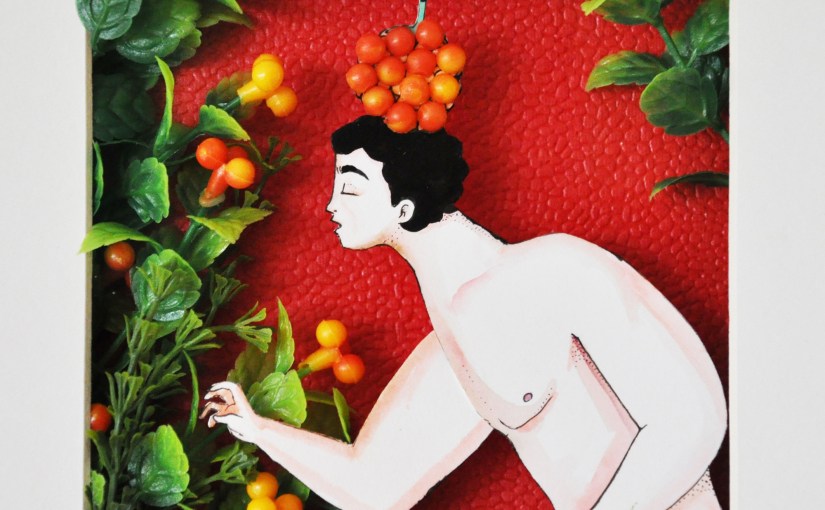
the-forbidden-fruit

The views expressed in the texts do not necessarily represent the views of the artist.

i.

No one in the village will tell her. The repossessed house. Her childhood home. The rotting wood. Four rooms. Iron stove. A table. A mother and a father. Two sisters, little brother. Grandmother. Sand dunes, grasslands, reed-lined backwaters, tiny white farms. Disassembled.

Poïesis clangour. Percussive bowing. Scavenging emptiness. Improvisation, nomadic process. Obsessive. The marginal and maimed. That which is cast out. A place of no place. Into the nothing. Riffing off these lines. Her mother reporting the bad news. Or retelling old bad news. Keeping track of shapeless, violent births; confessions and letters; the omen unfolding in real life. Shuffling. Slurring. Inept.

A purple iris. Faceless, carrying her. Name folded into another name. Put black paint back to its unblemishedness. Unbruised.

ii.

Wading in warm mud. A womb. Tales of sexual predation. Cruel loneliness.


these words by Ilona Martonfi were inspired by the art of Sonia Alins Miguel