On Homophobia and Masculinity: “Shame”

front

We were the kind of drunk you can’t really get once you’re adult, once you have a job and pay rent. The kind of drunk only teenagers can achieve. Delirious to the sound of our own nonsense, K and I staggered back towards Jayne’s mum’s garage.

Pat and Jayne peeled away ahead of us. Their hazy dark shadows disappeared into the distance as we trailed behind.

*

       I fucking love you, K said to me with a smile- he laughed, his attention pulled away.

You too, bro… you’re obviously way more wasted than me,

Screw you-u-u


His last words struck with a hiccup, face turned up into a snarl. He shoved me hard just below the collar bone; unbalanced, I fell back.
What are you doing?


Don’t fucking laugh at m-m-e-e


Another shove to balance broken syllables, his face drove in close to mine.


What the fuck are you guys doing?


K’s older brother strode over – I hadn’t seen him until now – his presence shifted K’s attitude.

*

       Together, we poured into the garage. Weathered carpet cuts laid from wall to wall. Rushed graffiti and blinking fairy lights and a cheap cylindrical fold-out bed. Wasn’t much but it was enough to be ours. The only place we could smoke in ease and there was something in that.

The lights blew and K’s brother and Jayne seemed to be fucking each other; always Pat and Jayne. The music wasn’t as loud as their drunkness calculated.


What the fuck was that about before? I whispered to K.


I stared fiercely into the pitch black.


I love you


We were best friends. He had always been a better brother than any of mine had been. He and his dad only had each other, so I was always around. It just worked.


Stop fucking around

Is that wrong?


I staggered out into a wall; my head was spinning; I staggered out into the dark.

*

I didn’t talk to him. Years. When he came out I still didn’t talk to him. He never called. He could not be a real man. I was the last of our high school friends to reach out to him. Everyone knew I was last. He never answered. They stopped texting me- but I was a man. I am a man. I am a man.


word by Sam Fresco

colour by Fintan Magee

Born in Lismore NSW, Fintan Magee moved to Brisbane as a child and began drawing shortly after. In his early teens he was exposed to Brisbane’s graffiti culture and began painting on walls.

Moving away from traditional graffiti in recent years, his large-scale murals often inhabit the isolated, abandoned and broken corners of the city. Mixing surreal and figurative imagery his paintings are deeply integrated with the urban environment and explore themes of waste, consumption, loss and transition and contain a sentimentality and softness influenced by children’s books.

He has traveled extensively completing projects in Sydney, Melbourne, London, Vienna, Los Angeles, Miami, Atlanta, Bogota, Buenos Aires, Copenhagen, Moscow, New York, Oslo and Dublin amongst others. His diligence, technical skill and progressive approach to painting have solidified his reputation as one of the leading figures in Australia’s Street Art and Contemporary Mural movements.

On Memory: “A Kind of Red”

Josh - Marina Gonzaleseme

There was a point, close to the edge of my memory, when all my stories started sounding the same, rehearsed; a point when I found myself clicking on the same websites every day, brain rotting, literally rotting in my skull; a point where rage and riot and raucousness were replaced by routine. I’m vitriolic in the face of routine.

I can’t help but feel like I used to be a much more interesting person. And this feeling, it’s pulling me apart. I can’t even tell youwhen I was more interesting – I just was. I can’t tell you what it was.

I’ve often wondered what might happen to my record collection if I were to up and disappear, what’s left of me no more than a puff of smoke carried towards the horizon on a westerly wind. Most of my stuff is just that, stuff…but my records? That’s me, man. If there’s one interesting thing about me, it’s my record collection. 

Faces on album covers, track lists, liner notes, mix tapes, Motown, delta blues, the Clash (original U.K. pressings only, fuck those American re-releases) and Abbey Road and the more obscure stuff, The Gun Club and Captain Beefheart all blur together to form a comprehensive understanding of an individual. My autobiography. The legacy of a puff of smoke. A subject for future study.

Even just talking about this, I can feel an uneasy frustration settle so deep it’s sticking to my bones. I am entirely unable to glue the interesting bits of myself back together. I’m grinding my teeth as I drop the needle on the turntable. Miles Davis, Kind of Blue. It’s funny, because I feel red. 

word by Josh Elyea

From the author: “Perhaps more than ever, I find myself being pulled in multiple directions. I’m often disparate, distracted and unfocused in the face of constant stimulation (from a wide variety of sources and mediums). When I saw this piece, it spoke to that feeling in me, the idea of being pulled apart and never quite being put back together, of lusting after some evanescent sense of fulfillment that may or may not lie right around the corner. It was quite a visceral reaction, and it left me wondering if others experiences this sense of deconstruction as well, this feeling of not being whole.” 

colour by Marina Gonzalez Eme 

Issue #218: You’re Not Racist If You Find Me Pretty

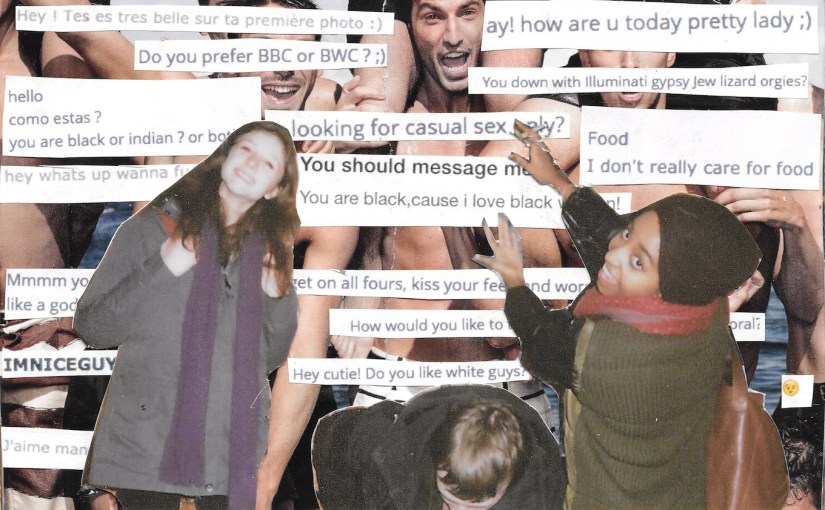
wow okcupid

“You’re not racist if you find me pretty”

Sitting downtown Montreal, mid-afternoon spring, at the kind of booth that makes your pelvis sink, in the kind of café where you can stay for hours without buying a thing.

And no one has cleared the cups of soggy knotted teabags. The staff are wearing collared polyester and leaning against the display cooler. The windows are level with the sidewalk and people’s shoes and ankles and bicycle-wheels pass by our heads.

*

Earlier  I saw someone smoking under the awning in the rain and thought of you. I thought of how beautiful you are, and I don’t tell you this, but know that I could and that would be alright too. Tomorrow is your third date with someone more than cut and paste.

*

What do you do on a Friday night?
I wash my arms.
Oh.
And your life? What are you doing?
Nothing.
I love you.

*

Because she couldn’t hear past the barking anymore, the low growl and the hiss.


No, you’re not racist if you find me pretty.


Attends: tu penses que je suis raciste? ?
Je voulais juste savoir
 d’où tu viens
je te trouve          belle.

 *

Your curiosity tastes like vomit. Your curious  entitlement to interrogate my ancestral origins,  colonial narratives of migration, grief, diaspora that we have not unraveled and yet exist through—

to draw forth the accumulation of every other moment before this when a dark body has been a site of violent intrigue.

Because she looks exotic: sweetpotato caramel, something to bite into with pleasure.

Flesh beneath your tongue, your words are never innocent, loaded with power you may not have asked for, granted by default you entrench entitlement.

*

This is your responsibility, white man: swallow your tongue,

direct your gaze to what’s
charging your bark.


We are not laughing.

//

You say you’ve been watching men jogging and you’ll let me know how it goes.


word by Alisha Mascarenhas

colour by Jasmine Okorougo 


Issue 217 (Gender, Sexuality): “IN THE BATHROOM”

unnamed

“IN THE BATHROOM”

May and Silas lie on the bed. May knows that it would be worthwhile having sex right now—to feel close to him, to remind him that she is not ordinary. Right now she would rather have sex with her substitute science teacher (he had that hair that she liked, it licked up the back of his neck) or the butch woman who had stared at her in the waiting room at the dentist after school yesterday. The staring had made her go red in the face and her vagina spasm in a way that Silas’s gaze hadn’t in months.


Silas turns his slender frame towards her. He is fine and delicate. I’m bored, he grins, let’s cuddle. She grins back and stretches out her arms to pull him in—her arms over his shoulders as always, her body bigger and darker than his will ever be. They kiss and then she pulls back just enough for him to pull back too. Do you want to, he asks, hot breath smelling of closed rooms and wet toilet paper. She pauses. Yes. His eyes coat her in beauty—when he is aroused she feels like he sees her better. She can toss her head and whinny, like a mare, and he will kiss her pulsing veins. They help each other to pull off their clothes: her undies, his exhausted boxer briefs. There is always a laugh here, when her undies are down around her ankles and she is shifting and twisting to fling them off. Sexy, he says.


Moans. Noises she never makes at any other time but that she consciously makes now. Light, quick breaths on his collarbone and light, quick bites of his stretched out neck skin. She doesn’t feel like it until his penis goes in. Then it does feel good, good, like she tells him.


May rolls over, taking Silas with her until he is underneath. She can feel the sweats of each of them slipping and creaking against each other.  She is provocative up here. Silas is beaded lightly all over and his eyes bulge. May resists an urge to reach out and gently move his hair from out of his eyes. This must be over quickly before the sheen wears off and he starts to see the hair on her arms, her pores. Silas tells her he loves her. She feels the warmth of the words in her fingers and her vagina aches just behind and below the labia when she looks down to see his light tuft and her dark one, their tufts, bouncing against each other.


Silas pulls her hips tight in against his own and heaves at her, the sound a bath drain slurping. May breathes out and pulls the sheet across her shave-cut legs. She will bring herself to climax later, will run the tap to quiet her sounds, in the bathroom.

word by Laura McPhee-Browne

From the author: “I saw this art piece as the collage of a girl going through the emotions of becoming a young adult.

 
This art piece brought back to me the insecurities, anxieties and play-acting aspects of being a young woman, and I decided to write a story that delved into the mind of a young woman trying to be ‘normal’ and to do ‘normal’ things, such as having satisfying, meaningful sex with her boyfriend, despite the ambiguity and complexity of such an act.
 
Through my story, I also wanted to get across how much pressure there can be on young women to be ‘nice’, to be ready and willing, and to be relaxed, and to sacrifice their own pleasure and well-being for the sake of men, when this is an impossible and unrealistic expectation. I believe that the various slogans in the art piece, ‘BEING NICE IS COOL’ and ‘DON’T FRET’ are the slogans that young women chant inside themselves, when really it should be okay to not be okay.”

colour by Jasmine Okorougo

Issue #215: On memory and colour

OLYMPUS DIGITAL CAMERA

When I look at my hands I start to cry. Leathered and worn, dry skin flakes between my fingers and my lifelines seem etched into my palms, my hands are permanently stained; dark hues of purple and green crept below the surface, and stayed there. My life is on my hands and I can’t hide the fact that I have graced many a wall with my personal epithets. I staked my claim, marked my territory with a manifest destiny-type vengeance and sought out every clear space, every void, and every emptiness to fill it.
 art colour memory
My face is wet and I let the tears fall freely from my face. My hands lay in my lap, unmoving, poised for continued inspection. They tell every memory and moment and hurt with the knowledge of a past ached for.
  art colour memory
In the summer time heat, the humidity was thick and held the paint in the air around me. I searched the streets for new ground and found beautiful canvasses in the neatly tucked away spaces between buildings, inside dimly lit tunnels and parking lots; these were areas ripe for beautification. Can always at the ready, I would surveil the area and quickly throw up my tag. I would come home tinged in color, turned sepia, a danger to all white surfaces in my vicinity. I would take my black off, strip down bare, lay on my back, raise my arms in the air and look at my hands with intense interest. Color caked in the crevices of my cuticles and my knuckles darkened by the paint in the creases of my skin. I would lay there until my arms were tired, feeling the adrenaline leave the extremities of my body. Right index finger bent, I would practice above my head, my tag lines fluid, clean and quick. They littered the pages of my school books, and even now, the discarded envelopes that formerly housed my bills, bank statements and junk mail. I make my mark everywhere, although no one else sees it now.

word by Cora-Lee Conway

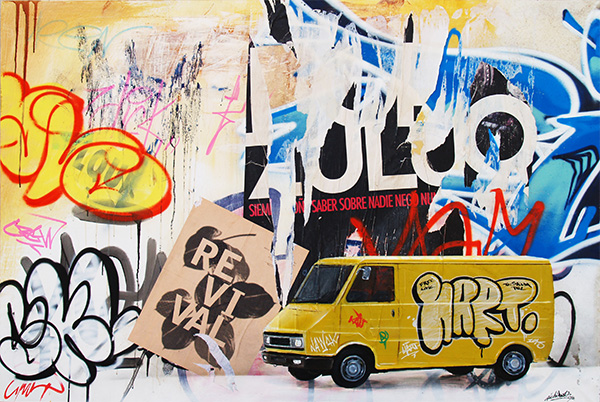
colour by Pichi&Avo

Review: Justseeds Vernissage Confronts Injustice

support1

Justseeds’s artists Mary Tremonte & Jesse Purcell put up a wonderful exhibit last Friday – with Tremonte DJ-ing and Purcell showing off artwork from the thirty person collective, as part of the Howl! Arts FestivalJustseeds is a decentralized network of artists that produce pieces highlighting social, environmental and political injustices.

support

buy this print now by Jesse Purcell

One project, “Celebrate People’s History,” has been fifteen years in the making, and recognizes and commends ‘little people protesting big things’ through print art.

‘Big events’ include the Ejército Zapatista de Liberación Nacional (EZLN) in Chiapas, Mexico, protesting the American Free Trade Agreement in 1994, or the 2011 Wisconson protests that opposed the Wisconsin Budget Repair Bill.

02wisco_400.jpg


buy this print now by Sue Simensky Bietila

For those of you who missed Justseeds’s event last week, don’t worry! You can still check them out online at justseeds.org

Allison Kutcher, 28 Apr 2015

familyphoto2014.jpg

Support Word and Colour’s live art event!

Review: Howl! and CKUT host panel on austerity

image via Ecole De La Montagne Rouge

As part of the Howl Arts Collective Festival, CKUT FM invited four panelists to discuss artistic resistances to austerity in a live broadcast at Casa del Popolo. In discussing the relation between art and the movement against austerity in Montreal, the chief question was: What is the role of artists in the fight against austerity?

According to the panel – which included artists Edith Brunette and François Lemieux, graphic designer Kevin Yuen Kit Lo, and photojournalist Amru Salahuddien- artists have a choice: they can use their creativity to smooth over the bumps or they can reveal societal tensions through their creations.

However, if art can be used as a space where it is possible to dream, to envision a new future and to picture new social relations, then artists have not only the option, but the responsibility to define and depict an anti-oppressive future in order to raise awareness about austerity and engage discussion.

In addition to the discussion by the four panelists, La Chorale du Peuple, founded in 2011 during the occupation of Square Victoria, denounced neo-liberal policies and inequality through their songs: “Que la vie est belle” and “Ça fait rire les Libéraux.”

A problem underlined by Amru Salahuddien, an Egyptian photojournalist who was on the ground during the Egyptian uprising, was the lack of connections within the international anti-austerity movement. Though the fight against capitalism seems to be a fight that has a certain level of continuity across time and space, the lack of links, not only on an international level, but also within our own communities, has rendered the anti-austerity movement quasi-ineffective.

Salahuddien parallelled the Egyptian and Quebecois students, stating, “while in Egypt, bullets were used against the protesters, the weapon used by the government against Quebecois students was neglect.”

Despite the possibility of connections between these two groups of protesters, Salahuddien criticized the fact that very little support was given to either group by the other: that, though our world is said to be shrinking through technology and social media, there is little global awareness or concern for movements that do not affect us directly.

Concluding the discussion was a conversation about hope, where panelists suggested that if art is used as a tool in the fight against capitalism and the structures of power, it is because artists have hope for a better future, despite their use of seemingly sinister artistic tools, like irony or dystopia, in depicting their criticisms.

Thank you to Howl Arts Collective and to Casa del Popolo for hosting this interesting panel discussion- click here for more events happening this weekend!

Jiliane Golczyk, 23 Apr 2015, Montréal

On Beauty Standards: “Deep Hues and Curves”

untitled

“Deep Hues and Curves”

It was her thirteenth birthday and she’d asked for red lipstick, strapped heels, and an appointment to have her eyebrows waxed. We went to the mall together to try on dresses for the celebration. She wanted pale blue to match the balloons.

She picked one with a frill along the neckline that accentuated her small waist and cut off above the knee. She had flat-ironed her springy brown hair and twirled a smooth lock around her finger as she gazed at me from the floor of the changing room.

“This would look better on you,” she moaned.

I winced. What was unbelievably clear to me seemed positively inaccessible to Ella. How would she react if I told her she looked like Brooke Shields in the pale blue—smooth-skinned, perfect frame?

What I would give to look anything like that.

Instead I mustered a weak, “I like it.”

I saw a spectrum of colour in her eyes.

She shook her head and tossed the dress to the ground. We finally settled on a violet strapless cocktail dress that draped across her body regally.

I came over early to help set up. Her mother asked me to tie the knots as she inflated helium balloons. I watched Ella stride down the living room stairs in the purple dress, lips tinted bright red, eyes lined, she flashed me the kind of grin that said you’re in on the secret.

I smiled back, twisting the elastic of another balloon around a ribbon and letting it float to the ceiling.

How reassuring it must feel to be factory-made.

“Let me do your hair!” She sang, running her fingers through my messy blonde.

I followed her upstairs, where for a moment as she braided, I watched her lock eyes with herself in the mirror. The colour drained from her face and she looked away, turning back to me. “Will you help me go blonde?”

It was somewhat an absurd request, but one to which I was compelled to oblige. The title of best friend came with great levels of moral responsibility.

It was five and guests were supposed to arrive. Her mother was frosting the cake in the kitchen. It was chocolate, Ella’s favourite. She proceeded to dip a slim finger into the bowl of frosting, receiving a glare in return, and a harsh murmur of disapproval. Promptly, she ran her hand under the faucet, sugar dissolving in water, before turning back to me.

“She’s right,” Ella whispered.

I didn’t ask about what.

“I don’t need it.”

I found myself by her side for the remainder of the evening. It felt natural, shadowing her: my image of womanhood. She grasped my hand as she blew out her candles.

After her mother sliced the cake, I watched Ella stare at the plate placed in front of her. She prodded the chocolate with a fork, all the while inhaling the wafting smoke of blue striped candles. Not once did I see her lift the fork to her mouth.

word by Annie Rubin

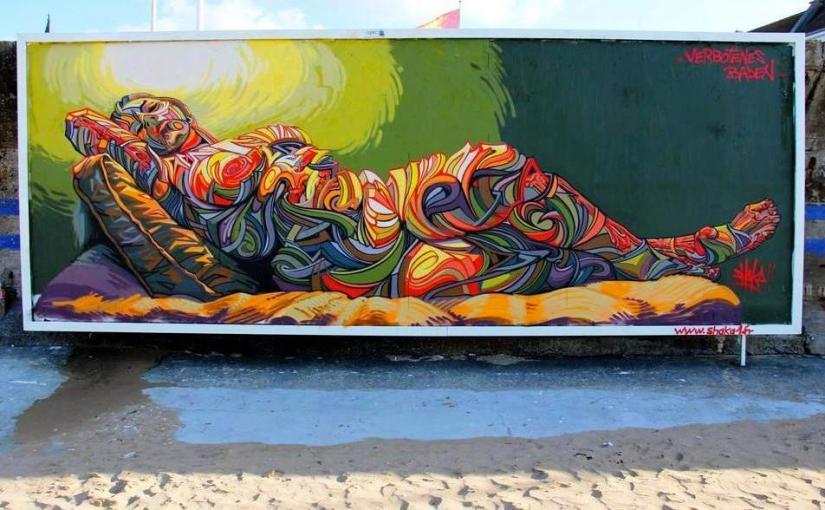
colour by SHAKA

From the author: “Adolescence is the time when our ideals of beauty are explored most thoroughly. As we grow, we learn about ourselves through our parents, our friends, and through what we see in the media.

Often, though, we are our own worst critics—what we see in the mirror is far more flawed than what our friends might see when they look at us.

Each of us are made up of many colours, and once we begin to accept our uniqueness, we can rest as confidently as this figure sprawled upon her couch.”

Support our live art event! 

On memory: “self and other”

image

Despondent at the sight of her, waxing caramel and silk, bruising blue from apathy. Who it is I am looking for in the shape of her, the curve and weight of her bones. The scrutiny of this survey has everything to do with consumption. Mass of flesh, scent of jasmine, soap, talcum powder.

I become suddenly thirsty and my legs fold in like a hand. From every angle calls some small adjustment, something not quite in place, not quite concealed. I remember the shirts I wore in highschool, carefully selected from your laundry pile and big enough for my body to move beneath them unnoticed.

Meanwhile she moved with such a lightness I had never been empty enough to feel, spread her toes across the bathroom counter smoothing lotion into her calves; she had six children for the institutions of God and marriage. What I saw for the sake of this story was the width of her waist on an inhale, saw her spinning across the living room floor. She praised my poetry then stopped calling altogether.

Of course I never expected she would, and this is not really about her, or the blue light of my new apartment where no one eats and everything is covered with a film of dust and the smell of smoke. I blink into the mirror and take a sip from a white, enamel cup stained with her lipstick. I know that I will see her in the kitchen and she will have cut her hair again. She will be quietly frantic, pouring cream in her coffee and letting the filter drip. The garbage can is full of dust and the ends of her cigarettes stained with lipstick.

If the weight of my bones were a little less dense. If I did not bruise under the touch of her fingertips. I could step into this room unfeeling, dressed in animal prints and steel, chewing a stick of gum.

word by Alisha Mascarenhas
colour by Gan Chin Lee 

On Family: “Bug”

152251_orig (1)

Bug

when Benny was 1 and I was 7, I took him down to the park near our place on the lane named after Shakespeare

he’d been at the pool with Mum all morning, tucked behind the blue walls on Alexandra Parade, and his tuft of soft hair was still wet

he nestled into my arm as we walked along the cooking bitumen, and when I crooked my arm to let him in, he cooed like a bird would, if a bird was Benny

at the park I climbed us up the ladder of the slide and put his bum on the cool grey top of it

he giggled as I backed down the rungs one by one and as I walked away from him and the slide and the sand and the dog poo, I felt my heart get bigger slowly like a blowing up balloon

my heart kept getting bigger and bigger as I walked down the street towards the milk bar, and as I was paying for my lemonade icy-pole it burst

Benny was wailing when I got back

I told him I’d just gone to get us an icy pole and he didn’t have to be sad

he was choking on his tears but then the tears slowed to hiccups and then the hiccups slowed to snot and I told him he’d crawled into my heart like a funny little bug, and it was just as well you can’t spray bug-spray near your heart

word by Laura McPhee-Browne

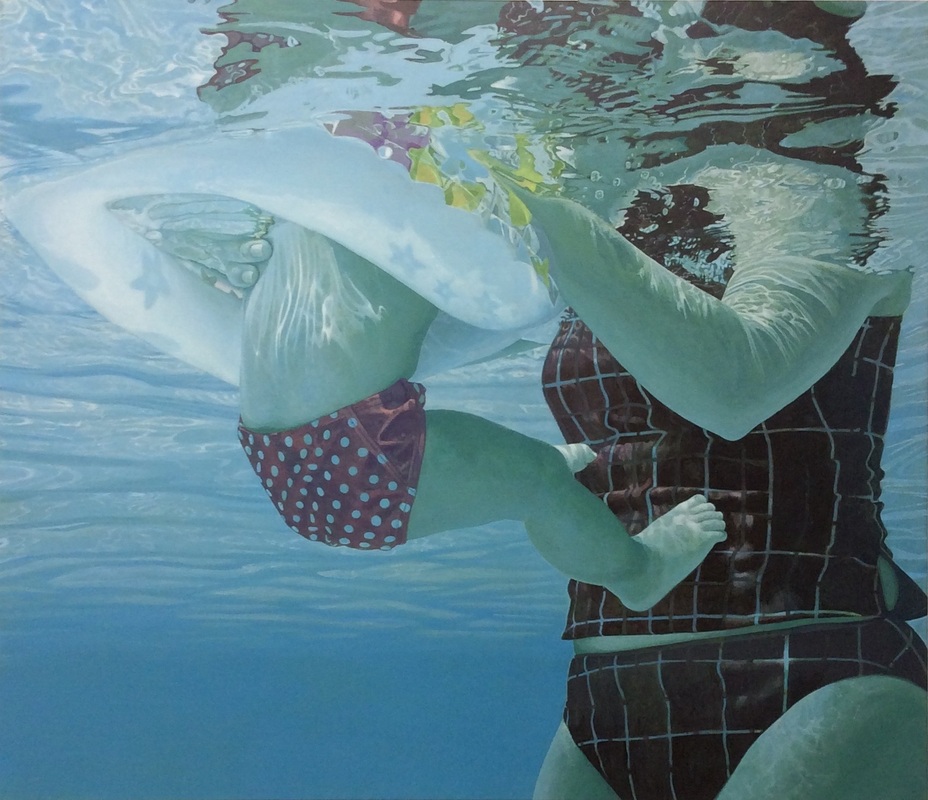
“This painting is beautiful, and reminded me of familial love. 

It reminded about how it for me was when my brother was a baby, and how older siblings often experience a cacophony of emotions when they are confronted with siblings, emotions that are strong and fierce and both negative and positive.” 

colour by Kojiro Ankan Takakuwa