New Prose by Josh Elyea: “On Punching a Nazi”

Passing Through


He had a habit where he’d slowly and meticulously pull the hairs out of his beard and pile them, as though they were kindling to start a fire, on whatever surface lay in front of him. It was a disgusting habit, one he was not fond of and one he would’ve judged others for having, and despite his most earnest and steadfast attempts, he was simply unable to quit it.

He wondered if that’s how Trump supporters felt about their casual racism, about their callous disregard for their neighbours. Maybe they wanted to stop, he said. Maybe they were aware of the shame of their habit, maybe they knew what they were doing was wrong. Maybe they just couldn’t stop.

Who cares whether it’s conscious or not, she says. This is the 21st century—we have Google and Wikipedia, for chrissake—and you’ve got the totality of human knowledge at your fingertips. There’s no excuse for ignorance, she says, and he knows she’s right. She’s cool, of the old-school variety. Think Dana Scully, but with more heart. When she speaks, it’s with a sort of callous candor, a ruggedness of speech that only works when underscored by a passionate sincerity. She listens to old jazz records and calls Louis Armstrong by his proper name (Satchmo, she says with love, and she blows him a kiss across the time-space continuum). As he stares, it seems as though she’s blurred into the landscape, a variety store Venus on the warpath, ready to lay waste to the barbaric conservative politics that have, almost overnight, eclipsed the American consciousness.

The future is female, she tells him, and he knows that she’s right. How could it not be, with an arbiter like this?

Maybe it’s time to take off the kiddie gloves, she says. Maybe, just maybe, the left has been playing nice for too long, and it’s time to stop rolling around in the mud with the GOP.

It’s time to call alternative facts what they are: propaganda.

It’s time to call Trump’s Muslim ban what it is: racism.

It’s time to call the alt-right exactly what they are: Nazis.

Maybe it’s time to stop giving credence to the idea that we’re all entitled to an opinion, regardless of whether that opinion is right. You’ve got the right to an informed opinion, but fuck those people who choose ignorance over equality. Maybe we need to stop playing to our slowest members, and maybe we need to grab these petulant, misinformed, archaic relics of a bygone era by the scruff of their hypocritical necks and smack them until they realize that the only ones who don’t deserve a place in the world we’re building is them.

Of course we ought to strive to live in harmony, of course. In fact, that’s exactly what most of us are trying to do. But there comes a time when punching a Nazi isn’t just the right thing to do, it’s the only thing to do.


these words by Josh Elyea were inspired by the work of Mairi Timoney
New Prose by David Emery

Dimension

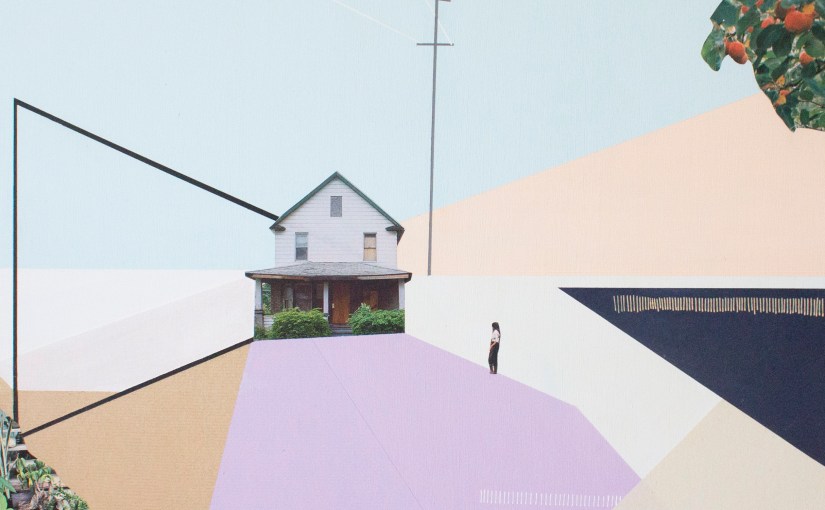
A house is not the same twice. Even if I stare long and hard and try not to blink and let the breeze distract, the house changes right in front of me. That was and was not my room. That was and was not the crooked porch roof. Was that wall always that short? It’s not the way I remember it and can’t be. How dare the house change? How dare it bend time and space? A person can’t be prepared to expect that. It used to be simple to start at the mouth of a neighbourhood and make your way to the belly. When you’ve been gone from a neighbourhood for twenty years, and you make your way back to that neighbourhood, that neighbourhood tries to throw you up.

Some neighbour I don’t recognize gives me a dirty look from two doors down, watching me to see what I’ll do. She’s tired of watching kids break through the plywood planks, carrying spray cans in their backpacks; when she calls them out they laugh at her wrinkled face and toss rocks at her Oldsmobile. You can’t blame a woman like that for being suspicious. I don’t half believe I’m standing here myself. Down the road, kids play ball hockey, treading new marks into freshly seeded grass, thrashing their sticks against the concrete curbside, taking chips out of something that always kidded me into seeming permanent. It would always be the same street and the same sun and the same gardens and trees, but at some point it stopped being the same. Now it stands here like a forgetful elderly relative, politely asking for a reminder, some flicker of a memory I can lay before it to make the house say, “Yes, I am the house you remember; you have all my love, you always have and always will.”

You don’t grow in a house. The house shrinks around you, becoming too small for your body until you have to escape through a front window before it splinters and cracks from clenching at your waist. Mostly they don’t bother to knock houses down. Curious. They stay standing and you keep growing and before you know it everything is in bits and pieces. This house is a standing nightmare. I wish I had the guts to step inside and reclaim that bedroom that was and was not mine. I’d yank the plywood out of the window and stay looking out at the streets until the sun went down, and the kids playing ball hockey were called in to eat, and the falling sun spread rays through the branches of the trees that have also changed, and the woman eyeing me suspiciously called the police on me.

If I’d been dragged out of here by force twenty years ago, that might have killed the urge to come back. I wouldn’t be standing in front of this house, watching it change, feeling myself shrink, feeling digested.

these words by David Emery were inspired by the work of Mairi Timoney

“Water Snakes or Medusa,” by Keah Hansen

sonia-alins-miguel_4

The views expressed in the texts do not necessarily represent the views of the artist.


She asked, “Why is it that women are always drowning?”

And Kate Chopin replied, “The voice of the sea speaks to [her] soul.”

And this soul seemed to wash out over the sidewalks like leafs held by puddles. They were singularly beautiful and flickered in the mid-afternoon sun and then almost jumped like fish in a koi pond. I thought of that good Lady of Shalott as a leaf, perhaps oak, swirling in a soapy green dress then resting amongst the reeds and silt. A body proffered to the sublime. The “dark continent.” The flumes of smoke that rest on eyelids or the foams that fork the beach into bits that yield and bits that take. The water admitted her hunger, spit it out with opal teeth, and the subconscious grasped another victim. But who, I wondered, had first moulded water into a woman?

I walked home and broke eggs in a pan. They sung and floated merrily in butter. I asked aloud, “Who would have the audacity to decide on a woman’s body or soul?”

And these words sizzled like life itself on the floorboards. They scratched the ears of my cat mindlessly and drew quizzical circles of soapy water on the moon-shaped plate in the sink. This soul seemed to hide inside the crinkles of the tissues. Or the steam from a lavender-scented bath. It even nestled in the roots of the houseplant when fed droplets from the dripping tap. But I was ravenous so I ate and thought and moved my body through the kitchen, falling into the news headlines and letting the water recede to wreak havoc in the basement.

Then a nasally voice bleated, “Storm warning in effect.” It was Clorox, which smartened up the murky underpinnings of each woman in her home, breaking eggs into pans and thinking. At this point, I used my tissues and waded into a bath soaked with the sounds of violin and imagined myself a muse then invoked all the saints of this city. The secular and sacred vied for me and I wondered which institution would best house my eyes and swaddle my soul in warm linen, made to look like silk.

I glanced outside and saw teardrops clawing at the windowpane and gathering strength in the rivets thrush against the vines. Then I heard the strength of a voice, and another, break through this window and worm into my submerged ears. It was the distinct sound of soul, not misty nor desperate but full as wildflowers bunched with string. I hunched my shoulders and raised myself, steaming, from that bath and pressed my forehead to the window. The tears had morphed back to rain, and there were women, not woman, moving through the streets with volition. The puddles remained but the leafs were trodden upon and the moving mouths were buttresses for all types of watery symbols.

I dried my legs and arms in time and gently pressed a towel against my wide eyes. Then I donned some clothes and linked with someone’s hand, though my hair still gleamed with wetness.


these words by Keah Hansen were inspired by the art of Sonia Alins Miguel

“Tinaja,” by Ruth Daniell

dona-daigua_4_2014

The views expressed in the texts do not necessarily represent the views of the artist.


Sometimes you wish you could forget your body,
walk away from its needs and all the ways you believe

it fails you. You are not always kind. Just now
you are scrambling up a canyon. The rock is red

and the sky is blue. This is your first time in the desert
and you had not expected to be so in love

but you are. You love the deep blue sky
and the yellow and orange and red sandstone

and the creosote bush and the Joshua trees and
you note with curiosity that the beauty doesn’t

make you less aware of your small self,
it doesn’t take you away from your body. No,

instead your body is a marvel, too, a marvel
that carried you to these other marvels, the sky,

the rock, the creosote bush and the Joshua trees and
now, finally, to the tinaja, this natural basin

carved by wind and filled with rare desert rain. It is
uncommonly wonderful: cool and green and quiet.

Your own body took you here. It is wonderful, too,

to notice your body in this way, when so often

you notice it only when you are hungry or thirsty

or tired or too hot or too cold or you have to pee

and you’re miles from the nearest rest stop.

Your body will be inescapable for your entire life

but you will not be ungrateful. You will press

your hands onto the smooth sandstone

and feel where the wind has come and gone
and will come again and slowly change the world.


these words by Ruth Daniell were inspired by the art of Sonia Alins Miguel

New Prose Poem: “Washi Tales,” by Ilona Martonfi

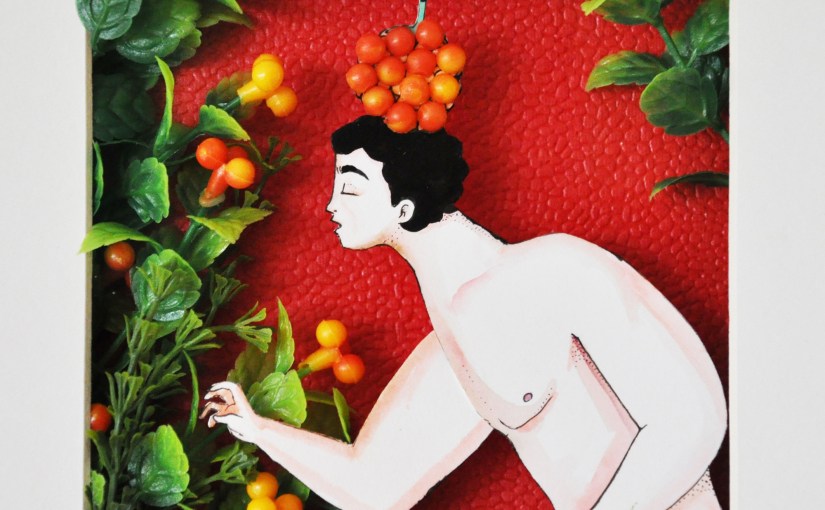
the-forbidden-fruit

The views expressed in the texts do not necessarily represent the views of the artist.

i.

No one in the village will tell her. The repossessed house. Her childhood home. The rotting wood. Four rooms. Iron stove. A table. A mother and a father. Two sisters, little brother. Grandmother. Sand dunes, grasslands, reed-lined backwaters, tiny white farms. Disassembled.

Poïesis clangour. Percussive bowing. Scavenging emptiness. Improvisation, nomadic process. Obsessive. The marginal and maimed. That which is cast out. A place of no place. Into the nothing. Riffing off these lines. Her mother reporting the bad news. Or retelling old bad news. Keeping track of shapeless, violent births; confessions and letters; the omen unfolding in real life. Shuffling. Slurring. Inept.

A purple iris. Faceless, carrying her. Name folded into another name. Put black paint back to its unblemishedness. Unbruised.

ii.

Wading in warm mud. A womb. Tales of sexual predation. Cruel loneliness.


these words by Ilona Martonfi were inspired by the art of Sonia Alins Miguel

“For Those Who Don’t Fit Into Boxes,” by Shagufe Hossain

blok_1200px

Growing up
I never lived
in houses with lawns or little gardens or backyards,
with weeping willows or wooden benches.

 I lived,
sometimes,
in a city
where pedestrian walkways,
‘footpaths’ they were called,
were resting places for those who couldn’t afford rooftops
over their heads.

 I lived in apartment buildings,
boxes stacked one on top of the other
to save space
in overpopulated cities—
in lands
dominated,
sliced up
with sharp blades of politics, religion and language
and distributed
like a decadent dessert (not enough)
amongst gluttons, never satisfied.

 But these spaces for living?
They constructed and constricted
and made it difficult to breathe
in boxes,
with each wall
closing in,
a divide,
made of those very same blades.

 Now these boxes stand
stacked one on top of the other
with one wall, standing tall,
the wall of class
(check box: rich/poor)
one wall, standing tall,
the wall of gender
(check box: male/female)
one wall, standing tall,
the wall of body
(check box: abled/disabled)
one wall, standing tall,
the wall of beauty
(check box: fair-skinned/dark-skinned)
one wall, standing tall,
the wall of knowledge
(check box: valid/invalid)
Mighty walls, standing tall, solid
with edges like blades.

 I lived,
sometimes,
crossing over to the other side.
But these walls with their sharp edges
would cut into my flesh
so I grew up
wounded,
bleeding.

 And these boxes?
They worked
for those who lived in black-and-white worlds.
Lazy minds, refusing to see colours or greys,
fitting themselves into moulds
as others saw fit,
gift-wrapping themselves in societal expectations
and presenting themselves
(happily?)
to a world
that was ready
for no more.

 But not you and I.
You and I
stood either somewhere in the middle, bleeding,
or outside,
in a corner
of a verandah
looking at the skies, limitless,
using boxes with pinholes,
projecting realities,
our own,
to capture the essence of life.
Breathing.


these words by Shagufe Hossain were inspired by the work of Marcin Wolski

“View From the 20th Floor,” by Jo-Ann Zhou

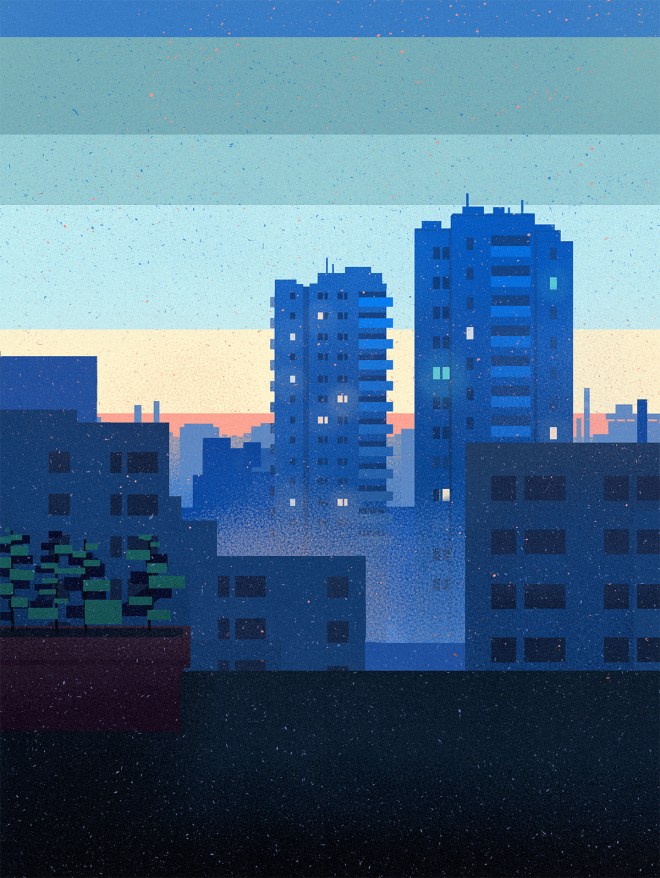
widok_1200px

content warning: abusive relationships

When the tiny rays of light were desperately grasping at the sky, when almost all the lights in the city beyond had turned black—that was when he came alive. His wine-stained teeth, the colour of dried blood caked into the crevices, would start to quiver as finally his lips moved at a rapid pace. At last, I would think. At last he is here. Here was the version of the man I liked and knew: interesting, articulate, prone to philosophical rants about metaphysics. He shone so much brighter than the version of himself with clean teeth—the version that only appeared when the sun was up, when the sky was too blue and bright—timid, uncertain, unwilling to express much more than the occasional nod by way of emotion.

I don’t know what drew me to him. Maybe it was because he was smart in ways that I wasn’t, and a few years older, and so completely unlike anyone I had ever met. I might never have met him if we hadn’t lived in the same building. He was funny: witty funny, laugh-out-loud-and-snort-with-laughter funny, but only in private when his teeth were stained from wine as we watched the sunrise from his window on the 20th floor. Sometimes when we were with his friends he was funny, but that was after three pitchers of beer, when the bar floors were sticky. As everyone else’s words began to slur and grow fuzzy, his would grow sharp.

In the daylight, we didn’t talk. He avoided me. He didn’t know how to talk to me without a glass in his hand. I don’t know what the view looked like from the 20th floor under blue skies. He would message me after his first glass in the evening, still not quite the version of himself that he would become a bottle later, but loosened up enough to ask for my presence. I probably should have known then that the bottle wouldn’t just make him funnier and louder and more confident.

I probably should have foreseen that after the first bottle, his hand would start reaching for the stapler, or the lamp, or the phone—knuckles white, hand shaking—as his wine-emboldened voice told me to get out or else. I don’t remember fighting. I just remember feeling utterly bewildered as we went from one moment chatting calmly and looking at the view of the sunrise to another where I was running out the door, wondering if the stapler might make contact with my head once my back was turned.

I’m glad I didn’t stay. We never really talked about why. Sometimes, after it was all over, I found myself back on the 20th floor. I would stand in the doorway with a million unasked questions—but then I would turn around and take the elevator back down to my apartment on the 5th floor. His door remained un–knocked upon and my questions all unanswered. Then I stopped going to the 20th floor entirely.

After I moved out of the building, I would look up to the 20th floor every time I walked past. I would think about how happy I was that I never found out what the view looked like from that window over the city when the sky was blue. A few years later, they built a new, taller building right in front of his window, so I suppose that view is gone. No one else will ever see the way the lights twinkled just so when the sun was coming up, glinting on his teeth stained the colour of dried blood.

these words by Jo-Ann Zhou were inspired by the art of Marcin Wolski

“Considering.”: New Prose by Tristen Sutherland

moonrise_1800px_rgb

Once upon a time, there was a man on a ledge. Well, not a ledge. A balcony. Every day at dusk, like clockwork, the man stood on the balcony, staring out into the blue hazy expanse. Sometimes, he looked down, considering the 20-story drop. Sometimes, he considered jumping. The man had everything he’d ever wanted. His apartment was beautiful. His job was prestigious. His car was automated. And, yet, he considered the 20-story drop from his apartment balcony.

 Once upon a time, there was young girl who would watch the man on the balcony, like clockwork. She would watch him standing there as he considered the urban twinkle of lights. She had frizzy hair and no freckles. She never understood why. All the people she knew had freckles and wore their hair in long ponytails. The girl’s mother had given up on combing through the girl’s hair years ago. Now, it sticks up in all directions, with a bow neatly placed by her ear as if to say, “Truly, we tried.” Once, the girl gathered the courage to ask her parents why she had frizzy hair and no freckles and they didn’t. Her mothers just glanced at each other, considering.

 Once upon a time, on a particularly blue day, the man stood on his balcony, considering. The girl watched him. She noticed that his hair had gotten wilder and his dark eyes seemed more… Determined? Anxious? Afraid? The man looked across the horizon. It looked like the ocean, shades of Prussian blue, cerulean and hints of ochre swirling in and out of each other like a Van Gogh painting. His achievements would never change how people felt about him, the man finalized. Cursed with no freckles, frizzy hair and chestnut skin, he was hopeless. He considered. The girl watched attentively. The moon was full and its white light competed with the industrial glow of the city. The man tried to convince himself that the drop would be like jumping into the ocean. Quick. Easy. Painless. He considered. The girl began to worry. She thought of the man as a friend, her only friend with frizzy hair, no freckles and dark skin, like her. But the man was finished with considering. He took a deep breath and scanned his surroundings. This would be the last time he’d look at the horizon this would be the— He noticed a girl with frizzy hair and no freckles standing on a balcony next to his peering back at him.

 Once upon a time, there was a man about to jump off a balcony. But he couldn’t. Not that night. Because a girl with frizzy hair and no freckles on a balcony next to his reminded him too much of himself. Instead, the man and the girl stood on their balconies, looking off into the Van Gogh sky. The girl was too nervous to speak. The man didn’t know what to say. So, there they stood, calm in each other’s presence. Calm. Of course, it wouldn’t last. The girl would go back inside to loving parents, who would never understand why the girl wanted freckles. The man would go back to his apartment, knowing that his skin would always hold him back. But in that moment, they were both calm. A unique unspoken solidarity was shared. So, there they stood. Considering.


 these words by Tristen Sutherland were inspired by the work of Marcin Wolski


New Prose: “January 20” by Ajay Mehra

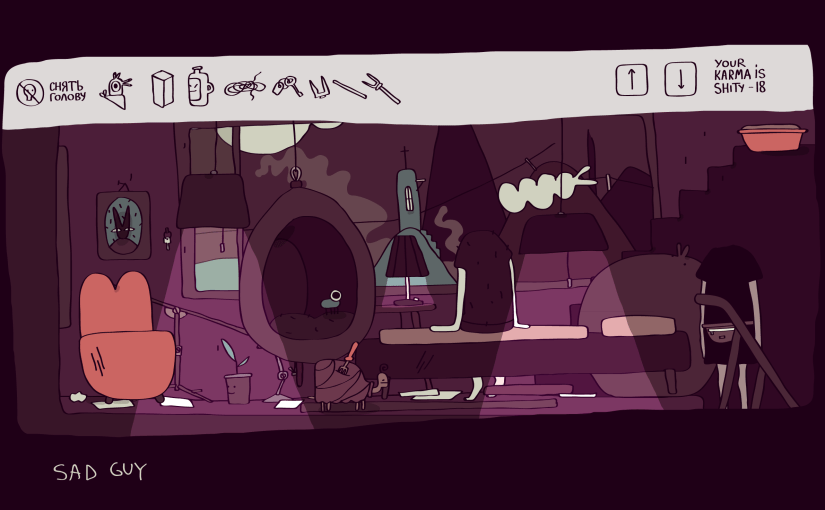
why-it-show-case-01

The knurled cloth handles of Nicos’ hamper cut into his right hand.  The straps are connected all the way to the base of the bag and the weight of the laundry keeps pushing them apart.  They’re too short, now that the laundry is folded and holding the bag to its shape.  You switch hands but there isn’t enough time to rub the indentations out of the left hand before the pain in the right hand is impossible.

Nicos puts the hamper down on a bench facing the front window of a coffee shop.  People sit looking out onto the street—at the sidewalk and the bench and the parked cars and the road and the storefronts across the road that you can’t make out what they are from here.   You have to rub your hands with each other and look out as well.  How does anyone sit on this bench with the coffee shop staring them in the face.  You’d have to seem surprised all the time that you’d caught someone sipping or biting or reading.

You can’t sit next to your laundry on a bench.  It looks like you’re waiting for someone to come help you, because people can’t tell it’s done.  Is it still laundry when it’s done, and folded.  It’s laundry when it’s dirty, and while it’s getting clean, and while you fold it.  It’s clothes when you put it away.  You can sit next to clothes.  Clothes are like shopping.

Nicos had sat next to half his laundry at the laundromat.  Only because all the machines were full.  You can sit next to your laundry in the laundromat, if the machines are full and you have enough for a good-size load.  And if it’s a clean laundromat.  How do laundromats get dirty.  Car washes get dirty and the dirty ones have the strongest sprayers so you go to the dirtiest ones.  Luckily the closest car wash is filthy.

You don’t care about how a hamper carries when the machines are in the building.  Or when the laundromat at the corner is clean.  Who sends you to a dirty laundromat.  There isn’t another laundromat between here and home, so you have to buy another new hamper.  The store that sells hampers isn’t on the way either.

these words by Ajay Mehra were inspired by
the art of Pasha Bumazhniy

Why Black Role Models Matter


fullsizerender-1

As a young child, if someone were to ask me about my race, I would say with great pride: I am Black. Being the daughter of a Women’s Studies Professor definitely had its informative advantages – by the age of 6, I was familiar with heavy terms such as systemic racism, visible minority, and gender politics. This early exposure, untainted by perspectives of my peers, made me proud to identify as Black. Unfortunately, various life experiences caused this pride to waver. It never died completely, but at times it did temporarily burn out.

The first time my Black pride died was in fourth grade. I had just returned from Nigeria, and upon being re-introduced to an environment where being Black meant being Other, I realized that my identity was bizarre to those around me. At first, I did not realize the slight differences that caused my peers to distance themselves from me. However, when my rude awakening did happen, it altered the picture-perfect idea of my Blackness. It was my first day at a new school, and all I wanted was to be friends with the tattoo club girls, who would always be on the basketball court making cool designs for their temporary tattoos during recess. I distinctly remember mustering up all the courage I possibly could in order to approach them; more importantly, I remember my request being politely declined because the tattoos would not show up on my skin. After that, it became difficult to take pride in something that my peers considered strange – so I gave up embracing my identity in order to be accepted by them. I decided that I needed to re-define my Blackness, and I turned to the Internet for inspiration. At the time, I did not realize that re-defining such an important part of my identity in order to be accepted by my white counterparts would cause me to view being unapologetically Black as something to be ashamed of.

As an adolescent, if someone were to ask me about my race, I would pause and quietly admit that I was Black. I was no longer the young Black girl who ran around the house shouting, “sing it loud I’m Black and proud!” The girl who begged her mom to tell more stories about the Nigerian Civil War, and about the history of slavery in Canada, was gone. This young carefree Black girl was replaced  by the Black girl that loved catfish, grape soda, and fried chicken, because the media told her that this was the acceptable way to embrace Blackness. This girl refused to have crushes on Black boys because she thought they would all eventually become “thugs” and “gangsters.” She idolized Cinderella and knew that her Prince Charming could only be white. She identified as stereotypically Black in order to be convenient for her white friends, but wished she was white so that she could be exactly like her idol, Cinderella. The media told her that her Blackness was only okay when it was stifled by the stereotypes created by whiteness to control Black people and Black bodies. Her Blackness was accepted only when she realized that she was ‘other,’ while whiteness was the standard. She accepted this as the truth because Cinderella did not look like her, but the characters who did were servants, antagonists, and clowns. She truly believed that in order to be the princess she wanted to be, she had to somehow achieve this standard called whiteness.

I know the effect of not having role models that look like you in the media, and for me it was a catastrophe. When you see people that look like you represented in a negative way, you begin to believe that there is something wrong with you. The shift from young pride and innocence is subconscious and slow, but before you know it you have stifled yourself in order to attain a certain standard that the media enforces. In times of self-doubt, I looked to my movie and TV show characters for an affirmation that my Blackness was acceptable. When I failed to find this affirmation, my ten-year-old self watched the movies with the white Disney princesses and began to idolize them. But my ten year old self looked nothing like her idols and this was a problem, because in order to become them, she had to look like them.

I say all this to emphasize the importance of events like the Montreal Black International Film Festival, which took place earlier this month. This annual festival allows Black artists and creators to express themselves in an area where they are often both underrepresented and misrepresented. Representation of Black people in the media is crucial because there are young Black children out there, watching and waiting for their next idol. They all need to know that not only are they acceptable, but they are beautiful and destined for excellence. In times when their non-Black peers question their Blackness, they need a Disney princess that looks like them so they know that they too are royalty. And lastly, they need to know that whiteness is not the default, and that Blackness is not the ‘other’. They need to be able to turn on the television and see a positive representation of someone who looks like them. These young people need to be aware that unapologetic Blackness is not only acceptable, but something to be proud of.


Chidera Ihejirika is a proud Nigerian Canadian in her second year at McGill University. She is an admirer of Chimimanda Ngozi Adichie and a lover of storytelling, dance and hiphop.