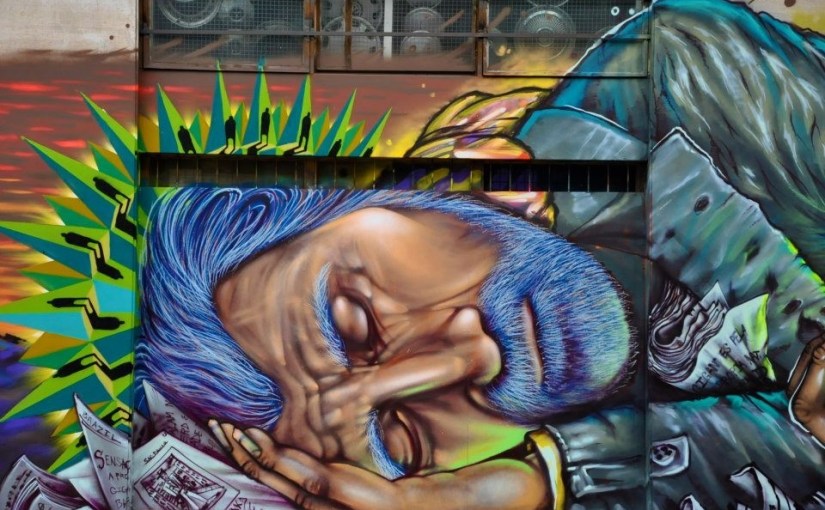
On Travel, Identity: “Try being your own friend”

kosi3

“Try being your own friend”

word by Annie Rubin

colour by Kosisochukwu Nnebe

“Try being your own friend.”

It was an exhausting job; he shook his head and hung up the phone.

The plane ride had felt long and treacherous, with each dip of the wing he was certain they would nose dive through the sky, be compelled to grab for their yellow life vests stored either directly beneath the seat or above you in the overhead compartment.

He would search frantically for the flight attendants out of the corner of his eye, secure. If they were still passing through the aisles with a variety of drinks and Skymall paraphernalia, he’d have no reason to panic.

The streets were shimmering with a blue-black slickness as he marched with conviction in the direction of the hotel.

The streetlights were flickering in and out of view. There was an unsettling echo of footsteps that he couldn’t swear were his own. Perhaps this was part of the adventure. Perhaps he was en route to be mugged. In either scenario, he found it best to focus his gaze on the road ahead, calculating the distance between fear and safety. Two hundred meters, now one-ninety…

In the lobby, he smoothed the lapel of his suit. It was one action in a whirlwind of unfamiliarity that brought him a moment closer to home. He couldn’t understand the startling sense of discomfort he experienced, surrounded in the idiosyncrasies of this place. The country felt oddly reminiscent of something he’d seen once in a dream, or maybe it was just that things felt so cartoonishly similar to images he’d stared at for months in preparation for the journey.

This recognition was stained by the fact that everything was just vaguely different than what he was used to. The water faucets, the scent of the stagnant air, the accents, of course a language he had never learned as his own.

Should this culture have been a piece of him, imparted by nature, somehow inherent in his blood? He wandered into a pizza joint out of habit or homesickness.

This was not his home. This did not remind him of the meals cooked by his grandmother; this was nothing reminiscent of his college chants or practiced habits or the inside jokes, memories collected into phrases and images that composed his true identity.

Maybe he was searching for something profound; maybe he wanted inspiration—confirmation that he had a home, a country, a culture that reflected his unique self. Instead, he was left in a state of flux: what was truly his? The room had fresh floral wallpaper and he felt nostalgic for a place that had until now, never truly understood him.


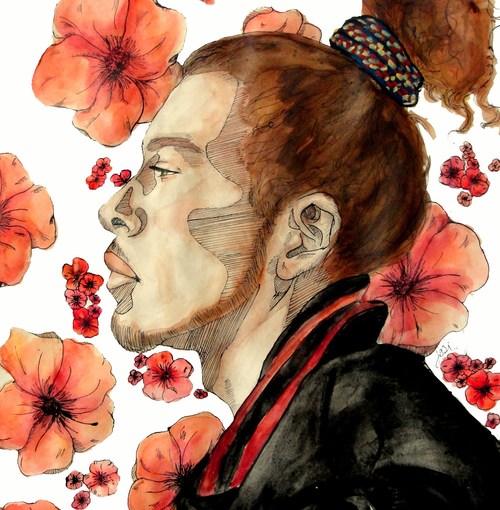
From the author: “I was inspired by the juxtaposition of the poised human look and the fragility of nature reflected in the vibrancy of the flowers. This led me to question identity, especially how to maintain a sense of self against a backdrop of an ever-fluid environment. The concept of identity raises questions about the significance of cultural background, and exposure, where the protagonist explores his familial history by visiting the country where his family comes from, realizing that he has little to no connection with a place he has never been, himself.”

Waterlogged Love

tomasz3

Waterlogged Love

word by Keah Hansen

colour by Tomasz Kartasinksi

16 minutes left of class. The seconds drift onto the floor, clustering like fallen leaves or crumpled love notes around her converse shoes.  Laughter seeps sideways from her mouth – I inhale her sounds. Filling the blank spaces on the corners of my notebook with cryptic doodles.  Inside jokes nestled on the pages, shading in the loopy curves with tenderness.  She slips me a mint, like any other day, under the roaming eyes of the teacher and spinning discussion, which floats to the florescent lights in a hazy, vapid way. I follow the din upwards, over her curly hair and alight on the fire alarm, with vague notions of apprehension and pensive yearning.

Today, the mint is imbued with significations, defining our comfy closeness on her worn yellow couch and clandestine ice cream escapades (alternating spoons of chocolate ripple and gossip) with flaming gravity. We snicker together over something trivial, then with giddiness I alone levitate equidistant to her forehead. The bell sounds and the class streams out. We tumble to the water fountain together and pause. She splashes over me with her usual locutions while I take a long sip of water.

The water is icy and clarifies my thoughts.  6 months of uncertainty.  6 weeks of contemplation. I’m bobbing here, staring at the grandeur of the stars from this makeshift raft. Her crocked elbow is my mooring.  The water ebbs unceasingly. I feel seasick (or is it butterflies?).  She’s never had a boyfriend.  We’ve held hands in the hallways. Oh to hell with it, I dive in.

My statement, a small confession of love, comes to her in small timid waves. We are the last ones in the building. I’m fixated on those worn converses again; her feet dance nervously while I’m a shipwrecked mess, letting the waves pass through my lips. The rocks hold me steadfast on the hopes for our relationship; they are sharp and make my voice waver more than I’d like.

Her features are catatonic. She contorts her face into a sympathetic smile. I surface into the glaring sunlight. Her face is burnt; she doesn’t understand my watery, viscous existence. These mermaid musings mean nothing to her. My ears are clogged. I feel the palpable pressure of her discomfort; my skin is cracking as impressions of my declaration sink into her body.

Another bell sounds. I slink back into the water, my element. Half coherent and murky, I don’t need to define myself or reveal my pinings to anyone.  I’ll cry tonight, alone, but gather my tears as jewels. Later, I’ll string them together and wear them on my neck, something beautiful and brave.

For now, I drift away.  A current pulls her brisk minty existence away from my waterlogged love.


From the author: “I was inspired by this artwork to write a story about an experience of revealing your romantic affection to a friend of the same gender.  The blue material at the bottom of the piece expressed to me both bed sheets and water.  I interpreted the water as a symbol of renewal and rebirth, which I related to coming out with your sexual orientation. 

The positioning of the legs also gave me the impression of figuratively “diving in” to a relationship or a new experience.  The opaqueness of the blue inspired me to think of the colour as a form of protection, which I developed later in the story.  Furthermore, the vertical tiered nature of the piece affected the progression of my story, while the Facebook friendship sign symbolized the ambiguities of relationships, especially during adolescence as we have a tendency to question our sexuality.”  


On Love: “Teach Me to Speak”

Sylvie2

My apartment has the music of love in it.  There is a row on my left and soupy breathing on my right.  I hear “fuck you” and I hear “fuck me.”  In love, someone is always getting fucked.  The rain outside patters the windows like a bowl of milk being filled with Rice Krispies and these slow and then moderate and then fast percussive bangs mimic the action unfolding here and there.  Snap crackle pop snap crackle pop snap crackle pop.

Behind the closed door to my right it sounds like my roommate and his girlfriend are hiccupping in harmony and it dawns on me there, wrapped in nothing but a towel, that this marked speechlessness seems more conversational and comprehensive and wholesome than the stuff going on to my left; but both still sound like love.  These are but two of love’s many iterations.

When I was younger, I would tip toe from my room to the stairwell that led to the kitchen to sit there and listen to my parents disagree loudly, hurtfully.  And I’d fear that the two people no longer loved each other.  I might enter the kitchen, crying, and ask if everything was all right, if they weren’t going to get a divorce.  It was in my kitchen that I learned that two people in love are allowed to fight.  Love necessarily yields war but war does not necessarily yield love.  And so back in my apartment, I feel like I’m seated again at the top of my staircase, all teary-eyed, only now I see that love can not only be scary, but that it is a choice.

Each of my roommates feels something in his heart if it is possible to feel there at all.  Right now I feel something there too.  Right now the Yankees are playing the Blue Jays and Lord knows a W for the Yanks here is huge.  Right now I have an unwritten story that my publisher needs by Wednesday.  Right now my English professor wants 500 words from me on the tension that Hemingway generates between language and experience.  I like that writing prompt.  It is worded beautifully.  My publisher also wants 500 words from me.  Twitter wants 40 characters.  That last sentence was 36.  Forty characters, 500 words: who cares?  It’s as if I’m talking to you through a damn keyhole.  Right now I have all this inside me but to you it’s only words and words and words.  Right now I wish my heart could talk because it has so much it would say to you.

Love and conversation, though, aren’t characterized by words; it is me and it is you, bundled up for minus 50 degree cold, undressing one another without letting either of us freeze.  My roommate engaged in the stuff at the end of the hall, you see, though, is freezing.  He moved too fast.  He inhabited himself without inhabiting his girlfriend.  So that makes true love going up to someone and saying, “Let me thaw you out.”

Can I?


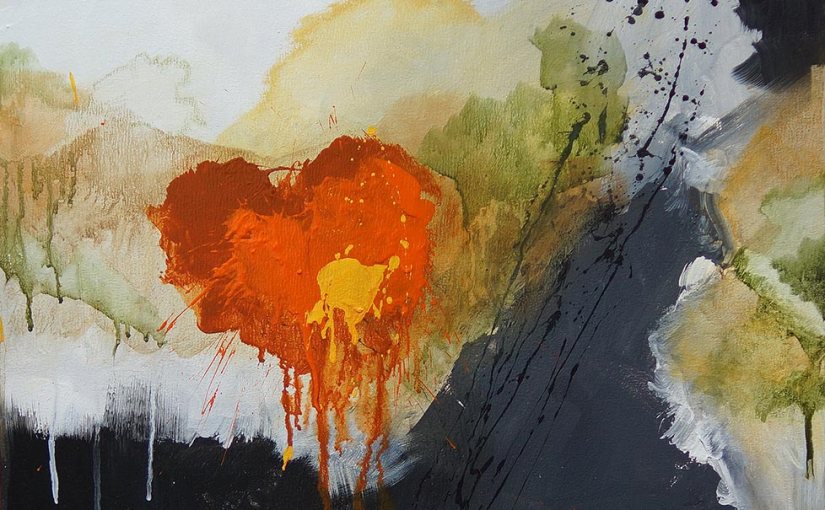
word by Jacob Goldberg: “The image has a heart in it.  This all happened in my house the other night, and I thought it was fitting to write about love.”

colour by Sylvie Adams

“A native New-Brunswicker, Sylvie Adams has lived mostly in Montreal since the 1980s. She has travelled intensively throughout her life, residing for brief periods in Germany, England and France.

She obtained a Bachelor’s Degree in Fine Arts from Concordia University and a Master’s Degree in Applied Sciences (Architecture) from Université de Montréal. She worked in the design field for close to fifteen years in Canada, the United States and Europe. Her love of visual arts brought her back to painting and she now has her own studio in Montreal, where she paints. 

Her work has been featured in solo exhibitions. She has also participated in numerous group exhibitions, nationally and internationally, in Quebec, Ontario and at the Affordable Art Fair in Seoul, South Korea (2015).

Her work can also be found in private and corporate collections, including the Permanent Art Collection of Rio Tinto Alcan.”

On Spousal Abuse: “I Thought You Were Dead”

leah

Trigger warning: spousal abuse

When she got really angry, she’d throw anything in sight. Once she took a painting right off the wall and threw it and it hit me in the side of the head. I blacked out and when I woke up she was on top of me, covering me with her body, and crying. “I thought you were dead,” she said. “I thought you were dead and I was so lonely.”

She moved into my apartment a week after we met. We threw out all of my furniture and she filled the apartment with her couch and table and chairs and bed. The first month, we would sit on the porch sharing cigarettes and discuss what pieces of my furniture had been picked out of the pile, which pieces we thought were the saddest. The coffee table went quickly, but it seemed like no one wanted my old mattress. One night, we drank too much and she punched me in the jaw. It snowed that night and the leftover furniture disappeared.

Sometimes when she threw things, I would grab her wrists until they were raw and swollen. And then she’d kiss me and I would put my arms around her thin waist, hold her so tight she would ask me to stop. We’d sit in front of the television, her face covered in blue from the screen, and I’d bandage her wrists, burned from my skin on hers. We’d laugh that our love was so hot we could burn one another just with a touch.

When you fall in love, the end is never important. The end is another day.

word by Leah Mol

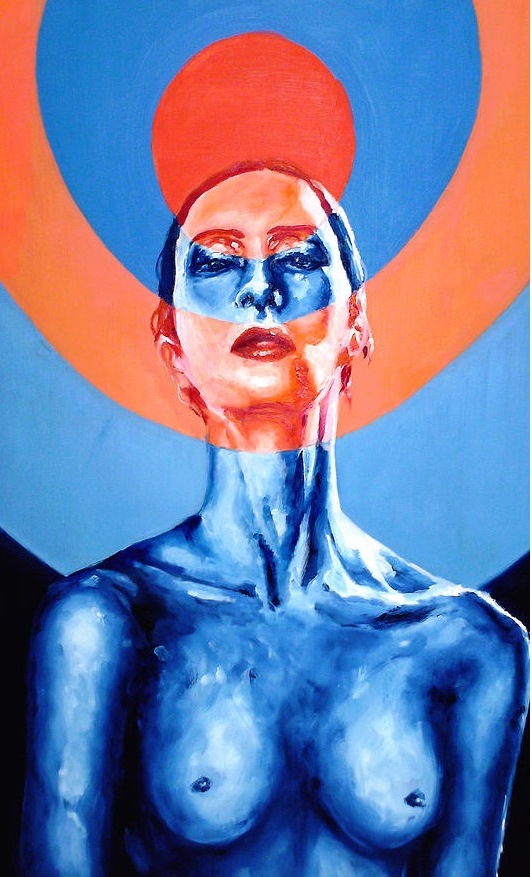
“I found it very intriguing that the woman in this piece seems so strong, and is also seemingly being targeted. She is perfectly in place to be ruined. Because this piece brought forth the theme of contradiction for me, I wanted to write about people who love one another and want to hurt each other all at the same time. People house so many contradictions.”

colour by Rebecca Proppe

“I’ve been making art my whole life, drawing story books and cartoons since I was a little kid. Now I’m an adult, and I still love to draw.

I’m currently studying art history mixed with some painting and drawing classes. Like most people I don’t know where my life will take me after graduation, all I know is I love art in all its forms and will be making it for the rest of my life 🙂

I hope some of you can enjoy my art as much as I did making it.”

On the Environment: “Forest for the Trees”

b31b950206fa403d7071aecce8d44b52

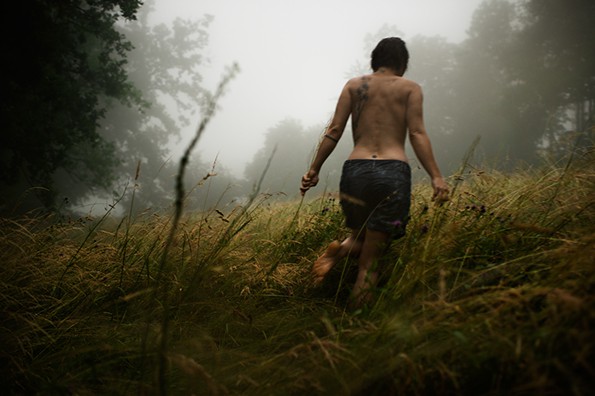
I’LL LOVE THIS FOREST UNTIL THE DAY I DIE.

It was a place of possibility.  Where anything could happen.  Secrets hidden behind every tree.  Discovery around every bend.  Adventure was everywhere.

I was always struck by the trees.  So much bigger than anything we had in the city.  And so many.  No matter where you looked, there they were, towering above and continuing on past the horizon.

Walking beneath them today, I’m reminded of the games of hide and seek we’d play in their shade.  The time I came upon the perfect spot.  When no one could find me, I cried my eyes out, waking hours later to Mom’s touch as she picked me up and carried me back to camp.  To the bonfire.

I craved the smoke’s heady scent in my nostrils while simultaneously doing everything in my power to avoid its brutal sting to my eyes.  Every night Liz and I would get one step closer to the perfect s’more recipe.  It’s a miracle our teeth didn’t fall out with all the scorched marshmallow and melted chocolate we ate amongst these trees.

In later years, we discovered the lake.  The forest stayed to its shore, watching on as we swam and played.  It became near impossible to get us to leave the water.  We’d spend full days splashing about, emerging only when our bodies became too tired to keep us afloat.

It’s still hard to believe this will be my last visit.  I wanted to protect this place.  To protect the memories it’s given me.  Now all I want is one last dip in the lake.

I never knew there were so many different machines for destroying trees.  I can only hope the water will drown out some of the noise.


word by Grant McLaughlin

colour by Julien Coquentin


On #Alllivesmatter: “The Sting Of The Jellyfish”

2

There’s a mural in the street that says ALL LIVES MATTER. A few days ago, it said BLACK LIVES MATTER.

As I stare at the defaced artwork, I begin to understand that the great sin of our time isn’t hatred. It’s apathy. It’s the impulse to surrender to your default settings, to your pre-configured notions of who somebody is based on how they appear. To assume, rather than think. To fear, rather than learn. Hatred has agency, it has intent. Hatred is a spear, ground to a fine point over hundreds of millions of years to serve a single purpose. It knows only one end, and therefore it’s limited. You dig? We can overcome hatred. But apathy? Apathy is easy, unassuming; it’s a jellyfish floating in the waves. Shifting and amorphous, it poses a far greater threat to the ocean than the spear, it’s callous indifference spread to all those around it via a simple touch. The  jellyfish is content in its carelessness, happy to administer its sting to both the tiniest fish and the greatest whale, as though they have fought the same current all their lives. Except they haven’t

This is why BLACK LIVES MATTER is an anchor, a rallying point for the marginalized and disenfranchised victims of systemic violence, and ALL LIVES MATTER is a mindless platitude, a jellyfish whose deadly sting serves only to satisfy our base impulse towards indifference, our desire to look beyond the pointed issue towards a world where we may all float along, unaware of to whom our ignorant stings are being administered. That’s the non-polyp ideology;  float on and care not who runs afoul of your tentacles, for your conscience will remain clean. You didn’t make the ocean violent, and therefore you don’t feel responsible for the structures that exist before you, around you, inside you. This is how indifference has become our new prejudice, how a lack of awareness has become far more toxic than even the most hateful of voices. When everyone is content to say nothing, even the quietest utterances of discrimination can be heard.

word by Josh Elyea

colour by Andre Barnwell 

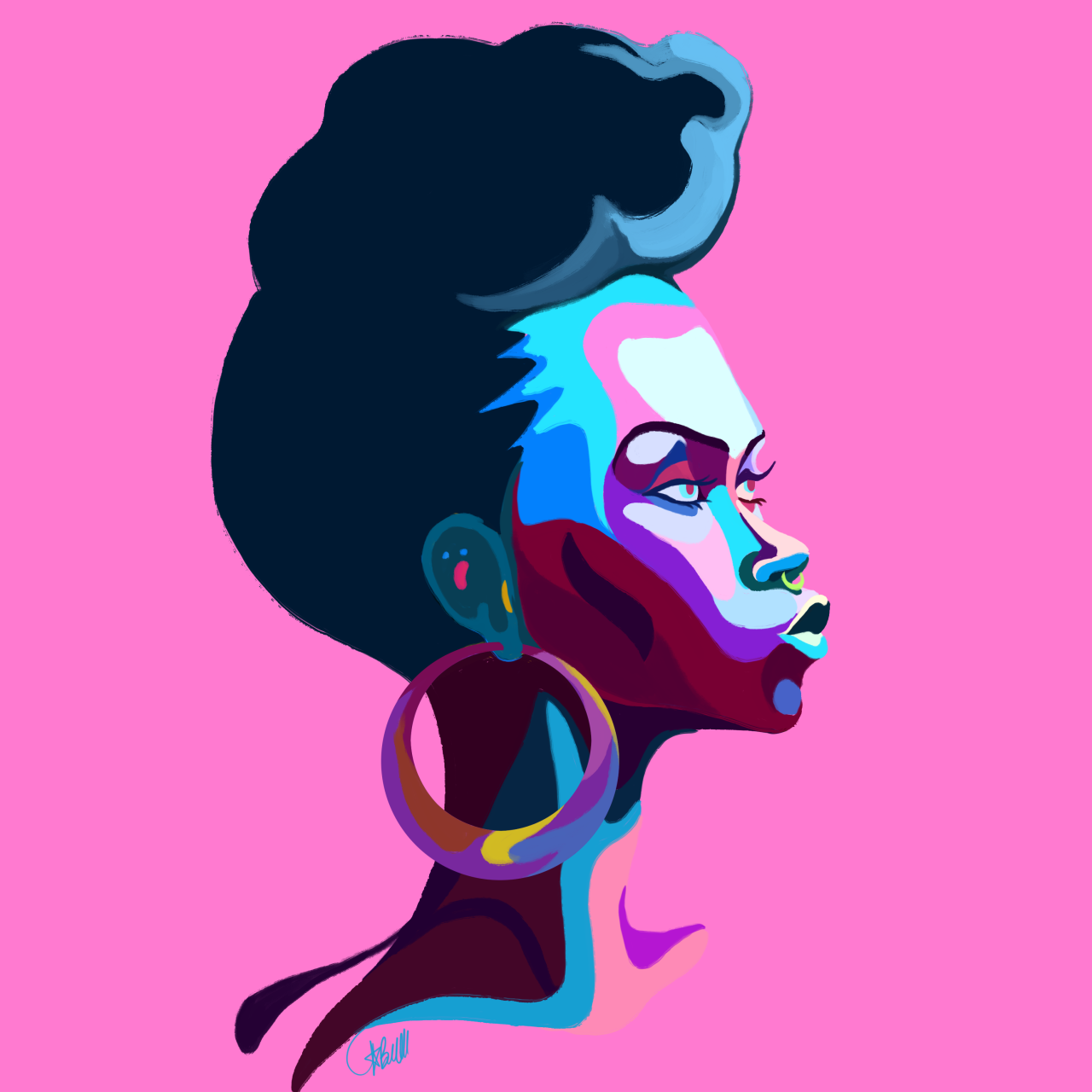
Andre Barnwell was born July 7th, 1984 and raised in Toronto but currently resides in Vancouver. Ever since moving out west in 2013, Andre has been inspired by the city’s art community and motivated by the accessibility to the tools he needs to pursue his artistic passion and desires. Graduated as an animator from Ontario’s Sheridan College he was exposed to various styles and media to create art even though he prefers to use digital as a means to an artistic end. Fascinated by the human face, most of work is portrait based ranging in different colour schemes, particularly his blue and red monochromatic digital studies.

Outside of portrait work and digital sketches, he enjoys music, film, travelling, and building his brand, Sex N Sandwiches. He looks forward to collaborating with artists such as sculptors, photographers and musicians for future projects. With the world getting smaller with the help of technology, he implores artists and art lovers to follow his growth via social networks and eventually to international stages.

Keep it growing!

Professional Contact: 
Email: andrebarnwell@gmail.com

Social Contact:
Twitter: @AndreBarnwell77
Instagram: AndreBarnwell77

The author’s words do not necessarily represent the views of the artist.

On Homelessness: “Walking past”

Shalak3

“Look. I know. But I’m telling you, we, like, run in the same circles or something.”

“Which fucking circles are you running in?”

“I dunno, man, just…I’m telling you, I see him everywhere.”

“Give him some cash, man, he’ll leave you alone.”

“I dunno. Do you think he, like, stalks me?”

“Who knows, man. You know what he’s after.”

“Think he can hear us?”

“Probably. Keep looking forward don’t want to give him the wrong idea.”

The subject of their intrigue happened to be a well-recognized face on this street. His salt-and-pepper beard perpetually caked in sweat, eyes bloodshot, if ever opened, fingernails speckled with dirt.

When he wasn’t pacing the corner of the main street, he would lie curled on the ground, enveloped in a makeshift bed, a mattress formed from warped cardboard and a newspaper pillow.

A Styrofoam coffee cup rest at his feet to collect spare change—its position was far enough from his person so as not to elicit too intimate an interaction between hopeful donors and himself, yet close enough to grasp in the case of a thief lurking uncomfortably nearby. This was his domain.

The men who passed him daily found themselves split between curiosity and repulsion as they, in American Apparel, wondered how one could end up on the streets, and why the man couldn’t pull himself up by the bootstraps “and just find a job,” as they all had done for themselves.

The day he disappeared, those who questioned his absence primarily didn’t know who to confront with their concern, or why they felt they needed an answer in the first place, and never did anything about it.

word by Annie Rubin

“With such ease, passersby devalue or dehumanize the lives of homeless people. This story’s focus on the interactions of one man tries to demonstrate a lack of compassion and emphasize the societal conditioning that our culture perpetuates towards those who are not able to work or find a home.”

colour by Shalak Attack

“Shalak Attack is a Canadian-Chilean visual artist dedicated to painting, muralism, graffiti urban art, and canvases. Shalak  has manifested her artistic expression on urban walls across the world.  Shalak is a co-founder and member of the international art collectives “Essencia”, the “Bruxas”, and the “Clandestinos”. 

Shalak also works with several other mixed media approaches such as tattoo art, jewelery, illustration, installation, sound, and video making. In the past ten years, she has participated in numerous artistic projects and exhibitions in Canada, Chile, Brazil, Mexico, Palestine, Jordan, Isreal, France, Belgium, Spain, Argentina, Venezuela, the Dominican Republic, Senegal and recently in Sweden for the Artscape Mural Festival. 

Shalak shares her passion for freedom of expression, and has facilitated visual art workshops to youth of under-privileged communities and prisoners in various countries across the Americas, Europe, the Middle East and in Africa.  Her artistic work and community art-reach is rooted in the social and cultural values she received from her family growing up across Canada.  Since then, her most impacting education has been learning from different communities around the world. Public walls has become her favourite place to paint, she uses graffiti as an art form to create accessibility to culture for diverse communities.” 

A reminder: your fate is permeable

back_03

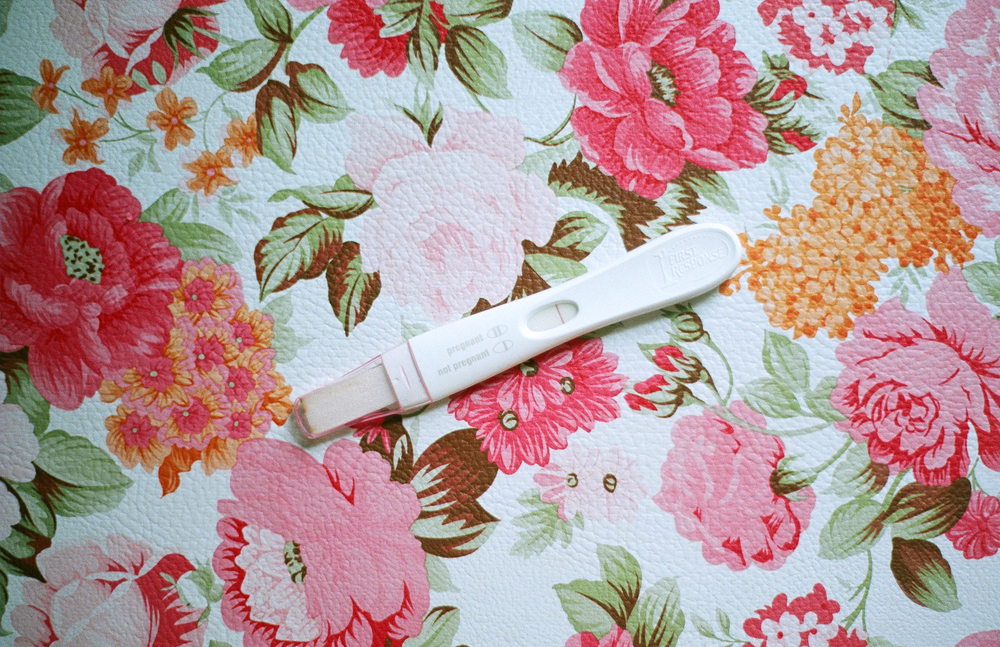
The only time I ever took a pregnancy test I was eighteen years old and living with my boyfriend in a stranger’s apartment in Prague. We spent the days wandering and the nights drinking quietly, not knowing what or how to cook.


I curl into the kitchen windowsill smoking what might be my last cigarette, and silently contemplate this bleak fate. He slouches on the bed twirling the butterfly knife bought that afternoon despite my un-nuanced anti-violence politics. Or maybe I just couldn’t support violence for the sake of masculine amusement.


The kitchen table is draped in pink blossoming polyester flowers and the fridge is mostly empty. I swallow, and clutch to the unfinished sketches of my life, slipping. It is a small kitchen, badly lit and the night sky drops away from my body.


On a walk with mother, she told me that having children doesn’t necessarily equate to happiness. They did a study, she told me. On happiness. Together we unravelled the assumed inevitability that one day, you’ll see, it will just happen. Bam. Motherhood. And eventually you’ll even learn to like it.


Still I shrink away from the word, hold close and fast to the solitude, the silence, the ability to switch apartments seven times in four years.


Even without the study, her words sucked me out of the story. At least far enough away to bring it into focus. Socialization never amounted to fate in any mystical sense of the word. My anatomy does not presume that I was made for this, and mothering, just like any other job, must be knowingly consented to.


There I was: eighteen, tender and bitter with my un-nuanced anti-violence politics, licking childhood wounds and refusing fate. That small pink bar. I taped it to the wall along with the blossoming table cloth.


word by Alisha Mascarenhas 

“I thought about all of the babies in strollers I’ve walked past this week, and about the persistent disjuncture that often presents itself between what we need and what we are told that we need. I thought of how socialization of femininity is made real through direct transmission from those who impress upon our minds most legibly, and how necessary that there are alternative narratives offered to us in these moments. I thought of the economics behind the inevitability of motherhood, and the threatening possibilities that can surface when what appears fated is pulled apart, set aside and seen through.”

colour by Fannie Gadouas

“I am an interdisciplinary artist working with photography, fiber arts and performance. My work explores issues pertaining to feminine, identity and experience. By re-appropriating various traditional imagery, techniques and rituals, I question and challenge the way gendered identity is constructed, inherited and perceived in western society. Textiles is, and has traditionally been associated with the feminine realm. Critically engaging with techniques such as weaving, knitting and embroidery allows me to subvert and question my own role as both woman and artist. In this sense, my practice as a whole becomes a performance in which the process holds more relevance than the resulting objects. Informed and greatly influenced by feminist theory, the work I produce is a critical response to the social structure of western society.”

Ken

floating-away_650 (1)

Ken and Mavis lived at number 9 Flosstooth Avenue. Ken loved Mavis like a dog loves its favourite bone—he would chew on her every now and then to remind himself what true gristle could taste like, but then he would bury her, and all that she meant, and would wait for weeks or months until he dug her up to gnaw at her all over again. That way it was special, and that way Ken knew he would never get bored of his favourite bone. Mavis didn’t like being gnawed at every few months; she told him just before she asked him to leave that she expected constant gnawing. He hadn’t realised that, and offered to never bury her again, but by then it was far too late.

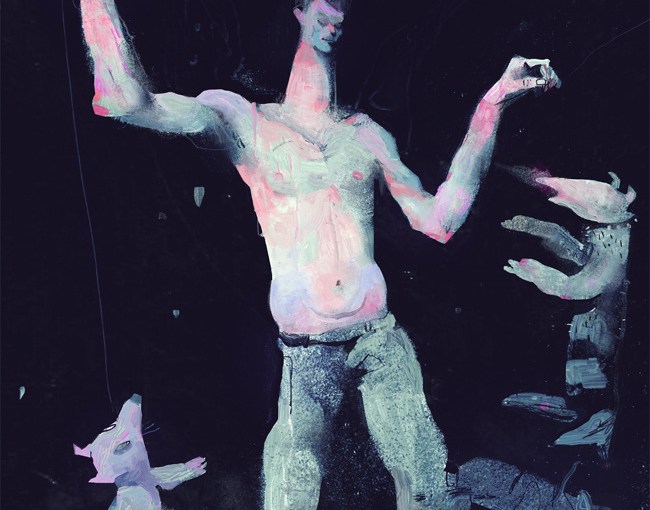
The summer before the end, the neighbours on the side with the dead rose bush that looked like a mutant spider moved out. A few weeks later a dual-cab UTE was parked in the driveway when Ken got home from work, and after some careful investigating from the kitchen window through Mavis’s homemade gauze curtains, Ken gathered that their new neighbour had moved in, and that he was a tall, broad-chested man, with the necessary bulges to wear only a singlet as he loped from his UTE to the door with boxes and bags. Ken saw that the man with the necessary bulges had two lean and hefty dogs. Ken was terrified of dogs, ever since he had been chased by a pack of gnashing greyhounds up and over the slide in the playground one afternoon when his father had forgotten to pick him up from school. He felt trapped in the house, and told Mavis about it when she came home weary from the salon, but she didn’t seem to be listening, and just stood and watched out the window until the sun went down and there was nothing to see anymore.

A couple of months later on a Friday Ken decided to leave work early. He arrived home to see that Mavis was already there, and though he called out for her in every room in the house but he couldn’t find her. Mavis didn’t like to walk anywhere; if her car was there, she had to be too. Ken poured the tap for the kettle and as he poured he looked through the gauze straight into the man with the bulges’ living room. There he saw Mavis, completely naked and dancing around the room with the man with the necessary bulges.

Ken hadn’t wanted to leave, even after watching Mavis and the man with the bulges in a variety of positions all over the living room that made him begin to sweat under his arms and in between his elbow creases. When she came home that night, crumpled and smelling of dog food, he had offered to stay in the spare bedroom. That she simply agreed, and didn’t seem to need to ask him why, told Ken that he would never unearth his favourite bone again.

word by Laura Mcphee-Browne

colour by Ilya Shipkin

From the author: “When I first saw this illustration by Ilya Shkipin, I saw the man and the dogs he was feeding as dangerous, as hostile. As I came back to look at the illustration again and again, I began to feel that there was a special relationship between the man and the dogs; that they knew each other well, and perhaps looked after each other.

My story, ‘Ken’ is about a man who does not feel comfortable in his own skin like the man in this illustration surely does. It is about the threat that confidence and mystery can be to a flailing relationship.”

his wolf

piiiiiiiiiiiiiiiiiiiiiiinnnk

Dad got anxious. Mama didn’t: she just swished around beautifully like colour in a paintbrush jar, singing Moon Shadow and tying scarves around her forehead so I never really knew how big it was. But Dad was anxious. His thin body shook inside his dressing gown, taking the tea Mama would bring him in his match-stick rouge hands, thanking her with his quiet voice, his normal voice; the voice I never heard raised.

Dad was so thin because he barely ate, and anything he did eat he told me he tapped away. He did tap it away—I watched him each night after school as he sat as close to the fire as he could in winter, and as close as he could to the fan in summer, his foot tapping at the floor and his hands tapping at his crooked, dancing leg.

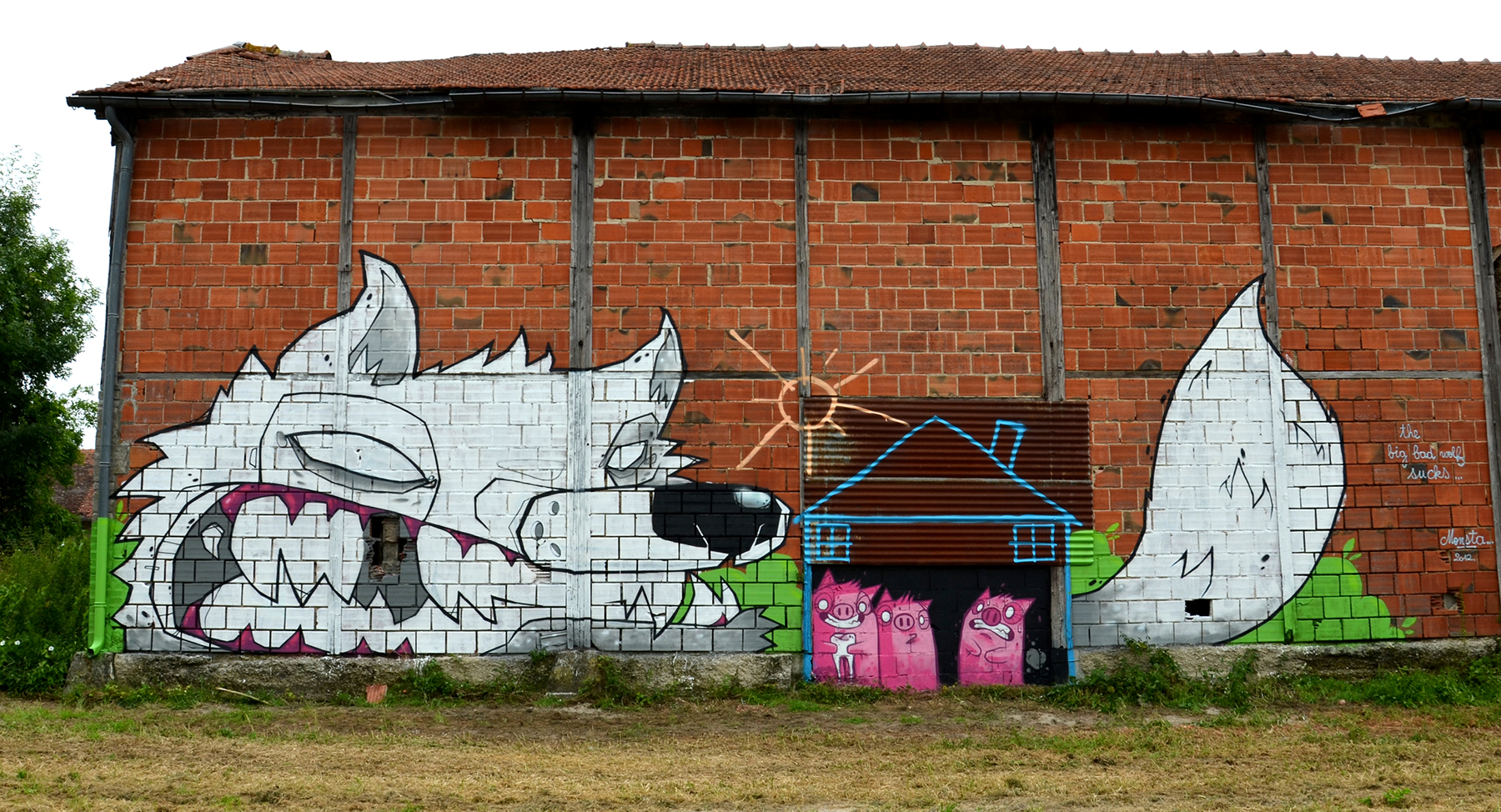
Dad wouldn’t eat pigs—he said he was too fond of their pink hairy backs and the way they really had those curled tails you saw in picture books. He wouldn’t eat apples for obvious reasons; ‘they’re so happy up there on the tree and then we cruelly pick them down.’

When Mama would make me eat my carrots and corn, Dad would sit there smiling faintly, his plate free of anything but bread and thick shiny butter. He didn’t have to eat carrots and corn. I didn’t shake like him.

One morning I got up early to see whether Mama had left the butter on the kitchen table. I liked to spoon curves of it into my mouth before we had breakfast, so the grease would sit warm and safe in my mouth. I remember it was winter-time because I dragged my mittens onto my feet after searching to no avail for my slippers and they made it hard to get down the stairs without slipping. As I passed their room I heard Mama’s voice low and hurried and edged my head around the door. Dad was lying on the bed, flat and old, and Mama was standing above him. She was crying—I could see the tears dropping onto the doona and the air felt thick with worry and damp. She looked over at me.

‘Daddy’s sick darling. He’s very sick,’ she said, gulping, clutching at the doona’s soggy edge.

I asked her what was wrong with him, standing as tall as I was just there in my mittens.

‘His wolf has come again darling,’ she said. ‘His wolf has come to scare him.’

I ran to my bedroom, tripping on stairs in knotted wool mittens, grasping at the wooden edges to pull myself up and up.

I sat tight on my bed, wondering when my wolf would come.

word by Laura Mcphee-Browne

colour by Monsta

piiiiiiiiiiiink