people are clay

Quarrymen

The thud on the porch means that the newspaperman is now awake as well. The boy retrieves it (i.e. the paper) and takes with him to the bathroom the most important section of the New York Times: the Arts. He finishes shitting in about 3.5 min. but is in the bathroom for at least 26. He has had one hemorrhage from these marathons.

The cover story is titled: “Sgt. Pepper’s New Look.” The boy reads that The Beatles have reunited for a world-tour “with a catch:” they have surgically removed their heads and replaced them with various members of the Rosaceae family.

Details of how this is done safely are enumerated by Dr. Kumari in the Science Section.

As he gets dressed, the boy cleans his circular glasses and checks his Facebook for notifications. Avery wants to see the Beatles live. Caleb wishes him a Happy Birthday.

The boy is convinced his computer is Canadian, because red DNA strips appear below the words “favorite” and “color” [sic]. Sierra, his cousin, was so “inspired” that she got the picture of the four of them inked on the nape of her neck. The girl who wished him a happy birthday was a day early.

It is now 0630h and the boy leaves his house and walks to the subway, which is three blocks away. He nods to the man who works the opening shift at A&M Deli. The 15th Street Subway stop is bizarrely multi-leveled for a station that only services two trains, both of which run on the same track.

A woman sells churros out of a cooler that probably held beer over the weekend, given the smell. The boy realizes he has never once actually looked at the ceiling of this station and subsequently realizes how often he misses anything that is above eye-level.

The G train pulls in and the boy gets in the middle cart, and goes to his favorite seat (which is totally, undeniably, everyone’s favorite seat: the one by the window on one of the old trains).

He overhears a girl say: ‘If I got that done to my head, I would have certainly gotten carnations.’

A smell hangs on the train. The boy cringes at the omitted ‘had,’ but agrees with her assessment. He grows uneasy.

A few stops later, as the train exits the Smith and 9th Street Station, he peers out of the window and looks east as the sun is still creeping over Brooklyn’s horizon. This is the only time of the day that Gowanus Canal could be called something other than repulsive. Kentile Floors in big letters w/ Seraphs looks as though it’s been tattooed on the sky right next to the Chrysler Building.

It was the boy who farted.  He feels centered.  And as he stirred from his dusk-dreams, he looked out at the city’s silhouette, and he committed himself to the idea that for his 17th birthday, tomorrow, he will turn his neck into a vase as well.

word by Jacob Goldberg

colour by Eugenia Loli

From the author: “People, myself included, are heavily influenced by pop-culture. The characters in this story surrender their identities to The Beatles. What happens here is tricky: one thing is that the protagonist loses his sense of identity (one may wonder whether he ever had one in the first place, given its (viz. his personality) malleability; another is that when people so quickly look to celebrities (or preferably artists) on what it means to be Hip, we so often forget what made them “cool” in the first place. It was certainly not their style, but their artistry, and their ability to uniquely express who they are. This overwhelming loss of identity leads to loneliness.”
the artist

Paper Cut

She would look back in later years and ask herself if she had been right. It was irrelevant, quickly became removed from the frame of present life, but, still, she wondered.

Never one to plan for failure, she had certainly positioned herself to be right, that night: she had worn the right dress, invited the right people, ordered the right drink. She had educated herself thoroughly on questions of technique and style. Where necessary, she had asked Paul minimal questions, inquiring about his influences but not prying into his inspirations: she wanted to appear intellectual, perhaps in possession of knowledge unavailable to the simple attendee, but not to flaunt her connection to the artist.

That night, she lingered in front of the pieces known to be masterworks, gesticulated near the controversial (and higher-priced) items, pointed out canvases that she thought friends and connections would enjoy. She lost sight of Paul only a few times throughout the night.

It pleased her deeply to see that he seemed to be enjoying himself, was engaging in conversations with pleasure, losing the usual rigid reservation that bordered on condescension and inevitably settled over him in groups.

In other words, the evening was going well, until she saw it.

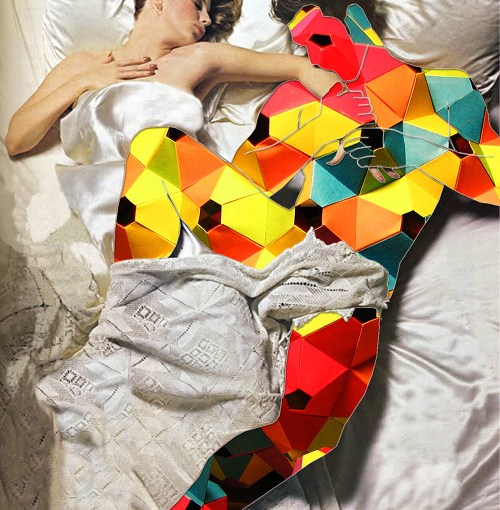
She couldn’t fathom, at the time, how it had arrived there, how it had come to be hung on the wall with a little white card next to it, a blurb and a title and a price, without her having noticed, without someone (not Paul, certainly, but someone) informing her of its existence. But exist it did, on a scale more immense than anything else in the gallery: her head, her bare shoulders rising above the gathered party, her face drawn in either ecstasy or a half-sneer of pride.

The other form on the bed, she had to assume, was Paul, sprawled at her knees, legs spread.

He kissed the arm, flung sideways, that pinned him to the bed. He had no face, no skin, no shadows, a collage of bright colours with the outline of a human man. Beside him, she looked like stone.

Other onlookers moved away as Faith stood looking up at it, overwhelmed by unidentifiable emotion. His hand was on her back, he who seemed to prefer not to touch her when he could avoid it. In later years, she would remember thinking he had drunk too much; through the tide of wounded shame washing over her, she had that one petty point of clarity.

He moved so that he was standing in front of her, between her and the colossal painting.

“Is this a confession?” she asked.

He faded from her life, some time after, managed to evanesce though there had been papers to sign and furniture to divide and accounts to split. There should have been a shared existence to break apart but really there was just the painting and then the wondering, occurring at larger and larger intervals in the life that followed him.

word by Charlotte Joyce Kidd

colour by Eugenia Loli

From the author: “I was initially curious about the male figure in this piece. The crime-scene outline seems to indicate that he’s absent, but even if he has already left the bed, his relative colour and movement give him a presence and appeal that his companion lacks.

Where has the man gone, and why has he left? What is it about him that would leave such an imprint behind? Has he left it on purpose? Art naturally demands that we tell stories; it presents us with startling, intriguing, even troubling images and leaves us either to supply our own explanations for what is happening and why, or to remain startled, intrigued, and troubled.

In this case, my answer to the picture was to write about the woman in it, who I thought was likely to have her own questions about it.”

no excuse for stillness

Waiting190

Trace the effort that it takes not to see us; this is the work of disappearing. Let your flesh be erased into the skin of the walls you pass, feel the weight in your heels as they touch the ground before us: prostrate. This is our altar, rest-stop, bedroom, front porch on a Tuesday afternoon.
 
What will you do with your hands? 
 
Wish you had pockets? A cigarette? Something to bite into.
 
My spine grinds softly into the wall but it won’t make a mark. These surfaces don’t have the give to take the impressions of my body; I know. My legs have held the same bend for hours, and to shift weight would suggest movement, but there is nowhere I need to be today.
 
Not looking is also a choice: Keep your chin steady, level with the chest and with the slope of the sidewalk, your stride has suddenly widened – did you notice? Hold your breath, I am not sorry; wait for the reward, the prize of making it four steps further until you can relax, release your mind.
 
Does it hurt (to look)? 
 
Why are you afraid?  
 
I appear idle in spaces designed for movement. I won’t be ordering any pizza or beer or pulling keys from my bag to enter the stairwell or slipping cellphone into pocket or leaning against the doorjamb waiting for someone who should be here any minute or gripping the end of the leash while the dog takes a piss. I am here without an acceptable excuse for stillness.
 
My belly is swollen with indigestion and my hair slicks back at the nape of the neck. Chips of paint fall into my eyes, and you: your mouth tastes of chalk; your feet are light, but the burden is heavy. The sky is falling in streaks of blank nothingness and your apathy is numbness you use as armour. It is wiping us out and away from one another. It is killing you. What you cannot see does not disappear; it festers untended and intentionally forgotten, I take on your sickness. I am not the exception: with this strategy, everyone will be left behind.

word by Alisha Mascarenhas

colour by Brett Amory

From the author: “I needed to write this in response to my own complicity in the stigmatization of homelessness, both visible and intentionally erased. I wanted to address the violence of looking away, which I relate to and am sickened by. The posturing of the man passing on the sidewalk stirred a particular kind of anger, invoking fragments of a larger struggle with how to navigate interactions with people I meet in the street; chance encounters, moments of confrontation and real as well as perceived threats.”

otters holding hands

big_356604_4050_Web_arne_quinze1

Towards the horizon, a yacht crawls across sand. It’s a trip to watch – a massive silhouette against a Nevada furnace. A rhythm, something dancy and electronic, thumps in the distance. The beat hadn’t changed in six hours. This is what it means to be a DJ in the 21st century, he thinks… toss on the laptop and let that record spin, baby! He would’ve hated it if he wasn’t so stoned. What’s so great about the fucking desert? Some of these mammoth sculptures were awe-inspiring, sure – they were standing inside some sort of terrific wicker palace, after all – but it didn’t resonate with him the way he wanted it to.

“Why bother building it if you’re just going to burn it down?”

“If you don’t get it, there’s no point explaining it – you’ve got to dig it to dig it, ya dig?”

“But I don’t dig it. I don’t. It’s like sure, you want to forgo the material limitations forced upon us by a capitalist consumer society. I get that. I can dig the idea of transient art. I’ve read Kerouac… the here and now? I dig that. But this… just seems like a whole lot of work, doesn’t it? I think radical self-reliance goes out the window with the yachts, man.”

“You’re missing the point.”

“Maybe Burning Man shenanigans are falling victim to the systemic trappings they’re trying to undo: maybe this all started as an escalation of the Haight mentality, the sitting-around-the-campfire-smoking-a-joint-and-singing-kumbaya hippie dippie shit of the sixties, but it’s gone beyond that. We’ve hit a point of market inflation, and it begs the question…have we managed to bottle bohemia?”

“Wasn’t that a Thrills album?”

“Irrelevant and immaterial, your honour. Move to strike.”

“Let’s say you’re right and all of this is becoming a commodity. Let’s say this spectacular monolith, designed and constructed with the sole purpose of being burnt the fuck down, sent back to the scorched earth from whence, has been co-opted by the man. A commodity being something that can be sold…who benefits?”

“The lumber mill?”

“…”

“Acid dealer?”

“Don’t ask a serious question and then fuck about when I offer you a legitimate rebut. What you have is a gathering of like-minded people who want nothing more than to come together, celebrate radical inclusion and maybe draw attention to the fact that the world we live in isn’t the best version of itself it could be, you know? There are alternatives. What’s more wholesome than that?

“Otters holding hands while they sleep so they don’t drift apart.”

“There’s a point in every conversation where you stop being a cynic and you start being an asshole.”

“It’s a matter of serious consideration. Those otters are cute, man.”

“And consider it I will. I’m not worried, though. I was skeptical too, at first. But the flames will wash all of that away. At dawn, when all that’s left are ashes, it’ll be hard to be cynical. You’ll see.”

word by Josh Elyea

colour by Arne Quinze

shoplifting

EYEZ

“The first rule,” Joanna says, “is make sure nobody’s watching.” She tells me that because she wants me to be ready for anything. “It’s pretty obvious.” She rolls her eyes.

Make sure nobody’s watching. I say it three times in my head. I know what obvious means.

Joanna is five years older than me. We have the same mother but we live in different houses. She has a boyfriend named Peace. He’s waiting in front of The Bay because he can’t smoke inside. We’re walking around the mall looking for a store that looks easy for my first time. The mall is shaped like an L, and we’ve already passed every store. Joanna is chewing gum and blows little bubbles, over and over.

            “Can I have some?” I ask. “Gum?”

            “None left.”

Joanna stops in front of a store called Girl Thang. She tilts her head, staring into the store, and blows another bubble. “This is good,” she says.

As we walk through the entrance she whispers, “Just be normal.”

Just be normal, just be normal, just be normal.

I follow Joanna over to a table covered in T-shirts. Just be normal, just be normal, just be normal. I try to lean on the T-shirt table in a normal way.

Joanna glares at me. “Pick something to try on,” she says, in her fakest friendly voice. I look for things that don’t have a plastic tag on them, just like Joanna told me. I find two blue T-shirts that remind me of water and the sky and a sweater with a panda bear on it. I walk back over to Joanna but she motions for me to follow her and goes into a changeroom. Make sure nobody’s watching, make sure nobody’s watching, make sure nobody’s watching. I look around. The only person in the store is a girl at the cash register. She’s biting her nails from the sides.       

            “This is good,” Joanna says in the change-room. “It’s expensive.” She shoves the panda bear sweater into my backpack.

            “What now?” I ask.

            “We have to buy something,” she says. “You always buy something.” Joanna chooses a cheap T-shirt she didn’t even try on.

We walk up to the counter and the girl smiles at me. “You didn’t like that bear sweater? It’s adorable.”

Joanna smiles. “She has bad taste,” she says. She takes her wallet out of her coat pocket and there’s a stick of Juicy Fruit in foil stuck to the outside.

We don’t want the receipt.

Joanna slips the gum between her lips and I make the foil into a swan and when you pull the tail the wings flap.

At night, I sleep with the panda bear sweater. I fall asleep.

word by Leah Mol

colour by Vincent Viriot

little red riding hood

massini 2

Little Red was going to her grandma’s house in her red cape that was supposed to protect her from the bad men the men that wanted to hurt her. Little Red had never seen a bad man in the forest and she thought it was sort of silly; she had seen plenty of men in the city they looked at her and she was told to be afraid but she was sort of curious. Here in the woods there was nothing just Little Red and her grandma and her grandma’s house with scones in it there were always scones in her grandma’s house and she didn’t know what to do about all the scones any more than she knew what to do with the men. Blueberries in some of them.

Grandma said “Take off your cape Red” when Little Red got to grandma’s house, and that made sense because now here in the house there was no danger she could take off the cape and be safe so she obeyed. Grandma was reading something Little Red couldn’t see the title of it but it looked serious.

“Eat a scone” said Grandma but Little Red ignored that as politely as she could because she didn’t feel like eating a scone. She had brought a basket with wine in it, sweet juice of fermented grapes and Grandma drank some now and it stained her mouth so that it looked like she’d sucked on a painting of a Red Delicious.

“Where did you get such big teeth” Little Red asked and Grandma smiled and said

“When I was your age I looked just like you”

Little Red didn’t know what to say but still she tried to look polite

“I looked just like you but I didn’t know the things you know and life was much easier then”

“How did your skin get so loose”

“There were rules and that made things simple, we followed the rules and they told us what to do”

“How did your face get so long”

“You took off your red cape Red”

“I don’t need it here Grandma”

“Your shoulders are bare, aren’t you ashamed”

“I thought it was safe here”

“I had shoulders just like yours and they’ll hurt you”

“My shoulders feel fine Grandma, the basket wasn’t that heavy”

“Come here I want to touch your face Red”

“I don’t think you should Grandma”

“Come here I want to feel your skin and those shoulders”

“How did your claws get so sharp you’re scaring me Grandma”

“I want you to always be good and never get hurt”

“No one will hurt me Grandma I wear my cape always”

“That’s good Red eat a scone you’re too thin”

word by Charlotte Joyce Kidd 

colour byAnaïs Massini 

listening to the sewer

nychos 0

Above and below surfaces, things fall apart.

*

I am slick and black but I am not like you. Undulating beneath New York City pavement and thrashing against walls of concrete, my slippery skin has begun to wear. I am speaking to you when you are not listening, filaments of plastic wrappers bind my teeth but I have not lost momentum. The weight of the ocean is throbbing against the tunnels of your subway trains and cars, threatening collapse of cherished architectural capital. How much longer will the patchwork of your tired men hold up the cohesion of this city?

*

See my shadow as I pass, roaming pre-historic. Feel the echoing THUMP of my tail as you unlock your bicycle from the post, a little tipsy after midnight.

Watch the bathwater drain from the tub and listen for the suction as I inhale your pubic hair, phlegm and soap scum. My belly is pulsating, white, smooth and heavy and I am sick on your waste; hear me groan.

See the ripples and cracks in the concrete, press your ear to open gorges in the sidewalk and listen. I am speaking to you when you are not listening: Hear me as the F train exhales upon arrival – look down for a moment between the platform and doors that rattle.  

*

As you stand immobile on that subway train hurtling underground, remember your mortality. This city constructed with imperial dreams and blood, shrouded with fears as my hard, black dorsal fin propels me through the organized chaos, the quick of my tail displacing the debris, my underbelly pulsating, white, smooth and pristine.

As the tides rise, feel me coursing through the underground arteries – hear me gnash my teeth and see my shadow pass silent beneath your feet.

*

Above and below surfaces, things fall apart, and you are bound to one another. You glide over oceans, across invisible lines, to reach each other. Return to Montréal and see how colours turn outside your window, suffused with light: you steep handpicked medicine in cold glass jars, wrapping threads she wove around your wrists. You have eaten the fruit: wet strawberries from California, the mint and green grapes she sliced into halves.

word by Alisha Mascarenhas

colour by NYCHOS

cold souls

HideandSeek_LorisLora (1)

This all started because he’d seen an old movie where some stoned chick with an 80’s crop cut said something about when you grow up, your heart dies. (You’d know the flick; kids in detention.) It was supposed to be funny, but it scared the shit out of him. Nothing funny about compromising your soul, he’d thought. That’s why they were out here in the cold, freezing their tits off. This was about never losing sight of your soul.

                The mask was a little tight against his face- it felt right. The fox had cost him $17.99 at the costume store, a small price to pay for immortality, and it was one with him now,  a new face. His true face. The book of voodoo had said they had to choose masks they thought reflected their character, their true selves. It said this was the most important part of the ritual. Before you could change something about the world and your place in it, you had to know, really know, who you were inside. In your soul. That’s why voodoo doesn’t work for grown-ups in the West: they’re all dead inside.

                His breath in the cold leaves little beads of condensation that run down the inside of the mask and out the bottom. He watches them and listens to the crackle of the fire underneath the languid, off-time clapping that seems to pervade most any pagan ritual. The children’s chanting is hushed now, but it’ll grow, feverish and in leaps and bounds, to a frenzied crescendo when the moon is brightest. He isn’t sure they’re speaking the right words, but he hopes whatever gods they’re praying to get the jist. Through the slitted eyes of the fox he tries to count the number of snowflakes the fire touches. He can’t. There’s too many, a million. If the magic works, the flakes will never melt. The inevitable thaw that follows the cold will never come, and they’ll endure, ageless, in the depths of winter.

word by Josh Elyea

colour by Loris Lora 

heart-shaped

15226017509_c52c5c6a18_k

Hey mate. Howyagoin?

Good mate. Fark mate—you look like shit.

Haven’t slept mate. I was up all night with that farkin chick that was hangin off me at the party—you know that one with her tits out?

Aw—shit yeah. She was farked mate!

So farked. And when I said I was goin home she started farkin crying! I mean—fark!

Fark mate!

Yeah. Fark. I couldn’t farkin be bothered with it. And then she farkin spewed everywhere—

No way! Gross!

So gross. In her hair and shit. And she reeked! So I took her upstairs—

Didya root her?

Mate!

Yeah—not worth it mate.

Wasn’t keen. She was cryin and yellin out after me but fark, I hardly know the girl. I went home then but it was like 5 in the farkin morning.

Fark.

Yeah. And she had this stupid heart-shaped tattoo on her neck. I hate that shit. Tattoos n’shit—they make girls look so cheap.

But not always hey—like my sister’s got a rainbow on her back and it’s kind of nice, y’know? Colourful n’shit.

Oh yeah, some are nice, yeah.

Yeah…

Troy’s mums got one on her arm. She got it when she was young but she told me she’s proud of it though—and she said there’s no point hiding who you once were.

True man.

Yeah. That was actually kind of inspiring to hear her say man.

Yeah, it is pretty inspiring ay.

Yeah, like it makes me feel like maybe it’s okay to make mistakes… Or that maybe there are no mistakes—y’know?

Yeah…

 …wannanother beer mate?

Yeah mate!

word by Laura Helen McPhee Browne

colour by KOSO

the artist

FMR-3051

Before Bre and Adam walked into the house, the realtor gave them a warning: Some things would need to be changed.

“You might not like it much,”

“Why are you showing it to us then?”

The realtor shrugged. “It’s in your price range. There are two bedrooms. Just try to imagine the rooms looking the way you’d want them to look.”

The house was a house. None of the rooms had doors. There was no kitchen sink. The second bedroom was where the living room should have been. Adam had to go down to the basement by himself because there were two broken stairs and he didn’t want Bre to fall. He’d been wary of everything lately. He came back upstairs, stuffed his hands in his pockets and shook his head, sighing.

“Who’s ready to see the bathroom?” the realtor said, clapping her hands in a show of enthusiasm.

 FMR-2912

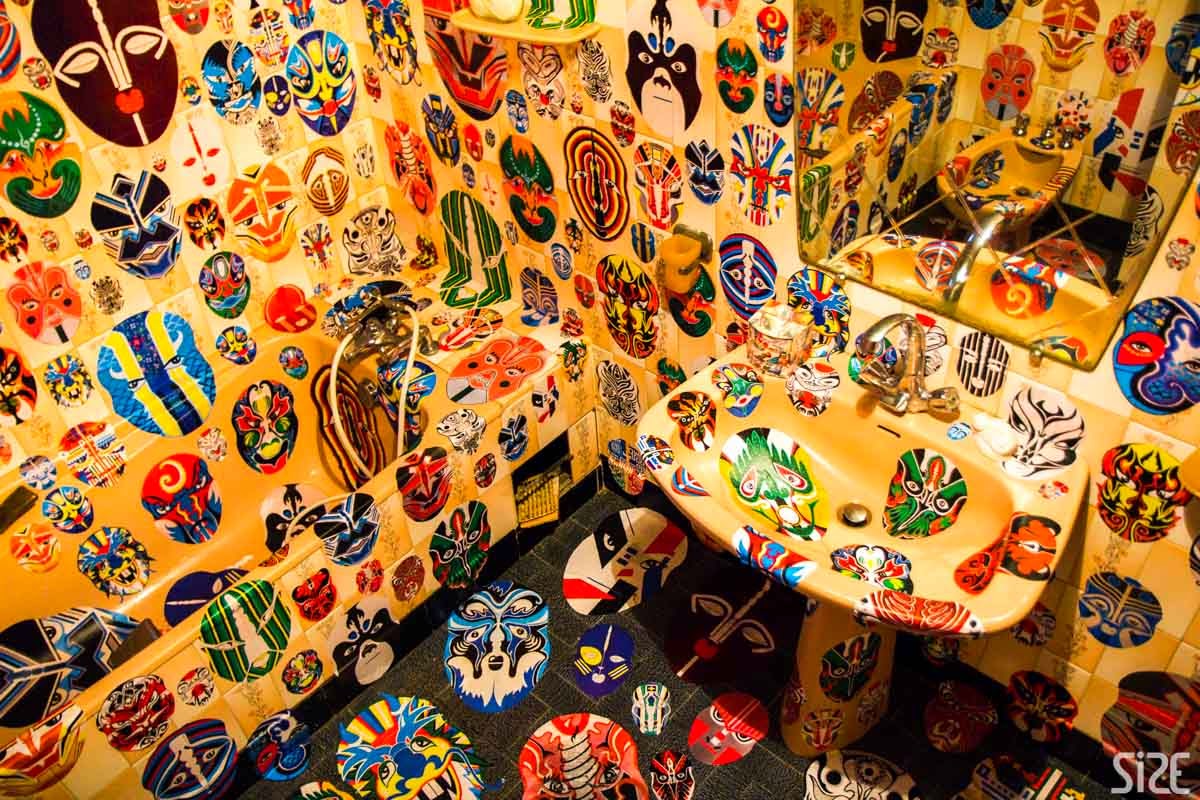
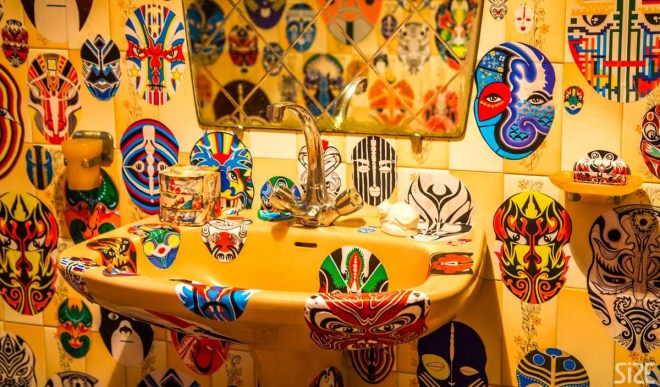
When they stepped into the bathroom, it took Bre a minute to realize that’s where they were. Everything—the walls, floor, sink, toilet, bathtub—was covered with pictures of something. It made it seem like the room was empty, fixtures blending together until they all became one thing.

“What are they?” Bre asked.

“I don’t know. The man who lived here before was an artist.”

The realtor whispered the word, as if it explained every little thing that was wrong with the house.

“They’re lucha libre masks,” Adam said. “Mexican.”

“It certainly seems cultural,” the realtor whispered.


They hadn’t thought finding a place would be so much work. Adam had shelled out money for the cheapest realtor. He’d told Bre that having someone on their side would lessen the stress.

“So, what’d you think?” Bre asked.

“Are you fucking kidding? It was terrible, and the rotten cherry on top of the pile of shit was that bathroom.”

“At least it’s interesting,” Bre said.

“I don’t want to settle for interesting.”

“We’re going to have to settle for something. Isn’t interesting better than nothing?”

Adam looked straight ahead, but he found Bre’s hand with his as they walked into the wind.


Adam had grown a beard, and Bre was seven pounds heavier, but the house looked the same. When the movers dropped the first boxes in the front room, the house sighed.

That first night Bre couldn’t sleep, so she had a bath. She sat in the hot water and looked at her body, the size and shape of her belly seeming as absurd as the masks staring up at her through the clear water.

She tried to name all of them, but didn’t get far.

The two towels they owned were still packed in a box somewhere, so she left puddles as she stepped out of the bathtub. She looked at herself in the mirror – her face was just another mask, just another part of a whole. She closed her eyes and the child inside her knocked three times. 

Not yet, she thought. Please, not yet.

sdb 2

word by Leah Mol

colour by BauBo