shark and whale

10262265_476646099136322_7572693832391211453_n

She spent most of the waking hours of her life in an office tower. It was obvious to her that this was not a real problem, that the people around her were also spending most of their lives in office towers, and that everybody else seemed fine with it.

She spent only ten minutes of her day everyday outside, the walk between her apartment and the subway station, five minutes in the morning after which she descended underground and remained there, subway station to tower lobby, tower lobby to elevator, elevator to sky, to being up in the sky but also trapped inside a grey-walled cubicle. She could see a piece of sky over the top of her cubicle wall and the sun glinted sometimes in a way that was the most flippant, the most torturous of teases. And then five minutes on the way home, dark by the time she emerged. This, too, she knew was not a problem, because the air was cold in the city she lived in and to be inside, indeed to be underground, was desirable. Shelter was a plea granted.

There were tall mirrors in the elevators of the office tower, and sometimes she looked in these mirrors in the middle of the day and was surprised by the normalcy. She looked like an office worker, wearing the right clothing for an office worker, with her hair done up and her shoes clean and her teeth brushed. What she felt like was something big and floating, something that took moving with a crane or the buoyancy of an ocean of salt to support. Something helpless and slow.

There was a boy who worked in the Starbucks in the lobby of the office tower. He had long hair and a nice, easy smile. She started to take trips down to the Starbucks on her breaks and moon around. She reached sailing plateaus of caffeine highs by the end of the day.

One week, she came in on a Sunday, and the boy was not there. Another boy handed her a cup of coffee instead, a boy with short hair and a sharp, too-big smile. It occurred to her that Starbucks had paid for this smile, that this boy and maybe all the boys were smiling at her because Starbucks had told them to.

She drank too much coffee that day anyways.

She could not sit on the subway home, and because it was late and the only other people in the carriage were too gone to care, she paced back and forth for the whole ride, long strides that made her legs feel real for the first time in weeks and she imagined the office tower being filled with water, with salty ocean water and then with monstrous animals that stared without seeing and bit with delight and she imagined them darting back and forth in the gloomy, empty space. Shreds of mangled whale floated past them.

word by Charlotte Joyce Kidd

colour by Fiona Tang 

From the author: “It looked to me like the shark and the whale in this picture were both trying to break free from the wall, but whereas the whale strains against it, the shark bites its way out. I’ve also been thinking a lot lately about what the inside of the office tower I work in would look like if it was hollowed out and made into an aquarium, or some kind of colossal sculpture gallery. Those images together became this piece of writing.”


the world can come to you

3

There’s a now-redundant wall outside the (currently unsponsored) stadium, on which someone has scrawled a strange, pseudo-cubist bird. It’s bulging, ever-watchful eye was painted at some point before tech made that kind of old-school social mischief – the real good stuff – obsolete. Graffiti doesn’t give you the same rush as virtual reality, ya dig?

The stadium hasn’t been used in years. I’d venture to say that the bird is the only one watching sports in person. People can’t be bothered to leave their houses for anything, let alone sports, since the nationwide rollout of the Microsoft Xperience Holographic Immersion Throne v.2.1 ™ and its accompanying Virtual Reality processes.

Why go out into the world when the world can come to you?

The tagline from the commercials was secured with some science gibberish, something about how a series of small pulses from the throne’s electromagnetic halo could be delivered to the part of the brain responsible for…whatever…and a neurological substitute for an external stimuli could be produced… all very sci-fi, except, you know…it was real.

The Microsoft Xperience Holographic Immersion Throne v.2.1 ™ was real. It was here, in America, and it was addictive. Look on a long enough timeline and you’ll see abuse follows the distribution of any groundbreaking technology. Most of the time, this abuse stands to exacerbate some mental burden, some level of active participation that can easily transition to passive consumption. That’s not marketing: it’s a fact.

Passivity became the norm. Of course, some people will argue that it was status quo long before Microsoft (hell, I might even be one of ’em) but something just clicked in the American psyche when that fucking chair came out.

It was like all the little bits and pieces of the broken people of America were glued back together as soon as the electromagnetic halo, like a scorpion’s tail ready to sting, fired that first electric shock straight into the brain. The MXHIT v.2.1.

External stimuli are irrelevant once you figure how to manipulate intra-neural connections. There’s no reason to trudge all the way to a stadium to watch a football game when you can download a bioprog that makes your brain think you’re there, eating nachos and drinking beer with all your famous friends (Scarlett Johansson’s been the most downloaded bioprog three years running). All of this from the comfort of your own living room.

What hard-working, overeducated, underpaid American could resist that?

Could you?

Some days I sneak past the bird and into the stadium. I sit way up high, in the nosebleeds. I can’t imagine being able to afford ones close to the field. I breathe deep and picture tiny players scrambling around the dilapidated field far below. The stadium seat isn’t as warm as the one I’ve got at home.

word by Josh Elyea

colour by Mark McClure

From the author: “When writing this piece, I really wanted to ponder what it was about the contemporary moment that’s so threatening to “the real” (I know that’s vague…bear with me). I’m often distracted by questions of authenticity; authenticity of art, authenticity of experience, anything. This piece gave me the opportunity to analyze some of those questions through the technological filter that’s omnipresent in our everyday lives. It’s overwhelming to think of the sheer speed of technological advancement these days, and it begs the question; how does technology affect our understanding of authenticity? Is there something to be said for genuine experience? Hell, if that’s your argument, does technology diminish an experience at all? Or does it enhance it? Life’s not as simple as sitting in a chair anymore, and I really wanted to take a look at why.”

she dreamt in tiny fists

untitled (1)

She dreamt in tiny fists. The fever pushed at her eyelids when she kept them shut, and leaked out and over when they were open. Each morning Nathanael came to her with tea and the newspaper and an orange but every afternoon she woke to find the tea cold and the orange so soft and pungent she had to pick up and throw it away, an effort that made her grunt—a wild sound against the curtains.

She didn’t know what day it was, or what time it could possibly be. She only knew that she threw the oranges in the afternoons because of the clock that ticked like loss on the blue wall. Sometimes she threw the orange at the clock, but it was invincible.

Each hour became a cold and wobbly upper arm that no one ever touched or thought about. Perhaps this was what depression was like, she thought, as she blew her wretched nose and spluttered into the sleeve of her dirty nightie, but it wasn’t: she could see that through the waves.

Once, after throwing the orange and wondering for a long time whether it had landed on the air vent where she imagined it heating up and bleeding out onto the floor, she sat up and turned and bent her legs and lifted, and then she stood.

Her head was still on the pillow as she rocked gently there on the carpet. Eventually it met her in its place and together they walked to the corner of the room where the orange lay, nowhere near the air vent, perched on top of a yellow dress she had forgotten all about.

She laughed then and coughed and a purple snake slid past her foot before she tipped herself back in and under the covers.

Nathanael came at night to pick up the oranges and dispose of the bits of newspaper she had used as tissues. One night he had six heads—one night, seven incredulous eyes. Then there was the night that he had one face, and it was beautiful, and she wished she would recover so she could love it better and kiss it more.

That was the night it was over. Suddenly her stomach ached for food; it writhed and echoed with hunger. Can I have some soup, she asked, lightly and without commotion. Nathanael smiled and opened the curtains to the moon.

word by Laura McPhee-Browne

colour by Young Wavey

From the writer: “When I first saw this piece of art, I was instantly reminded of a dream; a feverish dream of the sort you have when you are ill with the flu, and sleep is confused and brief and uncomfortable, with a sort of sick surrealism just around the next corner.

When I have had a serious case of the flu in the past, I remember thinking in quick bursts about things that later made no sense. I remember having no appetite except for relief from the heat and the pain, and I remember feeling like I was going to be sick forever and ever. This story is an attempt at encapsulating how it feels to have the flu, and the dream-like nature of being stuck inside an unrelenting fever.”

cold souls

HideandSeek_LorisLora (1)

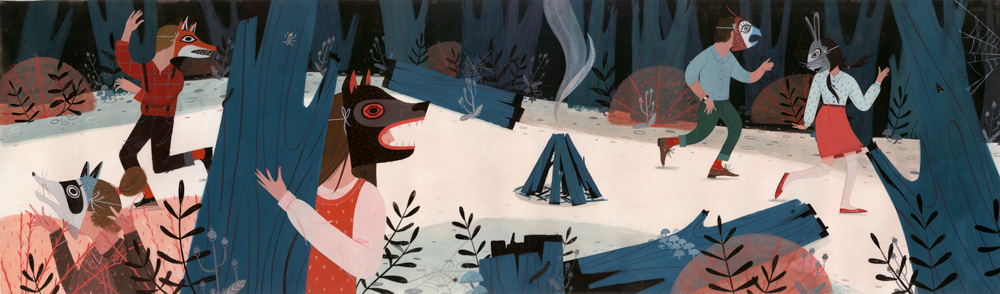
This all started because he’d seen an old movie where some stoned chick with an 80’s crop cut said something about when you grow up, your heart dies. (You’d know the flick; kids in detention.) It was supposed to be funny, but it scared the shit out of him. Nothing funny about compromising your soul, he’d thought. That’s why they were out here in the cold, freezing their tits off. This was about never losing sight of your soul.

                The mask was a little tight against his face- it felt right. The fox had cost him $17.99 at the costume store, a small price to pay for immortality, and it was one with him now,  a new face. His true face. The book of voodoo had said they had to choose masks they thought reflected their character, their true selves. It said this was the most important part of the ritual. Before you could change something about the world and your place in it, you had to know, really know, who you were inside. In your soul. That’s why voodoo doesn’t work for grown-ups in the West: they’re all dead inside.

                His breath in the cold leaves little beads of condensation that run down the inside of the mask and out the bottom. He watches them and listens to the crackle of the fire underneath the languid, off-time clapping that seems to pervade most any pagan ritual. The children’s chanting is hushed now, but it’ll grow, feverish and in leaps and bounds, to a frenzied crescendo when the moon is brightest. He isn’t sure they’re speaking the right words, but he hopes whatever gods they’re praying to get the jist. Through the slitted eyes of the fox he tries to count the number of snowflakes the fire touches. He can’t. There’s too many, a million. If the magic works, the flakes will never melt. The inevitable thaw that follows the cold will never come, and they’ll endure, ageless, in the depths of winter.

word by Josh Elyea

colour by Loris Lora 

the fire

unnamed (2)

They’d seen a caiman at the zoo, her and Sadie, when they were little, maybe five and eight.

“What’s a caiman?” Sadie had asked their mother.

“It’s an alligator.”

She had read the sign and whispered to Sadie: “It’s not an alligator. It’s different.”


 “I was just letting her know I still existed,” he said. “So I lit her pillow up. It was a harmless prank.”

You burned down half of campus, they said.


People watched as the fire burned, from the other, safe side of campus, where the arts buildings were. It was pretty, if you let it be, the way it was black and orange and danced with the red and yellow leaves of October in Ontario. 

Thank goodness it was reading week. Thank goodness there was barely anyone on campus. Otherwise who knows what you could have caused. Do you understand the implications of your actions?


She went back for the caiman. At least, later she would tell herself she went back for the caiman. Once it was dead, it was easy to mourn its passing.

The truth was that she liked it. Her lab partner, a guy named Robert who was already crotchety at age twenty-seven, hated the thing. He called it Stinkeye and shuddered when he had to feed it.

She’d called Sadie to tell her, her first day on the assignment. “I’m a lab assistant now – we’re studying caimans.”

“That’s nice, Sab. What are you finding out?”

Sabrina had started to explain, the microbe that lived between the teeth, how they might learn to reconstruct molars, but she felt Sadie stop listening almost immediately. “How are the kids?” she asked instead.

She thought she was going back for the caiman, but when she reached the lab, she realized how silly that was, how improbable. How had she planned on carrying a caiman? Was she going to wrap it up in a towel, cradle it like a baby? Put it in a duffel bag, sling it over her arm? No, she could not save the caiman; she went back for the research.

She stood with her fingers to the glass tank, and thought that some understanding passed between them. She thought she saw, in its reptilian eyes, a knowledge of what was to come, an acceptance. Then they flickered shut and all that remained was its broken zipper mouth and its listless, horny skin.

She took all of the files on the caiman, all of the pieces of paper, all of the very important measurements and observations, she gathered it up and took it back to her apartment, where it sat in stacks on her living room floor until they were moved to a temporary lab where they bought another caiman. 

The condemnable actions of one student have been responsible for the loss of countless hours of research and millions of dollars of lab equipment, the dean said.

And the death of a caiman, she thought. A charred little skeleton in the wreckage somewhere.

word by Charlotte Joyce Kidd 

colour by Russell Cobb

oasis

1796661_288174391333568_1670898555_n

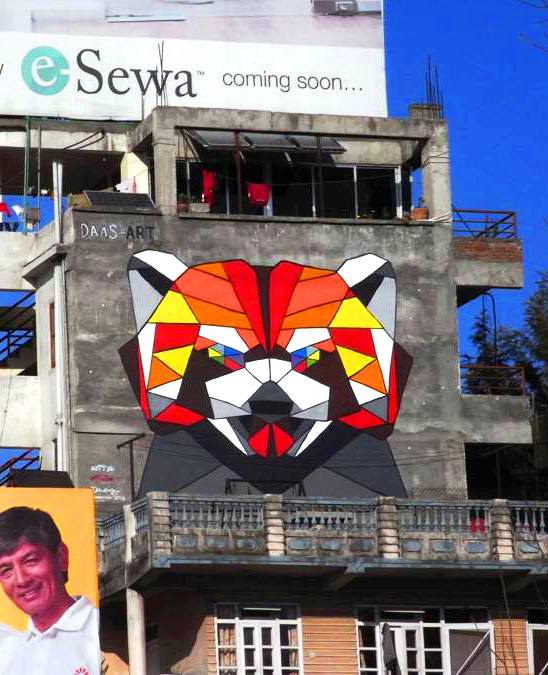
On the street she walks along most days there is a wall. The wall is one side of a building and is tall and made of brown bricks, neatly piled and cemented together. The wall has been painted in one spot, up high, and it is this painting of a triangle fox that she watches as she walks. The fox is brightly coloured, with kaleidoscope eyes. The first time she saw it was not so long ago, for she is new here and has only had the courage to walk the streets since she has known to some extent where they join. She told Miles about the fox that first time, but he frowned and kept typing and she couldn’t really explain about the yellow parts and the cave cheeks and the spike of its ears, or how it made her scared and safe at the same time, so she stopped, mid-sentence. Later he touched her hair as he walked to brush his teeth and asked her to tell him more about the tiger. She didn’t correct him.

Then there are the days when she walks down the street with the wall with the painting on it for no reason other than to look up at the fox. She isn’t very busy—jobs are like lucky pigs here—and she feels small and blurry in the apartment on her own. Sometimes as she rounds the bend and lets out a small sigh as she sees the fox up high, there is an old man standing where she stands when she looks at the fox, and he is looking up, too. He gives her a heart ache, with his grubby mittens in the middle of summer, the same drooping plastic bag by his side, every time. She feels so sad – her heart is an emptying bath. But he always moves before she gets to the spot, so, without guilt, she can look up, drinking in the kaleidoscope gaze from above her.

She is looking up at the fox one day, at that time in the very late afternoon when you can almost smell the sun sinking. She does not see the man until he backs into her, his grey hair combed straight and his jacket sticky. She apologizes; chokes out a laugh; wants him to know she does not fear him. He doesn’t seem to hear her. The man stumbles and she moves to let him as he tilts back his head and looks up at the fox. He is saying something—she can hear something croaking out between his upper lip and jaw. She cups her ear to hear him. 

word by Laura Helen McPhee-Browne

colour by DAAS 

mosquitos

bur

“I fell in love with you the first time I saw you fall off a horse.”

Her eyes are watery, glistening in their sockets. I can’t tell if it’s drool running over my lips and down my chin and neck or just some bruised emotional response to what’s happened, happening.

“You’re so stupid.”

She’s wiping at her eyelashes. If she keeps doing it I feel she’ll have no eyelashes left by this time next week. The window is open and all I can think is I know the mosquitoes are eating me alive and I can’t feel it. Most people unconsciously wish they could live a life in which mosquito bites don’t itch, can’t be felt. Others don’t mind the actual itching and scratching, finding themselves more inclined to fume at the violation of it all, the unseen bloodsucking and flying off into the night.

“I told you not to go.”

I think what happened was I drank a little too much, as is habit, and walked or stumbled out to the stables, snuck a horse out with what I can only imagine as indescribable grace and horsemanship, thereupon divining myself up onto it’s back, into the saddle… And there’s where all memory stops. And if I’m being honest, something I am not necessarily known for among both friends and enemies- everything I just remembered could be made up. I’d cry if I could feel anything physical. Not for me, but for this girl that knows the truth, the reality that I can’t remember. I can hear Sarah, and I think I can see her, but what I am listening to could be nothing more than unreality catching up with me. She sobs uncontrollably and I see her right arm, the good one, swing and slap my left arm. I can’t feel it and though my head wants to whip toward her in some accusatory fashion, nothing happens.

I fell in love with Sarah under a harvest moon. Sarah says it was blue and I made a mental note to check and see if harvest moons are ever blue. I never checked. I told her before we got serious that I can’t really have friends because I fall in love too quickly, platonic, heart-love, sexual fantasy, all of them separately but often attributed to the same person. And as a result I end up hurting everyone, like a man made of plutonium, some inevitable occurrence will disrupt my atmosphere and I’ll blow up and there won’t be anything left of us: and so I lie. I lie and never stop lying.

And now in an ironic twist of fate, here I am lying, on my back, catheter rooted and probably a dish of some kind caressing my naked buttocks, tubes jutted unfelt into my skin and veins, into my blood and the girl I may have actually changed for is crying and pulling out her eyelashes and I can’t even muster up the words, “It’s okay.”

word by Anthony Statham

colour by Sarah Burwash

how to escape a whale

cccc

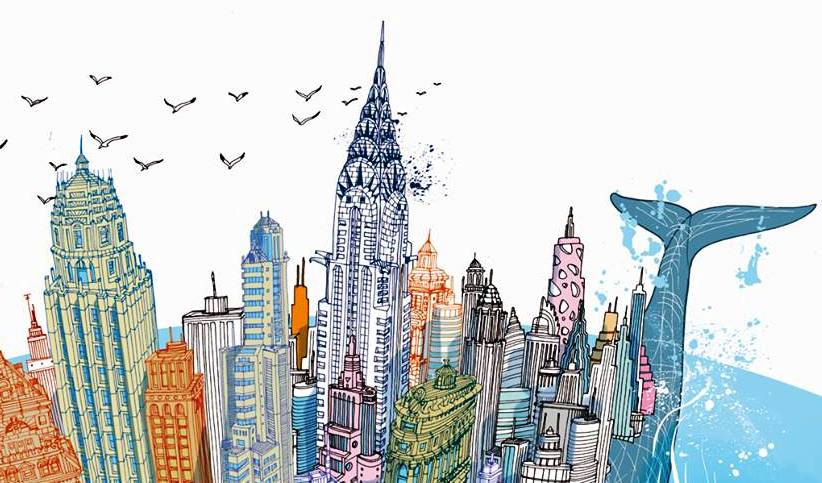
Becca’s leaving the city. She’s accepted this: after the fight, the crying, the insults neither really meant or believed, after all the ways in which they’ve hurt each other – it’s time. She’s leaving. It’s not just him. There is, after all, a whole city. She could avoid him if she wanted to. But it’s that, it’s the city: The city is the problem.

Lately, she suspects that the city is following her – the same placid towers, the same ageless fire hydrants, the same cheery, nondescript shops trailing her from block to block. Its serenity, its immutability, make her want to scream in her state of perilous irritation. She used to love the city.

She used to hum to herself as she walked through it. She used to smile at strangers on its streets.

Now, especially at night, it seems smug. Streetlights glow with calculated eeriness. Its inexplicable rustlings take on a self-important tone, as if to prove that industry and vigor will always exist in the city.

She had come here to feel that things were happening. Even when she herself was doing nothing, she could walk out onto the street and smoke a cigarette and watch the million odd goings-on passing her by and feel that the night was not wasted. Look, a man in a velour suit with an iguana on his wrist – pet or accessory? And over there, those two women, well-dressed, middle-aged, wearing a bit too much bronzer perhaps, that woman has just stuck her ice cream cone directly into the face of her friend.

She wanted to go to street markets, to art galleries, to neighbourhoods she’d never seen before, and partake in culture and romance and all of the borrowed nostalgia of other people’s lives.

She wanted to go out at midnight and get drunk on gin and tonics and revel in the sad, seen-it-all glamour.

It was her who had loved the city. Not him. They’d had an argument once: he’d told her that living in the city was like being a mite on the back of a great, eternal animal: You could drop right off and nothing would change. But you could also burrow your own tiny hole in the surface of the animal, and you would be free to do so. The city would continue in its forward momentum, unbothered by the specks living on its skin.

“That’s ludicrous,” she’d said. “We anthropomorphize cities, giving them entities, but they’re just made up of people. If we all disappeared, they wouldn’t keep going on their own.”

“How can you be so sure?”

“A city is not a tree with no one to hear it. Besides,” she’d added, “look at Detroit.”

Becca’s leaving the city. Every time she tries to picture being somewhere else, she can only see herself floating: Treading water, she watches its million winking points of light recede into the dark.

word by Charlotte Joyce Kidd 

colour by Carlo Stanga 


bonsais and bad manners

10363475_10100669499245845_2793881420624295760_o

My ticket is one-way, CHICAGO-SEOUL. I’d always wanted to go to Chicago- Bill Murray is from Chicago, and Harrison Ford, too- Han fucking Solo and Indiana Jones. My layover is four hours- not long enough to leave the airport. I’m hungry. Can’t find a place that sells deep dish pizza. Can’t find a deep dish pizza in O’Hare. Maybe I’m not looking hard enough. Maybe it’s just 9:30 A.M. I try to meditate.

I must look ridiculous, sitting cross-legged in my Chucks and leather jacket, trying to ignore the hustle of the masses, molasses. Worrying about looking ridiculous defeats the purpose of meditation, I think. Can’t focus. Take out my laptop. Twenty minutes of free Wi-Fi: That’s all you’re given these days: Twenty minutes. A taste. Bastards might as well be pushing drugs. Take out a book. Kerouac’s Dharma Bums. I read it writing my thesis, not the same as reading it now. Get on the plane. Take off is bumpy in the tail. Cruising altitude.

The sun is so much brighter above the clouds. This is the closest I might ever be to it, I think. I watch the wing tilt up, towards an ethereal blue. People sneer at me and the angry sun streaming in my window. I feel like I’m watching myself from the cloud, or from the ground, like a bird. They’re trying to sleep. I don’t care: Nobody should sleep this close to the stars. Jimmy Page massages my eardrums with the Ramble On as I stare over the pillow-soft clouds. Zeppelin II- so underrated. I remove my headphones when I notice my neighbour talking to someone in front.

Now you see here, Chuck, alls I’m trying to say is equilibrium is possible, even if you have to fly 32,000 feet to find it.

This cowboy, looking like Woody Harrelson, steals me from the clouds. Maybe it is Woody- sounds like him. I’ve been awake too long, I think.

It’s about balance, he says. He is talking to the chair.

Are you talking to me?

Who else?

My name isn’t Chuck.

Look, there: Perfect sorta balance. He points out the window. Man wound tight as you oughta realize there’s a simplicity to this: Equilibrium. You’ve gotta learn to balance your fuck yous with your Feng Shuis, your Bonsais with your bad manners.

We’re flying to Korea, not Japan- wrong Asian country.

I’m saying that in a backwater Buddhist temple or here, up here, at 32,000 feet, you’ve gotta realize you won’t have peace until you reconcile your recklessness, you hear?

I wanted to reach out and touch his hand to make sure that he was real.

You’re pretty smart for a cowboy.

I’m not smart, don’t know a damn thing. He lowered his Stetson over his eyes. Just a man who has to fly 32,000 feet to find his equilibrium, ‘course.

Bonsais and bad manners… I looked back over the clouds. Made sense up here, down there?

word by Josh Elyea

colour by Jade Rivera

aliens in the delicatessen

BOUWBESLUIT_2012

I’ve known for over a week now that Han is an alien, and it’s actually been a pretty normal week. Han and I work at Coles – me in Liquorland and her in the deli in one of those meat-stained aprons, her brown hair tucked inside an oily hair net.

It happened in the cool room. I was hiding from Drunk Dave who regularly sang in the middle of the wine racks and had to be escorted out, shaking and telling us he couldn’t leave without his wine. Han had been told to take a breather after she’d got shirty with a fat-necked middle-aged man asking for 17 slices of tasty cheese, cut ‘as thin as tracing paper.’ We sat down on the beer battered chip boxes to be sarcastic and chew on twiggy sticks for a while.

My mouth was hot and lined with salt and fat when Han told me that she was pissed off at everyone that day. I asked why. She said she hadn’t been sleeping well. ‘My brother, who’s also an alien, is being teased at school, big time. I’m so angry for him. At night I just lie there and think about punching their fucking faces in.’ She was looking straight at me, watching for my reaction. ‘I’m an alien, you know? And it seems like we still need protection. After all this time. My dad’s right.’ It didn’t really shock me – Han being an alien. I’d grown up being told about aliens by my parents, and had watched the landing on telly when I was five. I didn’t care, and I sure as hell didn’t want Han to think I didn’t like her anymore.

‘Yeah,’ I said. ‘I think you’re right. There are some dickheads out there who are scared of anyone different from them. Your brother’s lucky he’s got such a cool big sister.’

It’s Tuesday and I’m cleaning out behind the dumpsters, where our most regular customers head to zonk as soon as they’ve paid. It’s a shit of a job – we Rock Paper Scissors each week to work out who does it, and I did Scissors one too many times. Han’s called in sick and I’ve texted her but she hasn’t replied. As I’m coming in from the back I pass through the lunch room. The TV’s blaring. Steve from Shelving turns around, his eyes wide like paper plates. ‘Didya see the news? They’re taking the aliens back into detention. Say it’s for their own safety.’ He has a floppy sandwich in his hand and sauce on his upper lip. ‘Hey maybe that’s why Hannah’s away today! I always thought she was weird.’ He laughs and chokes and coughs up a bit of mushy bread.

‘Shut up Steve,’ I say. ‘You don’t know anything about it.’

I don’t know anything about it either. I scroll my phone for Han’s number and press down hard on the picture of a green telephone. She doesn’t answer but I’ll keep calling.

word by Laura Helen Mcphee-Browne

colour by Patswerk