“Make Me,” new poem by Justin Million

Alison_Scarpulla_1.jpg

so we took up inspired
fights like the -isms,

the air, the water,
the rolling glaciers,

the fears we feel
in homes, our least conversated

doors staying owned,
most only accepting MEN, to say (like anyone intelligent asked or cared)

they still exist
to pretend they wouldn’t jerk a man off in a secret vacuum.

The glow of a few decades’ mistakes
still spreads red,

despite us being in charge forever and no one else, no handed down way, no alien us,
most mostly

alike, tho some stopped reading this poem
because of my science on men wanting to try cock at least once,

my science being don’t make an individual
a video of that same individual being you. They are not you.

This is where we’re at.

No gigantic man handing us down to us. I can’t stress that
or anything else enough. I am shaking for a world of reasons.

We have a 2000 problem, 0000’s of MEN
are videos displaying how dim men continue

to study spectrum
with the light out.

That last bit was a metaphor
for porn, men’s rights, and the new Nazis

(you lost fucks see me on George Street, stab fast,
or you’ll lose the personal war too this time);

this open bomb of a world.

Amazing we exist in this at all. Amazing we exist.
Amazing.

The young man at the protest about to climb the lamp
can’t be Gene Kelly,

trained to keep his hands off the high light,
take home as much grace as he can scrape off the bottom.

There is a baby who is important to the future lying
by the political blast zone Schrodingering,

and because everyday’s a news day, the knife
or branch in your hand;

keep the future you don’t know down is the red lesson. Stab a gay baby.
You have to have a gun,

your right to not much isn’t God
given, or taken. It’s plain. Your belief is a ladder to another finity.

In charge of nothing
but fixing

the world we went into
debt to see, and have

since brunched back
to our mothers and fathers,

lived inside basements, inheritances,
until we had the wall space to hang

what failed us; photos of hairdos all
ecstatic to be sepia, cross-legged on the wall, denying they’re putting us down;

every memory back then
straight.

Oh mother,
come back to bread.

Yes, we are furious,
because we were ushered in, without shushing, when the world was still

blind, and quarrelling over how much YES is left when it’s a ruin, and the whole
time just around the corner

You, absolutely
not your father,

maybe President;
worth a shot-

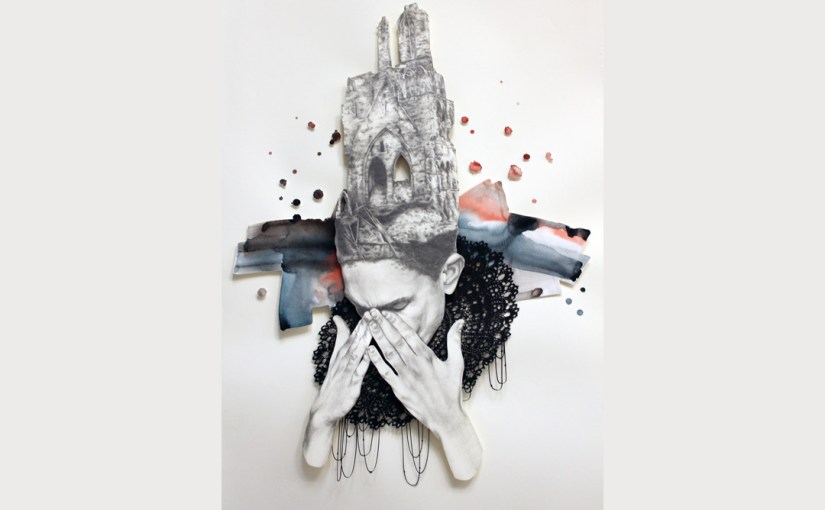
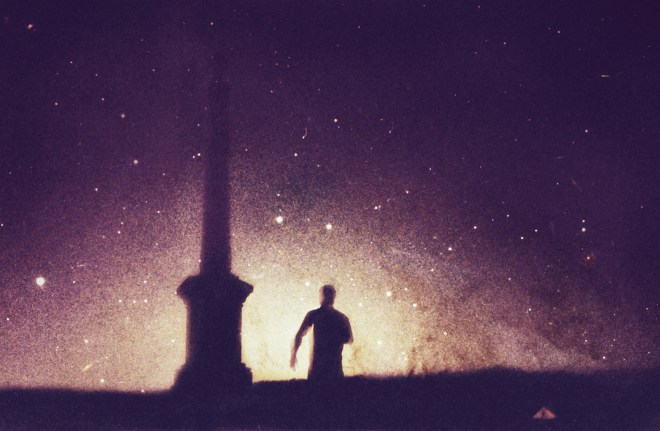
these words by Justin Million were inspired by the photography of Alison Scarpulla
 

“Code Switching of the New Romance,” new prose by Kate Shaw

Alison_Scarpulla_3.jpg

Spanish cropped up in their discourse in a very predictable way. Their relationship was established in English — her first language, his second — and Spanish tended to couch the more intimate sentiments. For her, it created distance — both from the topic and from him — when they traipsed into territory that was rife with vulnerability, con dudas.

—Pues ¿por qué crees que te sientes así?

Spanish, in case asking directly about his emotions was too big a threat to his masculinidad, to the machismo of his culture. Spanish to distance herself from a fair question, but one that asked for vulnerability from a new partner who maybe wasn’t ready to give it. Spanish, porque tenía miedo.

She used code-switching as a buffer, a way to protect herself when she took a tentative step into the thick haze that was an infinity of potential futures for them.

It was different for him.

—Te escondes con mi idioma.

He didn’t fear that haze. The lack of clarity was something he simply accepted as inevitable, even beautiful in its incertidumbre. His Spanish was meant to pierce it boldly, shoot it through with light — aunque efímera — so they could both see, at least for a second. See each other.

The contexts overlapped almost perfectly. If you didn’t know them — as individuals, as partners — you might think the role Spanish played for each of them was identical. You had to have a much more personal perspective to see that what allowed her to hide was what most allowed him to show.

these words by Kate Shaw were inspired by the photography of Alison Scarpulla
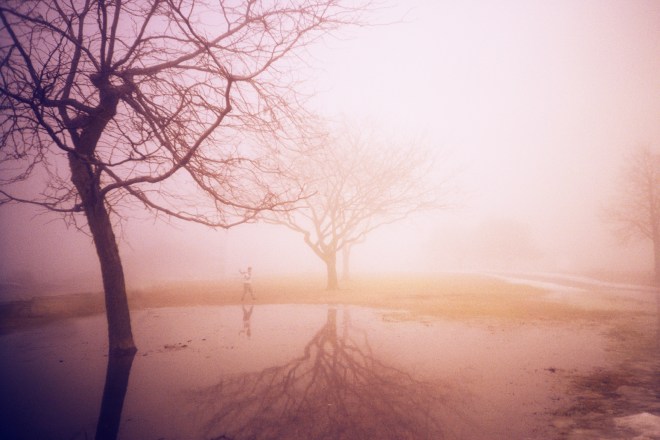
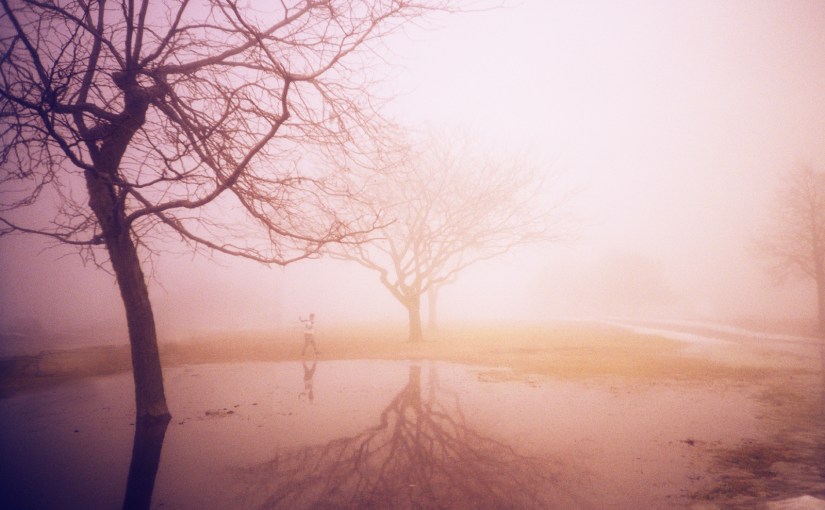
From the author: “What spoke to me most about the photo was the haziness of the image and the reflections. I linked the lack of visual clarity in the photo to the uncertainty of the future shared by the two characters, which they approach in different ways. The idea that a reflection appears identical to the source it reflects without actually being the same is connected to the fact that the characters use Spanish in the same contexts but with very different intentions.”

New prose by Annie Rubin, “We Are Survivors”

christinekim_3

It felt like dying, only you’re expected to reincarnate much faster: rapid loss of breath, chest heaving to compensate. Dizzy. The room would fade in and out. I watched myself descend into fight or flight, an encumbered observer over my own body.

At fifteen, I asked to be separated from that part of my identity rooted in fear. Was it possible to unlink? Could I attain the division of self: an existence without the weight of imminent extinction?

My father felt it too. He brought me tea one night, bourbon and honey. It Will Help You Sleep, he promised. What If I Die, I asked. You Will, he said. But Not For A Long Time. We Are Survivors, You And I.

They gave me Zoloft to stop the shaking and Seroquel to help me sleep and Prozac when I had the urges to go to temple when it rained and they gave me Lexapro for the side-effect depression. They gave me Klonopin and Ativan and Valium and Xanax was my favorite; it made the room spin the least.

The effort was in solid determination to mute what so viscerally tied me to my ancestors: that brink-of-death anxiety we all know so deeply. It ebbs and flows through our veins tethering us to each other, the Jewish people.

Maybe we didn’t speak Hebrew at our Seders but the bloodlines flowed. We were descendants of those lucky enough to hold on, who knew they had to keep living. At family gatherings, the room would get silent. Why Is Our Family So Small? someone asked once. The Rest Of Us Were Killed.

But the drugs seemed to perpetuate more drugs; we were desperate for some kind of medicalized solution, capitalizing on our ingrained identity. Could we learn to escape? Or to ever quell the pharmaceutical self?

The healing had to begin through the (re)discovery of voice. Shrouded by years of institutionalized hate, the beauty of our culture must manifest itself in celebration, unapologetic lighting candles and sharing kindred spirit. Singing and loving and never- forgetting, we must come out of hiding. I want to hear each voice.

this prose by Annie Rubin, “We Are Survivors,” was inspired by the art of Christine Kim 

From Annie: “This work is inspired by the image of a character looking poised and overwhelmed, the base, supporting a dilapidated castle. The figure represents the protagonist’s Jewish ancestry in the strife and struggle of the Jewish people, who bear a weight that has been carried through generations. Striking colours provided a glimmer of hope through the subversion of institutionalized hatred, confiding in the expansive possibility of self-expression.”

New prose by Finn Morgan, “Home Enough”


christinekim_2

CW: abuse mention (child)

A peach morning, shards of grass sneaking into the sidewalk, branches swaying dull and dead. I arrive at the building gate and I am shaking, shaking still; should have kept the winter coat. I call the number saved from the last round of search scrolls and feigned phone pep. The concierge answers: “I’ll be right there!”

I am courteous, perform norm, stand straight and feminine, chuckling at a stray comment on tattoos and irresponsibility; be in-group, be in-group, be in-group to get what you need.

In the elevator, unmoving, with steady smiles. My tired eyelids linger closer shut with each rumble conveying us up, up. I hear the crash and the sobbing; the anxious adrenaline snaps me to wake. Concierge and I meet glances and she, with a light nod, softens her smile. The elevator sounds at the 22nd. “It’s right over this way,” she says, pointing, as the door rolls slowly open.

The hall is well-lit but there are scuffs on the wall. From neighbours? Is the building not maintained? How much can I afford to care? How much does care cost?
Concierge fidgets the key and jerks the door. A good lock. The apartment inside is fine. Nice view. Thick walls. Clean enough. Big enough. Enough is enough sometimes. Concierge points out the kitchenette, the fridge, the bathroom, the balcony. I remove my coat as we look around. I yawn and I hear a small sniffle as we head towards the bedroom.

The concierge gets a call. Issue on the 4th, will be right back.

I don’t expect the shaking and unsettled breathing to leave with her but I am still disappointed when it doesn’t. I open the room door, feel empty. I close my eyes, knowing exactly what will appear: a child with thick ringlets, crouched and sniffling in the corner of the open closet. This child lives in every empty room I visit. Ever since our first room was emptied. I know them well. Sometimes they tell me when I need to leave, sometimes they just need to be held. I am tired and this room is wide enough, sunny enough, so I tell them:

“She won’t find you here.”

“But what if she does?”

“There are locks on the door.”

“But you’ll still hear her.”

“We’ll drown her out.”

“How?”

“Music. The Shower. However we can.”

“And what if we can’t?”

“We’ll survive.”

“I’m still scared.”

“I know. Me too.”

“What do we do?”

“What we can.”

“Will it be enough?”

“It has to be.”

When Concierge returns I ask to start the paperwork. Home is wherever I’m without you.


this prose by Finn Morgan, “Home Enough,” was inspired by the art of Christine Kim 

“The monument,” new poetry by Jessica Goldson

the-monument-final-piece

Foreign
construction;
Mirrors
cling to past images,
Smooth
edges recite falsehoods
Fraught
with mixed emotions.
Dissociated
desire;

Fractured by efforts to complement the landscape.


this poem by Jessica Goldson was inspired by Juan Travieso’s “The Monument”

“White Paper,” by Keah Hansen

Endangered Bird #131.jpg

Brother Bird alights on the silver birch, branches siphoned off from the moons with the frazzle of leaves. Golden leaves that lace the night, and the crinkly coins of the newcomers seem mawkish compared to these yellow hands coursing with veins and sugars. They wave incomprehensible at the new hands, which are different, all white and papery, pockmarked and brine-stained after a journey in a strained wooden frame. These hands are weaving into the woods uncouth and unwanted, gesticulating with the urgency of papers that make crisp noises as they fall into neat stacks on a knotted wood desk. They are dizzying themselves amongst these leaves that are falling from the birch. They are blanketing the grounds in smooth white words all flat and stark. The leaves are browning and returning to the earth. Winter is setting in.

Brother Bird thinks the spindly limbs of the trees seem ethereal from way up in the vapour. The white sheets with marks blackened by some unfortunate quill feather read like an ambiguous pattern. And the voices, which nest among the trees, seem strangely silent. Brother Bird thinks he sees tracts of smoke creeping westward from the shores, though the gales of wind are moistening his eyes and humming auspicious in his ears. The season of snow is bound to pass, says Brother Bird, giddily to himself. The air is brusque and flapping papers up, loose from their death grip on the grounds. They dissolve within the frail wisps of sunlight hitting Brother Bird’s head.

Centuries passed and the smithy whiteness blew through the trees, prying the bark back with all the soft power of snowflakes. Sap soldered with this milky presence, which poured all its white ink into etching the soft underbelly of the trees. There are new names now and the first peoples are dogs that bark. Or stoic like the trees, so the papers say. Then a white paper descends from some federal courier and is acclaimed for its difference. This paper ought to be peopled with leaves from when the first storm blew through. Pulling the pressed leaves out of dusty yellowed spines of books and planting seeds in the margins. But the paper that is published offends like blots of lead, or clammy hands in a handshake. White hot rage settles and Brother Bird swallows another bitter seed.


this short story, “White Paper, was written by Keah Hansen 

and inspired by Juan Travieso’s “Endangered Bird #131”  

from the author: “I wrote this piece about the White Paper Act of the Trudeau government of 1969. I was inspired by different modalities of expression, represented in the layering of the artwork. The layering of the artwork also made me think of erasure and censorship, which occurs when cultural worlds clash, and the irony in a paper literally titled the ‘White Paper’ that was intended to give representation to Indigenous peoples.”

“Buzz,” prose inspired by Nikoladze’s sound machine

L says to T, “Do you ever hear sounds coming from your fingers?” She’s examining the tips of her fingers, the little grooves put there by the strings of T’s guitar. She holds her fingers to her ears. “I swear I can hear a buzzing sound.” L is learning to play. Ever since T told her that guitars have songs trapped in them waiting to get out, she’s been practicing. One day I’ll free them all, she thinks.

“I don’t actually believe that, you know,” T says, “that thing about songs being trapped in guitars. It’s just something some musician said ‘cause it sounds cool.”

L says the real reason she’s practicing is because she wants T to fall in love with her. Then she says, “Just kidding,” because she is, partly, though another part of her isn’t. She’s seen the way he looks at those girls in bands when they go see shows. Bass players, keyboardists, lead singers playing guitar.

L watches YouTube videos of people playing songs on the guitar and tries to imitate what they’re doing. Most of the time the people in the videos talk too fast, or the camera angle is off and she can’t see where they’re placing their fingers. Rewind, pause. Rewind, pause. Find a different video to watch.

T is out seeing bands every night now. He usually calls and asks L to come but then he’ll say things like, “But if you’re tired, don’t worry about it,” or “I think those guys won’t go on until late, so it’s okay if you don’t want to.” So, she stays home and practices until her fingers burn. Sometime after midnight, she goes to bed with aching hands and wrists, and falls asleep imagining her fingers are red and glowing under the bedsheets.

The next week L barely hears from T at all, just one text that says, “Hope your week’s going okay. Let’s hang out soon,” followed by a champagne bottle emoticon. She types, “Okay, sounds good,” then stops before sending it. She erases her reply. According to the formula—take the total time you’ve been dating someone and divide it by two—she’ll forget about T in about a month or so.

On the bus, she examines her white calloused fingertips now permanently indented from the stress of the guitar strings. She thinks of the tips of T’s fingers, remembers how they looked the same as hers do now, dry, white, torn, how they felt rough on her cheek when he touched her face. She places her own rough fingertips against her cheeks then moves them back towards her ears so she can hear the buzzing sound again. She wonders if maybe one of the songs that was trapped in T’s guitar has crawled out of it and into her fingers. Whatever it is, it isn’t a very good song, she thinks. There’s no melody to it. It’s just a bunch of random notes and pitches. When trapped songs are freed, do they need to be decoded somehow?

L is listening so hard to her fingers that she misses her stop and has to backtrack two blocks in the rain to her apartment. When she gets inside, she takes off her coat and hangs it in the bathroom so it can drip into the tub. She goes to the living room to get the guitar but it’s gone. Then she remembers T still has her spare key.

She stands there in the middle of the living room and closes her eyes, lets her feet sink into the floor like she’s standing in an inch of warm water. Her fingers are vibrating now and the room is filling up with the buzzing sound and without even realizing it, she starts to hum along.

words, “Buzz,” by Tariq Hussain, were inspired by the colour of Koka Nikoladze

on Nikoladze’s video: “Filling the Glass”

12:20pm

The glass stands tall. Still. Sure. A foil to the thundering chaos in your mind—crash. A few straggling fingers of feeble winter sun clamber through the window, bouncing delicately off the clear vessel. It is entirely transparent, down to the liquid within. Pure.


I.

12:22pm

A resigned hand stretches toward the glass, slipping effortlessly into an old action so long suppressed. Soft fingertips alight on flawless glass—how is it that the union of such smooth surfaces ends in such a crash?

1:37pm

You roll your head back. It lands heavily on the scratchy couch cushion. Your eyes are trained on the ceiling above, pocked with all sorts of nicks and notches. They’re multiplying as you watch, so you shut your eyes, allowing the third glass’s contents to trickle through your thoughts unimpeded. The sadness comes in crashing waves—you will the drink to hasten the ebb of the tide.

3:40pm

The slam of the front door tears you unceremoniously from a fitful doze. Your head swims thickly. The sea hasn’t ebbed; it’s just become murkier. You can no longer see the sand beneath. That used to be comforting—now it only adds to the chaos.

The sun is disappearing now, and none of its final rays manage to cross the threshold of the window. The glass looks different now, empty in the early wintertime twilight. Small. Weak.

You struggle to pull it all together—your disobedient limbs, your weak eyes and lips—to muster up an impression of control. But before you manage to focus your sight and orchestrate a warm smile, he’s already shutting the door to his bedroom. The only sign that he was there is the mail strewn on the doormat.

A new wave wells up, merciless, fueled by whatever placidity you mustered while you slept. You feel its crash resonate through every part of you. You fill the glass again.


II.

3:34pm

His tread is mechanical. His body could walk him home blindfolded. Music is playing loudly into his ears as he turns the corner onto his block, backpack swinging from one shoulder.

3:38pm

His hand reaches into the mailbox and meets several envelopes. He doesn’t have to look to know they’re bills, warnings, notices. His jaw tightens.

3:40pm

It smells like home: air freshener and gin, one a pathetic attempt to mask the other.

A drunken pile of limbs on the couch. Unsurprising. He drops the mail where he stands and shuts the door with a crash, much harder than necessary. He’s done being sympathetic.

much harder than necessary.

words by Kate Shaw, “Filling the Glass,” were inspired by Koka Nikoladze‘s “INFINITELY SUSTAINED GLASS BREAKING WITH GRANULAR SYNTHESIS” (shown above)

From the author: “Recording glass breaks creates the sensation of a process of shattering that doesn’t end. It defies time, moving backwards and forwards, generating a feeling of chaos that can’t be controlled. That feeling of a lack of agency in a situation spinning out of control spoke to me of alcoholism at its true root. The belief that there is agency in a case of alcoholism—depicted here by the son of an alcoholic parent figure—plays into a dangerous stereotype that allows alcoholics to be blamed for their “choices” instead of helped to overcome their addiction.”

new prose, inspired by sound: “The Trill”

Content Note/ Trigger Warning: Sexual assault, rape culture

They were jittering parallel, his leg and hers. They faced away from each other, tapping in terrified Morse code against the legs of the bed between them. He was shrinking and she was expanding. He was supposed to be the downbeat and she, the trill.

She recalled how his fingers had played her strings. How there was something so excruciatingly offbeat in the way that he’d sped up. He said he liked that sound; she said nothing. There was the pounding of their hearts and the curls of her hair. His hips were rhythmic. She counted to ten, holding onto nothing until he was empty and she was supposed to feel full.

She was his echo, the drum he hit against, a projection of his voice, and she convinced herself to feel empowered to exist solely in the glory of his smile. Too soon it became automatic: a euphoric cacophony of springs and curls.

In the climax, one of her strings snapped. She cried out, he froze. It was unlike her, he thought. She never asked to be hit, she thought. She removed herself from him, shaking, and perched on the edge of the bed.

words, “The Trill,” were written by Annie Rubin: “Koka’s electronic creation made automatic the emotive experience of producing music. This new system, mechanical and intricate, represents a structure of oppression we perpetuate through unawareness or indifference: one in which women are left voiceless and unquestioning. The moment of escape occurs when the woman rejects her role as a void (Cixous) and gains agency through expression.”

the colour and inspiration for Rubin’s work was inspired by Koka Nikoladze’s sound project, 

“Beat Machine No. 2”

Blueberry Leaves

blueberry-leaves-mi-ju

Those people who latch on
for stability.
What good is it to you
to bear the weight
of their despair?
Forced down
by the pressure of shared frustrations,
strapped to the same sinking ship.
Sure, blueberries can float in water…but can we?

word by Jessica Goldson

colour by Mi Ju