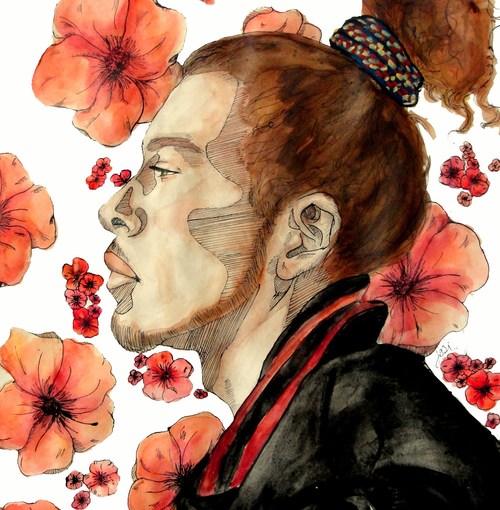
On Travel, Identity: “Try being your own friend”

kosi3

“Try being your own friend”

word by Annie Rubin

colour by Kosisochukwu Nnebe

“Try being your own friend.”

It was an exhausting job; he shook his head and hung up the phone.

The plane ride had felt long and treacherous, with each dip of the wing he was certain they would nose dive through the sky, be compelled to grab for their yellow life vests stored either directly beneath the seat or above you in the overhead compartment.

He would search frantically for the flight attendants out of the corner of his eye, secure. If they were still passing through the aisles with a variety of drinks and Skymall paraphernalia, he’d have no reason to panic.

The streets were shimmering with a blue-black slickness as he marched with conviction in the direction of the hotel.

The streetlights were flickering in and out of view. There was an unsettling echo of footsteps that he couldn’t swear were his own. Perhaps this was part of the adventure. Perhaps he was en route to be mugged. In either scenario, he found it best to focus his gaze on the road ahead, calculating the distance between fear and safety. Two hundred meters, now one-ninety…

In the lobby, he smoothed the lapel of his suit. It was one action in a whirlwind of unfamiliarity that brought him a moment closer to home. He couldn’t understand the startling sense of discomfort he experienced, surrounded in the idiosyncrasies of this place. The country felt oddly reminiscent of something he’d seen once in a dream, or maybe it was just that things felt so cartoonishly similar to images he’d stared at for months in preparation for the journey.

This recognition was stained by the fact that everything was just vaguely different than what he was used to. The water faucets, the scent of the stagnant air, the accents, of course a language he had never learned as his own.

Should this culture have been a piece of him, imparted by nature, somehow inherent in his blood? He wandered into a pizza joint out of habit or homesickness.

This was not his home. This did not remind him of the meals cooked by his grandmother; this was nothing reminiscent of his college chants or practiced habits or the inside jokes, memories collected into phrases and images that composed his true identity.

Maybe he was searching for something profound; maybe he wanted inspiration—confirmation that he had a home, a country, a culture that reflected his unique self. Instead, he was left in a state of flux: what was truly his? The room had fresh floral wallpaper and he felt nostalgic for a place that had until now, never truly understood him.


From the author: “I was inspired by the juxtaposition of the poised human look and the fragility of nature reflected in the vibrancy of the flowers. This led me to question identity, especially how to maintain a sense of self against a backdrop of an ever-fluid environment. The concept of identity raises questions about the significance of cultural background, and exposure, where the protagonist explores his familial history by visiting the country where his family comes from, realizing that he has little to no connection with a place he has never been, himself.”

Waterlogged Love

tomasz3

Waterlogged Love

word by Keah Hansen

colour by Tomasz Kartasinksi

16 minutes left of class. The seconds drift onto the floor, clustering like fallen leaves or crumpled love notes around her converse shoes.  Laughter seeps sideways from her mouth – I inhale her sounds. Filling the blank spaces on the corners of my notebook with cryptic doodles.  Inside jokes nestled on the pages, shading in the loopy curves with tenderness.  She slips me a mint, like any other day, under the roaming eyes of the teacher and spinning discussion, which floats to the florescent lights in a hazy, vapid way. I follow the din upwards, over her curly hair and alight on the fire alarm, with vague notions of apprehension and pensive yearning.

Today, the mint is imbued with significations, defining our comfy closeness on her worn yellow couch and clandestine ice cream escapades (alternating spoons of chocolate ripple and gossip) with flaming gravity. We snicker together over something trivial, then with giddiness I alone levitate equidistant to her forehead. The bell sounds and the class streams out. We tumble to the water fountain together and pause. She splashes over me with her usual locutions while I take a long sip of water.

The water is icy and clarifies my thoughts.  6 months of uncertainty.  6 weeks of contemplation. I’m bobbing here, staring at the grandeur of the stars from this makeshift raft. Her crocked elbow is my mooring.  The water ebbs unceasingly. I feel seasick (or is it butterflies?).  She’s never had a boyfriend.  We’ve held hands in the hallways. Oh to hell with it, I dive in.

My statement, a small confession of love, comes to her in small timid waves. We are the last ones in the building. I’m fixated on those worn converses again; her feet dance nervously while I’m a shipwrecked mess, letting the waves pass through my lips. The rocks hold me steadfast on the hopes for our relationship; they are sharp and make my voice waver more than I’d like.

Her features are catatonic. She contorts her face into a sympathetic smile. I surface into the glaring sunlight. Her face is burnt; she doesn’t understand my watery, viscous existence. These mermaid musings mean nothing to her. My ears are clogged. I feel the palpable pressure of her discomfort; my skin is cracking as impressions of my declaration sink into her body.

Another bell sounds. I slink back into the water, my element. Half coherent and murky, I don’t need to define myself or reveal my pinings to anyone.  I’ll cry tonight, alone, but gather my tears as jewels. Later, I’ll string them together and wear them on my neck, something beautiful and brave.

For now, I drift away.  A current pulls her brisk minty existence away from my waterlogged love.


From the author: “I was inspired by this artwork to write a story about an experience of revealing your romantic affection to a friend of the same gender.  The blue material at the bottom of the piece expressed to me both bed sheets and water.  I interpreted the water as a symbol of renewal and rebirth, which I related to coming out with your sexual orientation. 

The positioning of the legs also gave me the impression of figuratively “diving in” to a relationship or a new experience.  The opaqueness of the blue inspired me to think of the colour as a form of protection, which I developed later in the story.  Furthermore, the vertical tiered nature of the piece affected the progression of my story, while the Facebook friendship sign symbolized the ambiguities of relationships, especially during adolescence as we have a tendency to question our sexuality.”  


On Heteronormativity, High School: “Easy”

word by Alisha Mascarenhas

colour by Tomasz Kartasinski

tomasz

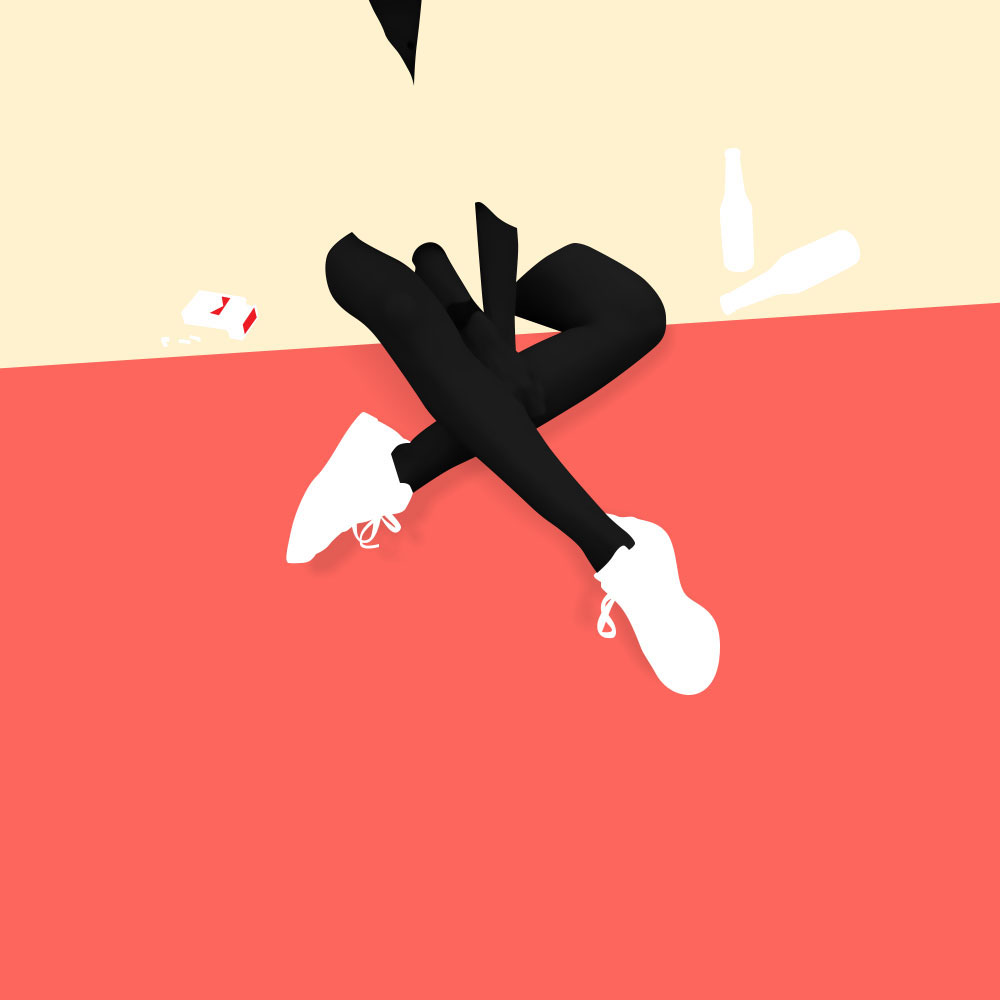
The bend in her legs is relaxed; easy.

She folds one beneath the other, waiting for the night to set in.

The loop in each clean, white hightop precise and dangling with that quiet anticipation that comes after sucking back the frenetic bubbling of the first beer. Giddy elation that rises to the sternum.

From where I stand in that hot pit of a parking lot all I can read on her body I feel in my hands: blunt fingers softening into the pinch of polyester jacket pockets.

All my life taught how to be seen by men, I don’t know what it is to look at a girl. I never gave myself permission. I want to know how to look without inhaling her; to let my gaze settle on her whole being; the space she inhabits and the retreat of a sleeve that licks her inner forearm.

She won’t look at me. At home with the other queers I’ve found ease in a different norm. Ambiguous friendships warmed by late night snuggles on that long, blue couch in my apartment, kisses on the mouth and other quiet affections. Sometimes sex.

But to her, I’ve decided, I’m someone to compare haircuts and outfit choices with. She might squeeze my hand later, or borrow my jacket as we walk home. We might share a cigarette and she won’t give a second thought to what’s passed between us. To her, I’ve decided, I’m another girl and she won’t ever look at our intimacies as anything other than sweet, dry and easy.

If she calls, it will be easy. The gesture only half thought through as she decides what to do with her Sunday afternoon. Not the tense thrill of an inhale that catches at the throat. Not the fleeting imagination of all the ways our bodies might move against one another. I’m a girl. We are girls. She’ll talk about boys. Girl talk. Girl love: not a boy-girl kind of a thing.

She won’t need to think about what to wear or how she smells. She might take a shower just to clear her head of the day; show up at my front door with her hair disheveled to eat ice cream at the kitchen table as I shrink into the wall across from her, afraid that if I get too close I might feel her breathing.

When we part, she’ll give me a little squeeze. Like a friend. Like girls do.

From the author: “I wrote this as a commentary on how systemic narratives of heteronormativity seep into the ways girls are taught to relate to one another and to their desiring selves. It is a response to how friendships between girls are mediated by romantic relationships with boys: constricting the kinds of intimacies that are permissible. I chose to use the words “girls” and “boys” to speak to a process of revisiting an adolescent self: a critical time during which heteronormative scripts can be particularly forceful.”

How To Dress Like An Activist

rourke 1

It was the yellowness of the room. Lead-paint-coated plaster. The way the sunlight streaked through the one window and splayed shadows on the yellow wall—flashing beige and grey.

He sat by her side, smoothing her hair and humming a song she recognized but couldn’t name. He had created her. He had brought her into the world and had shown her right from wrong. As far as she knew, his word was law, and she followed his advice as such.

The rulebook was constructed through mere preferential suggestion. He had always told her that women look better in heels, that “sensible” shoes were actually just self-indulgent. He told her that short dresses were sexy, that long hair was feminine and that women’s legs, when standing with feet parallel and together, should curve into three separate gaps: one at the ankle, one at the calf, and one at the thigh.

Of course, to her, it became implicit that all men would examine her as a specimen, analyzing her aesthetic relentlessly, adjudicating her body’s rights-from-wrongs. This overwhelming notion made her particularly conscious of any clear defiance of the rules.

When she left home for the first time, she discovered that hers wasn’t the only rulebook. There, in the depths of “Outer Comfort Zone” dwelled a population whose inhabitants challenged every norm she had grown to embrace.

She met The Photographer, whose unshaven legs protruded from scuffed Doc Martens, whose ripped jean shorts extended well past mid-thigh, whose hair was chopped short and who bore a spidery tattoo that trailed from her shoulder down to her wrist, circling her olive skin in place of jewelry. The offense struck severely. The Photographer did not have complete disregard for Law—she would often wear bright lipstick lips and dangling earrings, the kind that pulled at her earlobes, weighing heavily as she walked—it was that she chose her battles, maintain that this was what made her feel free.

It was a simple defiance, the regaining of autonomy over her body. Her legs, which in a month grew a shaded a chestnut brown with hair, itched when they rubbed together—but at least she was fighting the patriarchy? She felt less at home in her body, which, she convinced herself, was a stage closer to “figuring it out.”

One evening, sitting across from him at a booth, yellow-brown menus folded in their laps, she tried to find herself in the pale green. A woman approached. She was all bright-reds as he eyed the way her calves arced gracefully into suede stilettos, tight red dress wrapped around long torso. Maybe this was the kind of woman who without fail could obey The Law, who never thought to question whether they’d suited her, looking so thoroughly comfortable. She sneered, angrily—can’t you see that you’re putting our gender to shame?

She thought of the stinging red blisters, oppressive yellow rays of sun, and the blatant confidence that radiated from the woman’s blue-green eyes. She felt the warmth of his gaze, the hollowness of his affection, and the eternity that appeared within those who looked at her and see more than a “pretty woman.”

But what if she had simply appropriated The Photographer’s stark defiance of the mainstream—was it truly her own autonomous self-expression? In fact, she wondered, pressing down into the heels of her beaten Converse, whether she had become the same kind of analyst towards others that she’d despised, herself?

Yes, she was fighting objectification, but in doing so, had the movement taken on on a rulebook of its own?

It occurred to her, gazing at the woman, bathed in orange sunlight, what if this dress is just a dress? And what if, she thought, I prefer my legs to be bare?

***

words by Annie Rubin: “I was inspired by the merging of colours, the unsettling streaks, the abstract quality of, muted tones, and by the soft brushstrokes. This piece targets the objectification of femme beauty standards. As the protagonist is exposed to a counter-culture movement, she explores the dilemma of how or whether actively adhering to gender norms can be decisive and empowered. The stark difference between yellow and green represented the struggle against over-sexualization through counter-culture self-expression. I hoped to expose a systemic entitlement to harsh judgment, and to beg the question of how such assumptions work to keep the system alive.”

colour by Alexis Rourke

Hollywood, Heartbreak & Horsepower

ptb_Van

Alone in the mountains, a van sits idly as the sun rises. From the west comes a slight breeze, and were there any grass it would’ve rustled in the wind. As it is, there’s only the subtle sounds of the shifting sands to act as a soundtrack for this lonely scene.

Inside the van, a young man wakes up. He uses a worn French press to make a cup of coffee and then steps outside briefly to survey the landscape. Back indoors, he sits down at the folding kitchen table (it doubles as a bed and sleeps three, in a pinch) and inserts a tape into the video camera perched precariously on a makeshift tripod of books, tupperware and vinyl records. He holds up a sign that reads Day 155, P.B. (Post Bridgette) and begins to speak directly into the camera.

Fuck Hollywood, he says. And while we’re at it, fuck Bruce Springsteen too.

He doesn’t mean that last bit, of course. He loves Bruce Springsteen; he’s America’s most treasured songwriter. Speaks for the people, you know? But he was angry and felt betrayed by The Boss, and if you couldn’t trust Bruce Springsteen you couldn’t trust anyone.. All those stories on Born to Run, the ones about the good times with the fast cars and beautiful girls, they’d been a lie. There was no peace to be found on the open road, or perhaps there was no peace to be found in him. Either way, he could see now that you could never walk in the sun, and there was no gorgeous brunette putting the sunset to shame as you stare at her and press down on the gas pedal, just a little harder. 2,567 miles from New York to Nevada, and he didn’t feel any better than when he had left. He blamed Hollywood for the heartbreak, and Springsteen too; decades of bizarre and damaging genre clichés, of sitcom reruns and pop song replays had  codified romance as nothing more than a means to an end, a search for a simulated intimacy that taught people all the wrongs ways to find each other, to be together. People hate on Hallmark, but their cards are just the falsities of romance given physical form; it’s the movie studios who are to blame, and the music makers too, for the idea of romance, for that poisonous ideology which has become inescapable in our day to day lives. And he finally understood romance, or at least he thought he did. Standing alone in the desert, he knew what it meant to have been in love.*

word by Josh Elyea

“I’ve always been particularly susceptible to the allure of the open road, due in no small part to early exposure to Kerouac and a strong affinity for the Springsteen works mentioned in this piece. While I think these narratives are important for the ways in which they offer an escape from the mundane, it’s also important to look at the inconsistencies in these narratives; for example, while guys like Springsteen and Kerouac were the strongest proponents of the restorative powers of the open road, they rarely deal with what happens when you reach the end of your road. What happens after you drive off into the sunset? That’s what I wanted to look at with this piece.”

colour by Hey Studio

“Hey is a graphic design studio based in Barcelona, Spain.
We specialise in brand identity, editorial design and illustration.
We love geometry, color and direct typography.
This is the essence of who we are.
We take care of every single step of the design process and we always work closely with our clients, big or small, in one-to-one relationships.

We also undertake side projects. These activities aim to play with new ideas, push our creative boundaries and develop a passion that is then injected into client’s work.

In 2014, we opened an online shop, a place to share our passion for typography, illustration and bold graphics.

Hey was founded in 2007 with the idea of transforming ideas into communicative graphics.
Here is a selected list of projects crafted for our clients.
We would love to hear from you. Say hi here.”

On Persecution: “The Strangers”

5d36cf2748e179d7de3b18bdcd289c04

Noise noise noise noise noise.

A million million voices try to talk one on top of the other. It sounds like music. It sounds like the worst jazz you have ever heard.

The effect of all the voices is to make you feel screamed at, but no one is screaming. They are speaking with only a note of urgency. They are not shouting, but they know they should be heard. That you should hear them and that they must say their piece.

This is just when you first go through the gates. This is nothing yet.

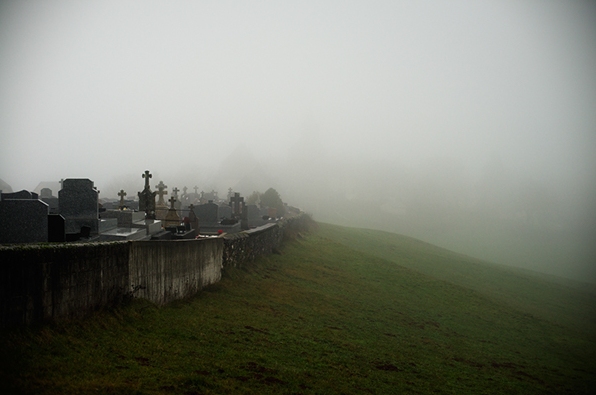
The gates, by the way, are tall and iron and topped with diamond-shaped spikes. They are there for a very specific purpose: because the boys of the town will try to sneak in and put mirrors on the graves. The gates will not stop the boys from trying, but they will stop all but the most resourceful boys from getting into the graveyard. In the time before the gates, that everyone remembers but no one was alive for, there were shards of mirrors all over the graves like magpie confetti. No one remembers why, but the boys know that this is what they are supposed to do. The gates are especially needed at holidays.

After you have recovered from the shock of all the voices – because it will be a shock, even though I’ve told you about it now – you can start walking into the graveyard. If you step too close to someone’s grave, there will be a hush. This will be tempting. But you should be careful, because the longer you linger by any one grave, the harder it will be to go back into the fray. Once, a girl who was not prepared ran into the graveyard at night time. She was overwhelmed by the voices, and she sat down on a grave to rest in the peace. They found her the next morning, lying on the rectangle of grass as if it were a down mattress. They were never able to wake her. This is another of the stories – the ones that everyone will tell you.

If you listen carefully, you’ll start to pick individual voices from the noise. You should listen to them. It will be hard. It won’t be hard to catch the thread, to latch onto a voice and follow it. But it will be hard to stop yourself from shaking it off once you do catch it. They don’t scream, the voices, but they do not flinch from the truth.

These are the graves of the strangers. None of them exist anymore. If they do exist, in an outnumbered molecule of someone’s blood, someone is not telling. I doubt that anyone will ever tell.

You will make your recommendation to the town council by the third of November. We didn’t know these people. Their traditions were not ours, and they are gone now. The land could be put to good use.

word by Charlotte Joyce Kidd

“This story could be about anyone.

My own familial and ancestral background is Jewish, and it’s a group that has been dodging annihilation throughout history.

Religious, racial and ethnic persecution happens and has happened everywhere, and too often results in genocide.

I also wonder about the living’s obligation to the dead in regards to burial wishes and traditions, especially in cases where the desired ritual of the deceased seems obsolete or culturally irrelevant. I was a voracious reader of Egyptian mythology and history growing up, and I questioned the ethics of excavations and exhibitions as much as I revelled in seeing them. Although it was anthropologically exciting and potentially important to dig up a Pharaoh’s grave, what if he had been right to believe that he needed a pyramid of clay figurines to survive in the afterlife? Had we just destroyed his vision of paradise? We can dismiss the desires of the dead as quaint, erroneous, or even morally wrong, but we don’t get the opportunity to argue; we can only choose to refuse or honour them.

In this piece, I tried to create an image of a society that may no longer believe in traditional burial, that has no connection to the buried, that exists on land that has no meaning to them but is historically deeply significant, that perhaps is even responsible for the elimination of a certain group, and finds itself struggling with the presence of a vanished people.”

colour by Julien Coquentin

A Wild Animal

10623805_316600748548691_1181472894378573553_o

Trigger Warning: Sexual Assault 

We’ve gone to counseling a few times, but I don’t like it. Tom keeps saying the same things over and over again. Why are you so angry with me? he asks constantly. I want to say, When you start off loving somebody more than you can even imagine is possible, there’s only one way to go, but I don’t say anything.

The counselor asks us to initiate sex more. She says we should both initiate at least twice a week. The word initiate makes me feel extremely unsexy. When we get home from the session and turn off the lights and get into bed, Tom moves down to eat me out and I say I’m not into it and he says You love it and I try to push his head away but he starts licking my clit anyway. I clench my fists and close my eyes tight and I see spots that look like they belong on a wild animal. I tense my whole body as I feel the beginnings of an orgasm, and I am so frustrated I can feel a million bees pushing against my organs, trying to break through my skin from the inside. Tears force their way out between my eyelids and run down my cheeks, and I thrust with my breathy sobs. I come but everything else is still inside me. Tom moves back up and kisses my face and I wonder if he can taste the salt. See, I knew you’d love it, he says.

word by Leah Mol

“This piece made me think of two living things that exist in the same place but will never really be joined together, and the conflict created as a result. So, I wanted to write a story exploring a relationship that has serious conflict, but neither party can really explain where it comes from. Relationships are complicated and confusing and boring and exciting. We are all just animals, in the end.”

colour by Chris Gismondi 

“I am an artist and an activist. I know this because I lie awake at night thinking about things in my life, in our world, and I think about communicating them to others. Not in text or song, but in performance, acrylic and instillation. I do not like the way the world is: I want to change it, make it better, loving, healthier, sustainable, tolerant and accepting. At first I thought my two passions of art and activism were disconnected, but as my thoughts came alive in performance, mixed media, acrylic, print making and body painting, I realized they were one in the same.” 

High School Visionaries

randeecrudo2

Rebecca Platt is and continues to be a member of an unrecognized but nonetheless elite club: Senior Superlative Actualization.  Rebecca Platt’s Willstown High School Class of ‘12 voted her Most Likely to Find The Meaning of Life.  As senior superlatives go, Ms. Platt’s was considered one of the more unachievable ones, along with Most Likely to Steal the Statue of Liberty, which Damon Quinn has still had no luck with.

The Class of ’12 had no good reason to believe that Rebecca was going to Find The Meaning of Life.  This is because Ms. Platt is as dumb as a doornail.  For example, she is known around Willstown High as the girl who infamously commented, ‘Is this Pennsylvania?’ on Hank Wiley’s photo in front of the Eiffel Tower.  She has regrettable tattoos.  E.g., a trail of generic lips runs down her oblique and beneath them reads, “Christ Was Here.”  Her fridge is empty because she spent her $300 monthly allowance on a Sun Conure, which she named JFK.  And with no additional money for a cage, JFK has been shitting everywhere.

It’s a boring story of how Rebecca Platt came upon The Meaning of Life.  She didn’t have a vision; there was no beam of light.  What it was was a series of mundane events that gave her some insight into the way the world is.  It happened on her 22nd birthday.

Rebbeca Platt was on the subway to work.  She sat across from a woman whose triceps were loose flaps of fat.  The man next her said, ‘Happy Birthday, Beth.’  ‘What?’ Beth said, leaning closer; she couldn’t hear him.  Beth was a mirror for Ms. Platt that day.  Fifty or some odd years separated them.  Beth’s arms were in some metaphorical sense a signpost of what Rebecca had to look forward to.   Ms. Platt imagined herself with her own flaps of fat, her own hearing aids, and sensed that she was deteriorating, nearing the end of her visit here.  Everyone has a Beth, and Rebecca observed that she could either neglect her eventual decay or accept it.  So she decided to bow to her mortality instead of avoiding it.

The subway stopped.  ‘Someone on the train needs medical attention.  We appreciate your patience.’  Work started in ten minutes and if Ms. Platt were late again she’d be fired.  Surprisingly, she didn’t get irritated.  Other people on the train are probably in similar or worse conditions than I am, she thought.  Rebecca didn’t know what to call it, but what she understood there on the stalled train was the importance of compassion.

Ms. Platt then learned about forgiveness.  ‘I’m sorry I always said that your brother was the smarter one,’ Rebecca Platt’s mom said through a teary happy-birthday call.  For most of her childhood, Rebecca was blue.  But daughter forgives mother, and by waiving her inner rage toward her mom, Rebecca relieved herself of a lot of psychic pain, and grew steady.

When Rebecca Platt got home from work later that day, though, she was unemployed and hungry, and still had to clean up all of JFK’s shit.

word by Jacob Goldberg

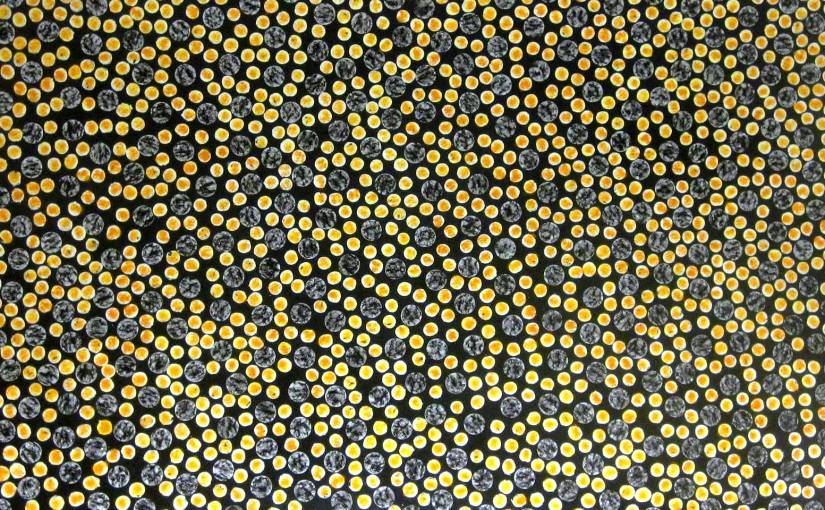
“If there is a meaning to life, I think it has to do with the stuff in the story.  And if you were to come across it, I imagine that a palette of colors might merge as they do in the artwork, and people would realize that deep down we can blend, too.  It’s important to always keep in mind that even if you think someone is stupid, they might in fact be worlds smarter and more capable than you think they are.  People are mirrors, and we shouldn’t miss out on opportunities to see ourselves in them.”

On Racism: “Choosing your ethnicity”

Shalak

This planet is comprised of a collective of starving artists painting prejudiced portraits that hang hidden in family homes. Cheap but sturdy frames are forced around those to whom difference is a prison, painting them with preconceptions and adding them to crowded collections. These brushstrokes soothe worn out eyes but suffocate those trapped behind the chipped glass piling up in petty portfolios.

Mouths do not have slots for double A batteries so why the hell do tongues mimic low-grade labelmakers spitting out insignificant identifiers based on the prominence of pigmentations and the foreignness of fatherlands?

We are all just souls upon bleeding soles traversing the tough terrain only some of us are allowed to call home.

She is exhausted because her ancestors planted their aching feet near the equator rather than the North Pacific. The ink from the classifieds dyes her fingertips a deeper shade of dark because the last name on her resume reads “Latin” rather than “qualified”.

He cries at night because his classmates pick at his afro but never pick him to be on their teams at recess when they run across the field at the school where the confederate flag flies half-mast because its just another Wednesday.

Those sons are dead because he saw them walking down the street and their melanin levels matched that of his entitlement so he pulled his regulation firearm because apparently blackness is still synonymous with corruption despite the alleged 150 year anniversary of the Civil War.

Don’t you get it?

The ability to pronounce and be proud of one’s diversity is a privilege reserved for those who have the ability to choose when to show it.

We live in a world where “dare to be different” is a slogan splashed on the t-shirts and timelines of pre-teens everywhere yet we fail to admit that unless you are lucky enough to fall into the majority, you will be damned if you do.

You will be harassed if you do.

You will be killed if you do.

We are all just souls upon bleeding soles traversing the tough terrain only some of us are allowed to call home. We take one step at a time but walk in circles because the ones who hold the keys are the same ones who refuse to hang contemporary art because their frames cling to the same vintage pieces their parents displayed in their own living rooms.

We are blinded to sameness and seized by difference, never fully allowing the interweaving web of pure humanity to unite us all in the sweet solace of symbiosis.

So she stays sleepless, and he never stops hanging his head. Fox News mornings lead to daylong mourning by faraway strangers thanking God it’s not their own kin suffocating under soil and sun-shriveled forget-me-nots. But from within their palisades of privilege, they never stop to think about who brandishes the brush and who keeps the key.

We are all just souls upon bleeding soles traversing the tough terrain only some of us are allowed to call home.

Don’t you get it? Turn the key. Welcome home.

word by Hannah Chubb

“This piece is designed to be a wake-up call in the face of the racially-driven Charleston massacre, in addition to countless other hate crimes. It is a stripped down reminder that while difference is often glorified, it is a ball-and-chain for those who do not have the ability to hide their minority status.”

colour by Shalak Attack

“Shalak Attack is a Canadian-Chilean visual artist dedicated to painting, muralism, graffiti urban art, and canvases. Shalak  has manifested her artistic expression on urban walls across the world.  Shalak is a co-founder and member of the international art collectives “Essencia”, the “Bruxas”, and the “Clandestinos”. 

“Shalak also works with several other mixed media approaches such as tattoo art, jewelery, illustration, installation, sound, and video making. In the past ten years, she has participated in numerous artistic projects and exhibitions in Canada, Chile, Brazil, Mexico, Palestine, Jordan, Isreal, France, Belgium, Spain, Argentina, Venezuela, the Dominican Republic, Senegal and recently in Sweden for the Artscape Mural Festival. 

Shalak shares her passion for freedom of expression, and has facilitated visual art workshops to youth of under-privileged communities and prisoners in various countries across the Americas, Europe, the Middle East and in Africa.  Her artistic work and community art-reach is rooted in the social and cultural values she received from her family growing up across Canada.  Since then, her most impacting education has been learning from different communities around the world. Public walls has become her favourite place to paint, she uses graffiti as an art form to create accessibility to culture for diverse communities.” 

On Sexual Abuse: “Sizzler”


unnamed (1)

‘Is that all you’re having?’ Phillip has looked over her meal and seen that she is starving. It is the peak of a Melbourne summer outside and Merry feels fat and tired and large enough as it is. He frowns and pushes the breadbasket towards her. ‘You don’t have to worry about your weight, you wouldn’t suit being skinny. Have some bread.’

‘I’ve always been fat.’

art fiction 

Suddenly she doesn’t care about anything except what this conversation could be. No one since her father has ever brought up her weight. She has never talked to anyone about it either but now she feels she might be able to tell Phillip something, something that could perhaps explain.

He doesn’t reply with anything, doesn’t deny her statement. Merry feels a little light-headed, though she has hardly touched her Amaretto Sour. She fishes around in the glass with her fingers and pulls out the cherry, dangling it above and then down into her mouth.

art fiction 

‘Don’t do that. Women shouldn’t eat with their fingers.’

art fiction 

She wipes hand on the paper napkin beside her plate, mouth slightly watering from the effort not to lick.

After Phillip has gone back for more veal schnitzel and duck gravy and they are lily-lipped and cloud-eyed, he asks her if she will take him home.

art fiction 

‘I live with this old woman who hates it if I have guests. I think she’s in love with me.’

art fiction 

He smiles a little and adjusts his sagging shirt collar. Merry feels that the woman is most certainly in love with him; she understands through the liquor that the woman flirts with Phillip in her tattered kimono over eggs and beans for breakfast and that she has a cat who curls often on Phillip’s knee.

art fiction 

‘What’s her name?’ she asks.

‘June. Why?’ His voice has coloured slightly—it is a storm in the distance, in the heavy clouds.

‘Oh, I just wondered. June is a nice name.’

art fiction 

He frowns, forcefully, as if it will help him to tolerate her stupidity.

art fiction 

‘She’s just my housemate. She’s old and sagging and pays most of the rent.’

art fiction 

There is a familiarity to Phillip’s forehead that she did not see before. It’s in his crooked eyebrows, the slight pouches of muscle above each one that move when he talks like they are his voice. It must be the reason why she feels a pulsing in her groin at every word he speaks—because she knows him.

      They have dessert, coffee, more sours, more smooth froth on lagers like chocolate milkshakes. It is Phillip that decides when they need to leave, and he doesn’t come back to her nervous, cluttered flat after all. He starts to eat at her neck and then her chin in the taxi on the way there and tells the driver to stop so that he can fuck her up against an alleyway brick wall that is sprayed in red and green and blue: coloured words she can’t read but that she thinks just might mean everything.

       Just as he pushes himself in she sees who his forehead is. Now it’s her father with his hand up under her dress, pulling at her nipple too hard. She closes her eyes and tries to remember the sound of Philip’s voice. She hears sirens and feels strangled breath heat the skin that covers her neck tendons.

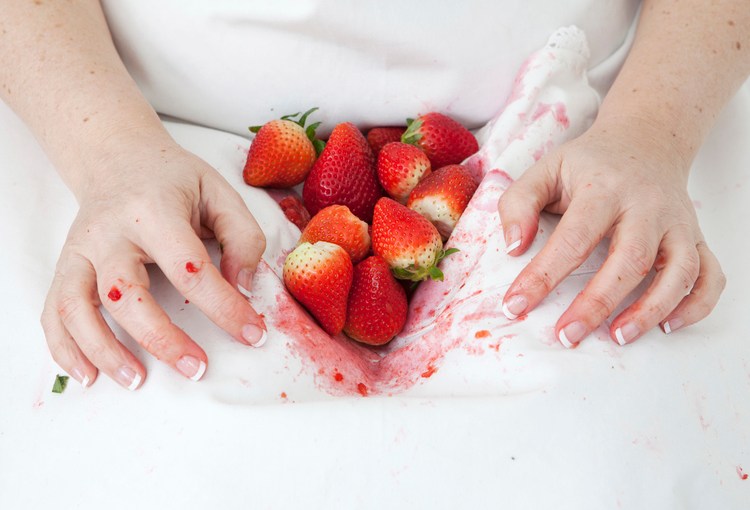
“When I saw this art piece by Fannie Gadouas, I immediately felt protective towards the woman with the blood and strawberries in her lap, with all her vulnerability so blatantly displayed. 
The character of Merry in my story ‘Sizzler’ is a vulnerable character because of her background, and the way her femininity and innocence was abused by those closest to her. Despite this trauma and vulnerability, Merry keeps living and trying to find something better for herself. The strawberries replacing most of the blood in Fannie Gadouas’ piece inspired the resilience inherent in the character of Merry, and reminded me of the resilience I have witnessed in so many (less fictional!) women I know and love.”

colour by Fannie Gadouas

“I am an interdisciplinary artist working with photography, fiber arts and performance. My work explores issues pertaining to femininity, identity and experience. By re-appropriating various traditional imagery, techniques and rituals, I question and challenge the way gendered identity is constructed, inherited and perceived in western society. Textiles is, and has traditionally been associated with the feminine realm. Critically engaging with techniques such as weaving, knitting and embroidery allows me to subvert and question my own role as both woman and artist. In this sense, my practice as a whole becomes a performance in which the process holds more relevance than the resulting objects. Informed and greatly influenced by feminist theory, the work I produce is a critical response to the social structure of western society.”