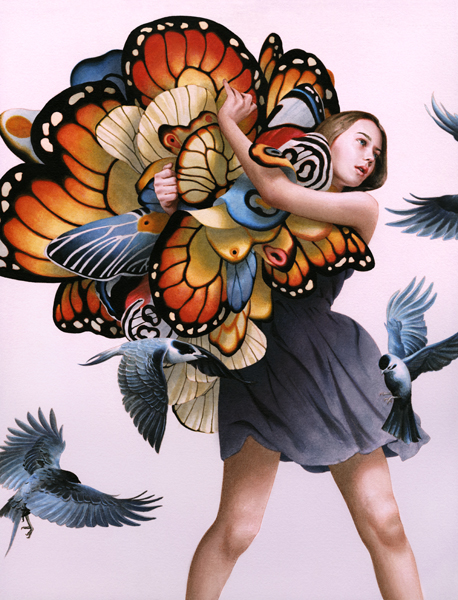
on self-harm: “other bodies”

owen gent 5

TW: Self-harm

The feeling that precedes it is a quiet panic: the sense that she is not feeling enough, or feeling too much the wrong way.

Safety pins and tacks do the job sometimes. The marks they leave are an irritated red. They heal like cat scratches, but too straight to fit the lie. It takes a lot of pressure to draw blood.

Sometimes, she can stave off the urge with the drag of her thumbnail down her forearm, or the center of her throat. This leaves a mark, too, but it’s faint enough that people don’t ask.

Sometimes other people’s bodies will do the job. His fingers are clumsy, floundering. She wakes up in a panic the next morning when she remembers what she’s done but not what his name is. She regains the knowledge via text from a friend: Hudson, like the Bay.

His fingers are slick when he enters her. He puts them in his mouth and sucks on them first, maintaining eye contact the entire time. His fingers jab into her in the general direction of where they both assume her g-spot is. They are rigid and insistent, maintaining the ruthless pace of a second-hand jackhammer.

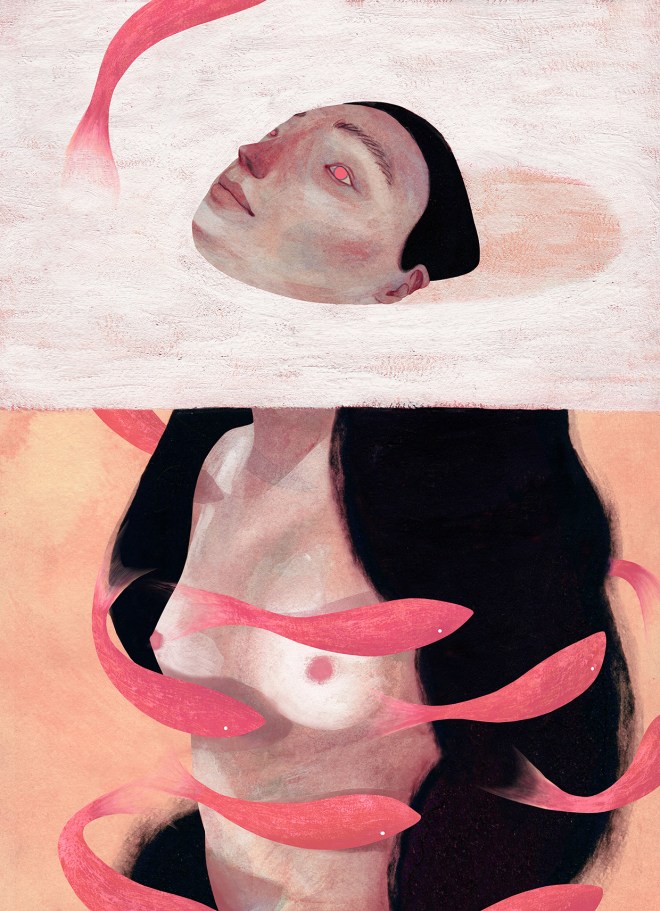
Metal is different. When she uses scissors — knives and razors seem too dangerous — she expects to see the flesh part red and wet, revealing complex patterns inside, like a pomegranate, or the little teardrops inside an orange slice.

(She looks them up later: they are called vesicles. She repeats the word to herself: vesicles.)

Instead, there is just blood. Not a lot of blood. She thinks there are some major veins on the inside of your thighs or something; she keeps this in mind when she drags the scissor blade over the muscle there, flinching. The metal is not the problem: it is her own wavering grip, too afraid to push too deep, of blooming more pain than she’s bargained for. She knows people have cut through muscles down to the bone. She knows people who have ended up in the hospital for it. She knows she is supposed to feel comforted that she’s not part of this dysfunctional elite, but mostly the knowledge makes her feel like she’s not trying hard enough.

She tries to keep them even in length and depth. They never are. The blood pools in straight lines. She wipes it away; it blossoms again, a thin line interrupted by sluggish beads, a delicate filament made of nothing but her.

When she was little, she always ran her baths too hot. She would sit on the edge, naked flesh pricked with goosebumps, running cold water in and stirring it, flinching at the hot current that made her hand flush. She acclimatized to heat in increments, trained herself over time to embrace water that makes her feel raw all over, makes her body breathe plumes of steam when she rises.

these words by Caitlyn Spencer were inspired by the colour of Owen Gent 


on the loss of Prince and Bowie, “The Before Breakfast Blues”

owen gent

I’m writing a song about the time I waste in line at the coffee shop. I’m calling it The Before Breakfast Blues. It’s a standard blues shuffle, but instead of covering the usual topics of wine and women, this one laments the type of folk who stand in line with me for fifteen minutes, only to realize at their chosen moment that they’ve no idea what they want.

       The guy in front of me is talking, too loudly for the morning. He’s an older guy, some kind of professor. Tweed jacket, patches on the elbows. For his sake, I’m hoping the woman standing next to him is a student, not a lover.

        “Not a Prince,” he says to the girl next to him. “The Prince. The Artist Formerly Known As. He died last night, at Paisley Park. I give it a week before he’s on the cover of Rolling Stone. A cover that used to mean something.”

       What a year, I’m thinking. First Bowie, now Prince? Talk about losing some characters, man. Sure places an impetus on seeing McCartney while he’s still kicking.  

       “The worst thing about losing Bowie was that it didn’t feel like losing one guy – it felt like losing twenty. We lost Ziggy Stardust Bowie and Diamond Dogs Bowie and Scary Monsters Bowie.”

       And I’m thinking that’s some fairly astute commentary for a man with his arm around the midsection of a woman a third his age. He’s right, you know? We didn’t just lose Bowie or Prince, we lost dozens of different iterations of those men, and they were both so skilled at the art of metamorphosis that each new character they espoused was a testament to man’s ability to constantly evolve, to strive towards something different than what came before, even if people really liked what came before, because sometimes trying something new is more important than sticking with what you know people dig. That’s what I call courage, my friend. Changing despite assurances of success.

      So now I’m thinking about guys like Prince, guys like Bowie, and about how they might the epicentre, the genesis if you will, of this phenomena that I’ve been noticing: used to be, everyone wanted to be a somebody. Now, it isn’t enough to be a somebody: everybody wants to be everybody. People don’t want to be rock stars or actors or authors, they want to be rock stars who act in movies and who just saw their memoir hit the New York Times Bestseller list. But what these new kids on the block miss, the thing that they lack that Bowie and Prince had in spades, is candour. Honesty. Truth. I’m talking about soul. Bowie and Prince, these guys changed based on what came from within, not from pressures placed on them from the public. Great souls aren’t found in folk who acquiesce to the desires of trends and fads, they’re found in people who work towards reconciling the myriad of characters inside them, and using that process to sow a little truth along the way. That’s what doing it with soul looks like.

these words by Josh Elyea were inspired by the colour of Owen Gent

Countdown to flight


tran nguyen 2

  1. Nineteen thirty-seven was Icarus in seamed stockings. My grandmother spent nights praying for the blanched bones of Amelia Earhart, femur and sacrum floating somewhere in a blackened sea. Gravity could kill a gal. Now, Google tells me that my fear of flying is an inherited nervousness, a bred-in-the-bone type of thing.
  1. WebMD prescribes knowledge. I learn about Harriet Quimby and Queen Bessie Coleman, early female pilots. Dead in their thirties, cockpits exploding without warning. I imagine a lone parachute floating out of the wreckage, silken and monarch-like in the sky.
  1. In the garden, Sasha tells me she is happy I get some time off. She makes it sound like a vacation, but I am obligated to fly. When she asks me what’s wrong I can only water the plants. People are so comfortable on planes they’ve made a whole club out of fucking miles-high. I am ashamed of my ridiculousness. But later, I tell her the truth when we are wrist-deep in the earth.
  1. “Fear of flying,” the webpage psychologist writes, “is a couched fear of relinquishing control.” As if letting go of all that bodily warning is easy. I read about aerodynamics, the structure of Boeing 747s, the years of pilots’ training. It isn’t enough. And I caution myself against equating education with trustworthiness.
  1. I read the article about the flight attendant and the pilot. How he’ll only be criminally charged if he returns to the island where he attacked her: palm trees, hotel layover, her heels kicking frantically into his flesh. I picture her dressing in the company’s colours, returning to the cabin, repeating the spiel about emergency exits as the earth gives way.
  1. It is still so far away, and then it is tomorrow. The night before, I dream of the ghost of my grandmother, her body bruised in a sea of crushed metal, a sea of blue birds and  bones. I dream of ghostly women plied open, their organs airborne. I dream of dangerous engines, a lathe of waves, winglessness.
  1. I stand in line at midnight, clutching my passport. The red-eye was cheapest. Sasha has loaned me her gray silk dress, and this alone keeps me calm: the fabric extravagant against my skin and the faint familiar smell of her, soil and strawberry leaves. This dress, her shared self, deserves to fly. If I plummet to death in a fiery crash, I tell myself, at least I will go out in style.
  1. On the plane, I have a window seat. It is dark and plotted evenly, like a little grave.

The man beside me asks, “Business or pleasure?” When I don’t reply, he laughs and   tells me I need to relax. I don’t know how to relax, so I open the in-flight magazine. I   hope this is a good way to end a conversation.

  1. A woman puckers her lips from the pages. She is surrounded by feathers and the engine underneath me starts shaking. “You’re a very interesting, mysterious girl,” the man continues, but his words are liquified by the engine’s shuddering so I can only hear  — you’re a girl. Then we are moving and it is all really happening so fast.
  1. This is the feeling of surrendering your centre of gravity. As I watch the city shrink beneath me I feel my body become weightless and irrelevant, strapped into an altitude I can’t adjust. I am only anchored by the things I’ve buried, all the things other women have carefully buried inside me. In my mouth, vomit blossoms like a flower.


these words by Sarah Christina Brown were inspired by the art of Tran Nguyen

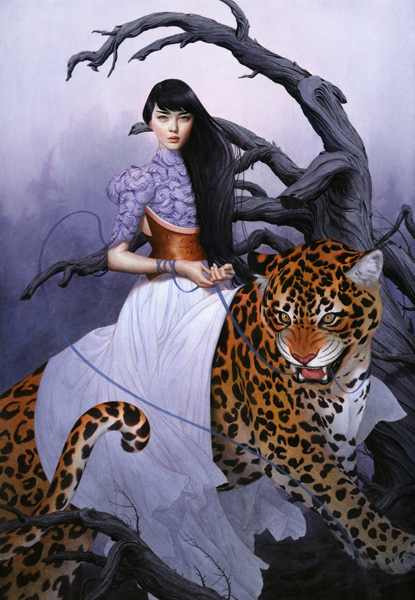
White Is Not My Colour

tran nguyen

curating colour requires

knighthood, rescuing a coloured image

restoring it to a coloured name


in the woods there is more than colour

the texture of bark, bitter acrylics

the labour beneath

the layers


if an idea is painted, a history, a desire

a colour is not just a colour


orange is not colour

merely

it is instinct, fang, rupture

awakening


a devouring (of roots)

of tigerhood

flesh open skin peeled back

slow and half at ease


the bones remain

uttering a different story

the pain is a ghost language


*

once upon a time

I came I saw I assimilated


trapped in the woods

I use white words, leaving a trail

of crumbs in circular argument


I write I grieve I love

in

more than

colour                         


but wielding a sword in white space

is easier

than cutting down

bark

these words by Lily Chang were inspired by the colour of Tran Nguyen

On Kink Dynamics: “Holding the reins”

tran nguyen 3

My lower vertebrae clutch and seize in towards centre, bringing my back to sway, chest thrown open. The muscles along my inner thighs grip, and I sense your body surge under me, releasing. That familiar flush of lavender spreads across the temples: I enter the state that lets me unleash my strength on you. This armour is a lie, but it is mine. The taste of metal in my mouth as I plunge into the folds of your body shields me and offers resilience. I do want to reveal myself to you, but slowly.

First, I want you to want me. Tell me over and over how good it is, how nobody has understood your body like I do. I shut my eyes out and feel you. It is not calculated, it is how I have learned to protect myself. I still don’t know how to ask for precisely what I want, while your desire is bare under me.

What I don’t tell you is how much I need this: not just to please you. I am not that generous. Your moans awaken a power in me that I cannot access alone.

The thought of you is not enough: I need to have you breathing against my skin, to feel your heat, to hear you say Please. I am not just doing this for you.

You tell me not to ask permission and I take this in, swallow it, find other ways of asking. I watch the arch of your back, listen for the depth of your breath, testing.

The lift of your pelvis instructs my mouth to move and you tell me not to be careful. You sense my fear and I say, Yes, because we are treading a thin edge. The structure slips, you taste my tears on your face, wrap my limbs around yours. Still trembling I gather strength and move into you. Each tug elicits the sound of more, the scrape of your claws on my thighs, your pulse beneath my teeth.

We catch each other over and over again.


These words by Alisha Mascarenhas were inspired by the art by Tran Nguyen,

and are also a response to Xan West’s “I’m not just doing it for you” 

From the author: “I wrote this in response to Xan West’s article on myths about “topping” in kink dynamics. West’s piece suggests some of the ways in which tops/dominants tend to be seen as selflessly offering an experience to bottoms/submissives, obfuscating the top’s own pleasures and desires. The physicality of Tran Nguyen’s piece evoked a sense of mutuality within an image that might presuppose power being held by the person holding the reins. I must be dead clear that I am not likening bottoms to animals being ridden (which would further exacerbate existing dichotomies between masculine/feminine and civilized/savage). I am, rather, drawing from the implicit, dynamic power relationship and vulnerabilities being represented through this visual.”


On Colonialism in Edmonton: “Here”

SW

On First Life: “Here”

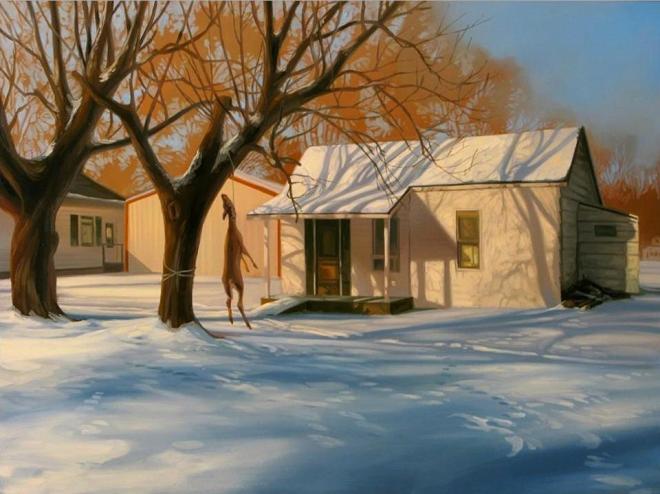
Look Here.  At the house in the sunlight

The light that is rising or falling on the house

The house that is the First Space

We imagine being in.  Look Here at the light that

Sets everything on fire in making and unmaking You

Visible.  Is it making You

Unforgettable or unimaginable?  Where is Here?


Here is a place

Of imagining pain, of forgetting pain

Of weapons that look like light

Light that conceals by throwing shadows on the snow

Light that lets Us pretend We don’t know

What Here is, where Here is, who was Here.


You were Here.  You are Here.

Here being Yours, We come always

Like light

Spreading silently.  Here being

Where We learn how to hear or not hear

The dying You.  Here being

In Our imaginations.  Our imaginations being

Where You are always drunk, always obscene, always

Too much and too many to be seen.  Here being

Where Your space and voice and people sink into shadows.  


Look Here.  The house.  The First Space.  The Vastness.  

What are We if We are Here

Where You continue to make noise

Where We cannot hear You without knowing

That We have been murderous

That We continue to be murderous

That We are infected with murderous light

Light that hates to see

Light that divides the First Space, the First Life

Light that is diseased with difference and destroys

Difference

Light that runs knives along the earth’s splayed bodies

Light that makes and unmakes Here.  


Where is Here? Here is

Where My light continues to rise and fall on

You.  Here is

Where the edges of the living

Find the edges of the dying.  

these words by Charles Gonsalves were inspired by the colour of Sarah Williams

From the author: “I grew up in Edmonton, Alberta.  One thing life in Edmonton exposes is the still-very-much-alive hatred and violence enacted upon First Peoples in Canada.  The degree to which this behaviour is normalized in the everyday gazes, thoughts, and speech of Edmontonians is disturbing—and something that I, as a youth and young adult, have been implicated in.

Unlearning—unmaking the weapons with which we so easily, so automatically harm people—is part of our responsibility as settlers and a process that is necessarily uncomfortable, difficult, and destructive.  This poem reflects on the sustained presence of systemic colonial hatred and violence in Canada and takes a few premises about place and pain for granted.*  

-To have pain is to have certainty.  To witness pain is to have doubt.  To doubt or ignore someone’s pain amplifies their suffering.

-To inflict pain on a body is to destroy that body’s world, voice, and self.  To inflict pain on many bodies (a people) is to destroy that people.  

-The distance between the person(s) in pain and the person(s) observing or inflicting the pain is impossibly vast, and can only be occupied by the imagination.

-Home is the First Space.  Home is where we learn to imagine.

-The First Space is sacred.  

-We are destroying everything that is sacred.  Our homes occupy the imaginary space between the bodies in pain and the weapons.

* I owe these ideas to Elaine Scarry’s The Body in Pain and Gaston Bachelard’s The Poetics of Space.  

On Running Away: “Jack-o’-lantern”

SW 4

        Big city at last. Buildings, cement, a few trees. Some birds tweeting the fall of dusk. I’d hitched in. Now what? I must have had a lost look on my face because a van pulled up and drove alongside me, matching my pace.

         “Hello there!” called the driver.

         “Hi,” I said.

          He stopped the car and got out. Introduced himself as Norbert.

         “What’s your take on the problems of this country?” he said.

         “I don’t know,” I said.

         “Feel like talking about it?” he said.

         “Sure.”

         “Feel like having a free dinner?” he said.

         “Alright,” I said. He opened the back of the van. There was a young woman in there.

         “That’s Sarah,” Norbert said. I got in. Norbert shut the doors and the van took off. 

        I talked with Sarah. Another runaway picked up off the street. Where the hell were we going? Can’t be any worse than where we came from, we both laughed. She took my hand in hers as we bumped along.

         The van came to a stop. Norbert opened the back. I heard cicadas.

        “Come on, you two,” said. Sarah pulled up her tights and we followed him onto some sprawling estate and into a red brick country home. The cooking aromas were scintillating. I had not eaten all day.

        “Help yourselves,” he said. “After that we’ll have a little presentation.”

        The food was laid out buffet style in the dining area. Stacks of clean plates, plastic cups, a pitcher of water with lemon slices in it. There were six or seven dishes to choose from. Some other young people joined us. They were all quiet and respectful. The food was vegetarian, cooked to perfection, completely satisfying.

      “We’ll begin the presentation whenever you’re ready,” said Norbert. There were about ten cheap plastic chairs unfolded in the salon, but only Sarah and I sat. It was a slideshow. Norbert used a pointer as he clicked from slide to slide. The world was in crisis, he said. It was up to us to fix it.

        I raised my hand. “Is this a cult?” I said. Not that I really minded if it was.

        Norbert laughed. “We are called a cult by the mainstream. But we think the mainstream is a cult.”

       In my mind’s eye I saw a generic house, some generic suburbs. The home I’d bolted from. The home my father came to at dusk, exhausted, complaining. Ugly mood. Hating his job, his colleagues, his family. Yet, judging the fools who did not live their lives as he did.

       Good Riddance, he’d have said Mom. The only way we let her back is if she cries and begs and apologizes. Otherwise she does not set foot in this house again. Is that clear? 

         Mom would nod, her head down, hands folded, like a statue.

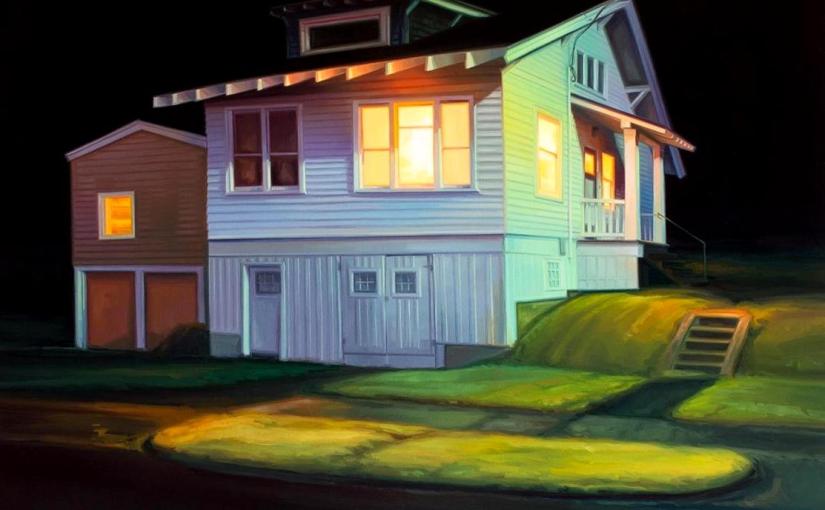
       He’d sleep. She would not. The light would be on all night. The house like a Jack-o’-lantern. My mother at the kitchen table, begging me to call, to let her talk to me one last time, so she could beg me to grovel before the old man like she did.

these words by Alden Chorush were inspired by the colour of Sarah Williams

these words by Alden Chorush were inspired by the colour of Sarah Williams


On Male Entitlement: “Water”

SW 2

In the southern suburbs of Manhattan you’ll find these immense water towers. They hover above the rest of the city, providing high-pressure to showers and sinks across the Island with water that, allegedly, contains high levels of estrogen, but as anyone on the North Shore will tell you, there’s a filter for that.

It’s winter; one of those nights the snow is frozen solid to the ground and darkness spreads across the city at 4pm. We’re all inside Murphy’s—the place you find yourself when you get out of work late and you’re too tired to stay in The City. It’s a full house tonight; there’s this Guthrie-esque musician, he’s playing something John Mayer and we sway either because it’s nostalgic or from too much mulled wine.

Sylvie and I are plotting the matriarchy when Ben approaches. He’s tall, got this shaggy yellow hair and the forming of a goatee. He takes a seat, Budweiser in hand.

“How’s life treating ya, gals?” It’s been two years. He’s aged but in a sad way.

“What have you been up to?” I ask him.

“Been working lights at Rosie’s.”

“Any good shows this season?”

He scoffed. “Oklahoma again.”

“Cheers to that,” we drain our glasses together, old times, and Sylvie goes to the bar for another round. Ben turns to me, tilting his head in her direction.

“Damn, is she seeing anyone?” I can’t help but smile.

“Yeah, we’re together.” Beat. He snaps his head towards me.

“What? Like, you two?”

“Mhmm.”

“Is that even…possible?”

“It sure is.”

He considers it, takes a swig. “I could be into that, I guess.”

No one fucking asked you, Ben.

Sylvie comes back with two beers. I wrap my arm around her waist to make my point. Ben can’t decide if he’s disgusted or turned on.

“Whose place are we going to?” He asks. Sylvie shrugs. It’s like this: they always feel entitled to a space in your bed.

***

These words by Annie Rubin were inspired by the colour of Sarah Williams 


On Reclaiming Space: “Incense”

SW 3

Content Warning: Assault

My childhood cabin was built on an island that was built into a peninsula. At the top of that peninsula is another island, connected by an inconstant sandbar. No matter how many times I have crossed that sandbar, I have never made it past the tip of the island. Sometimes, I like to imagine that this sequence of islands never ends, that on the other side of the island is just another sandbar, although a search on Google maps suggests I’m wrong.

Crossing the sandbar is the closest I can come to walking on water. Between islands, the lake stretches out of view. Like the ocean. Like how I used to imagine the ocean.

Sometimes it is too windy, or rainy, or icy, or deep, or cold, or hot to cross. On those days I sit across the lake from the island and write about what might be on the other side. Sand fills my shoes, my shorts, gets under my nails.

Sometimes there are animal tracks on the sandbar and I wonder, if I ever do make it past the peak, whether I might be devoured by a cougar. Sometimes I can imagine myself as a deer. Not Bambi, but wild and afraid, at constant risk of being hunted or running in front of a truck.

I have a photo of the lake cast in ice: frozen waves caught in motion. What makes the shot so beautiful is that I almost died taking it, almost froze myself into the landscape.

The shore is sinking into the lake now, but I still recognize this spot. This is where he held me to a rock and put his hand down my pants. I remember that all I could think about were the bugs, how the mosquito bites would keep me up that night. I remember that as the moment I realized the difference between romance and romanticizing.

A frog rustled the leaves next to us. That was the summer of frogs – they were everywhere. You couldn’t drive down the street without crushing them. That was the summer of death, the air sick with hundreds of tiny dead bodies, and none of them princes.

Under sheets of snow, it has been hard not to long for summer. But what I hope for is not always what I get. I used to imagine a lot of things. Now I mostly get them wrong. My wrongness sees the flaws in what is right.

It snowed again in the city and a stranger grabbed my arm in the station. I looked at his smile and didn’t know what to say.

I escaped to a bookstore. I noticed the shop smelled like my cabin and I told this to the cashier. “It’s the incense,” she told me, “to cover up the smell of rot.”


these words by Eileen Mary Holowka were inspired by the colour of Sarah Williams

Laëtitia, an elegy

verona 1

A barking, seal-like cough, melancholia. Morphing sounds. Reinvent your face. Chaos. Knot of reeds. A village in the south of France, Vaucluse department. Provence-Alpes-Côte d’Azur. On the banks of the Rhône. Shut away. Years were lost to you. To me, us. Aged twenty-nine. Seizures. Psychosis. Laëtitia.

Incarcerated at Montdevergues Asylum, avenue de la Pinède. On a hill in Montfavet, near Avignon. You survived. The brutality you had lived. Short term memory loss. Until that savagery. Until disfigurement with straight jackets. Cast of grisaille. Branches, mixed media. Tore into your skull. Prisons and carceral spaces. Pages ripped out, the many rooms.

fields of lavender
tossing stones into river
summer after summer

Unkempt children, dirty dishes. When life became surreal. Relentless fatigue. Weight loss. The layering of old. Acrylic on cradled wood panel. Finishing nails. Bamboo bone folder. Juxtaposed grey-black. Dreamlike. Scraping. Shadow boxes.

Wrapped in ochre earth. White and the silences. We all will have narratives. As if we had witnessed it. Little did you know about the curse. You did not know the word madness, Laëtitia. Born in Nogent-sur-Seine. Fascinated with clay and shells as a child. Collage, junque, glass.

Unmournable. A grave in the cemetery of Monfavet. You’ll know about how I loved, Laëtitia. Avignon scouring mistral winds. Leaving the sun to shine. You will never speak the word, Mother.

guided to water’s edge
goddess appearing as crow
summoning the moon


these words by Ilona Martonfi were inspired by the colour of Raphael Varona 


From the author: “Marginalized, the outsider. From the locked doors of the psychiatric ward and hospital. Led us to the local outpatient foster home, homeless shelter, streets where they spent their days.”