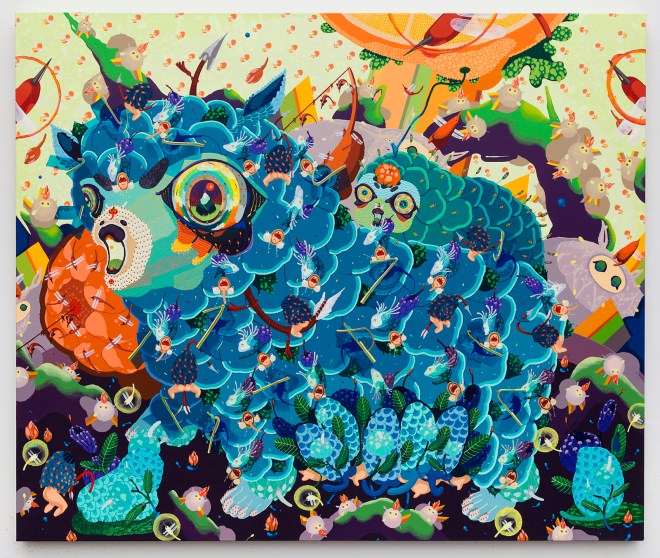
Brother Bird alights on the silver birch, branches siphoned off from the moons with the frazzle of leaves. Golden leaves that lace the night, and the crinkly coins of the newcomers seem mawkish compared to these yellow hands coursing with veins and sugars. They wave incomprehensible at the new hands, which are different, all white and papery, pockmarked and brine-stained after a journey in a strained wooden frame. These hands are weaving into the woods uncouth and unwanted, gesticulating with the urgency of papers that make crisp noises as they fall into neat stacks on a knotted wood desk. They are dizzying themselves amongst these leaves that are falling from the birch. They are blanketing the grounds in smooth white words all flat and stark. The leaves are browning and returning to the earth. Winter is setting in.
Brother Bird thinks the spindly limbs of the trees seem ethereal from way up in the vapour. The white sheets with marks blackened by some unfortunate quill feather read like an ambiguous pattern. And the voices, which nest among the trees, seem strangely silent. Brother Bird thinks he sees tracts of smoke creeping westward from the shores, though the gales of wind are moistening his eyes and humming auspicious in his ears. The season of snow is bound to pass, says Brother Bird, giddily to himself. The air is brusque and flapping papers up, loose from their death grip on the grounds. They dissolve within the frail wisps of sunlight hitting Brother Bird’s head.
Centuries passed and the smithy whiteness blew through the trees, prying the bark back with all the soft power of snowflakes. Sap soldered with this milky presence, which poured all its white ink into etching the soft underbelly of the trees. There are new names now and the first peoples are dogs that bark. Or stoic like the trees, so the papers say. Then a white paper descends from some federal courier and is acclaimed for its difference. This paper ought to be peopled with leaves from when the first storm blew through. Pulling the pressed leaves out of dusty yellowed spines of books and planting seeds in the margins. But the paper that is published offends like blots of lead, or clammy hands in a handshake. White hot rage settles and Brother Bird swallows another bitter seed.
this short story, “White Paper, was written byKeah Hansen
from the author: “I wrote this piece about the White Paper Act of the Trudeau government of 1969. I was inspired by different modalities of expression, represented in the layering of the artwork. The layering of the artwork also made me think of erasure and censorship, which occurs when cultural worlds clash, and the irony in a paper literally titled the ‘White Paper’ that was intended to give representation to Indigenous peoples.”
L says to T, “Do you ever hear sounds coming from your fingers?” She’s examining the tips of her fingers, the little grooves put there by the strings of T’s guitar. She holds her fingers to her ears. “I swear I can hear a buzzing sound.” L is learning to play. Ever since T told her that guitars have songs trapped in them waiting to get out, she’s been practicing. One day I’ll free them all, she thinks.
“I don’t actually believe that, you know,” T says, “that thing about songs being trapped in guitars. It’s just something some musician said ‘cause it sounds cool.”
L says the real reason she’s practicing is because she wants T to fall in love with her. Then she says, “Just kidding,” because she is, partly, though another part of her isn’t. She’s seen the way he looks at those girls in bands when they go see shows. Bass players, keyboardists, lead singers playing guitar.
L watches YouTube videos of people playing songs on the guitar and tries to imitate what they’re doing. Most of the time the people in the videos talk too fast, or the camera angle is off and she can’t see where they’re placing their fingers. Rewind, pause. Rewind, pause. Find a different video to watch.
T is out seeing bands every night now. He usually calls and asks L to come but then he’ll say things like, “But if you’re tired, don’t worry about it,” or “I think those guys won’t go on until late, so it’s okay if you don’t want to.” So, she stays home and practices until her fingers burn. Sometime after midnight, she goes to bed with aching hands and wrists, and falls asleep imagining her fingers are red and glowing under the bedsheets.
The next week L barely hears from T at all, just one text that says, “Hope your week’s going okay. Let’s hang out soon,” followed by a champagne bottle emoticon. She types, “Okay, sounds good,” then stops before sending it. She erases her reply. According to the formula—take the total time you’ve been dating someone and divide it by two—she’ll forget about T in about a month or so.
On the bus, she examines her white calloused fingertips now permanently indented from the stress of the guitar strings. She thinks of the tips of T’s fingers, remembers how they looked the same as hers do now, dry, white, torn, how they felt rough on her cheek when he touched her face. She places her own rough fingertips against her cheeks then moves them back towards her ears so she can hear the buzzing sound again. She wonders if maybe one of the songs that was trapped in T’s guitar has crawled out of it and into her fingers. Whatever it is, it isn’t a very good song, she thinks. There’s no melody to it. It’s just a bunch of random notes and pitches. When trapped songs are freed, do they need to be decoded somehow?
L is listening so hard to her fingers that she misses her stop and has to backtrack two blocks in the rain to her apartment. When she gets inside, she takes off her coat and hangs it in the bathroom so it can drip into the tub. She goes to the living room to get the guitar but it’s gone. Then she remembers T still has her spare key.
She stands there in the middle of the living room and closes her eyes, lets her feet sink into the floor like she’s standing in an inch of warm water. Her fingers are vibrating now and the room is filling up with the buzzing sound and without even realizing it, she starts to hum along.
Content Note/ Trigger Warning: Sexual assault, rape culture
They were jittering parallel, his leg and hers. They faced away from each other, tapping in terrified Morse code against the legs of the bed between them. He was shrinking and she was expanding. He was supposed to be the downbeat and she, the trill.
She recalled how his fingers had played her strings. How there was something so excruciatingly offbeat in the way that he’d sped up. He said he liked that sound; she said nothing. There was the pounding of their hearts and the curls of her hair. His hips were rhythmic. She counted to ten, holding onto nothing until he was empty and she was supposed to feel full.
She was his echo, the drum he hit against, a projection of his voice, and she convinced herself to feel empowered to exist solely in the glory of his smile. Too soon it became automatic: a euphoric cacophony of springs and curls.
In the climax, one of her strings snapped. She cried out, he froze. It was unlike her, he thought. She never asked to be hit, she thought. She removed herself from him, shaking, and perched on the edge of the bed.
words, “The Trill,” were written by Annie Rubin: “Koka’s electronic creation made automatic the emotive experience of producing music. This new system, mechanical and intricate, represents a structure of oppression we perpetuate through unawareness or indifference: one in which women are left voiceless and unquestioning. The moment of escape occurs when the woman rejects her role as a void (Cixous) and gains agency through expression.”
the colour and inspiration for Rubin’s work was inspired by Koka Nikoladze’s sound project,
This article contains references to a variety of forms of abuse.
I do not have the privilege to consider discussions of violence as intriguing places to display my intellect. I do not have the privilege to enter these talks as though it’s a game, to ‘play’ and say things in the tone of a dramatized television series politician before leaving the ideas behind when I exit the arena.
Instead I teach and I speak and I read and I write and I talk and I laugh and my body is still injured by the lazy romanticizations of violence from people who consider it meaningful because of its perceived deviance and sense of foreignness from their experiences, like the teenage boy who thinks he will become a man the first time he has sex. I am patient and I learn and I speak to paid listeners and I meditate and I fight and I exercise and I control addictions to substances or work or hobbies or people and I am still haunted by ghosts and still I react to conflicts in public that others have the luxury to laugh off.
Look at the people around you. Whether you are on the bus or at work or in line or in class or at the gym or in a library or in a grocery store or on the sidewalk many of the people around you do not have the luxury to ponder the presence of violence because they are hurt, trying to heal, about to be attacked again.
I often see groups of people who have not been injured ruminating among themselves over how violence feels or should feel or if it exists at all. Never do these talkers consider to ask the person with the snapped rib if their pain feels real. The argument seems instead that it is impossible to break a bone if the person speaking has not had their bones broken.
Whole cities, planets, must not exist to these people.
Survivors of violence do not have the luxury to engage in such conversations about the illusory nature or impact of violence because we are busy tearing off band-aids and pouring peroxide over wounds or wincing as wrists are pulled and re-broken. We do not consider to ask one another for proof because we have seen the x-rays.
Right now, you likely can’t tell which person around you is surviving violence because we have learned that hiding the tangible evidence of the faults for those who have attacked us is more important than our well-being. Complicated by the fact that Canadian society prefers to punish those who have been attacked than to address those who attack others, we blend. Because so much violence is also not as tangible as a bruise, hiding it is easier than you might think.
While many of these survivors around you listen to the opinions of those who have not been hurt about the proper ways to heal, know they do not take them seriously when they choose to philosophize about the existence or impact of violence. Let’s say a few volleyball players who have never played hockey suggest that hockey should be banned from television because it is too violent. In the least, they suggest, remove all checking from the sport. As a hockey player, how seriously do you take their opinion?
“I often see groups of people who have not been injured ruminating among themselves over how violence feels or should feel or if it exists. Never do these talkers consider to ask the person with the snapped rib if their pain feels real.”
1. The first glaring flaw of the anti-trigger warning speaker is that they believe their opinion to be binding. How seriously do surgeons take the advice of people who have never studied medicine?
2. The weakest and least creative arguments use violence as seasoning. Ask a survivor how much violence improved or ‘exoticized’ their life. How appreciative they were for the growth provided by the experience. The impulse to use trauma tourism as an attempt to expand the perceived depth of one’s personality or work is a mistake. Put in the work or do not touch the subject.
3. The laziest flaw of anti-trigger warnings is a confused connection to censorship. This is the volleyball player who, when a goalie asks for a helmet, suggests that goalies should not wear helmets because they won’t play if they wear them. Besides ignoring the request, this reaction is based on a bizarre logic and seems inspired by a fear of complexity, more designed to rationalize intellectual laziness than to resolve an urgent problem.
“A few volleyball players who have never played hockey suggest that hockey should be banned from television because it is too violent. In the least, they suggest, ban checking from the sport. How seriously do you take their opinion?”
4. The thin foundation of anti-trigger warning advocates is the suggestion that it is possible to speak about a topic without being political. That language has the capacity to be objective-as though omission and history and socialization are separable from experience as a socialized person speaking a language. This is particularly embarrassing to hear when the people are speaking English. Ask nations across the world how they came to learn this language.
5. The person without a history of violence who resists trigger warnings suggests that the bodies around them do not matter as much as the protection of their isolated beliefs.Neurologists have demonstrated that memory of pain and language registers in the same part of the brain as does immediate physical pain.
The last objective of any serious critical discussion should the impossible attempt to exempt ourselves from complicity through passionate defenses of laziness in order to avoid fixing a critical problem. Passive inaction is required for many forms of violence to continue. Don’t be an accessory to murder because your ego was too threatened to adapt.
To the anti-trigger warning camp: grow out of the lazy philosophical presumptions of being able to speak for ‘all’ and ask how to become the accomplices of survivors in your classrooms, in your workplaces, in your romantic relationships, and among your friends, who may not have felt comfortable sharing their history of trauma with you. If they don’t want to talk about it, don’t probe. If they do, help them to destroy the insecure ways of socializing people that has normalized and required violence to exact legitimacy (see: mass incarceration; we’re legitimate because we attacked ______ to keep you safe). This philosophy of power has trickled into the structures of our social relationships.
These models of social power relations are outdated and will be crushed. What side will you be on when they are history? The side furiously suggesting that they were not affected by words? Or the side that acknowledged the humanity of those around them and who worked to dismantle the violence that they internalized, from where their luxuries were drawn?
“The last objective of any serious discussion should be the impossible attempt to exempt ourselves from complicity through passionate defenses of laziness in order to avoid resolving a critical problem.”
I want to conclude with a complication of the “survivors” I’ve been using in this piece. I am referring to survivors of violence. I am a ‘survivor’ of child abuse. I do not aim to speak on behalf of all child abuse survivors. We are nuanced. The last time I checked, for example, a cousin of mine was abusing women in the way that he was abused by a woman as a child. I would likely be doing the same should I have lived through his exact conditions because conditions are largely responsible for the development of abusive behaviours (to avoid pain). I fail and I have failed others and I continue to fail for a variety of other attacked groups. Accepting the imperfections of my attempts because of my status as a nuanced human being seems vital to moving forward, toward healthier and less-violent ways of organizing and relating to each other. Protecting self-assessed conceptions of my illusory perfection through passionate defenses of laziness does not.
If you are unable to move past the guilt, and you are not a person dealing with trauma, know that we do not take your tantrums on violence seriously. You may threaten us. You may even attack us. Know that these reactions prove that our society relies on violence when it does not want to do the work of fixing a complex problem. Aligning yourself with passionate laziness is a bad look. Engaging with complex issues requires patience, and we are ready for you to learn how to be an accomplice and join us in the fight. Know that we will also be complete without it.*
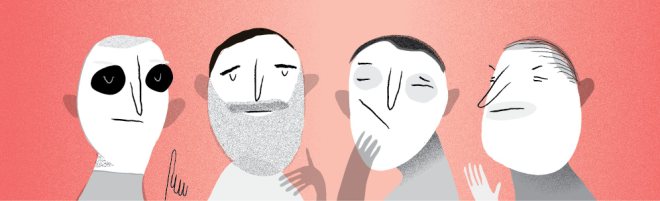
The colour, “bla bla bla,” was provided by illustrator Marie Mainguy, who does not necessarily endorse the opinions of the author
New Blue Eyes This Sudden and Correct Amount of Mirrors for The Modern Age Agoraphobia: Nature Is A Solid Slum Knock Shame Follows Intellect: Home Edition The Foulest Ball The Curtain No Longer Drawn, The Yard Dreaming Itself Into Rooms …Now Throw Your Rope Jealousy: It’s What’s In The Mix convins me ths flor is betr sharp Approaching Grief (When You’ve So Long Been Stone) Clear Tape Need “Through Ares’ Ire, The Whole Of Mars Made Snow Globe” Pearls Remember Glass Squirrels Run On Power So You Think You Can Dance While Burgling? Saskatchewan Kaleidoscope PATTERFALL Chaos Tracing Hot Heart Shapes Into Stuck, and Disparate Trees A Single Sailing Arrow Was A Secret Commit To Pieces Peter’s Gate Portrait of an Artist as an Old Photo of My Dad Leaning Against His Siren Red Chevelle “Move Me And My Dead Starling To The Sill For One Last Look At Those Avocado Trees” Everything’s Coming Up Dustpan A Handy Guide For Zero Not For Solitary A Garrison Tinkle “What’s A Former Square?”
First boyfriend, first kiss; I evaded a first fuck. You touched me in places I didn’t want touching: The first man to teach me that my body is not really mine.
“An Inability to Orgasm”
You were much older, and we were in the backseat of your car. I took my clothes off You were trying to rebound from a break-up. I was trying to prove something. “An Inability to Orgasm”
We kissed for the first time on my 18th Our lips touched, and I instantly recoiled We dated for four years. I never orgasmed. “An Inability to Orgasm”
Your lips felt tender until your strength became aggressive, violent I trusted you and you sexually assaulted me. “An Inability to Orgasm”
I felt comfort in your arms. I love you for accepting me, damaged goods and all I hate you for damaging me further, for throwing me to the curb like garbage. “An Inability to Orgasm”
The sensuality of your body brought me to the closest I’ve ever been to ecstasy. Thank you for the almost orgasm. “An Inability to Orgasm”
The wetness coming out of you made the lips of your vagina stick together. You wanted to see me again; I treated you the way men treat me
I’m sorry for not calling back.
Feminist politics, patriarchal sex. You came; our sexual tango ended I’ve still never reached orgasm.
word, “An Inability to Orgasm,” submitted by an anonymous writer,
[Kyoto, Japan. Mid-Fall, 2007. Leather jacket, jeans, black t-shirt. Dusk, that time of day when there’s enough sunset left to appreciate, but not so much as to dissuade folk from turning on their lanterns.]
I’m lying by the river when somewhere, far off and faint, a violin begins to play. It takes me longer than it should to realize it’s an old Ella Fitzgerald tune, but my brain gets there when the progression gets to the D minor [the one right before the chorus]. It’s an odd thing, the chemical reaction that occurs when a well-arpeggiated minor chord rings out against the harshly crisp air that always seems to accompany autumn; something about minor thirds and fallen leaves, I suppose.
I’ve been counting sheep and counting shots, tallying up missed hours of sleep and ingested cubic millilitres of saki. It’s little wonder why life feels more manageable from a horizontal position; Japanese businessmen can put them away, and jet lag is a bitch. Chords warble along the breeze, A-flat into F minor into G7. Dream a Little Dream of Me, that’s the song. She sings it with Louis Armstrong, Ella does. The violinist has finished now, and he/she has either packed it up or wandered off, since there’s no more music to be had. In its place there’s only the gentle hum of the city and the delicate chatter of the two young travellers splayed out on a picnic blanket to my right, just within earshot. She’s talking about a band she likes; yeah, but they’re no Zeppelin, he says.
The houses, set on stilts, glow brightly in the evening fog, and with so much texture to the air it’s as though you could reach out and touch the part of the universe where the neon lights rub up against the dark. The lanterns that hang from the eaves of the buildings are pleasantly old-fashioned, and something in their flickering helps with my sense of calm.
The grass beneath me is wet between my fingers, and I try and think of the last time it rained. Kyoto is beautiful in the rain, on those days when the damp and the chill slow the normally mad city down just enough to remind you how ancient it really is. Some dream of history, others drink it in. Me, I just want to fall into the heartbeat of the place, let the old circadian cadence put to rest most all of the unsavory distractions that pester the soul on the daily.
The violin begins again, but this time I don’t recognize the melody.
Those people who latch on for stability. What good is it to you to bear the weight of their despair? Forced down by the pressure of shared frustrations, strapped to the same sinking ship. Sure, blueberries can float in water…but can we?
The bottoms of the little creature’s feet were rough, as if they were covered in the tips of hazelnut shells. This was a thing it didn’t much like about itself. If it could have gotten some kind of procedure to fix its feet—surgery, maybe, or even something more temporary like a medical pedicure—it would have done it, but it wasn’t sure that it had time or money and besides, it didn’t even know if such a thing existed. Sometimes, just as it was about to fall asleep, the creature would feel the skin on the soles of its feet catch against the smoothness of its bed sheets (especially if the sheets had just been laundered), and it would wince.
Today, the creature was hurrying to work. As it scurried down the sidewalk, the petals on its back fluttered in the wind. The delicate, podlike lashes around its wide eyes blinked, keeping the debris of the city out of its face. The creature was carrying a stack of important documents. It wore a backpack and a satchel and was almost indistinguishable underneath it all—it must have looked, to passersby, like a worried fire hydrant. It didn’t wear much of anything, being covered in bright, yellow feathers (unlike poor, naked humans) but it wore a pair of dress shoes to the office—not because of its horny soles, but because it was afraid of the condensed exhaust and glass dust on the streets around its place of business. These dress shoes protruded from the bottom of the moving stack of bags, papers, and glittery fluff that was the little creature.
Rounding a corner, the creature caught a man staring at it. It was aware of its unusual appearance—how could it not be—but sometimes, it also caught people staring deeply into its eyes, which were a swirling, flaming mash of reds, like the palette of an indecisive stop sign. When the creature looked deeply into another person’s eyes, it could see an awe and an uneasiness there that made it think that it might be more powerful than it itself suspected. It wondered what this power could do. Sometimes it felt that, being an extraordinary creature, it should be trying to do more interesting things with its life. It knew, at the very least, that it should be asking for a raise.
The creature was so distracted by the staring man and its own racing thoughts that it didn’t see the bicycle coming around the corner. It was knocked onto its back, violently. Its papers were scattered through the intersection. As it went flying inconveniently through the air, it heard a small child on the sidewalk yell, “Mommy, what is it?” As it landed, it heard the cyclist yell, “Oh shit!” It could see the reds of its own eyes. It hoped to God it didn’t die before it had the chance to do something about its feet.
“I’m so excited to be taking over for Liam as an editor at Word and Colour. He’s done great things in the position, and I’ll take that as inspiration to work hard and keep publishing art that speaks to social issues and helps fight against oppression.
I’ve been working as a writer and editor for almost ten years, across a variety of platforms, and have always found that creative work speaks to people about social issues in a way that literally speaking to them doesn’t. Reading literary fiction improves empathy, making it easier for people to connect to one another. Communicating empathy is something I’ve always strived for in my own writing, and I’m so excited that I’ll be editing on a platform that encourages this kind of work. Fiction is priceless when it comes to developing a social conscience.
Over the past few years, Word and Colour has published amazing art alongside thought-provoking, beautifully written fiction, nonfiction, and poetry, and I’m looking forward to continuing that tradition.”






 wordandcolour
You must be logged in to post a comment.