How To Dress Like An Activist

rourke 1

It was the yellowness of the room. Lead-paint-coated plaster. The way the sunlight streaked through the one window and splayed shadows on the yellow wall—flashing beige and grey.

He sat by her side, smoothing her hair and humming a song she recognized but couldn’t name. He had created her. He had brought her into the world and had shown her right from wrong. As far as she knew, his word was law, and she followed his advice as such.

The rulebook was constructed through mere preferential suggestion. He had always told her that women look better in heels, that “sensible” shoes were actually just self-indulgent. He told her that short dresses were sexy, that long hair was feminine and that women’s legs, when standing with feet parallel and together, should curve into three separate gaps: one at the ankle, one at the calf, and one at the thigh.

Of course, to her, it became implicit that all men would examine her as a specimen, analyzing her aesthetic relentlessly, adjudicating her body’s rights-from-wrongs. This overwhelming notion made her particularly conscious of any clear defiance of the rules.

When she left home for the first time, she discovered that hers wasn’t the only rulebook. There, in the depths of “Outer Comfort Zone” dwelled a population whose inhabitants challenged every norm she had grown to embrace.

She met The Photographer, whose unshaven legs protruded from scuffed Doc Martens, whose ripped jean shorts extended well past mid-thigh, whose hair was chopped short and who bore a spidery tattoo that trailed from her shoulder down to her wrist, circling her olive skin in place of jewelry. The offense struck severely. The Photographer did not have complete disregard for Law—she would often wear bright lipstick lips and dangling earrings, the kind that pulled at her earlobes, weighing heavily as she walked—it was that she chose her battles, maintain that this was what made her feel free.

It was a simple defiance, the regaining of autonomy over her body. Her legs, which in a month grew a shaded a chestnut brown with hair, itched when they rubbed together—but at least she was fighting the patriarchy? She felt less at home in her body, which, she convinced herself, was a stage closer to “figuring it out.”

One evening, sitting across from him at a booth, yellow-brown menus folded in their laps, she tried to find herself in the pale green. A woman approached. She was all bright-reds as he eyed the way her calves arced gracefully into suede stilettos, tight red dress wrapped around long torso. Maybe this was the kind of woman who without fail could obey The Law, who never thought to question whether they’d suited her, looking so thoroughly comfortable. She sneered, angrily—can’t you see that you’re putting our gender to shame?

She thought of the stinging red blisters, oppressive yellow rays of sun, and the blatant confidence that radiated from the woman’s blue-green eyes. She felt the warmth of his gaze, the hollowness of his affection, and the eternity that appeared within those who looked at her and see more than a “pretty woman.”

But what if she had simply appropriated The Photographer’s stark defiance of the mainstream—was it truly her own autonomous self-expression? In fact, she wondered, pressing down into the heels of her beaten Converse, whether she had become the same kind of analyst towards others that she’d despised, herself?

Yes, she was fighting objectification, but in doing so, had the movement taken on on a rulebook of its own?

It occurred to her, gazing at the woman, bathed in orange sunlight, what if this dress is just a dress? And what if, she thought, I prefer my legs to be bare?

***

words by Annie Rubin: “I was inspired by the merging of colours, the unsettling streaks, the abstract quality of, muted tones, and by the soft brushstrokes. This piece targets the objectification of femme beauty standards. As the protagonist is exposed to a counter-culture movement, she explores the dilemma of how or whether actively adhering to gender norms can be decisive and empowered. The stark difference between yellow and green represented the struggle against over-sexualization through counter-culture self-expression. I hoped to expose a systemic entitlement to harsh judgment, and to beg the question of how such assumptions work to keep the system alive.”

colour by Alexis Rourke
On unrequited love: “Turning Around Her”

unnamed (5)
I wasn’t sure what direction things were taking. I was having trouble sleeping, trouble concentrating and for the first time in a long time I didn’t know what my next step was.
 
I wasn’t myself. I used to be methodical, to a fault. I planned everything: my schedule, my goals and pursuits… so this was well beyond my capacity to deal with. I started running to clear my head, I tried to exhaust myself to sleep each night but nothing could clear the soundtrack of self-doubt and indecisiveness that invaded my mind.
 
She was beautiful and so uninterested in me and all the things I thought I had to offer. I didn’t exist in her world. I mean she was thick and curvy, soft with the hardest edge and sharpest wit. She didn’t let you get away with anything; called you out on every disingenuous gesture or colloquialism and demanded that you be nothing but one hundred percent real all the time. She wore black denim like it was her uniform and her long box-braids were always tied back. You sensed her presence before you even saw her enter the room; her misshapen silver bangles adorned each of her forearms and she smelled of menthol cigarettes and cherry cola. Make-up never touched her densely freckled face and her ears were never without the small diamond stud earrings her father gave her before he passed.

“She was beautiful and so uninterested in me and all the things I thought I had to offer. I didn’t exist in her world.”

She talked to me about it only once in the 17 years that I’ve known her. She said things were dark for a long time, she was angry, she lashed out and hurt some people she loved. I was in love with her, but I was scared of her. I’d seen her gnaw away at the affection that others so easily bestowed upon her. Despite the edge, the anger and her demanding nature, you couldn’t help but want to be near her. There was an enigmatic energy that orbited around her and she unwittingly drew people close to her but she never let them in. When I came out five years ago she was fiercely loyal, almost stiflingly protective. I realize now that I didn’t know her back then, I probably still don’t. I guess I thought that the experience had bonded us, that my sharing this part of my life with her made us closer. I thought we were friends but she had her own thing going on; so I silently pined from a distance and grew sick over unrequited feelings while she pursued other phenomenal women like herself only to chew them up and spit them out soon after, leaving husk where there was once plenty.
It was only getting worse for me. I was barely functioning. And I couldn’t tell her. Clearly I wasn’t a contender, I wasn’t worthy of her affection and I would not succeed where others far better than me had failed. I was drowning in the throngs of a relationship that existed only in my mind. I didn’t know which way to turn. 

colour by Hey Studio

“Hey is a graphic design studio based in Barcelona, Spain.
We specialise in brand identity, editorial design and illustration.
We love geometry, color and direct typography.
This is the essence of who we are.
We take care of every single step of the design process and we always work closely with our clients, big or small, in one-to-one relationships.

We also undertake side projects. These activities aim to play with new ideas, push our creative boundaries and develop a passion that is then injected into client’s work.

In 2014, we opened an online shop, a place to share our passion for typography, illustration and bold graphics.

Hey was founded in 2007 with the idea of transforming ideas into communicative graphics.
Here is a selected list of projects crafted for our clients.
We would love to hear from you. Say hi here.”

Hollywood, Heartbreak & Horsepower

ptb_Van

Alone in the mountains, a van sits idly as the sun rises. From the west comes a slight breeze, and were there any grass it would’ve rustled in the wind. As it is, there’s only the subtle sounds of the shifting sands to act as a soundtrack for this lonely scene.

Inside the van, a young man wakes up. He uses a worn French press to make a cup of coffee and then steps outside briefly to survey the landscape. Back indoors, he sits down at the folding kitchen table (it doubles as a bed and sleeps three, in a pinch) and inserts a tape into the video camera perched precariously on a makeshift tripod of books, tupperware and vinyl records. He holds up a sign that reads Day 155, P.B. (Post Bridgette) and begins to speak directly into the camera.

Fuck Hollywood, he says. And while we’re at it, fuck Bruce Springsteen too.

He doesn’t mean that last bit, of course. He loves Bruce Springsteen; he’s America’s most treasured songwriter. Speaks for the people, you know? But he was angry and felt betrayed by The Boss, and if you couldn’t trust Bruce Springsteen you couldn’t trust anyone.. All those stories on Born to Run, the ones about the good times with the fast cars and beautiful girls, they’d been a lie. There was no peace to be found on the open road, or perhaps there was no peace to be found in him. Either way, he could see now that you could never walk in the sun, and there was no gorgeous brunette putting the sunset to shame as you stare at her and press down on the gas pedal, just a little harder. 2,567 miles from New York to Nevada, and he didn’t feel any better than when he had left. He blamed Hollywood for the heartbreak, and Springsteen too; decades of bizarre and damaging genre clichés, of sitcom reruns and pop song replays had  codified romance as nothing more than a means to an end, a search for a simulated intimacy that taught people all the wrongs ways to find each other, to be together. People hate on Hallmark, but their cards are just the falsities of romance given physical form; it’s the movie studios who are to blame, and the music makers too, for the idea of romance, for that poisonous ideology which has become inescapable in our day to day lives. And he finally understood romance, or at least he thought he did. Standing alone in the desert, he knew what it meant to have been in love.*

word by Josh Elyea

“I’ve always been particularly susceptible to the allure of the open road, due in no small part to early exposure to Kerouac and a strong affinity for the Springsteen works mentioned in this piece. While I think these narratives are important for the ways in which they offer an escape from the mundane, it’s also important to look at the inconsistencies in these narratives; for example, while guys like Springsteen and Kerouac were the strongest proponents of the restorative powers of the open road, they rarely deal with what happens when you reach the end of your road. What happens after you drive off into the sunset? That’s what I wanted to look at with this piece.”

colour by Hey Studio

“Hey is a graphic design studio based in Barcelona, Spain.
We specialise in brand identity, editorial design and illustration.
We love geometry, color and direct typography.
This is the essence of who we are.
We take care of every single step of the design process and we always work closely with our clients, big or small, in one-to-one relationships.

We also undertake side projects. These activities aim to play with new ideas, push our creative boundaries and develop a passion that is then injected into client’s work.

In 2014, we opened an online shop, a place to share our passion for typography, illustration and bold graphics.

Hey was founded in 2007 with the idea of transforming ideas into communicative graphics.
Here is a selected list of projects crafted for our clients.
We would love to hear from you. Say hi here.”

On Spousal Abuse: “I Thought You Were Dead”

leah

Trigger warning: spousal abuse

When she got really angry, she’d throw anything in sight. Once she took a painting right off the wall and threw it and it hit me in the side of the head. I blacked out and when I woke up she was on top of me, covering me with her body, and crying. “I thought you were dead,” she said. “I thought you were dead and I was so lonely.”

She moved into my apartment a week after we met. We threw out all of my furniture and she filled the apartment with her couch and table and chairs and bed. The first month, we would sit on the porch sharing cigarettes and discuss what pieces of my furniture had been picked out of the pile, which pieces we thought were the saddest. The coffee table went quickly, but it seemed like no one wanted my old mattress. One night, we drank too much and she punched me in the jaw. It snowed that night and the leftover furniture disappeared.

Sometimes when she threw things, I would grab her wrists until they were raw and swollen. And then she’d kiss me and I would put my arms around her thin waist, hold her so tight she would ask me to stop. We’d sit in front of the television, her face covered in blue from the screen, and I’d bandage her wrists, burned from my skin on hers. We’d laugh that our love was so hot we could burn one another just with a touch.

When you fall in love, the end is never important. The end is another day.

word by Leah Mol

“I found it very intriguing that the woman in this piece seems so strong, and is also seemingly being targeted. She is perfectly in place to be ruined. Because this piece brought forth the theme of contradiction for me, I wanted to write about people who love one another and want to hurt each other all at the same time. People house so many contradictions.”

colour by Rebecca Proppe

“I’ve been making art my whole life, drawing story books and cartoons since I was a little kid. Now I’m an adult, and I still love to draw.

I’m currently studying art history mixed with some painting and drawing classes. Like most people I don’t know where my life will take me after graduation, all I know is I love art in all its forms and will be making it for the rest of my life 🙂

I hope some of you can enjoy my art as much as I did making it.”

“Two Faced: On the Consequences of Beauty Standards”

proppe

“Two Faced”

The secrets of a woman’s mind are written in the details of her face.

Look closely.

Every expression, every line, and every crease has a tale to tell. They grow and change and multiply, just as the years do. Then, why is it that when I look in the mirror, I am consistently dissatisfied with what I see?

The root of my dissatisfaction lies in a variety of pubescent acne scars that have yet to fade; in the darkened circles under already dark, deep set eyes; in the thin but unmistakeable wisps of hair, around the corners of my lips and at the base of my nose, that bridge my eyebrows together.

I look in the mirror and I see an amalgamation of imperfections arbitrarily plastered together.

But there is a rawness in the way I choose to present myself. This amalgamation of imperfections is unassuming, unforgiving, and unafraid.
This is how I present myself to the world—this is how my story takes shape.

Why, then, is this what I am taught to dislike about myself? Why is this what I am taught to find fault with?

Every expression, every line, and every crease has its own tale to tell:

These acne scars are battle scars. My skin is my armor; tattered and trampled on, it shields my inner vulnerabilities and insecurities. These scars represent the years I spent hiding, covered in layers of foundation and concealer, failing to realize that beauty is more than skin deep.  These scars represent my development and growth, on both a physical and psychological level. While it is still imperfect, I’ve grown comfortable with my skin, in my skin.

It is often said that one’s eyes are the windows of the soul. Well, my soul shines out through them—they open wide, and bright, with excitement. Other times, these eyes are tired, showing exhaustion from late nights and sleep deprivation.
They crinkle when I laugh, just as tears pour out of them when I cry.

Hair grows relentlessly and freely all over my body—and, why wouldn’t it? Am I not human? Am I not alive and healthy?
Hair is the not-so-subtle reminder of my humanity, of my autonomy and my ability to choose. It can be both liberating and restricting, depending on how I choose to tame it.

My mouth is the vessel through which I articulate my thoughts; it is the vessel through which I express my emotions. The corners of my mouth curl up when I smile, and turn downwards when I am unhappy. It is with this mouth that I say, I love you, and with these lips that I let you feel and believe it.

The secrets of a woman’s mind are written in the details of her face.

Look closer.

Look deeper.

word by Fiona Williams

“The rawness of the artwork by Proppe caused me to reflect on how I view myself, particularly in light of the beauty standards perpetuated in the mainstream media. Whereas the female figure in Proppe’s art is depicted without inhibitions, I reflected on what I constantly find unsatisfactory, and then why I am unsatisfied with what I see: the immense amount of pressure we feel to be beautiful.” 

colour by Rebecca Proppe

“I’ve been making art my whole life, drawing story books and cartoons since I was a little kid. Now I’m an adult, and I still love to draw.

I’m currently studying art history mixed with some painting and drawing classes. Like most people I don’t know where my life will take me after graduation, all I know is I love art in all its forms and will be making it for the rest of my life 🙂

I hope some of you can enjoy my art as much as I did making it.”


On Family: “No applause for a hero”

50108d1d5ba0277995e238c6fe5396e2 (1)

“Teach your children well, their father’s hell did slowly go by,

And feed them on your dreams, the one they fix, the one you’ll know by.

Don’t you ever ask them why, if they told you, you would cry,

So just look at them and sigh and know they love you.”

“Teach Your Children,” by Crosby, Stills, Nash, & Young


‘What a fucking spread!’

‘Who woulda thought?’  Frances agreed.

‘Bagels, lox, whitefish, coffee, salami, bologna, provolone, macaroni—”

‘Chicken salad!’

Several parents crowded the cream cheese station at the back of the auditorium.  Henry admired his wife’s breasts as she crouched to pick up a tomato.  37.5% of the couples there were gay.  Mr. Hall, the middle school coordinator, wore a pesto green suit.  The hunchback look worked for him.  Everyone there paid $2.75 to ride the train to P.S. 463 if they didn’t hop the turnstile.  But by the looks of it, there were a few who might’ve jumped.

‘Hey!’  Caleb, 4’6”, rushed over and hugged his parents.  ‘Thanks for coming!’

‘Our pleasure!’

The chatter inconspicuously petered out when Mr. Hall tapped the microphone.  ‘Family, friends, distinguished guests: thank you for coming to P.S. 463’s annual Role Model Day!  In humanities this year, the students considered adolescence.  In lieu of their studies, they reflected on their role model’s unique qualities that they hope to emulate as rising middle schoolers.  Today, you will hear some of their thoughts.’

A little girl climbed on stage.  Mr. Hall adjusted the microphone stand appropriately. She looked down at her notecard: ‘Hi.’

After a pause, the audience realized it was being invited to exchange greetings.  ‘Hi!’

She continued, ‘My name is June Langley and my role model is Hermione.  Most of all, Hermione is a genius.  One day, I want to be a genius.  Hermione also helps Harry beat Voldemort again and again and again.  I want to defeat evil, too!’  June bowed, and the crowd cheered.  An ‘I love you sweetie!’ and, ‘You are a genius, babe!’ were made out from the clamor.  Surely it was June’s parents.

Another girl stepped on stage.  Her name was Anne Carney.  She had no index card.  Her role model was Serena Williams.  Serena, she informed the crowd, always wins and hates to lose.  Anne does, too, she tells the full house.  When she grows up she wants to be successful, like Serena!  The sound level meter for June’s speech reached a higher altitude.

Now Caleb hurried up the steps.  He took a piece of crumbled paper out of his pocket and unwrinkled it.  This had BOY written all over it.  Not once did he lift his eyes.  ‘My name is Caleb Monroe and my role models are my mom and dad.  Mom wakes up everyday at 5:00 and packs my lunch.  She fills the fridge with my favorite snacks.  Dad fought in court for my autistic brother Fred to go to a good school.  He drops me at basketball practice after school and always wants to play.  They are exhausted from work and then come home and cook.  If there is no food, they go shopping.  And tomorrow they’ll do it all again. They do not get paid for this job, and never ask for anyone to clap for their demanding work.  Being a parent is so heroic.  There’s no applause for a hero.’

The audience has no idea how to respond.


word by Jacob Goldberg

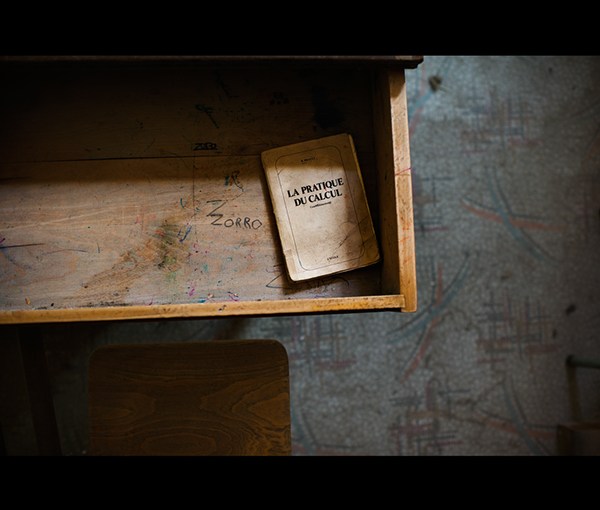
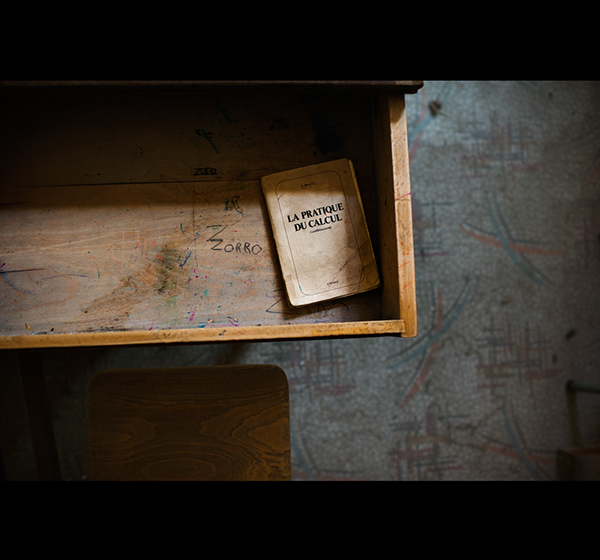
“After I learned that “La Practique Du Calcul” roughly translated to “basic calculus,” I wanted to write about how difficult calculus was for me but easy for others.  With that in mind, I hoped to sketch a story about something that I feel is at once important, simple, and uniquely hard: showing appreciation and love for those that really matter to us.”

colour by Julien Coquentin

On Persecution: “The Strangers”

5d36cf2748e179d7de3b18bdcd289c04

Noise noise noise noise noise.

A million million voices try to talk one on top of the other. It sounds like music. It sounds like the worst jazz you have ever heard.

The effect of all the voices is to make you feel screamed at, but no one is screaming. They are speaking with only a note of urgency. They are not shouting, but they know they should be heard. That you should hear them and that they must say their piece.

This is just when you first go through the gates. This is nothing yet.

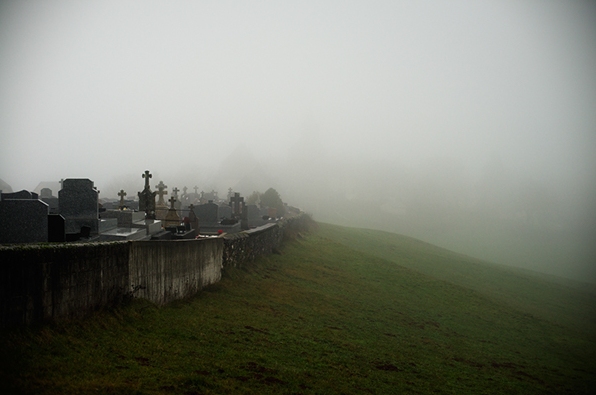
The gates, by the way, are tall and iron and topped with diamond-shaped spikes. They are there for a very specific purpose: because the boys of the town will try to sneak in and put mirrors on the graves. The gates will not stop the boys from trying, but they will stop all but the most resourceful boys from getting into the graveyard. In the time before the gates, that everyone remembers but no one was alive for, there were shards of mirrors all over the graves like magpie confetti. No one remembers why, but the boys know that this is what they are supposed to do. The gates are especially needed at holidays.

After you have recovered from the shock of all the voices – because it will be a shock, even though I’ve told you about it now – you can start walking into the graveyard. If you step too close to someone’s grave, there will be a hush. This will be tempting. But you should be careful, because the longer you linger by any one grave, the harder it will be to go back into the fray. Once, a girl who was not prepared ran into the graveyard at night time. She was overwhelmed by the voices, and she sat down on a grave to rest in the peace. They found her the next morning, lying on the rectangle of grass as if it were a down mattress. They were never able to wake her. This is another of the stories – the ones that everyone will tell you.

If you listen carefully, you’ll start to pick individual voices from the noise. You should listen to them. It will be hard. It won’t be hard to catch the thread, to latch onto a voice and follow it. But it will be hard to stop yourself from shaking it off once you do catch it. They don’t scream, the voices, but they do not flinch from the truth.

These are the graves of the strangers. None of them exist anymore. If they do exist, in an outnumbered molecule of someone’s blood, someone is not telling. I doubt that anyone will ever tell.

You will make your recommendation to the town council by the third of November. We didn’t know these people. Their traditions were not ours, and they are gone now. The land could be put to good use.

word by Charlotte Joyce Kidd

“This story could be about anyone.

My own familial and ancestral background is Jewish, and it’s a group that has been dodging annihilation throughout history.

Religious, racial and ethnic persecution happens and has happened everywhere, and too often results in genocide.

I also wonder about the living’s obligation to the dead in regards to burial wishes and traditions, especially in cases where the desired ritual of the deceased seems obsolete or culturally irrelevant. I was a voracious reader of Egyptian mythology and history growing up, and I questioned the ethics of excavations and exhibitions as much as I revelled in seeing them. Although it was anthropologically exciting and potentially important to dig up a Pharaoh’s grave, what if he had been right to believe that he needed a pyramid of clay figurines to survive in the afterlife? Had we just destroyed his vision of paradise? We can dismiss the desires of the dead as quaint, erroneous, or even morally wrong, but we don’t get the opportunity to argue; we can only choose to refuse or honour them.

In this piece, I tried to create an image of a society that may no longer believe in traditional burial, that has no connection to the buried, that exists on land that has no meaning to them but is historically deeply significant, that perhaps is even responsible for the elimination of a certain group, and finds itself struggling with the presence of a vanished people.”

colour by Julien Coquentin

On the Environment: “Forest for the Trees”

b31b950206fa403d7071aecce8d44b52

I’LL LOVE THIS FOREST UNTIL THE DAY I DIE.

It was a place of possibility.  Where anything could happen.  Secrets hidden behind every tree.  Discovery around every bend.  Adventure was everywhere.

I was always struck by the trees.  So much bigger than anything we had in the city.  And so many.  No matter where you looked, there they were, towering above and continuing on past the horizon.

Walking beneath them today, I’m reminded of the games of hide and seek we’d play in their shade.  The time I came upon the perfect spot.  When no one could find me, I cried my eyes out, waking hours later to Mom’s touch as she picked me up and carried me back to camp.  To the bonfire.

I craved the smoke’s heady scent in my nostrils while simultaneously doing everything in my power to avoid its brutal sting to my eyes.  Every night Liz and I would get one step closer to the perfect s’more recipe.  It’s a miracle our teeth didn’t fall out with all the scorched marshmallow and melted chocolate we ate amongst these trees.

In later years, we discovered the lake.  The forest stayed to its shore, watching on as we swam and played.  It became near impossible to get us to leave the water.  We’d spend full days splashing about, emerging only when our bodies became too tired to keep us afloat.

It’s still hard to believe this will be my last visit.  I wanted to protect this place.  To protect the memories it’s given me.  Now all I want is one last dip in the lake.

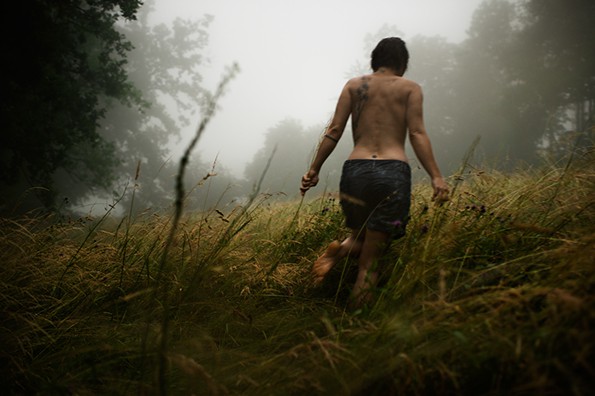
I never knew there were so many different machines for destroying trees.  I can only hope the water will drown out some of the noise.


word by Grant McLaughlin

colour by Julien Coquentin


On Heteronormativity: “Blue”

4

She recoiled from me; our breath left stagnant carbon dioxide in the air.

“What if—”

She bowed her head, interrupting me with piercing subtlety. I felt my body succumb to the numbness of rejection, some feigned self-defense in preparation for when she’d say the word that would make me crumble at her feet.

Her hollow cheeks were flushed, lips pursed- eyes, pensive now. I couldn’t bear the insurmountable shock of no.

Leave now, get out, I begged myself.

Go before she tilts her cheek at me the way she so-often does, ensconced in blue-violet, and says my name.

She was scorching and the thought of losing her felt unbearably electric as I reached for her arm, craving that magenta, tell me it’s okay.

She looked spooked.

“I’m sorry.”

She shook her head as if ridding herself of an awful dream.

“No.”

Blinking, I withdrew. She ran a finger over her lower lip, as if to feel the words as they left her mouth, and then shifted her gaze to me. “I don’t…”

I felt a surge of disappointment. But she let her eyes linger on mine. I studied their magenta hues, wanting to learn her before the moment she would inevitably tell me say goodbye.

I stared at her expectantly, unsure of what I could say.

“Of course I still care for you,” she spoke softly.

I no longer felt like crumbling.

“I want children, you know? This was fun. You have to understand.”

Now it was she who awaited my reaction. I wanted the moment last as long as possible. Anything I said now would become inextricably linked to a new era of us and I wasn’t ready to let her go just yet.

word by Annie Rubin
 
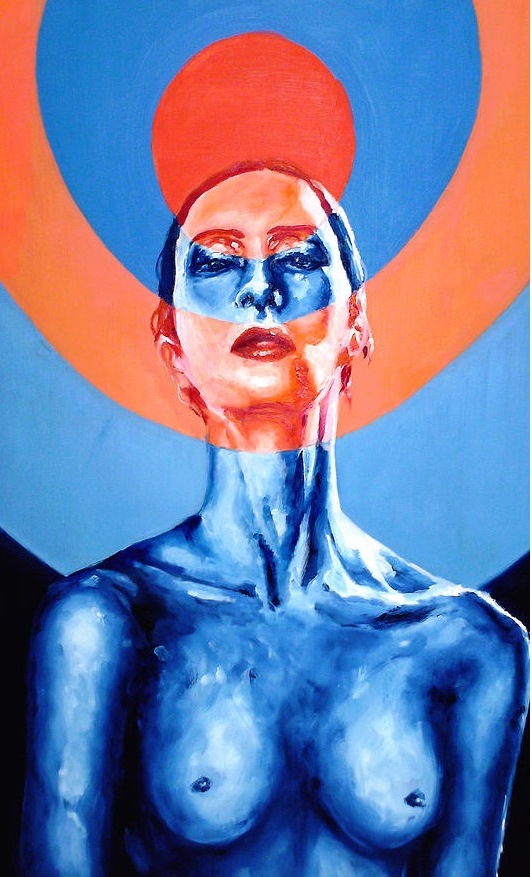
“Bold colours, and the well-defined silhouette of a woman inspired this piece to focus on passionate intimacy. This is a critique of heteronormativity, emphasizing two conflicting views on the legitimacy of a relationship between two women. I want to bring attention to the ways in which societal standards shape individual choices at a basic personal level.”

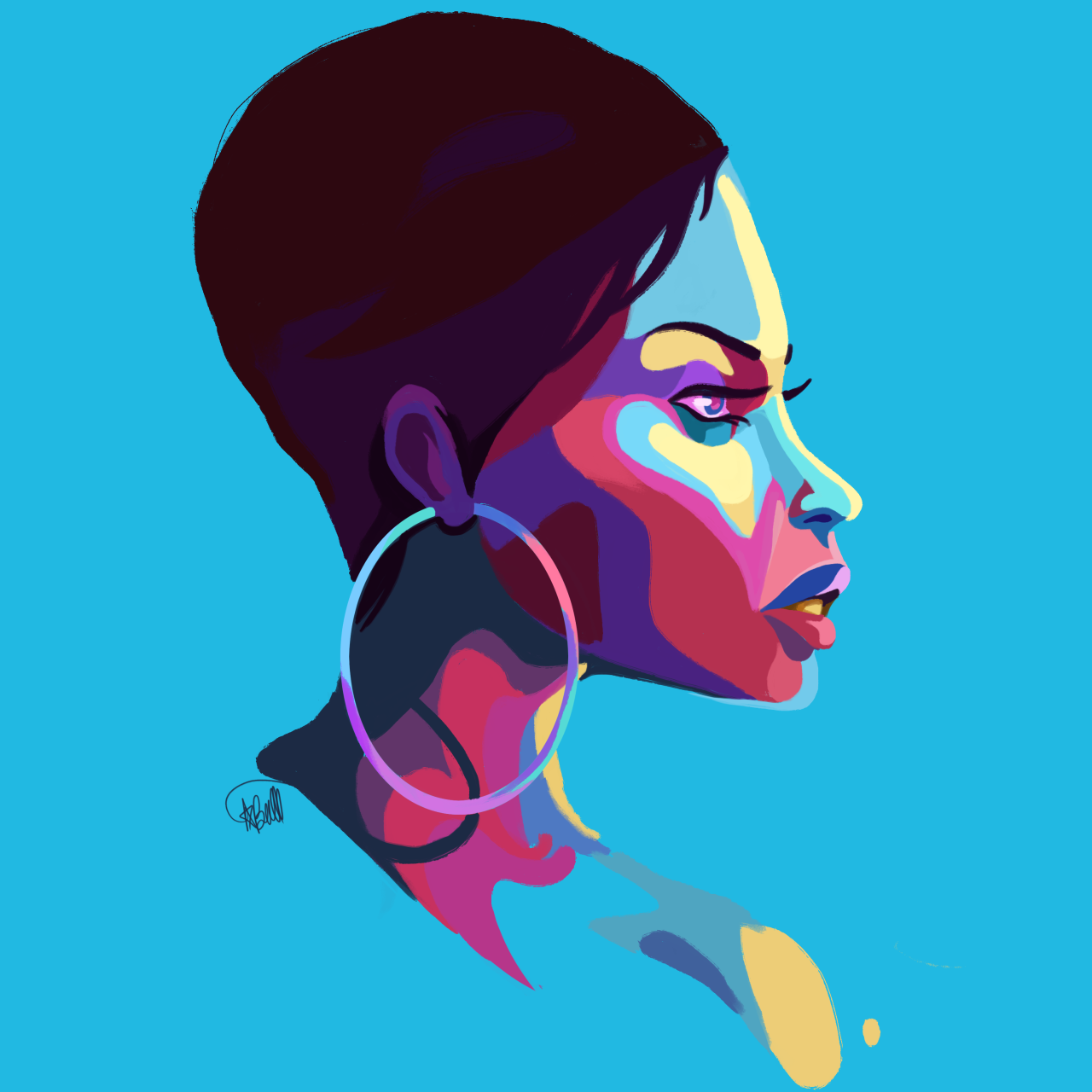
colour by Andre Barnwell 

Andre Barnwell was born July 7th, 1984 and raised in Toronto but currently resides in Vancouver. Ever since moving out west in 2013, Andre has been inspired by the city’s art community and motivated by the accessibility to the tools he needs to pursue his artistic passion and desires. Graduated as an animator from Ontario’s Sheridan College he was exposed to various styles and media to create art even though he prefers to use digital as a means to an artistic end. Fascinated by the human face, most of work is portrait based ranging in different colour schemes, particularly his blue and red monochromatic digital studies.

Outside of portrait work and digital sketches, he enjoys music, film, travelling, and building his brand, Sex N Sandwiches. He looks forward to collaborating with artists such as sculptors, photographers and musicians for future projects. With the world getting smaller with the help of technology, he implores artists and art lovers to follow his growth via social networks and eventually to international stages.

Keep it growing!

Professional Contact: 
Email: andrebarnwell@gmail.com

Social Contact:
Twitter: @AndreBarnwell77
Instagram: AndreBarnwell77

The author’s words do not necessarily represent the views of the artist.

25th edition of the First Peoples Festival

22
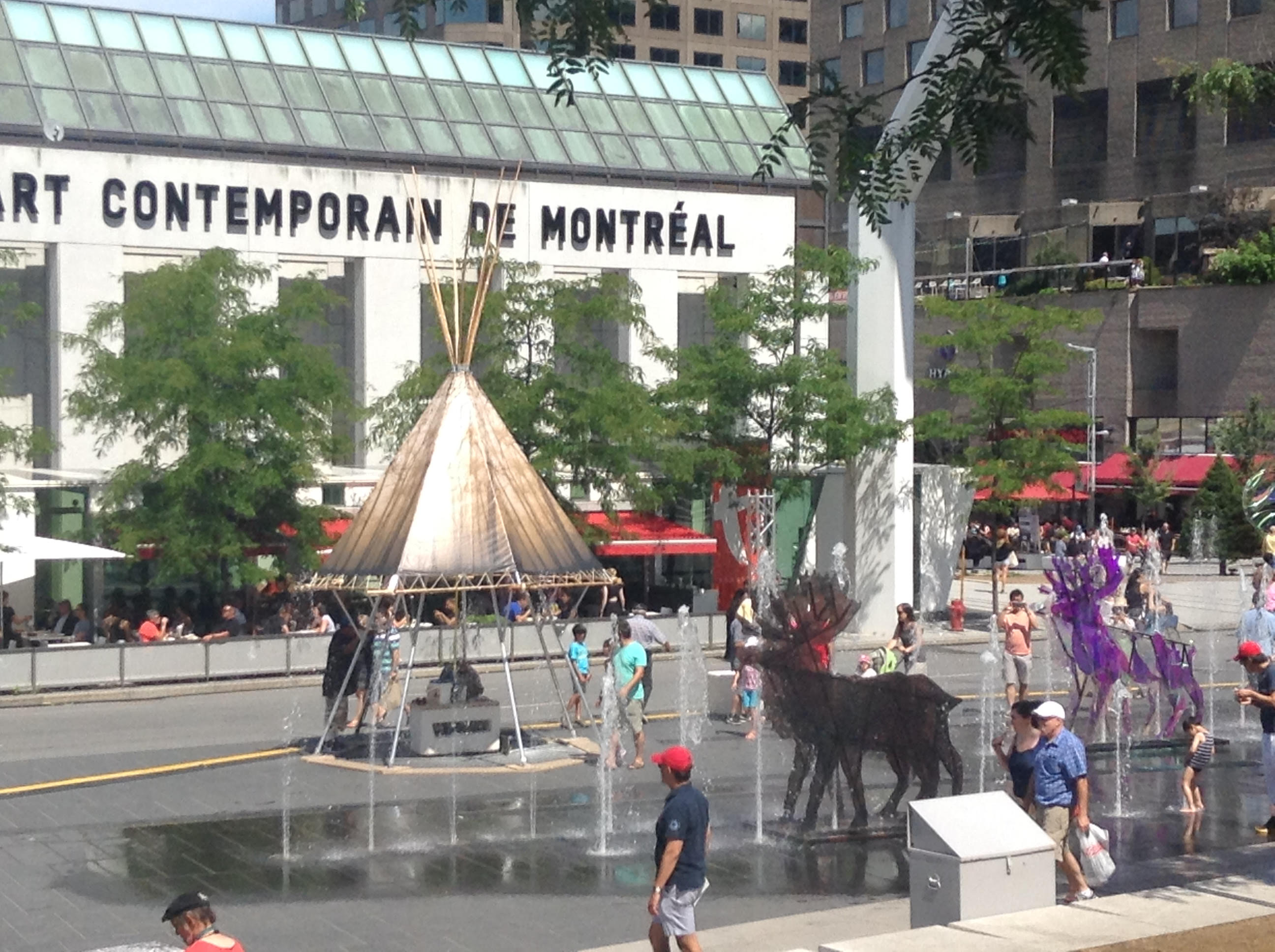
Présence autochtone, the 25th edition of the First Peoples Festival, is currently taking place at Place des Arts in Montréal, and is definitely worth checking out.

The festival features movies, concerts, readings, art, and more, celebrating aboriginal culture and its importance for Canadian identity.  Moreover, the festival highlights the evolution and adaptation of aboriginal music and art in a changing world.
Drumming circles and other forms of aboriginal traditional music, as well as new forms of aboriginal musical expression, such as DJ Psychogrid, Madekimo, Moe Clark, and Katia Makdissi Warren are featured every day on the big stage.
Additionally, many important aboriginal organizations like the APTN, the Makivik Corporation, Land Insights, and the AVATAQ Cultural Institute are using the festival to bring attention to the challenges that still remain within the aboriginal community, like the societal integration of First Nations and Inuit People who adapt to life in urban centres.
2
In response to this issue and others,  the First Peoples Festival promotes the use of art as a means of societal mobilization, identity building and cultural understanding.
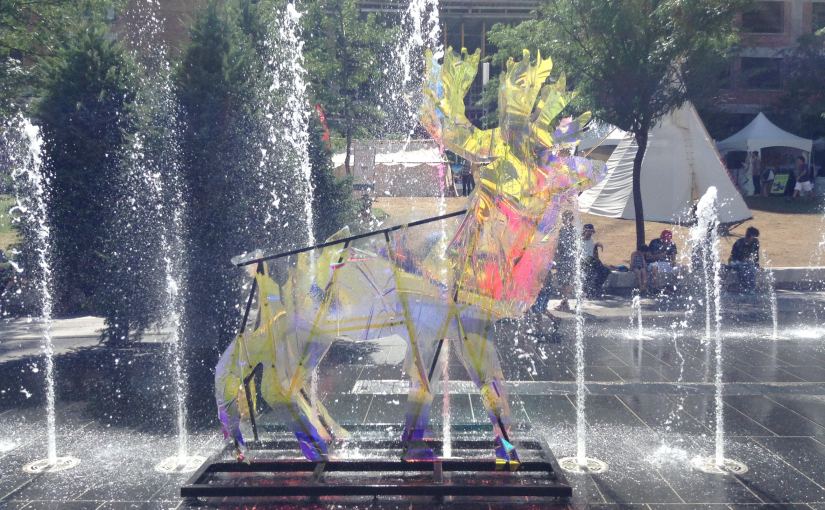
Inuit cultural expression using modern and non-traditional materials, including tepees and sacred animals like deer, turtles and moose, can be seen all over Place des Arts. In addition, the festival features First Nations artists like Jeffrey Veregge  of Port Gamble S’Klallam. Veregge’s art will be of particular interest to comic book fans, as it integrates traditional aboriginal artistic designs with popular culture icons like Iron Man and Buzz Lightyear.
Lastly, Parks Canada is giving out free airbrush tattoos of modern and traditional designs of aboriginal spiritual animals, each created by an aboriginal artist. With each tattoo comes a short explanation of the spiritual importance of each animal, and a description of the artist’s vision for the design.
The First Peoples Festival is not to be missed – check it out this week, until August 5, at Place des Arts!