cold souls

HideandSeek_LorisLora (1)

This all started because he’d seen an old movie where some stoned chick with an 80’s crop cut said something about when you grow up, your heart dies. (You’d know the flick; kids in detention.) It was supposed to be funny, but it scared the shit out of him. Nothing funny about compromising your soul, he’d thought. That’s why they were out here in the cold, freezing their tits off. This was about never losing sight of your soul.

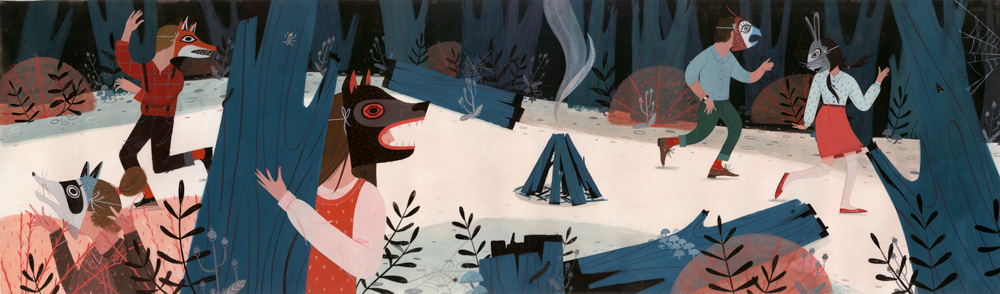
                The mask was a little tight against his face- it felt right. The fox had cost him $17.99 at the costume store, a small price to pay for immortality, and it was one with him now,  a new face. His true face. The book of voodoo had said they had to choose masks they thought reflected their character, their true selves. It said this was the most important part of the ritual. Before you could change something about the world and your place in it, you had to know, really know, who you were inside. In your soul. That’s why voodoo doesn’t work for grown-ups in the West: they’re all dead inside.

                His breath in the cold leaves little beads of condensation that run down the inside of the mask and out the bottom. He watches them and listens to the crackle of the fire underneath the languid, off-time clapping that seems to pervade most any pagan ritual. The children’s chanting is hushed now, but it’ll grow, feverish and in leaps and bounds, to a frenzied crescendo when the moon is brightest. He isn’t sure they’re speaking the right words, but he hopes whatever gods they’re praying to get the jist. Through the slitted eyes of the fox he tries to count the number of snowflakes the fire touches. He can’t. There’s too many, a million. If the magic works, the flakes will never melt. The inevitable thaw that follows the cold will never come, and they’ll endure, ageless, in the depths of winter.

word by Josh Elyea

colour by Loris Lora 

heart-shaped

15226017509_c52c5c6a18_k

Hey mate. Howyagoin?

Good mate. Fark mate—you look like shit.

Haven’t slept mate. I was up all night with that farkin chick that was hangin off me at the party—you know that one with her tits out?

Aw—shit yeah. She was farked mate!

So farked. And when I said I was goin home she started farkin crying! I mean—fark!

Fark mate!

Yeah. Fark. I couldn’t farkin be bothered with it. And then she farkin spewed everywhere—

No way! Gross!

So gross. In her hair and shit. And she reeked! So I took her upstairs—

Didya root her?

Mate!

Yeah—not worth it mate.

Wasn’t keen. She was cryin and yellin out after me but fark, I hardly know the girl. I went home then but it was like 5 in the farkin morning.

Fark.

Yeah. And she had this stupid heart-shaped tattoo on her neck. I hate that shit. Tattoos n’shit—they make girls look so cheap.

But not always hey—like my sister’s got a rainbow on her back and it’s kind of nice, y’know? Colourful n’shit.

Oh yeah, some are nice, yeah.

Yeah…

Troy’s mums got one on her arm. She got it when she was young but she told me she’s proud of it though—and she said there’s no point hiding who you once were.

True man.

Yeah. That was actually kind of inspiring to hear her say man.

Yeah, it is pretty inspiring ay.

Yeah, like it makes me feel like maybe it’s okay to make mistakes… Or that maybe there are no mistakes—y’know?

Yeah…

 …wannanother beer mate?

Yeah mate!

word by Laura Helen McPhee Browne

colour by KOSO

the artist

FMR-3051

Before Bre and Adam walked into the house, the realtor gave them a warning: Some things would need to be changed.

“You might not like it much,”

“Why are you showing it to us then?”

The realtor shrugged. “It’s in your price range. There are two bedrooms. Just try to imagine the rooms looking the way you’d want them to look.”

The house was a house. None of the rooms had doors. There was no kitchen sink. The second bedroom was where the living room should have been. Adam had to go down to the basement by himself because there were two broken stairs and he didn’t want Bre to fall. He’d been wary of everything lately. He came back upstairs, stuffed his hands in his pockets and shook his head, sighing.

“Who’s ready to see the bathroom?” the realtor said, clapping her hands in a show of enthusiasm.

 FMR-2912

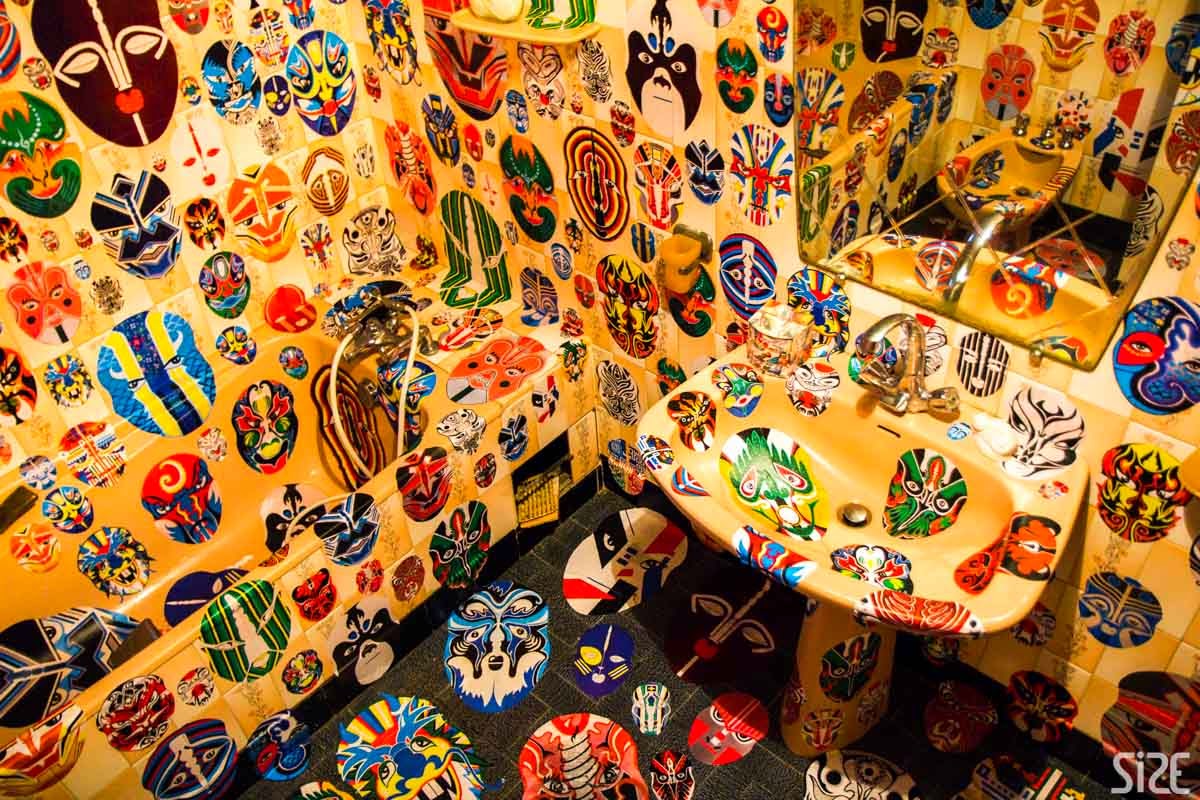
When they stepped into the bathroom, it took Bre a minute to realize that’s where they were. Everything—the walls, floor, sink, toilet, bathtub—was covered with pictures of something. It made it seem like the room was empty, fixtures blending together until they all became one thing.

“What are they?” Bre asked.

“I don’t know. The man who lived here before was an artist.”

The realtor whispered the word, as if it explained every little thing that was wrong with the house.

“They’re lucha libre masks,” Adam said. “Mexican.”

“It certainly seems cultural,” the realtor whispered.


They hadn’t thought finding a place would be so much work. Adam had shelled out money for the cheapest realtor. He’d told Bre that having someone on their side would lessen the stress.

“So, what’d you think?” Bre asked.

“Are you fucking kidding? It was terrible, and the rotten cherry on top of the pile of shit was that bathroom.”

“At least it’s interesting,” Bre said.

“I don’t want to settle for interesting.”

“We’re going to have to settle for something. Isn’t interesting better than nothing?”

Adam looked straight ahead, but he found Bre’s hand with his as they walked into the wind.


Adam had grown a beard, and Bre was seven pounds heavier, but the house looked the same. When the movers dropped the first boxes in the front room, the house sighed.

That first night Bre couldn’t sleep, so she had a bath. She sat in the hot water and looked at her body, the size and shape of her belly seeming as absurd as the masks staring up at her through the clear water.

She tried to name all of them, but didn’t get far.

The two towels they owned were still packed in a box somewhere, so she left puddles as she stepped out of the bathtub. She looked at herself in the mirror – her face was just another mask, just another part of a whole. She closed her eyes and the child inside her knocked three times. 

Not yet, she thought. Please, not yet.

sdb 2

word by Leah Mol

colour by BauBo

the fire

unnamed (2)

They’d seen a caiman at the zoo, her and Sadie, when they were little, maybe five and eight.

“What’s a caiman?” Sadie had asked their mother.

“It’s an alligator.”

She had read the sign and whispered to Sadie: “It’s not an alligator. It’s different.”


 “I was just letting her know I still existed,” he said. “So I lit her pillow up. It was a harmless prank.”

You burned down half of campus, they said.


People watched as the fire burned, from the other, safe side of campus, where the arts buildings were. It was pretty, if you let it be, the way it was black and orange and danced with the red and yellow leaves of October in Ontario. 

Thank goodness it was reading week. Thank goodness there was barely anyone on campus. Otherwise who knows what you could have caused. Do you understand the implications of your actions?


She went back for the caiman. At least, later she would tell herself she went back for the caiman. Once it was dead, it was easy to mourn its passing.

The truth was that she liked it. Her lab partner, a guy named Robert who was already crotchety at age twenty-seven, hated the thing. He called it Stinkeye and shuddered when he had to feed it.

She’d called Sadie to tell her, her first day on the assignment. “I’m a lab assistant now – we’re studying caimans.”

“That’s nice, Sab. What are you finding out?”

Sabrina had started to explain, the microbe that lived between the teeth, how they might learn to reconstruct molars, but she felt Sadie stop listening almost immediately. “How are the kids?” she asked instead.

She thought she was going back for the caiman, but when she reached the lab, she realized how silly that was, how improbable. How had she planned on carrying a caiman? Was she going to wrap it up in a towel, cradle it like a baby? Put it in a duffel bag, sling it over her arm? No, she could not save the caiman; she went back for the research.

She stood with her fingers to the glass tank, and thought that some understanding passed between them. She thought she saw, in its reptilian eyes, a knowledge of what was to come, an acceptance. Then they flickered shut and all that remained was its broken zipper mouth and its listless, horny skin.

She took all of the files on the caiman, all of the pieces of paper, all of the very important measurements and observations, she gathered it up and took it back to her apartment, where it sat in stacks on her living room floor until they were moved to a temporary lab where they bought another caiman. 

The condemnable actions of one student have been responsible for the loss of countless hours of research and millions of dollars of lab equipment, the dean said.

And the death of a caiman, she thought. A charred little skeleton in the wreckage somewhere.

word by Charlotte Joyce Kidd 

colour by Russell Cobb

the Bengal’s meal

tiger-room-akvile-magicdust_1000

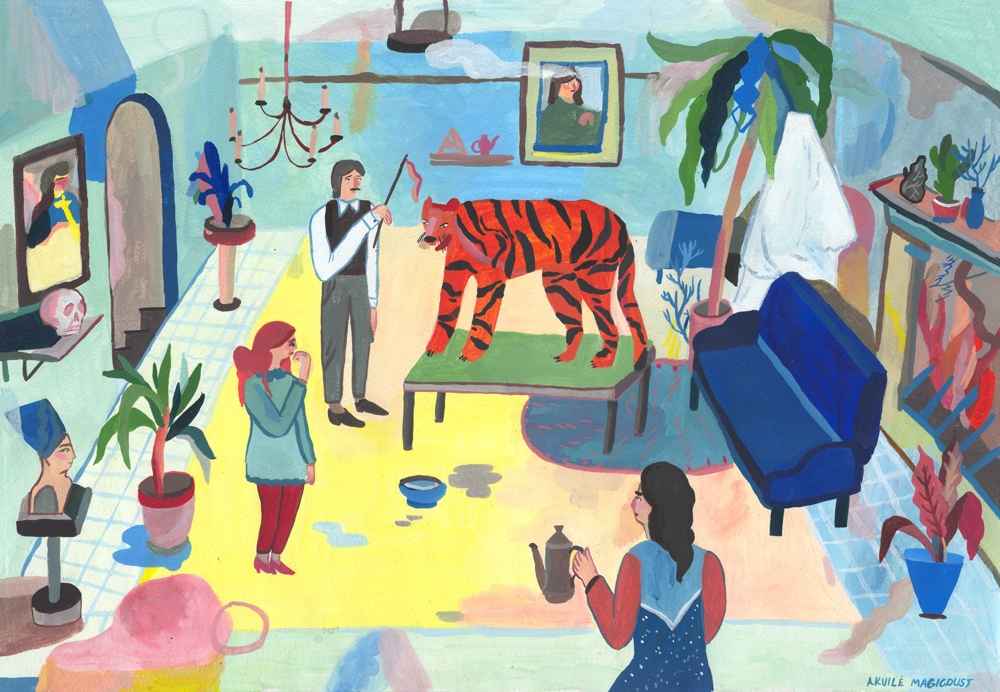
The drug, I’m told, is a fairly potent offshoot of the LSD compound studied by Timothy Leary in the mid-late sixties, whose experiments (and subsequent documentation of said experiments) with the drug were in no small part responsible for its explosion in popularity with the Flower Powerers. As the acid kicks in, I begin to wonder whether the old adage “they don’t make ’em like they used to” can be applied to hard drugs: I have a difficult time believing they made shit like this in the sixties.

The reputed hallucinogenic properties of this particular concoction, nicknamed The Bengal by the ever-growing population of acid-users in the Greater Toronto Area, would seem to explain not only the sudden appearance of the fuzzy death machine, smack in the middle of a reluctantly-attended dinner party, but also why I, sitting on the couch, seem to be the only one who is vaguely unsettled by its presence.

     I scream: THIS BENGAL IS DAMAGING MY SENSE OF CALM

The fichus beside me has no immediate response. I wonder if I’d have better luck with the poorly-potted orchid across the room, where a man with a stunning Selleck-esque moustache and a woman wearing a sweater made of what appears to be ocean waves are enjoying a lively conversation about what I’ve found to be the only obligatory topic at such gatherings: American politics (what with Canadian politics being completely devoid of the incendiary talking points required of the vaguely-informed yet heated exchange that always occurs at these sort of functions). I ignore the roars of panthera tigris and tune in.

     The overwhelming cultural and political ambiguity surrounding the renewed American presence in the Middle East…

Selleck 2.0 reaches for an hors d’oeuvre. The tiger watches. For God’s sake man, not the cocktail weenie: YOU’LL LOSE A HAND.

     I yell: YOU’LL LOSE A HAND

The tiger looks to me. Green eyes ablaze, tail twitching with a sort of unsettling anticipation, it watches me.

     I yell: WHAT’S HIS NAME

If I’m going to be eaten, I deserve to know who ate me.

     Reginald, comes the disinterested response.

The woman, in waves, pipes up.

     Rather regal name for a tabby, isn’t it?

     He goes by Reggie.

     I yell: TABBY…TIGER?

A light-bulb flickers in my acid-soaked brain. A tiger morphs into a tabby. At first, I am relieved. As the man drones on about drones, I long to be eaten – give me death over politics at any time of the night.

word by Josh Elyea

colour by Akvile Magicdust 

oasis

1796661_288174391333568_1670898555_n

On the street she walks along most days there is a wall. The wall is one side of a building and is tall and made of brown bricks, neatly piled and cemented together. The wall has been painted in one spot, up high, and it is this painting of a triangle fox that she watches as she walks. The fox is brightly coloured, with kaleidoscope eyes. The first time she saw it was not so long ago, for she is new here and has only had the courage to walk the streets since she has known to some extent where they join. She told Miles about the fox that first time, but he frowned and kept typing and she couldn’t really explain about the yellow parts and the cave cheeks and the spike of its ears, or how it made her scared and safe at the same time, so she stopped, mid-sentence. Later he touched her hair as he walked to brush his teeth and asked her to tell him more about the tiger. She didn’t correct him.

Then there are the days when she walks down the street with the wall with the painting on it for no reason other than to look up at the fox. She isn’t very busy—jobs are like lucky pigs here—and she feels small and blurry in the apartment on her own. Sometimes as she rounds the bend and lets out a small sigh as she sees the fox up high, there is an old man standing where she stands when she looks at the fox, and he is looking up, too. He gives her a heart ache, with his grubby mittens in the middle of summer, the same drooping plastic bag by his side, every time. She feels so sad – her heart is an emptying bath. But he always moves before she gets to the spot, so, without guilt, she can look up, drinking in the kaleidoscope gaze from above her.

She is looking up at the fox one day, at that time in the very late afternoon when you can almost smell the sun sinking. She does not see the man until he backs into her, his grey hair combed straight and his jacket sticky. She apologizes; chokes out a laugh; wants him to know she does not fear him. He doesn’t seem to hear her. The man stumbles and she moves to let him as he tilts back his head and looks up at the fox. He is saying something—she can hear something croaking out between his upper lip and jaw. She cups her ear to hear him. 

word by Laura Helen McPhee-Browne

colour by DAAS 

sharp teeth

bartsmeets

Ben belonged to the last generation that would remember life before implantation, before your boss could send a message at 6 a.m. – to your brain. Some people resisted, at first, staging massive protests… Ben was not one of those people. How could you not see the advantage of having all knowledge in thought’s reach: To pull up any novel by thinking of it, without knowing what it contained?

The glitch – again – there was a glitch – the shattering sound – explosion of steel – burst of seawater – and then – the shark. Snub-nosed, its blue-black hide scarred by a hundred unnamed battles – the shark once again invaded his mind as he stood up to read. It was fitting, at least, for this reading – The Old Man and the Sea- and it tore through the tight prose, scattering the words. He shut down the book and the shark disappeared with the pool of letters.

Briefly, he gave up on reading. It was swimming through his work reports, and, of course, his mistake at trying to sneak a few pages of Moby Dick, but, by Friday, he had to work. Plus, he missed his library. So he called his friend Arn. Arn was a geek. Arn came over.

   So this is a problem?

Ben shuddered.

   That bad?

He connected to Ben with a cord between their ears. It had been determined in the early days of implantation that wireless connection between minds was disastrous – all the hacking.

   Have you ever looked into a shark’s eyes? There’s nothing in there, man: No soul. There’s nothing about a shark that can be described as even vaguely fucking human. They are the farthest living thing from a human being.

   You feel strongly about this.

    I’ve always hated them. This totally validates it.

Arn frowned. He wiggled his fingers against his thighs, a physical stand-in for the days when he would have been tapping at a keyboard.

     That’s a hack. A really good one.

     How the fuck does that happen?

Arn managed to look both empathetic and impressed. 

      Whoever did this is a genius, and clearly furious at you.

      Cara.

     You said it, not me.

     So what the fuck do I do?

     Way beyond me. Could try to get rid of it, but I might end up trashing your code really badly. You’d have to get re-implanted.

     Can’t afford it.

          Then you have to talk to Cara, he whispered. 

      Fuck.

Arn informed him that if Cara could harm his brain like this, she had probably been in there for a while, keeping an eye on him. She had been watching on the weekend before the wedding, he realized, involving someone brought home from the bar, and Cara’s up to that point unused wedding dress, perhaps sacreligious for use, even though they had broken up.

Sunday night, Ben stood up and pulled up a book. Before it went to shit, he concentrated on solidifying the words, making each one into a waterproof brick. It worked for a second: Investing every ounce of his mental strength, straining against Cara’s digital virtuosity, Ben held the shark at bay – literally.

When it broke through, the dynamite effect it normally had on just the book engulfed his entire body. The worst Ben had ever experienced. And there it was, as usual, the shark, with its expressionless mug and its pitiless teeth, the only thing he could see, seeming to smile.    

He reached out and touched the shark’s nose – something he had never tried. Its little heart was pulsing and warm in his hand.  


 word by Charlotte Joyce Kidd

colour by Bart Smeets

looking for nothing

amargo 2

Alice waits a long time to pick up the book. On the deck, beside her, the cover is damp from the ocean spray, but she doesn’t mind. Traveled, the book is heavy in her hands when she flips to the beginning, wet. At first, she can only stare through the worn pages –  it takes time to focus on the words. She hears her mother’s voice (faint, as though yelling from the kitchen) telling her that the first line of a story is the most important. Her dull and grey eyes scroll down to those crucial first words. 

I’ll either be great or nothing at all.

Now that’s how you start a book, she thinks. Deep. Legs laced through the ship’s rail, she reads on, occasionally lifting her head to stare out at the horizon. The lava-red sunset bleeds into the darkening sky, seeping into the black, giving the panoramic a sloppy finish, like God tipped over paint cans. She reads, waiting for the rest of the book to offer more of the infinite pearl glimpsed in those elegant first words.

It never does. Great or nothing at all. Like my story, like everyone’s story, she thinks. Things always start out simply: It’s only after we keep pushing deeper and deeper and pulling everything apart to look for something unknowable before putting it back together only to realize that now it’s just pieces. Commitment is complicated and petty and you can’t see that until the only people left to comfort you are an old book and the sea. He left his name and address. Who knows, maybe things will return to our initial simplicity. She won’t know unless she finishes the story.

She wipes her face and tastes salt on her lips. The last of the sunlight streams across the water. She reads. The ship beats slowly, steadily toward the horizon, and she wonders if the last line will be as good as the first.

word by Josh Elyea

colour by Pablo Amargo

mosquitos

bur

“I fell in love with you the first time I saw you fall off a horse.”

Her eyes are watery, glistening in their sockets. I can’t tell if it’s drool running over my lips and down my chin and neck or just some bruised emotional response to what’s happened, happening.

“You’re so stupid.”

She’s wiping at her eyelashes. If she keeps doing it I feel she’ll have no eyelashes left by this time next week. The window is open and all I can think is I know the mosquitoes are eating me alive and I can’t feel it. Most people unconsciously wish they could live a life in which mosquito bites don’t itch, can’t be felt. Others don’t mind the actual itching and scratching, finding themselves more inclined to fume at the violation of it all, the unseen bloodsucking and flying off into the night.

“I told you not to go.”

I think what happened was I drank a little too much, as is habit, and walked or stumbled out to the stables, snuck a horse out with what I can only imagine as indescribable grace and horsemanship, thereupon divining myself up onto it’s back, into the saddle… And there’s where all memory stops. And if I’m being honest, something I am not necessarily known for among both friends and enemies- everything I just remembered could be made up. I’d cry if I could feel anything physical. Not for me, but for this girl that knows the truth, the reality that I can’t remember. I can hear Sarah, and I think I can see her, but what I am listening to could be nothing more than unreality catching up with me. She sobs uncontrollably and I see her right arm, the good one, swing and slap my left arm. I can’t feel it and though my head wants to whip toward her in some accusatory fashion, nothing happens.

I fell in love with Sarah under a harvest moon. Sarah says it was blue and I made a mental note to check and see if harvest moons are ever blue. I never checked. I told her before we got serious that I can’t really have friends because I fall in love too quickly, platonic, heart-love, sexual fantasy, all of them separately but often attributed to the same person. And as a result I end up hurting everyone, like a man made of plutonium, some inevitable occurrence will disrupt my atmosphere and I’ll blow up and there won’t be anything left of us: and so I lie. I lie and never stop lying.

And now in an ironic twist of fate, here I am lying, on my back, catheter rooted and probably a dish of some kind caressing my naked buttocks, tubes jutted unfelt into my skin and veins, into my blood and the girl I may have actually changed for is crying and pulling out her eyelashes and I can’t even muster up the words, “It’s okay.”

word by Anthony Statham

colour by Sarah Burwash

how to escape a whale

cccc

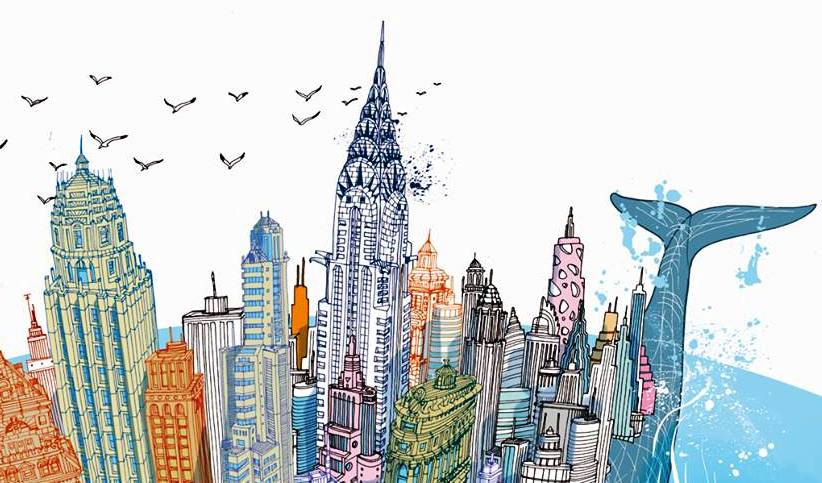
Becca’s leaving the city. She’s accepted this: after the fight, the crying, the insults neither really meant or believed, after all the ways in which they’ve hurt each other – it’s time. She’s leaving. It’s not just him. There is, after all, a whole city. She could avoid him if she wanted to. But it’s that, it’s the city: The city is the problem.

Lately, she suspects that the city is following her – the same placid towers, the same ageless fire hydrants, the same cheery, nondescript shops trailing her from block to block. Its serenity, its immutability, make her want to scream in her state of perilous irritation. She used to love the city.

She used to hum to herself as she walked through it. She used to smile at strangers on its streets.

Now, especially at night, it seems smug. Streetlights glow with calculated eeriness. Its inexplicable rustlings take on a self-important tone, as if to prove that industry and vigor will always exist in the city.

She had come here to feel that things were happening. Even when she herself was doing nothing, she could walk out onto the street and smoke a cigarette and watch the million odd goings-on passing her by and feel that the night was not wasted. Look, a man in a velour suit with an iguana on his wrist – pet or accessory? And over there, those two women, well-dressed, middle-aged, wearing a bit too much bronzer perhaps, that woman has just stuck her ice cream cone directly into the face of her friend.

She wanted to go to street markets, to art galleries, to neighbourhoods she’d never seen before, and partake in culture and romance and all of the borrowed nostalgia of other people’s lives.

She wanted to go out at midnight and get drunk on gin and tonics and revel in the sad, seen-it-all glamour.

It was her who had loved the city. Not him. They’d had an argument once: he’d told her that living in the city was like being a mite on the back of a great, eternal animal: You could drop right off and nothing would change. But you could also burrow your own tiny hole in the surface of the animal, and you would be free to do so. The city would continue in its forward momentum, unbothered by the specks living on its skin.

“That’s ludicrous,” she’d said. “We anthropomorphize cities, giving them entities, but they’re just made up of people. If we all disappeared, they wouldn’t keep going on their own.”

“How can you be so sure?”

“A city is not a tree with no one to hear it. Besides,” she’d added, “look at Detroit.”

Becca’s leaving the city. Every time she tries to picture being somewhere else, she can only see herself floating: Treading water, she watches its million winking points of light recede into the dark.

word by Charlotte Joyce Kidd 

colour by Carlo Stanga