Tag: montreal
Review: Justseeds Vernissage Confronts Injustice
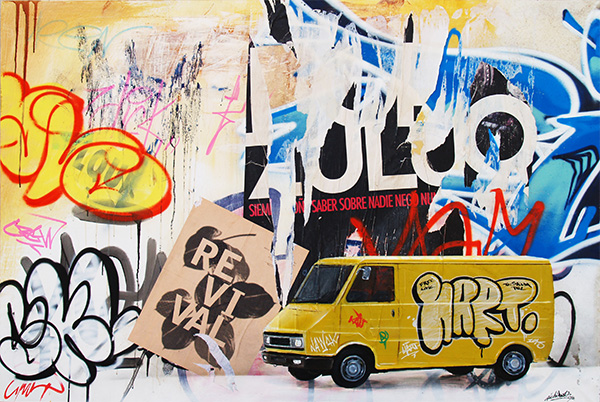
Justseeds’s artists Mary Tremonte & Jesse Purcell put up a wonderful exhibit last Friday – with Tremonte DJ-ing and Purcell showing off artwork from the thirty person collective, as part of the Howl! Arts Festival. Justseeds is a decentralized network of artists that produce pieces highlighting social, environmental and political injustices.
buy this print now by Jesse Purcell
One project, “Celebrate People’s History,” has been fifteen years in the making, and recognizes and commends ‘little people protesting big things’ through print art.
‘Big events’ include the Ejército Zapatista de Liberación Nacional (EZLN) in Chiapas, Mexico, protesting the American Free Trade Agreement in 1994, or the 2011 Wisconson protests that opposed the Wisconsin Budget Repair Bill.
buy this print now by Sue Simensky Bietila
For those of you who missed Justseeds’s event last week, don’t worry! You can still check them out online at justseeds.org
Allison Kutcher, 28 Apr 2015
Support Word and Colour’s live art event!
Review: Howl! and CKUT host panel on austerity

image via Ecole De La Montagne Rouge
As part of the Howl Arts Collective Festival, CKUT FM invited four panelists to discuss artistic resistances to austerity in a live broadcast at Casa del Popolo. In discussing the relation between art and the movement against austerity in Montreal, the chief question was: What is the role of artists in the fight against austerity?
According to the panel – which included artists Edith Brunette and François Lemieux, graphic designer Kevin Yuen Kit Lo, and photojournalist Amru Salahuddien- artists have a choice: they can use their creativity to smooth over the bumps or they can reveal societal tensions through their creations.
However, if art can be used as a space where it is possible to dream, to envision a new future and to picture new social relations, then artists have not only the option, but the responsibility to define and depict an anti-oppressive future in order to raise awareness about austerity and engage discussion.
In addition to the discussion by the four panelists, La Chorale du Peuple, founded in 2011 during the occupation of Square Victoria, denounced neo-liberal policies and inequality through their songs: “Que la vie est belle” and “Ça fait rire les Libéraux.”
A problem underlined by Amru Salahuddien, an Egyptian photojournalist who was on the ground during the Egyptian uprising, was the lack of connections within the international anti-austerity movement. Though the fight against capitalism seems to be a fight that has a certain level of continuity across time and space, the lack of links, not only on an international level, but also within our own communities, has rendered the anti-austerity movement quasi-ineffective.
Salahuddien parallelled the Egyptian and Quebecois students, stating, “while in Egypt, bullets were used against the protesters, the weapon used by the government against Quebecois students was neglect.”
Despite the possibility of connections between these two groups of protesters, Salahuddien criticized the fact that very little support was given to either group by the other: that, though our world is said to be shrinking through technology and social media, there is little global awareness or concern for movements that do not affect us directly.
Concluding the discussion was a conversation about hope, where panelists suggested that if art is used as a tool in the fight against capitalism and the structures of power, it is because artists have hope for a better future, despite their use of seemingly sinister artistic tools, like irony or dystopia, in depicting their criticisms.
Thank you to Howl Arts Collective and to Casa del Popolo for hosting this interesting panel discussion- click here for more events happening this weekend!
Jiliane Golczyk, 23 Apr 2015, Montréal
Support our art event!
Join the rest in helping our art event come true by visiting http://www.kisskissbankbank.com/en/projects/word-and-colour-s-live-art-exhibit/ !
Job opening: Head Of Colour
![]()
Job opening: Head of Colour
Reports to Editor
The Art Director will curate the art for upcoming features at the magazine. After contacting artists, the Art Director will inform the Editor of upcoming features with all required information. Certain events in Montréal may require the attendance of the editor to represent our brand, and the Editor may also select artists to feature.
*An awareness or openness to social justice politics is essential as a representative of the Word and Colour brand. Word and Colour is a creative Non-Profit Organization of volunteers. This position will be paid when revenue streams are implemented according to workload, and requires minimal hours of commitment.
Our Ideal Candidate:
Reliable, organized, proactive
Education / Experience with visual art
Knowledge of social justice issues
Responsibilities:
Contacts artists for weekly features
Represents Word and Colour at art events
Responds to e-mail within the day
Is available for monthly meetings in Montréal
Please read over our mission statement before applying!
Application deadline: Friday, May 1, 2015
Send CV to word@wordandcolour.com
Le théâtre des opprimés
Le théâtre des opprimés, présenté par l’association des étudiants arabes (ASA), est un spectacle en deux actes ayant la fonction de poser d’importantes questions sur les rapports entourant l’oppression – sans toute fois prétendre avoir des réponses. Le spectacle mets en scène oppresseurs et opprimés et vers la fin de la représentation, des spectateurs sont invités à recréer des scènes en tentant d’améliorer le sort des personnages opprimés.
Cette technique interactive – développée en 1971 par l’activiste Augusto Boal – mis de la fébrilité dans l’air, le public ayant eu l’impression que ses interventions pouvaient avoir un fort impact sur la manière d’aborder le rôle des genres dans la famille, du profilage racial ou du harcèlement public au coeur des scènes.
Les membres du public trouvèrent de nouvelles façons d’interpréter les scènes du point de vue des opprimés sans toutefois changer radicalement les traitements prodigués par les oppresseurs. Les harceleurs publics continuèrent d’harceler leurs victimes malgré les réponses renouvelées de ces dernières et un officier de police qu’on confronta à la présence possible de motifs raciaux derrière l’exécution de sa fouille répondit:
“Et alors?”
La décision de l’Association des étudiants arabes de rendre chaque personnage multiple est intéressante. Tous tentent vivement de trouver la paix tant dans leur vie privée que leur vie en société, mais n’y arrivent pas toujours. Ce qui pose plusieurs questions: est-ce que l’oppression entoure seulement l’existence des oppressés mêmes ou en sommes-nous socialisés pour en être tous porteurs?
Comment réduire la souffrance lors de situations oppressantes lorsque l’oppresseur semble insensible aux appels de l’opprimé?
Bien que le rôle du Théâtre des opprimés n’était pas d’apporter des réponses concrètes, l’expérience qui se veut une opportunité d’humaniser l’humanité a su soulever des questions majeures. L’association fait du travail important à Montréal et nous attendons leur prochain événement avec impatience.
Laurence Dauphinais – Montréal
Review: ASA’s Theatre of The Oppressed
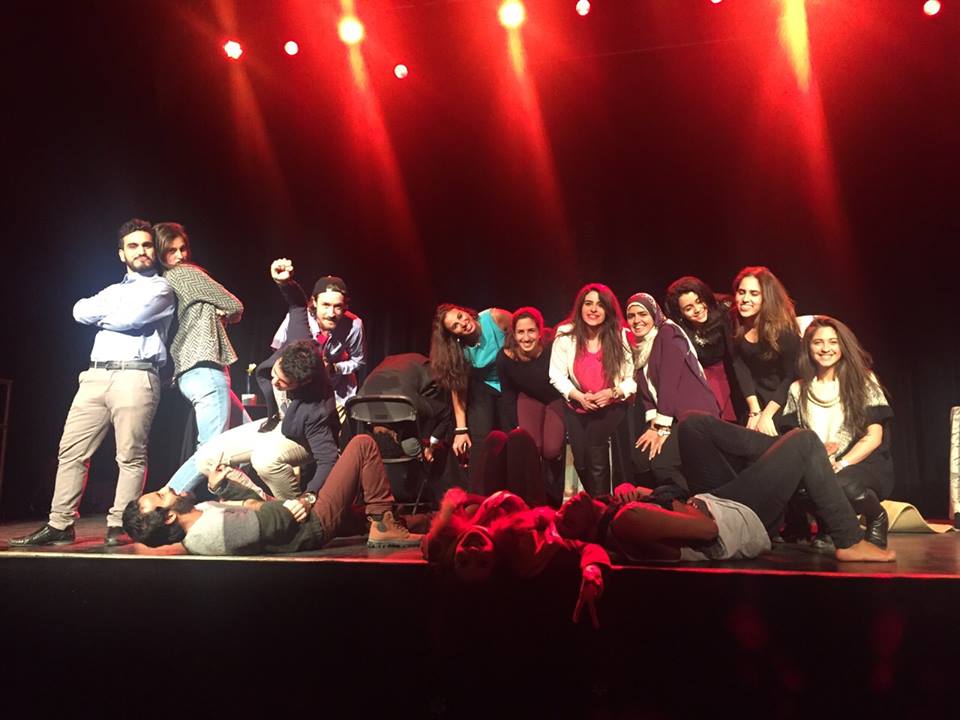
The Theatre of The Oppressed, put on by the Arab Students’ Association, was a two act show that served to ask important questions about interactions on oppression – without claiming to have the answers. The performance intertwined lives of the oppressed and their oppressors in an interactive way: upon closing, members of the audience were invited to recreate scenes where they felt harm could have been reduced by taking the place of an oppressed character.
The innovative technique – developed in 1971 by activist Augusto Boal – brought tangible excitement to the audience. The feeling seemed that these new interventions would make a significant change in the scenes on gender roles in the family, racial profiling, and street harassment.
Audience members brought new ways of interpreting the scene from the oppressed, although bringing little change to the treatment by the oppressor: street harassers went on harassing, regardless of new responses from the harassed. A police officer was confronted on the racial motives of a search. The officer’s response?
“So what?”
Valuable lessons come from the ASA’s decision to portray all characters in a multifacted perspective, each struggling to find a balance of peace in their home and public lives, raising many questions: is oppression simply ‘around’ the oppressed, or is everyone born with it? How do we reduce harm in oppressive situations, when it seems that, however the oppressed responds, the same treatment seems to occur?
As the group proposed, the Theatre of The Oppressed was not to provide prescriptive solutions for change, but rather to raise awareness and pose questions while ‘humanizing humanity.’ An important group doing important work in Montréal – we look forward to their next event.
Allison Kutcher, 23 March 2015, Montréal
Image credits: Arab Student Association of McGill
the fire
They’d seen a caiman at the zoo, her and Sadie, when they were little, maybe five and eight.
“What’s a caiman?” Sadie had asked their mother.
“It’s an alligator.”
She had read the sign and whispered to Sadie: “It’s not an alligator. It’s different.”
“I was just letting her know I still existed,” he said. “So I lit her pillow up. It was a harmless prank.”
You burned down half of campus, they said.
People watched as the fire burned, from the other, safe side of campus, where the arts buildings were. It was pretty, if you let it be, the way it was black and orange and danced with the red and yellow leaves of October in Ontario.
Thank goodness it was reading week. Thank goodness there was barely anyone on campus. Otherwise who knows what you could have caused. Do you understand the implications of your actions?
She went back for the caiman. At least, later she would tell herself she went back for the caiman. Once it was dead, it was easy to mourn its passing.
The truth was that she liked it. Her lab partner, a guy named Robert who was already crotchety at age twenty-seven, hated the thing. He called it Stinkeye and shuddered when he had to feed it.
She’d called Sadie to tell her, her first day on the assignment. “I’m a lab assistant now – we’re studying caimans.”
“That’s nice, Sab. What are you finding out?”
Sabrina had started to explain, the microbe that lived between the teeth, how they might learn to reconstruct molars, but she felt Sadie stop listening almost immediately. “How are the kids?” she asked instead.
She thought she was going back for the caiman, but when she reached the lab, she realized how silly that was, how improbable. How had she planned on carrying a caiman? Was she going to wrap it up in a towel, cradle it like a baby? Put it in a duffel bag, sling it over her arm? No, she could not save the caiman; she went back for the research.
She stood with her fingers to the glass tank, and thought that some understanding passed between them. She thought she saw, in its reptilian eyes, a knowledge of what was to come, an acceptance. Then they flickered shut and all that remained was its broken zipper mouth and its listless, horny skin.
She took all of the files on the caiman, all of the pieces of paper, all of the very important measurements and observations, she gathered it up and took it back to her apartment, where it sat in stacks on her living room floor until they were moved to a temporary lab where they bought another caiman.
The condemnable actions of one student have been responsible for the loss of countless hours of research and millions of dollars of lab equipment, the dean said.
And the death of a caiman, she thought. A charred little skeleton in the wreckage somewhere.
word by Charlotte Joyce Kidd
colour by Russell Cobb
looking for nothing
Alice waits a long time to pick up the book. On the deck, beside her, the cover is damp from the ocean spray, but she doesn’t mind. Traveled, the book is heavy in her hands when she flips to the beginning, wet. At first, she can only stare through the worn pages – it takes time to focus on the words. She hears her mother’s voice (faint, as though yelling from the kitchen) telling her that the first line of a story is the most important. Her dull and grey eyes scroll down to those crucial first words.
I’ll either be great or nothing at all.
Now that’s how you start a book, she thinks. Deep. Legs laced through the ship’s rail, she reads on, occasionally lifting her head to stare out at the horizon. The lava-red sunset bleeds into the darkening sky, seeping into the black, giving the panoramic a sloppy finish, like God tipped over paint cans. She reads, waiting for the rest of the book to offer more of the infinite pearl glimpsed in those elegant first words.
It never does. Great or nothing at all. Like my story, like everyone’s story, she thinks. Things always start out simply: It’s only after we keep pushing deeper and deeper and pulling everything apart to look for something unknowable before putting it back together only to realize that now it’s just pieces. Commitment is complicated and petty and you can’t see that until the only people left to comfort you are an old book and the sea. He left his name and address. Who knows, maybe things will return to our initial simplicity. She won’t know unless she finishes the story.
She wipes her face and tastes salt on her lips. The last of the sunlight streams across the water. She reads. The ship beats slowly, steadily toward the horizon, and she wonders if the last line will be as good as the first.
word by Josh Elyea
colour by Pablo Amargo
mosquitos
“I fell in love with you the first time I saw you fall off a horse.”
Her eyes are watery, glistening in their sockets. I can’t tell if it’s drool running over my lips and down my chin and neck or just some bruised emotional response to what’s happened, happening.
“You’re so stupid.”
She’s wiping at her eyelashes. If she keeps doing it I feel she’ll have no eyelashes left by this time next week. The window is open and all I can think is I know the mosquitoes are eating me alive and I can’t feel it. Most people unconsciously wish they could live a life in which mosquito bites don’t itch, can’t be felt. Others don’t mind the actual itching and scratching, finding themselves more inclined to fume at the violation of it all, the unseen bloodsucking and flying off into the night.
“I told you not to go.”
I think what happened was I drank a little too much, as is habit, and walked or stumbled out to the stables, snuck a horse out with what I can only imagine as indescribable grace and horsemanship, thereupon divining myself up onto it’s back, into the saddle… And there’s where all memory stops. And if I’m being honest, something I am not necessarily known for among both friends and enemies- everything I just remembered could be made up. I’d cry if I could feel anything physical. Not for me, but for this girl that knows the truth, the reality that I can’t remember. I can hear Sarah, and I think I can see her, but what I am listening to could be nothing more than unreality catching up with me. She sobs uncontrollably and I see her right arm, the good one, swing and slap my left arm. I can’t feel it and though my head wants to whip toward her in some accusatory fashion, nothing happens.
I fell in love with Sarah under a harvest moon. Sarah says it was blue and I made a mental note to check and see if harvest moons are ever blue. I never checked. I told her before we got serious that I can’t really have friends because I fall in love too quickly, platonic, heart-love, sexual fantasy, all of them separately but often attributed to the same person. And as a result I end up hurting everyone, like a man made of plutonium, some inevitable occurrence will disrupt my atmosphere and I’ll blow up and there won’t be anything left of us: and so I lie. I lie and never stop lying.
And now in an ironic twist of fate, here I am lying, on my back, catheter rooted and probably a dish of some kind caressing my naked buttocks, tubes jutted unfelt into my skin and veins, into my blood and the girl I may have actually changed for is crying and pulling out her eyelashes and I can’t even muster up the words, “It’s okay.”
word by Anthony Statham
colour by Sarah Burwash


You must be logged in to post a comment.