on substance abuse: “after the nightmare”

rive t 2

word by Leah Mol

colour by Stephanie Rivet 

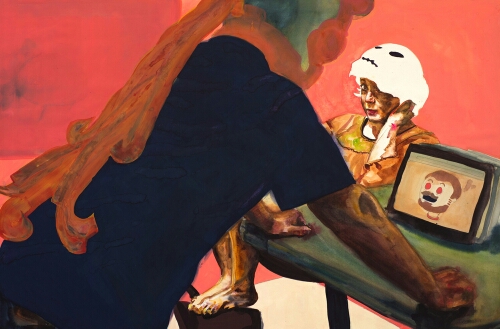
I used to have nightmares. The kind of nightmares you never really wake up from. The kind where you think you’re finally awake and then everything starts to melt. I started seeing a psychiatrist who asked me about work and relationships and my parents. I work a lot, I don’t have relationships, and my parents are divorced, which is just more work. The psychiatrist told me Relax, take a bath, have a glass of wine. I tried baths, but my nightmares were flooded. I spent my nights trudging through basements filled with water, swimming towards nothing at all, and I woke up soaked. The wine worked, so I don’t see the psychiatrist anymore.

The first night I drank, I finished two glasses and then passed out on the couch. I woke up with a headache and the vague feeling that I’d dreamed something terrible. But I couldn’t remember what terrible thing it was. The next night, I managed three glasses.

Now when I get home from work, I pull a bottle of wine from my purse and drink a glass while standing at the kitchen counter. The tile floor is cold on my bare feet, even in the summer. I refill the glass, leave my clothes in a pile, and shower until I’m done the second glass, which is when I stop thinking so much.

I grab the bottle of wine and place it beside my bed with my glass. I put on yoga pants and a sweatshirt many sizes too big, forgotten by someone I think I almost had a relationship with. I open Netflix and I watch a documentary about Mount Everest or a comedy about women who don’t know what they want.

I think about dinner but I’m not hungry for food.

I fall asleep quickly and I don’t dream about anything at all. When I wake up in the morning, I’ll know I’m awake and alive and I won’t be thinking about all the ways everything is horrible. I’ll think about drinking instead.


From the author: “This piece reminded me of these old drinking and driving commercials, where everything gets blurry as more and more glasses are placed in front of the driver. I think that’s such a perfect metaphor for addiction. Even as everything gets blurry— and often because everything is getting blurry—you keep going. And then finally, inevitably, you crash, but that can take forever.”

See more colour by Rivet

On child abuse: “Snow in the water”

Rondeau2

A small girl and a tall, middle-aged man eat lunch together at the local fast food restaurant. Both have sauce on their face: him on his chin, her just above her left eyebrow, and both eat the French fries between them with ferocity.

‘Can I have another burger?’ the small girl asks the middle-aged man.

‘No, you’ve had enough, little dumpling,’ the man replies.

The girl looks down at her white liquid thighs. There are delicate webs of blue vein just beneath the skin. She can almost see them wriggling.


The man and the girl go to see a film at the small cinema with the smell like neglected cupboard and forgotten jacket. They stand looking up at the posters.

‘What would you like to see?’ the man asks.

‘I don’t mind, Daddy,’ the girl replies.


The middle-aged man buys two tickets to Titanic and as the opening credits roll he reaches over and puts his hand in the small girl’s lap. She begins from one hundred in her head and pictures each number brightly coloured, flying free across the dark inside her skull.


word by Laura McPhee-Browne

“This piece of art is beautiful to me but it is also confusing, and I believe it is not what it seems. The title of the painting is ‘iceberg’, and I decided to write a little story about something that, like an iceberg, is almost never what it seems to be; child abuse.

When child abuse occurs between a parent and a child, it can easily be dismissed as imagination or exaggeration, but often what a child discloses about what has happened to them will be only the tip of the iceberg. It is important for us as adults to delve deeper—to dive down and find out what is really going on underneath the surface.”

colour by Emilie Rondeau

“My visual practice is a transgression and alteration of our perception of reality. I encourage free and intuitive interventions. Although abstract, my paintings carry the memories of atmospheric gardens, nebulous spaces, organic landscapes and architectures. Made of solid and bright colours, washes, painted and drawn marks, the compositions are reminiscent of complex and dreamlike environments. From the infinitely big to the infinitely small, cosmic or cellular spaces transport us with a strong impression of movement and energy.

The lines intersect and intertwine, linking shapes and colours together. Sometimes fast and agitated mark making succeeds to slow and smooth gesture. Colour is pure and vibrant. The harmony is rich and thoughtful within the limits of strangeness. A delicate balance takes place in this continual research for new visual forms. The eyes travel, search and rest. My paintings are an invitation for a trip in between the painting surface and your mind.”

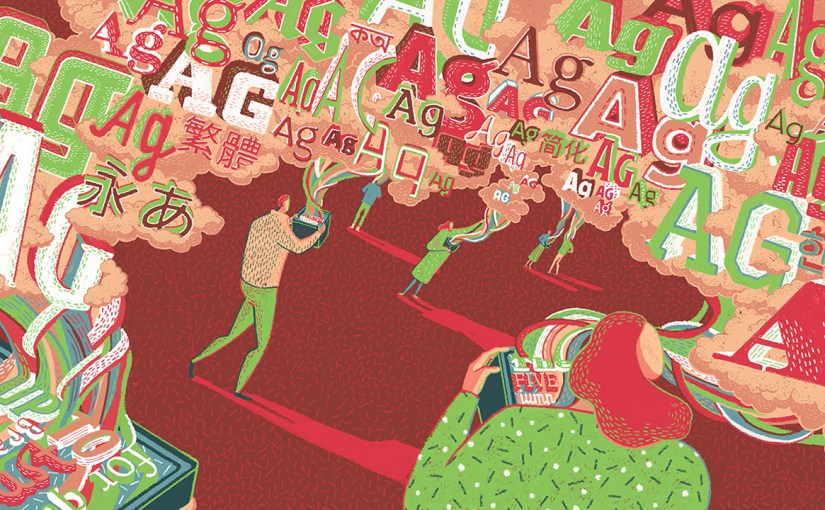
On Mental Illness: “Ag”

For Jennifer

I try to hold her hand and find that her nails are dug into her palm, so deep into her palm that I think they must have sunken into it, that they’re gone.

I try to touch her hair and I can tell that she doesn’t feel it.

“What are you thinking about?” I ask.

“I’m not,” she says.

“Then where are you?”

“I’m getting wrinkles in my forehead.”

“I don’t think so.”

She brings her forehead down to my eye level and zooms it in.

“There’s nothing there.”

“I can feel them,” she whines, and she puts her fingertips to her forehead.

“I promise,” I say.

“I scrunch my forehead when I worry. And I worry all day.” She breaks down, starts to cry on the subway, and I don’t know what to do.

Late, sitting in bed, she says, “It takes me so long to do anything. It takes me hours to clean the kitchen. How long does it take you to clean the kitchen?”

“It’s okay,” I say.

“I don’t have ideas anymore. It’s just a jumble of letters in my head. They’re all shaken up in there. Like Boggle.”

I don’t know what to say. “I’m sorry.”

“It’s okay. It’s not your fault. I’m sorry.”

She takes my hand. She strokes my palm.

“How was your day?”

“It was good,” I tell her. “I got a lot done at work.” It sounds inane.

She snuggles in close to me. She puts her nose in the crook of my neck.

“If it snowed for a week right now, what would you do?”

I laugh. “What do you mean?”

“It snows for a week, right now. It snows so badly that we can’t leave the house. We can’t do anything. We’re stuck here. What do you do?”

I put my arm around her. “I stay here.”

“Noooo,” she says. “Come on. You have to do something.”

“I rip up the carpet on the living room floor. I shred it into fluff. I turn the fan on and blow it around the apartment. It’s like a snow globe inside, but it’s warm.”

She laughs. “I coat myself in egg whites and then dance around the living room until I am covered in fluff. I am the beige abominable snowman.”

“Me too. Then we lie down on the floor. And we make love, two yetis who only know the cave that is this living room.”

“Nothing outside.”

“Just our furry bodies against each others’.”

“No job.”

“Just a wall of snow.”

“No hours ticking. No family calling.”

“Just snow.”

I reach for her hand, and it’s curled again.

“Is everything okay?”

“It is, it is, I don’t know.”

I try to do it. I try to close my eyes and fill my mind with letters, with nothing that means anything, with just the wheel that turns and never stops. She’s crying again. I love her.

word by Charlotte Joyce Kidd

The repetitive letters and the feeling of people watching reminded me of the hyper-awareness, the externalization, that occurs in the throes of an anxiety attack. The thing about loving someone living with a mental illness is that there is nothing to do but encourage them to seek help and not stop loving them. Often, they know they are sick, but they don’t know how to fix it. Sometimes they want help and don’t know how to find it, or don’t have the resources to find it. I spent a lot of time on this piece, because the art resonated with the feeling of anxiety.

colour by Yukai Du

Issue 217 (Gender, Sexuality): “IN THE BATHROOM”

unnamed

“IN THE BATHROOM”

May and Silas lie on the bed. May knows that it would be worthwhile having sex right now—to feel close to him, to remind him that she is not ordinary. Right now she would rather have sex with her substitute science teacher (he had that hair that she liked, it licked up the back of his neck) or the butch woman who had stared at her in the waiting room at the dentist after school yesterday. The staring had made her go red in the face and her vagina spasm in a way that Silas’s gaze hadn’t in months.


Silas turns his slender frame towards her. He is fine and delicate. I’m bored, he grins, let’s cuddle. She grins back and stretches out her arms to pull him in—her arms over his shoulders as always, her body bigger and darker than his will ever be. They kiss and then she pulls back just enough for him to pull back too. Do you want to, he asks, hot breath smelling of closed rooms and wet toilet paper. She pauses. Yes. His eyes coat her in beauty—when he is aroused she feels like he sees her better. She can toss her head and whinny, like a mare, and he will kiss her pulsing veins. They help each other to pull off their clothes: her undies, his exhausted boxer briefs. There is always a laugh here, when her undies are down around her ankles and she is shifting and twisting to fling them off. Sexy, he says.


Moans. Noises she never makes at any other time but that she consciously makes now. Light, quick breaths on his collarbone and light, quick bites of his stretched out neck skin. She doesn’t feel like it until his penis goes in. Then it does feel good, good, like she tells him.


May rolls over, taking Silas with her until he is underneath. She can feel the sweats of each of them slipping and creaking against each other.  She is provocative up here. Silas is beaded lightly all over and his eyes bulge. May resists an urge to reach out and gently move his hair from out of his eyes. This must be over quickly before the sheen wears off and he starts to see the hair on her arms, her pores. Silas tells her he loves her. She feels the warmth of the words in her fingers and her vagina aches just behind and below the labia when she looks down to see his light tuft and her dark one, their tufts, bouncing against each other.


Silas pulls her hips tight in against his own and heaves at her, the sound a bath drain slurping. May breathes out and pulls the sheet across her shave-cut legs. She will bring herself to climax later, will run the tap to quiet her sounds, in the bathroom.

word by Laura McPhee-Browne

From the author: “I saw this art piece as the collage of a girl going through the emotions of becoming a young adult.

 
This art piece brought back to me the insecurities, anxieties and play-acting aspects of being a young woman, and I decided to write a story that delved into the mind of a young woman trying to be ‘normal’ and to do ‘normal’ things, such as having satisfying, meaningful sex with her boyfriend, despite the ambiguity and complexity of such an act.
 
Through my story, I also wanted to get across how much pressure there can be on young women to be ‘nice’, to be ready and willing, and to be relaxed, and to sacrifice their own pleasure and well-being for the sake of men, when this is an impossible and unrealistic expectation. I believe that the various slogans in the art piece, ‘BEING NICE IS COOL’ and ‘DON’T FRET’ are the slogans that young women chant inside themselves, when really it should be okay to not be okay.”

colour by Jasmine Okorougo

On Body Image and Norms

untitled“The little skeleton girl”

She was born without flesh.

It was just one of those things that happened sometimes: there was nothing anyone could have done about it and it was a blessing that it hadn’t been worse.

Her mother sat her down the day before the first day of school, tickled each vertebra in her back and said, “You have a spine.”

She knocked her knee caps and said, “You have good, strong legs.”

She stroked the underside of the girl’s flappy, yappy jaw and said, “You have a mouth, and a heart and a brain. You’ll be just fine.”

The little girl was late to school because a small, straw-y twig got stuck in her rib cage and it tripped her up. All the other kids knew each other already.

The girl had a crush on someone. She asked him to be her boyfriend. He held out his hand in her face and she didn’t know what it meant so she grabbed it with her bony claws and kissed it with her lips that weren’t lips. She felt something go from his palm to her mouth and it dodged past her vigilant tongue and slithered down, down, down into her stomach where it sat like a thumbtack in an airless balloon. He had shoved a tiny stone into her mouth to see if it would break her bones and though it was the most that anyone had ever hurt her, she did not cry but rather looked at the boy with a look of understanding that said that she saw that it was the worst thing he would ever do and that it would haunt him always and be the last thing he thought of before he fell asleep for a long time. Maybe it hadn’t been true before , but that look scared him so much that after it, the boy never did do anything worse, even when he was a man and there were many things he could have done.

The little skeleton girl, though, was pretty much done with the world after that, and she retreated to her room, where she wrote very very sad poems that hardly anyone understood. She did that for nearly the rest of her life.

word by Charlotte Joyce Kidd

colour by Andy Rofles

Ken

floating-away_650 (1)

Ken and Mavis lived at number 9 Flosstooth Avenue. Ken loved Mavis like a dog loves its favourite bone—he would chew on her every now and then to remind himself what true gristle could taste like, but then he would bury her, and all that she meant, and would wait for weeks or months until he dug her up to gnaw at her all over again. That way it was special, and that way Ken knew he would never get bored of his favourite bone. Mavis didn’t like being gnawed at every few months; she told him just before she asked him to leave that she expected constant gnawing. He hadn’t realised that, and offered to never bury her again, but by then it was far too late.

The summer before the end, the neighbours on the side with the dead rose bush that looked like a mutant spider moved out. A few weeks later a dual-cab UTE was parked in the driveway when Ken got home from work, and after some careful investigating from the kitchen window through Mavis’s homemade gauze curtains, Ken gathered that their new neighbour had moved in, and that he was a tall, broad-chested man, with the necessary bulges to wear only a singlet as he loped from his UTE to the door with boxes and bags. Ken saw that the man with the necessary bulges had two lean and hefty dogs. Ken was terrified of dogs, ever since he had been chased by a pack of gnashing greyhounds up and over the slide in the playground one afternoon when his father had forgotten to pick him up from school. He felt trapped in the house, and told Mavis about it when she came home weary from the salon, but she didn’t seem to be listening, and just stood and watched out the window until the sun went down and there was nothing to see anymore.

A couple of months later on a Friday Ken decided to leave work early. He arrived home to see that Mavis was already there, and though he called out for her in every room in the house but he couldn’t find her. Mavis didn’t like to walk anywhere; if her car was there, she had to be too. Ken poured the tap for the kettle and as he poured he looked through the gauze straight into the man with the bulges’ living room. There he saw Mavis, completely naked and dancing around the room with the man with the necessary bulges.

Ken hadn’t wanted to leave, even after watching Mavis and the man with the bulges in a variety of positions all over the living room that made him begin to sweat under his arms and in between his elbow creases. When she came home that night, crumpled and smelling of dog food, he had offered to stay in the spare bedroom. That she simply agreed, and didn’t seem to need to ask him why, told Ken that he would never unearth his favourite bone again.

word by Laura Mcphee-Browne

colour by Ilya Shipkin

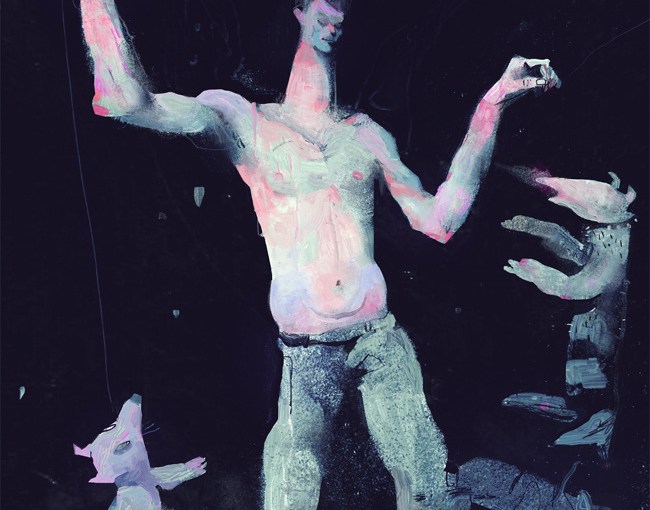
From the author: “When I first saw this illustration by Ilya Shkipin, I saw the man and the dogs he was feeding as dangerous, as hostile. As I came back to look at the illustration again and again, I began to feel that there was a special relationship between the man and the dogs; that they knew each other well, and perhaps looked after each other.

My story, ‘Ken’ is about a man who does not feel comfortable in his own skin like the man in this illustration surely does. It is about the threat that confidence and mystery can be to a flailing relationship.”

Personal Response for Ms. Mitchell for Art Class by Julia Harris

frontal2_650

#14- Blue, red, blue. Sometimes what’s important is just what’s right in front of your face.

#37- This sculpture was huge on the bottom but small on the top and it made me think of my dad’s girlfriend, Shelley. That’s what I have to call her, Shelley, like we’re friends or something.

#42- Vaginas. Art is full of vaginas.

#71- Egg all over a black wall, yolk and white and shell and everything. Like someone just couldn’t stand just looking at nothing anymore.

#89- Supermarket aisles. I got lost in a supermarket once. I didn’t know I was lost until someone found me.

#91- It looks like a building we used to see all the time that was covered in shapes and colours. My mom would say, “It’s too much like a Kandinsky,” and my dad would say, “You never like anything.” I thought it looked like an elephant, but I was just a little kid. My sister told me it was a picture of the most beautiful music in the world. She always saw things I didn’t.

#101- Rain.

#104- Ballerinas.

#111- The inside of a really big room.

#112- Two triangles fighting, one is upside down. This one was very red.

#118- This one looks like a lake. I remember thinking lots of pictures were of the ocean. When I was a kid, we used to take trips to the beach, but I found out a little while ago that we were swimming in a lake, not an ocean, so now I’m not sure if I’ve ever seen the ocean in art at all.

#154- Myself. But the art was just a big broken mirror. I could also see the other people looking at it.

word by Leah Mol

colour by Carlos Garci 

From the author: “One of the things that intrigues me most about art is how it can invoke such specific and personal memories, feelings, and ideas for so many different people. I also find it interesting that what a person sees in a piece of art often says much more about that person than the art itself. 

When I first looked at the art that goes along with these words, I was excited by the number of possibilities. I see certain specific things in the piece, but you will see something else entirely. In these words, I’ve tried to show the reader a character through what she sees in various art pieces. What she sees is part of who she is, where she’s been, and what she will become.”

cold souls

HideandSeek_LorisLora (1)

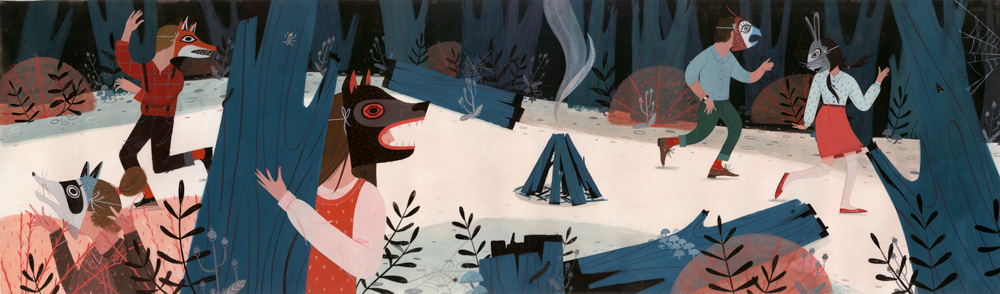
This all started because he’d seen an old movie where some stoned chick with an 80’s crop cut said something about when you grow up, your heart dies. (You’d know the flick; kids in detention.) It was supposed to be funny, but it scared the shit out of him. Nothing funny about compromising your soul, he’d thought. That’s why they were out here in the cold, freezing their tits off. This was about never losing sight of your soul.

                The mask was a little tight against his face- it felt right. The fox had cost him $17.99 at the costume store, a small price to pay for immortality, and it was one with him now,  a new face. His true face. The book of voodoo had said they had to choose masks they thought reflected their character, their true selves. It said this was the most important part of the ritual. Before you could change something about the world and your place in it, you had to know, really know, who you were inside. In your soul. That’s why voodoo doesn’t work for grown-ups in the West: they’re all dead inside.

                His breath in the cold leaves little beads of condensation that run down the inside of the mask and out the bottom. He watches them and listens to the crackle of the fire underneath the languid, off-time clapping that seems to pervade most any pagan ritual. The children’s chanting is hushed now, but it’ll grow, feverish and in leaps and bounds, to a frenzied crescendo when the moon is brightest. He isn’t sure they’re speaking the right words, but he hopes whatever gods they’re praying to get the jist. Through the slitted eyes of the fox he tries to count the number of snowflakes the fire touches. He can’t. There’s too many, a million. If the magic works, the flakes will never melt. The inevitable thaw that follows the cold will never come, and they’ll endure, ageless, in the depths of winter.

word by Josh Elyea

colour by Loris Lora 

heart-shaped

15226017509_c52c5c6a18_k

Hey mate. Howyagoin?

Good mate. Fark mate—you look like shit.

Haven’t slept mate. I was up all night with that farkin chick that was hangin off me at the party—you know that one with her tits out?

Aw—shit yeah. She was farked mate!

So farked. And when I said I was goin home she started farkin crying! I mean—fark!

Fark mate!

Yeah. Fark. I couldn’t farkin be bothered with it. And then she farkin spewed everywhere—

No way! Gross!

So gross. In her hair and shit. And she reeked! So I took her upstairs—

Didya root her?

Mate!

Yeah—not worth it mate.

Wasn’t keen. She was cryin and yellin out after me but fark, I hardly know the girl. I went home then but it was like 5 in the farkin morning.

Fark.

Yeah. And she had this stupid heart-shaped tattoo on her neck. I hate that shit. Tattoos n’shit—they make girls look so cheap.

But not always hey—like my sister’s got a rainbow on her back and it’s kind of nice, y’know? Colourful n’shit.

Oh yeah, some are nice, yeah.

Yeah…

Troy’s mums got one on her arm. She got it when she was young but she told me she’s proud of it though—and she said there’s no point hiding who you once were.

True man.

Yeah. That was actually kind of inspiring to hear her say man.

Yeah, it is pretty inspiring ay.

Yeah, like it makes me feel like maybe it’s okay to make mistakes… Or that maybe there are no mistakes—y’know?

Yeah…

 …wannanother beer mate?

Yeah mate!

word by Laura Helen McPhee Browne

colour by KOSO

the artist

FMR-3051

Before Bre and Adam walked into the house, the realtor gave them a warning: Some things would need to be changed.

“You might not like it much,”

“Why are you showing it to us then?”

The realtor shrugged. “It’s in your price range. There are two bedrooms. Just try to imagine the rooms looking the way you’d want them to look.”

The house was a house. None of the rooms had doors. There was no kitchen sink. The second bedroom was where the living room should have been. Adam had to go down to the basement by himself because there were two broken stairs and he didn’t want Bre to fall. He’d been wary of everything lately. He came back upstairs, stuffed his hands in his pockets and shook his head, sighing.

“Who’s ready to see the bathroom?” the realtor said, clapping her hands in a show of enthusiasm.

 FMR-2912

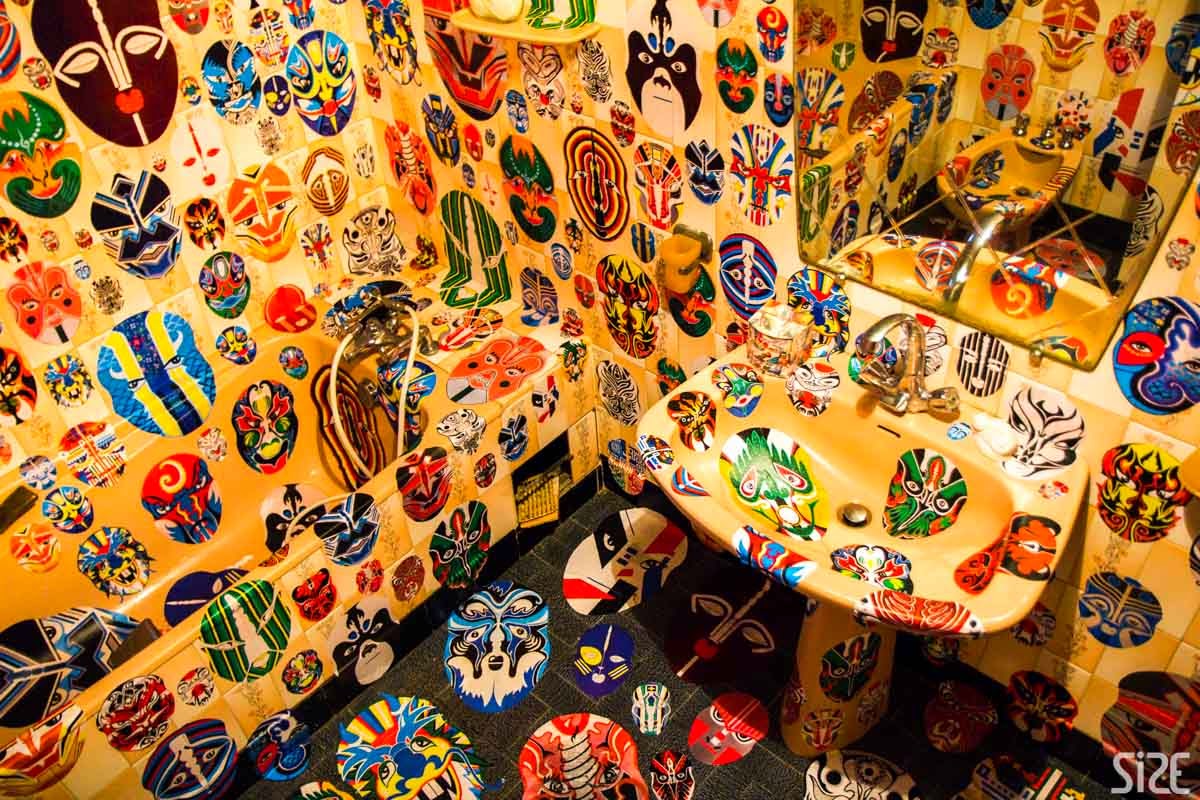
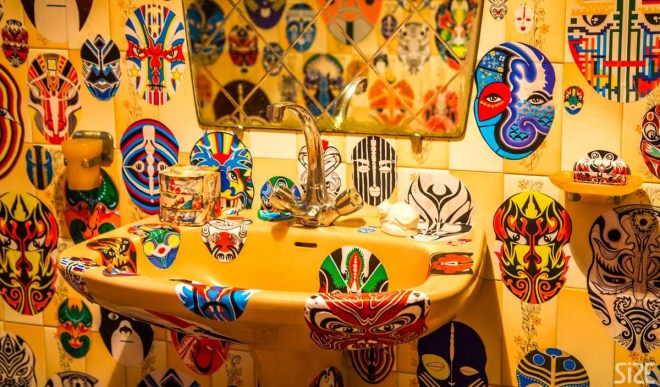
When they stepped into the bathroom, it took Bre a minute to realize that’s where they were. Everything—the walls, floor, sink, toilet, bathtub—was covered with pictures of something. It made it seem like the room was empty, fixtures blending together until they all became one thing.

“What are they?” Bre asked.

“I don’t know. The man who lived here before was an artist.”

The realtor whispered the word, as if it explained every little thing that was wrong with the house.

“They’re lucha libre masks,” Adam said. “Mexican.”

“It certainly seems cultural,” the realtor whispered.


They hadn’t thought finding a place would be so much work. Adam had shelled out money for the cheapest realtor. He’d told Bre that having someone on their side would lessen the stress.

“So, what’d you think?” Bre asked.

“Are you fucking kidding? It was terrible, and the rotten cherry on top of the pile of shit was that bathroom.”

“At least it’s interesting,” Bre said.

“I don’t want to settle for interesting.”

“We’re going to have to settle for something. Isn’t interesting better than nothing?”

Adam looked straight ahead, but he found Bre’s hand with his as they walked into the wind.


Adam had grown a beard, and Bre was seven pounds heavier, but the house looked the same. When the movers dropped the first boxes in the front room, the house sighed.

That first night Bre couldn’t sleep, so she had a bath. She sat in the hot water and looked at her body, the size and shape of her belly seeming as absurd as the masks staring up at her through the clear water.

She tried to name all of them, but didn’t get far.

The two towels they owned were still packed in a box somewhere, so she left puddles as she stepped out of the bathtub. She looked at herself in the mirror – her face was just another mask, just another part of a whole. She closed her eyes and the child inside her knocked three times. 

Not yet, she thought. Please, not yet.

sdb 2

word by Leah Mol

colour by BauBo