On Homelessness: “Walking past”

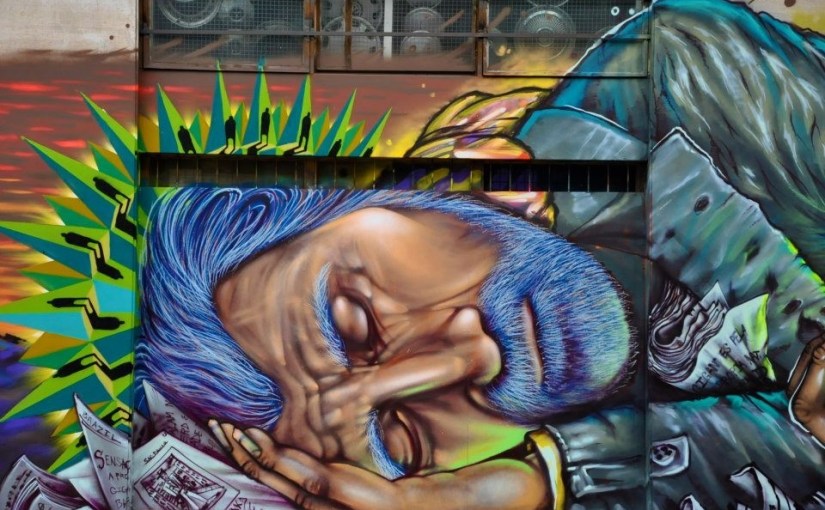
Shalak3

“Look. I know. But I’m telling you, we, like, run in the same circles or something.”

“Which fucking circles are you running in?”

“I dunno, man, just…I’m telling you, I see him everywhere.”

“Give him some cash, man, he’ll leave you alone.”

“I dunno. Do you think he, like, stalks me?”

“Who knows, man. You know what he’s after.”

“Think he can hear us?”

“Probably. Keep looking forward don’t want to give him the wrong idea.”

The subject of their intrigue happened to be a well-recognized face on this street. His salt-and-pepper beard perpetually caked in sweat, eyes bloodshot, if ever opened, fingernails speckled with dirt.

When he wasn’t pacing the corner of the main street, he would lie curled on the ground, enveloped in a makeshift bed, a mattress formed from warped cardboard and a newspaper pillow.

A Styrofoam coffee cup rest at his feet to collect spare change—its position was far enough from his person so as not to elicit too intimate an interaction between hopeful donors and himself, yet close enough to grasp in the case of a thief lurking uncomfortably nearby. This was his domain.

The men who passed him daily found themselves split between curiosity and repulsion as they, in American Apparel, wondered how one could end up on the streets, and why the man couldn’t pull himself up by the bootstraps “and just find a job,” as they all had done for themselves.

The day he disappeared, those who questioned his absence primarily didn’t know who to confront with their concern, or why they felt they needed an answer in the first place, and never did anything about it.

word by Annie Rubin

“With such ease, passersby devalue or dehumanize the lives of homeless people. This story’s focus on the interactions of one man tries to demonstrate a lack of compassion and emphasize the societal conditioning that our culture perpetuates towards those who are not able to work or find a home.”

colour by Shalak Attack

“Shalak Attack is a Canadian-Chilean visual artist dedicated to painting, muralism, graffiti urban art, and canvases. Shalak  has manifested her artistic expression on urban walls across the world.  Shalak is a co-founder and member of the international art collectives “Essencia”, the “Bruxas”, and the “Clandestinos”. 

Shalak also works with several other mixed media approaches such as tattoo art, jewelery, illustration, installation, sound, and video making. In the past ten years, she has participated in numerous artistic projects and exhibitions in Canada, Chile, Brazil, Mexico, Palestine, Jordan, Isreal, France, Belgium, Spain, Argentina, Venezuela, the Dominican Republic, Senegal and recently in Sweden for the Artscape Mural Festival. 

Shalak shares her passion for freedom of expression, and has facilitated visual art workshops to youth of under-privileged communities and prisoners in various countries across the Americas, Europe, the Middle East and in Africa.  Her artistic work and community art-reach is rooted in the social and cultural values she received from her family growing up across Canada.  Since then, her most impacting education has been learning from different communities around the world. Public walls has become her favourite place to paint, she uses graffiti as an art form to create accessibility to culture for diverse communities.” 

Is Mural Fest an Art Festival?

Montreal hosted its third annual Mural Festival this year on Saint Laurent Boulevard; lasting 11 days and featured 20 different artists from all over the world.

This year’s murals, in addition to the final products of the 2013 and 2014 festivals, certainly leave a feeling of awe – but street art does far more than add colour to a neighbourhood.

Most artists don’t create for the sake of creating.

The very nature of street art is accessible to all by being outdoors, free, and easy to appreciate, and there is a strong belief amid the street artist community that there is a certain degree of responsibility to criticize, to create debate, or to denounce injustice through murals and street art.

Namely, Spanish-American Axel Void is known for acting as a witness in depicting the homeless and the persecuted in order to create relatable symbols out of people who are generally discounted by the rest of society. As a part of his series titled “Nadie”, Axel Void painted a homeless man he met on Boulevard St. Laurent. The mural is calledPersonne, and the man in question is at first glance easy to miss, almost concealed, behind the white letters stamped over his face. His mural is a testimony and a criticism to the fact that itinerants are often seen as invisible in society.

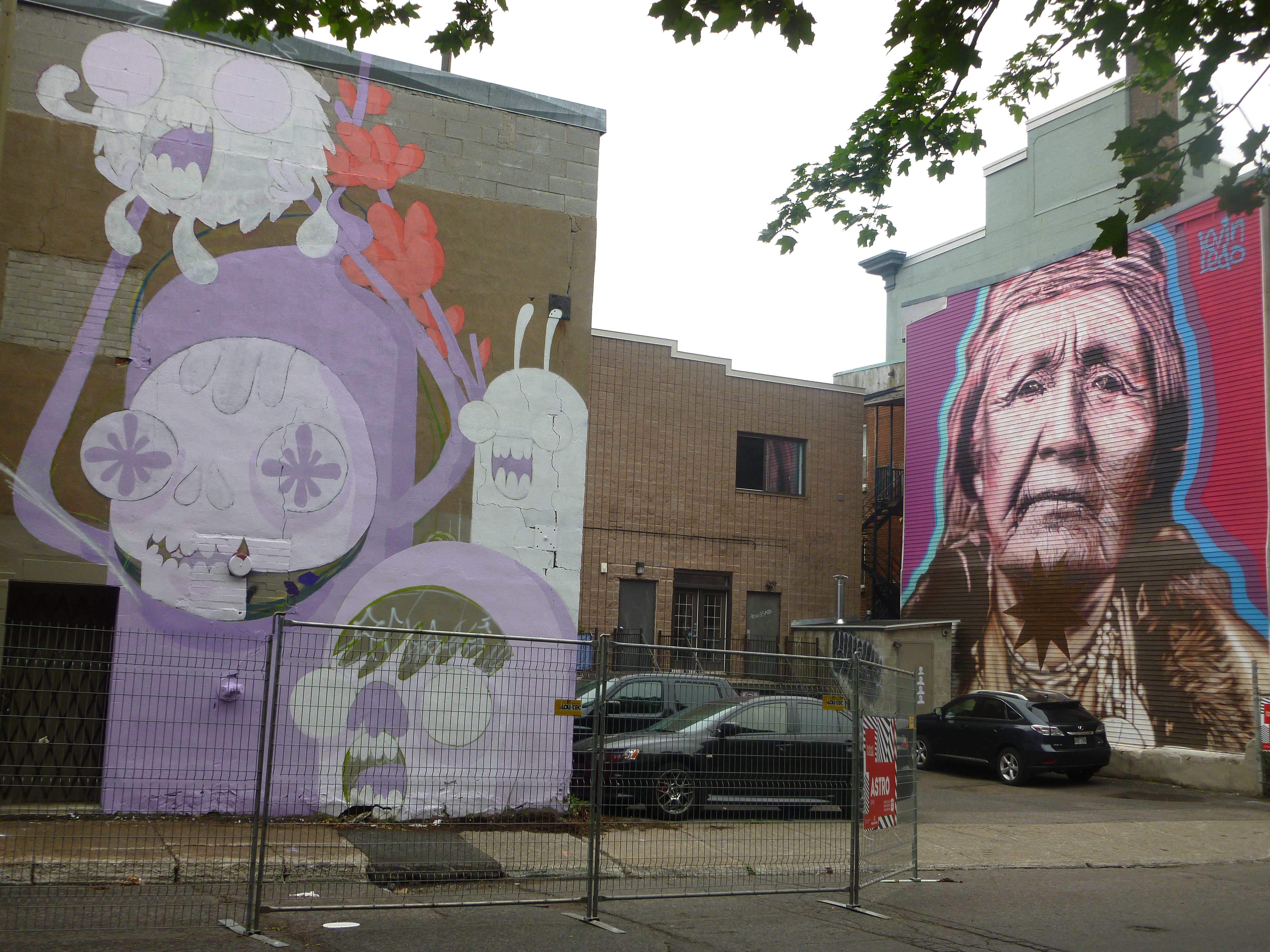
P1060999Mural by Canada’s ASTRO

Mexico city based Curiot is known for blending animal forms in creations inspired by Aztec art and Mexican traditions. His Montreal mural is no exception, and his chalk looking figures call for a heightened connection to nature and between human beings and animals.
P1070002

Austria’s NYCHOS- read his Word and Colour collaboration 

Argentinian Jaz is known for his political graffiti, often depicting scenes of conflict, confrontations, or combats. In his contribution to this year’s Mural Festival, he created a scene depicting cultural and identity clashes between two bulls with human bodies. The bulls are covered in tattoos of maple leaves, fleur de lys, and other Canadian and Québecois symbols.

Another interesting facet of street art is in its reflection of globalization. In addition to their murals in Montreal, you can find Reka One’s aboriginal inspired art in Australia, Italy and Austria, Seth‘s outward looking children in France, Tahiti and China; Etam Cru’s scenes of young girls in Poland, Germany and the United States.

If the artists strive to denounce inequality or injustice through their murals, the process of commercializing said art may strip it of its very purpose.
P1070006A mural by Brazil’s Bicleta Sem Freio 

The nomadic nature of street art allows for a presence of these recognizable characters all over the world. This creates a certain “fil d’attache” between street artists and enthusiasts, as well as between different countries, each faced by their own societal issues.

While Inti‘s mural in Montreal warns that our greed in exploiting Canada’s natural resources will in turn leave us waterless, his mural in Istanbul, Turkey encourages resistance to the government’s austere policies in solidarity with the 2013 Gezi protests. Through their murals, street artists encourage global solidarity in facing world issues.
And yet, when artists are commissioned into creating murals during a festival that clearly has commercial goals – commercial goals that became quite obvious through the street shopping component of the festival – we are called to question the subversive impact of the presence of capitalism in such a festival. Can art be critical of capitalism if it is created by and for capitalism?

P1070001

Moreover, many artists criticize capitalism through their work, but also struggle to pay for the materials necessary to create their works of art. Benjamin Moore sponsored most of the paint used by the artists during Mural Festival. Does art play the same role and have the same mission when its creator was sponsored, or commissioned, by commercial entities?

Though the muralists themselves may want to create art that criticizes capitalism, injustice or austerity, the fact that there was no platform to for them to discuss such themes with the public testifies to the fact that the organizers of the festival are perhaps not as concerned by activism as they are by capital.

In response to the commercialization of art within Mural Festival, the Anticolonial Street Artists Convergence has created a grassroots festival promoting anti-capitalist street art; Unceded Voices will take place from August 14 to 23 with the goal of sharing anticolonial values and indigenous resistance. Unceded Voices brings attention to the fact that Mural Festival takes place on unceded Kanien’kéhá:ka and Algonquin territories.

Contrary to Mural Festival, Unceded Voices will create spaces for artists and members of the community to discuss political issues and how art can act as a platform for such debate.

Check out the murals on St. Laurent, and support Unceded Voices this August.

word by Jiliane Golczyk

A reminder: your fate is permeable

back_03

The only time I ever took a pregnancy test I was eighteen years old and living with my boyfriend in a stranger’s apartment in Prague. We spent the days wandering and the nights drinking quietly, not knowing what or how to cook.


I curl into the kitchen windowsill smoking what might be my last cigarette, and silently contemplate this bleak fate. He slouches on the bed twirling the butterfly knife bought that afternoon despite my un-nuanced anti-violence politics. Or maybe I just couldn’t support violence for the sake of masculine amusement.


The kitchen table is draped in pink blossoming polyester flowers and the fridge is mostly empty. I swallow, and clutch to the unfinished sketches of my life, slipping. It is a small kitchen, badly lit and the night sky drops away from my body.


On a walk with mother, she told me that having children doesn’t necessarily equate to happiness. They did a study, she told me. On happiness. Together we unravelled the assumed inevitability that one day, you’ll see, it will just happen. Bam. Motherhood. And eventually you’ll even learn to like it.


Still I shrink away from the word, hold close and fast to the solitude, the silence, the ability to switch apartments seven times in four years.


Even without the study, her words sucked me out of the story. At least far enough away to bring it into focus. Socialization never amounted to fate in any mystical sense of the word. My anatomy does not presume that I was made for this, and mothering, just like any other job, must be knowingly consented to.


There I was: eighteen, tender and bitter with my un-nuanced anti-violence politics, licking childhood wounds and refusing fate. That small pink bar. I taped it to the wall along with the blossoming table cloth.


word by Alisha Mascarenhas 

“I thought about all of the babies in strollers I’ve walked past this week, and about the persistent disjuncture that often presents itself between what we need and what we are told that we need. I thought of how socialization of femininity is made real through direct transmission from those who impress upon our minds most legibly, and how necessary that there are alternative narratives offered to us in these moments. I thought of the economics behind the inevitability of motherhood, and the threatening possibilities that can surface when what appears fated is pulled apart, set aside and seen through.”

colour by Fannie Gadouas

“I am an interdisciplinary artist working with photography, fiber arts and performance. My work explores issues pertaining to feminine, identity and experience. By re-appropriating various traditional imagery, techniques and rituals, I question and challenge the way gendered identity is constructed, inherited and perceived in western society. Textiles is, and has traditionally been associated with the feminine realm. Critically engaging with techniques such as weaving, knitting and embroidery allows me to subvert and question my own role as both woman and artist. In this sense, my practice as a whole becomes a performance in which the process holds more relevance than the resulting objects. Informed and greatly influenced by feminist theory, the work I produce is a critical response to the social structure of western society.”

On Self-Doubt: “Weather”

unnamed

It’s been raining for days. The girl has just been feeling like rain lately. She’s not sure when it’ll stop, but she knows it can’t go on forever.

            She sits in the waiting room of the office and thinks about how boring it all is. The same magazines as always, the same water cooler across the room, the same assistant answering phone calls and shuffling papers.

            The doctor comes into the waiting room and says the girl’s name. He holds the door to his office open for her, and she gets up slowly, walks toward him past the painting of a horse, past the painting of a whale. When they’re both in the office, he closes the door behind them.

            “So,” he says, “how are we feeling today?”

            “How do you think?” she asks.

            “I thought we were past this.”

            “Apparently not.” The girl sits in the uncomfortable chair she always sits in. The doctor sits in the more comfortable chair, takes the lid of his pen off with his teeth. The girl leans back.

            There’s the sound of thunder and the doctor looks out the window.

            She saw the first doctor when she was eight. He called her problem an Extreme Emotional Response to Weather Patterns, but even then she knew it didn’t explain anything. What was inside her head matched the weather before she ever saw the rain or the sun or the tornado. She could always feel the truth of it.

            “What is good or bad weather anyway?” the doctor asks. She can tell he’s frustrated with her. They always get frustrated eventually. She gives this one another two weeks. “If you’d been feeling great for a month, say, so we desperately need rain, shouldn’t it rain then even if you’re feeling great, since rain would be the great weather?”

            “I don’t make the rules,” the girl says, crossing her arms.

            “Let’s try a visualization exercise.”

The girl knows how this goes; she closes her eyes.

            The doctor speaks slowly, confidently. “Think of a forest. You’re deep in the forest. So deep that nothing can come through the trees. It’s very, very dark. You’re feeling angry today, so let yourself really feel that. Stay there for a minute.

            “Now I want you to start walking. You’re walking through the forest and you come to a clearing, and the first thing you notice is that it’s sunny. You can smell it and feel it as you come to the clearing.”

            The girl feels her anger and she feels the sun on her shoulders and she opens her eyes.

            The doctor pulls his sweater a little tighter around his body.

            “It’s only going to get colder,” she says.

word by Leah Mol 

“The artwork reminded me so much of those moments when a storm is just beginning or just ending. My story is about a link between weather and emotion in the mind of a girl who nobody believes. She is, after years of trusting her own instincts, finally feeling the self-doubt creeping in, which could be the ending or just the beginning of the storm.”

colour by Nadoune Doune 

“Nadine est née à Montréal, d’une famille venant de s’installer d’Algérie. Elle grandit dans l’école buissonnière, une école dédiée à l’apprentissage par l’art. La musique et le visuel sont toujours présents dans sa vie, dès qu’elle le peut elle voyage avec son violon et ses poèmes/dessins au Mexique, dans l’ouest Canadien, et aux États-Unis où elle s’y installe un an. C’est une autodidacte qui apprend par les expériences, la rue est son terrain de jeu et où elle est le plus inspirée. Elle essaye de rendre la connaissance accessible en donnant plusieurs ateliers (notamment dans une coopérative d’art communautaire nommé le Milieu qu’elle essaye d’aider à bâtir). Elle est intervenante sociale, vend des popsicles artisanaux, et travaille présentement sur un projet de prise de parole chez les femmes immigrantes.”

“Nadine was born in Montréal to a family who arrived from Algeria. She grew up in the Buissonière School, where learning is achieved through art. Music and aesthetics are always present in her life, as she travels with her violin, her poems, and her drawings to Mexico, to Western Canada, and to the United States, punctually for years. The street and her experiences are her main sources of inspiration. She works to make education and art accessible by giving workshops – notably in Le Milieu, a community art cooperative that she’s involve in. She is currently working on a project that centers on the voices of immigrant women.”

Montreal’s Tam Tams Is Textbook Cultural Appropriation

Montreal is known for its summer festivals, such as the weekly drum circle around Sir George-Étienne Cartier’s Monument that occurs every Sunday. Thousands of people gather on the park’s lawns to listen and dance to the rhythm of the hundreds of Tam Tam players gathering to form an incredible drum circle.

Drum circles have shamanic origins, and have been used for centuries by aboriginal peoples around the world in order to celebrate their connections with each other and the Earth.

The nature of the drum circle, with no head or tail, suggests inclusivity.

To witness the Tam Tam festival in Mont-Royal Park is to see solidarity within a group that in appearance has little in common, yet that has the desire to share rhythm and create a collective sound.

However, the fact that this circle takes place on unseeded Kanien’kéa:ka and Algonquin nations territory reminds us of the colonial components of the current festival.

Cultural appropriation takes place when a group of people belonging to a dominant culture adopts the traditions of a historically oppressed culture.

Though the participation of settlers in a drum circle or a potlatch may at first glance seem inoffensive, one must take note that these very traditions were outlawed by the Canadian government not so long ago in an effort to suppress the existence of aboriginal culture.

The appropriation of the drum circle by settlers is confirmation that colonization is an ongoing process in Canada. Attempting to conceive of white Europeans as apolitical participants in colonialist practices is impossible. Choosing to ignore settler impact mirrors the logic behind colorblind racism: ‘Race doesn’t matter, because thinking about my privilege makes me uncomfortable.’

Failing to recognize the appropriation of aboriginal culture during the weekly Tams festival is proof of the persistence of the settler colonization mentality – the same mentality that refuses to recognize the residential school system as a genocide.

Wayside crosses, like the one on Mont-Royal, are an important component of settler heritage: there are more than 3000 in the province. These crosses are not only proof of a material culture symbolizing religious belonging, but evidence of the first colonial occupations by the French, starting with the first cross planted by Jacques Cartier in 1534 – who was the first European to climb Mount-Royal and give it its name. Tams’ drum circles take place in a park footed by this cross.

Settler colonialism in Canada originates with the very same Jacques Cartier, who, in one of his most infamous interactions with the aboriginal peoples, went so far as to ruse and abduct Iroquoian Chief Donnacona and his sons, bringing them to France to serve as circus attractions.

The juxtaposition of the Mont-Royal’s wayside cross, a symbol directly linked to Jacques Cartier, above a dancing group that is formed by a majority of settlers is a textbook case for cultural appropriation in North America. If you are a settler show your solidarity by not participating in the drum circles at Tam Tams.* 

Jiliane Golczyk is originally from Red Deer, Alberta, but has lived in Belgium, Chile and Turkey. She will be beginning her Master’s in International Affairs at Sciences Po this fall. 

More: 

http://www.lemontroyal.qc.ca/en/learn-about-mount-royal/short-history-of-mount-royal.sn

http://www.lemontroyal.qc.ca/carte/fr/html/La-croix-du-mont-Royal-42.html

http://www.winnipegfreepress.com/opinion/analysis/will-truth-set-us-free-306094501.html

http://racerelations.about.com/od/diversitymatters/fl/What-Is-Cultural-Appropriation-and-Why-Is-It-Wrong.htm

http://mycultureisnotatrend.tumblr.com/

http://www.thecanadianencyclopedia.ca/en/article/donnacona/

http://www.umista.org/masks_story/en/ht/potlatch02.html

Review: Howl! and CKUT host panel on austerity

image via Ecole De La Montagne Rouge

As part of the Howl Arts Collective Festival, CKUT FM invited four panelists to discuss artistic resistances to austerity in a live broadcast at Casa del Popolo. In discussing the relation between art and the movement against austerity in Montreal, the chief question was: What is the role of artists in the fight against austerity?

According to the panel – which included artists Edith Brunette and François Lemieux, graphic designer Kevin Yuen Kit Lo, and photojournalist Amru Salahuddien- artists have a choice: they can use their creativity to smooth over the bumps or they can reveal societal tensions through their creations.

However, if art can be used as a space where it is possible to dream, to envision a new future and to picture new social relations, then artists have not only the option, but the responsibility to define and depict an anti-oppressive future in order to raise awareness about austerity and engage discussion.

In addition to the discussion by the four panelists, La Chorale du Peuple, founded in 2011 during the occupation of Square Victoria, denounced neo-liberal policies and inequality through their songs: “Que la vie est belle” and “Ça fait rire les Libéraux.”

A problem underlined by Amru Salahuddien, an Egyptian photojournalist who was on the ground during the Egyptian uprising, was the lack of connections within the international anti-austerity movement. Though the fight against capitalism seems to be a fight that has a certain level of continuity across time and space, the lack of links, not only on an international level, but also within our own communities, has rendered the anti-austerity movement quasi-ineffective.

Salahuddien parallelled the Egyptian and Quebecois students, stating, “while in Egypt, bullets were used against the protesters, the weapon used by the government against Quebecois students was neglect.”

Despite the possibility of connections between these two groups of protesters, Salahuddien criticized the fact that very little support was given to either group by the other: that, though our world is said to be shrinking through technology and social media, there is little global awareness or concern for movements that do not affect us directly.

Concluding the discussion was a conversation about hope, where panelists suggested that if art is used as a tool in the fight against capitalism and the structures of power, it is because artists have hope for a better future, despite their use of seemingly sinister artistic tools, like irony or dystopia, in depicting their criticisms.

Thank you to Howl Arts Collective and to Casa del Popolo for hosting this interesting panel discussion- click here for more events happening this weekend!

Jiliane Golczyk, 23 Apr 2015, Montréal

On Beauty Standards: “Deep Hues and Curves”

untitled

“Deep Hues and Curves”

It was her thirteenth birthday and she’d asked for red lipstick, strapped heels, and an appointment to have her eyebrows waxed. We went to the mall together to try on dresses for the celebration. She wanted pale blue to match the balloons.

She picked one with a frill along the neckline that accentuated her small waist and cut off above the knee. She had flat-ironed her springy brown hair and twirled a smooth lock around her finger as she gazed at me from the floor of the changing room.

“This would look better on you,” she moaned.

I winced. What was unbelievably clear to me seemed positively inaccessible to Ella. How would she react if I told her she looked like Brooke Shields in the pale blue—smooth-skinned, perfect frame?

What I would give to look anything like that.

Instead I mustered a weak, “I like it.”

I saw a spectrum of colour in her eyes.

She shook her head and tossed the dress to the ground. We finally settled on a violet strapless cocktail dress that draped across her body regally.

I came over early to help set up. Her mother asked me to tie the knots as she inflated helium balloons. I watched Ella stride down the living room stairs in the purple dress, lips tinted bright red, eyes lined, she flashed me the kind of grin that said you’re in on the secret.

I smiled back, twisting the elastic of another balloon around a ribbon and letting it float to the ceiling.

How reassuring it must feel to be factory-made.

“Let me do your hair!” She sang, running her fingers through my messy blonde.

I followed her upstairs, where for a moment as she braided, I watched her lock eyes with herself in the mirror. The colour drained from her face and she looked away, turning back to me. “Will you help me go blonde?”

It was somewhat an absurd request, but one to which I was compelled to oblige. The title of best friend came with great levels of moral responsibility.

It was five and guests were supposed to arrive. Her mother was frosting the cake in the kitchen. It was chocolate, Ella’s favourite. She proceeded to dip a slim finger into the bowl of frosting, receiving a glare in return, and a harsh murmur of disapproval. Promptly, she ran her hand under the faucet, sugar dissolving in water, before turning back to me.

“She’s right,” Ella whispered.

I didn’t ask about what.

“I don’t need it.”

I found myself by her side for the remainder of the evening. It felt natural, shadowing her: my image of womanhood. She grasped my hand as she blew out her candles.

After her mother sliced the cake, I watched Ella stare at the plate placed in front of her. She prodded the chocolate with a fork, all the while inhaling the wafting smoke of blue striped candles. Not once did I see her lift the fork to her mouth.

word by Annie Rubin

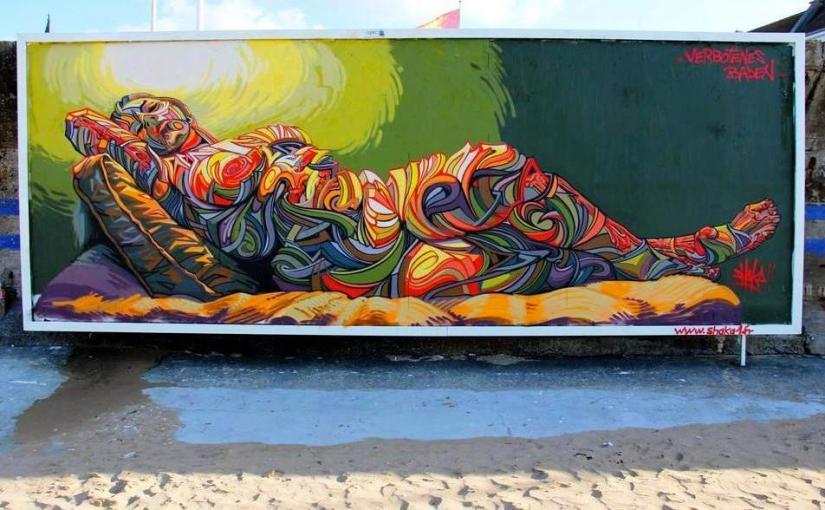
colour by SHAKA

From the author: “Adolescence is the time when our ideals of beauty are explored most thoroughly. As we grow, we learn about ourselves through our parents, our friends, and through what we see in the media.

Often, though, we are our own worst critics—what we see in the mirror is far more flawed than what our friends might see when they look at us.

Each of us are made up of many colours, and once we begin to accept our uniqueness, we can rest as confidently as this figure sprawled upon her couch.”

Support our live art event! 

On memory: “self and other”

image

Despondent at the sight of her, waxing caramel and silk, bruising blue from apathy. Who it is I am looking for in the shape of her, the curve and weight of her bones. The scrutiny of this survey has everything to do with consumption. Mass of flesh, scent of jasmine, soap, talcum powder.

I become suddenly thirsty and my legs fold in like a hand. From every angle calls some small adjustment, something not quite in place, not quite concealed. I remember the shirts I wore in highschool, carefully selected from your laundry pile and big enough for my body to move beneath them unnoticed.

Meanwhile she moved with such a lightness I had never been empty enough to feel, spread her toes across the bathroom counter smoothing lotion into her calves; she had six children for the institutions of God and marriage. What I saw for the sake of this story was the width of her waist on an inhale, saw her spinning across the living room floor. She praised my poetry then stopped calling altogether.

Of course I never expected she would, and this is not really about her, or the blue light of my new apartment where no one eats and everything is covered with a film of dust and the smell of smoke. I blink into the mirror and take a sip from a white, enamel cup stained with her lipstick. I know that I will see her in the kitchen and she will have cut her hair again. She will be quietly frantic, pouring cream in her coffee and letting the filter drip. The garbage can is full of dust and the ends of her cigarettes stained with lipstick.

If the weight of my bones were a little less dense. If I did not bruise under the touch of her fingertips. I could step into this room unfeeling, dressed in animal prints and steel, chewing a stick of gum.

word by Alisha Mascarenhas
colour by Gan Chin Lee 

Job opening: Head Of Colour

cropped-wqwww1.jpg

Job opening: Head of Colour

Word and Colour

Reports to Editor

The Art Director will curate the art for upcoming features at the magazine. After contacting artists, the Art Director will inform the Editor of upcoming features with all required information. Certain events in Montréal may require the attendance of the editor to represent our brand, and the Editor may also select artists to feature.

*An awareness or openness to social justice politics is essential as a representative of the Word and Colour brand. Word and Colour is a creative Non-Profit Organization of volunteers. This position will be paid when revenue streams are implemented according to workload, and requires minimal hours of commitment.

Our Ideal Candidate:

Reliable, organized, proactive

Education / Experience with visual art

Knowledge of social justice issues

Responsibilities:

Contacts artists for weekly features

Represents Word and Colour at art events

Responds to e-mail within the day

Is available for monthly meetings in Montréal


Please read over our mission statement before applying!

Application deadline:  Friday, May 1, 2015

Send CV to word@wordandcolour.com

Le théâtre des opprimés

10968503_1590582171177990_5645835069203416747_n

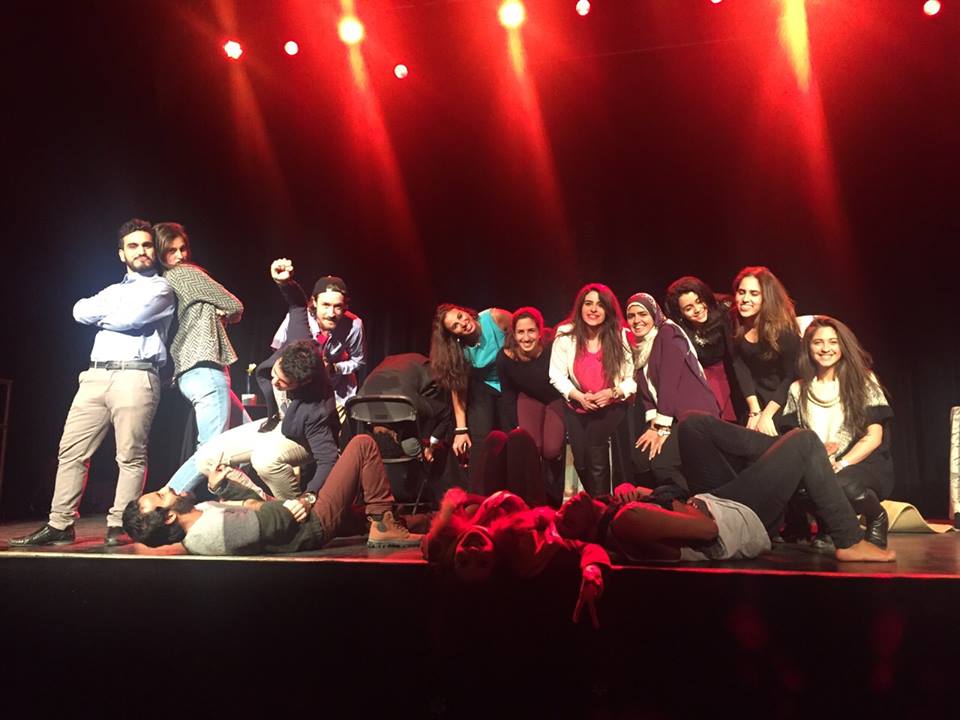
Le théâtre des opprimés, présenté par l’association des étudiants arabes (ASA), est un spectacle en deux actes ayant la fonction de poser d’importantes questions sur les rapports entourant l’oppression – sans toute fois prétendre avoir des réponses. Le spectacle mets en scène oppresseurs et opprimés et vers la fin de la représentation, des spectateurs sont invités à recréer des scènes en tentant d’améliorer le sort des personnages opprimés.

Cette technique interactive – développée en 1971 par l’activiste Augusto Boal – mis de la fébrilité dans l’air, le public ayant eu l’impression que ses interventions pouvaient avoir un fort impact sur la manière d’aborder le rôle des genres dans la famille, du profilage racial ou du harcèlement public au coeur des scènes.

Les membres du public trouvèrent de nouvelles façons d’interpréter les scènes du point de vue des opprimés sans toutefois changer radicalement les traitements prodigués par les oppresseurs. Les harceleurs publics continuèrent d’harceler leurs victimes malgré les réponses renouvelées de ces dernières et un officier de police qu’on confronta à la présence possible de motifs raciaux derrière l’exécution de sa fouille répondit:

“Et alors?”

11081047_1608204596082414_887284934734218877_n

La décision de l’Association des étudiants arabes de rendre chaque personnage multiple est intéressante. Tous tentent vivement de trouver la paix tant dans leur vie privée que leur vie en société, mais n’y arrivent pas toujours. Ce qui pose plusieurs questions: est-ce que l’oppression entoure seulement l’existence des oppressés mêmes ou en sommes-nous socialisés pour en être tous porteurs?

Comment réduire la souffrance lors de situations oppressantes lorsque l’oppresseur semble insensible aux appels de l’opprimé?

Bien que le rôle du Théâtre des opprimés n’était pas d’apporter des réponses concrètes, l’expérience qui se veut une opportunité d’humaniser l’humanité a su soulever des questions majeures.  L’association fait du travail important à Montréal et nous attendons leur prochain événement avec impatience.

Laurence Dauphinais – Montréal

click here for English