Notes on Hesitation

350dpi009

The birds in my neighbourhood are having an existential crisis. They’re hesitating on their branches, resting for a moment longer than they should. Even when I scream and stomp my feet at the foot of the tree, they stand there, thinking about whether or not to fly away, wondering if it even matters.

              I learned the term “existential crisis” from my English teacher because we’re reading The Stranger by Albert Camus. I’m in this advanced class where everything is so deep. I love it. Anyway, the birds, right? I think I noticed it before I learned the word—is that possible? Can you notice something subtle like that and then learn the word for it, or is it kind of invisible until you can name it? I guess it doesn’t matter—the point is I’ve learned it and I can’t unlearn it.

              It’s weird because I was pretty sure flying was autonomic. That’s another word I learned recently—it means things you do without thinking. The fight or flight instinct, for example. You feel it in your body and you’re off. Thinking is a problem. It interrupts the things you need to do to survive. Like, imagine if you had to decide to take every breath—you’d die.

              I kind of know how the birds feel. Lately, when things get confusing, I slow down and get stuck in my thoughts. I can’t even choose between flavours of ice cream anymore—I just stand there at the 7-11 with the cooler door open, breathing in Freon-tasting air. When my mom yells, I used to go hide right away. Now, I just sit there thinking about what to do. Half the time, I end up doing nothing at all, and that just makes her angrier.

              The other day, she was yelling because I’d forgotten to let the cat in before we all went to bed. She said she thought the cat was probably dead. She asked me for the millionth time why I was so stupid. I snapped and yelled at her to fuck off. I’d never done that before—it just bubbled up from inside. I guess that’s the fight part of fight or flight, huh?

              But the problem with things that you just do without thinking is that you don’t know what’s going to happen next. I think she was as surprised as I was when she slapped me across the face. Her eyes got really big, and we just stared at each other. We’re the same height now, I realized. Then she was gone, up the stairs to her room. I guess it was her turn to hide. Once you’ve learned something you can’t unlearn it, especially about yourself. My poor mom. Maybe that’s when I started slowing down like the birds, sinking into my thoughts all tangled like yarn. I worry for the birds. I think someday something terrible will happen to them.

 these words by Erika Thorkelson were inspired by the colour of Juan Travieso

New prose by Josh Elyea, “Pulp Influence”

7248.jpg

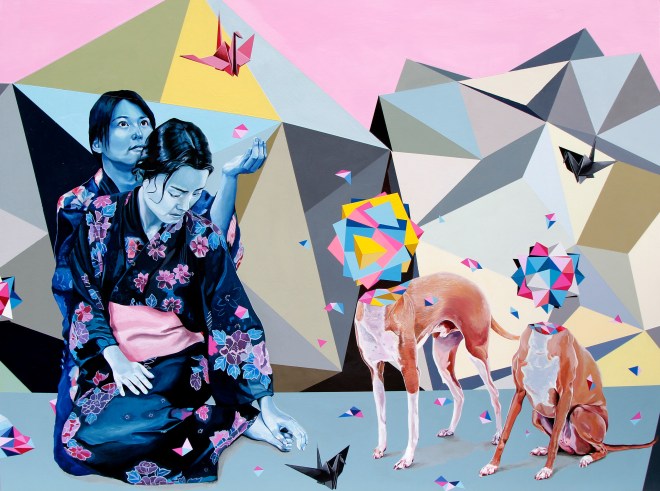
            I keep having this dream where I’m two-dimensional. This dream isn’t a nightmare, but I still wake up feeling as though I’ve lost something.  Like I’m lacking in substance, as it were. Dimensionally challenged.

            Paper cranes fall slowly from the sky, and I can taste cherry blossoms (and verbs) on my tongue. I wander through this paper forest, aimless, wondering if there’s any other type of wandering. There are characters scrawled across the trunks of the trees, messages left in languages I don’t understand. Trumpets sound as I see words I recognize, hc svnt dracones. That’s not foreboding, not one bit.

            What little light the moon emits slinks down through the treetops, leaving deep pools of shadow that shift when I look up or down. When you’re made of paper, there is no side to side. Impossible to keep a sharp eye for the monsters that undoubtedly permeate these pre-mulched maples.

            I get more and more lost as I ponder the potential for dragons. It’d be easy to lose oneself in the black of the forest. It’ll eat you up, noir. Between the paper and the concentrated instances of darkness, there’s a real pulp influence here, I say, maybe out loud (maybe not). What I’m noticing though, now that I’m paying attention, is the ways in which the darkness is growing, expanding, in spite of the moonlight. Tendrils of black extend outward as my person begins to shake, and at that moment it’s almost as though I’d prefer the monsters. There’s something tangible about a mummy or a hellhound, and it’s a well-known if little thought of caveat of life that damages to the corporeal are far preferable to those of a more ethereal nature. That’s what so devious about the dark; it doesn’t really harm you at all.

            And it’s a silly thing to fear the dark, really. But we all do it anyways.

this prose by Josh Elyea

this prose by Josh Elyea, “Pulp Influence,”

was inspired by Juan Travieso‘s “Nightmare in a Dream”

on Nikoladze’s video: “Filling the Glass”

12:20pm

The glass stands tall. Still. Sure. A foil to the thundering chaos in your mind—crash. A few straggling fingers of feeble winter sun clamber through the window, bouncing delicately off the clear vessel. It is entirely transparent, down to the liquid within. Pure.


I.

12:22pm

A resigned hand stretches toward the glass, slipping effortlessly into an old action so long suppressed. Soft fingertips alight on flawless glass—how is it that the union of such smooth surfaces ends in such a crash?

1:37pm

You roll your head back. It lands heavily on the scratchy couch cushion. Your eyes are trained on the ceiling above, pocked with all sorts of nicks and notches. They’re multiplying as you watch, so you shut your eyes, allowing the third glass’s contents to trickle through your thoughts unimpeded. The sadness comes in crashing waves—you will the drink to hasten the ebb of the tide.

3:40pm

The slam of the front door tears you unceremoniously from a fitful doze. Your head swims thickly. The sea hasn’t ebbed; it’s just become murkier. You can no longer see the sand beneath. That used to be comforting—now it only adds to the chaos.

The sun is disappearing now, and none of its final rays manage to cross the threshold of the window. The glass looks different now, empty in the early wintertime twilight. Small. Weak.

You struggle to pull it all together—your disobedient limbs, your weak eyes and lips—to muster up an impression of control. But before you manage to focus your sight and orchestrate a warm smile, he’s already shutting the door to his bedroom. The only sign that he was there is the mail strewn on the doormat.

A new wave wells up, merciless, fueled by whatever placidity you mustered while you slept. You feel its crash resonate through every part of you. You fill the glass again.


II.

3:34pm

His tread is mechanical. His body could walk him home blindfolded. Music is playing loudly into his ears as he turns the corner onto his block, backpack swinging from one shoulder.

3:38pm

His hand reaches into the mailbox and meets several envelopes. He doesn’t have to look to know they’re bills, warnings, notices. His jaw tightens.

3:40pm

It smells like home: air freshener and gin, one a pathetic attempt to mask the other.

A drunken pile of limbs on the couch. Unsurprising. He drops the mail where he stands and shuts the door with a crash, much harder than necessary. He’s done being sympathetic.

much harder than necessary.

words by Kate Shaw, “Filling the Glass,” were inspired by Koka Nikoladze‘s “INFINITELY SUSTAINED GLASS BREAKING WITH GRANULAR SYNTHESIS” (shown above)

From the author: “Recording glass breaks creates the sensation of a process of shattering that doesn’t end. It defies time, moving backwards and forwards, generating a feeling of chaos that can’t be controlled. That feeling of a lack of agency in a situation spinning out of control spoke to me of alcoholism at its true root. The belief that there is agency in a case of alcoholism—depicted here by the son of an alcoholic parent figure—plays into a dangerous stereotype that allows alcoholics to be blamed for their “choices” instead of helped to overcome their addiction.”

new prose, inspired by sound: “The Trill”

Content Note/ Trigger Warning: Sexual assault, rape culture

They were jittering parallel, his leg and hers. They faced away from each other, tapping in terrified Morse code against the legs of the bed between them. He was shrinking and she was expanding. He was supposed to be the downbeat and she, the trill.

She recalled how his fingers had played her strings. How there was something so excruciatingly offbeat in the way that he’d sped up. He said he liked that sound; she said nothing. There was the pounding of their hearts and the curls of her hair. His hips were rhythmic. She counted to ten, holding onto nothing until he was empty and she was supposed to feel full.

She was his echo, the drum he hit against, a projection of his voice, and she convinced herself to feel empowered to exist solely in the glory of his smile. Too soon it became automatic: a euphoric cacophony of springs and curls.

In the climax, one of her strings snapped. She cried out, he froze. It was unlike her, he thought. She never asked to be hit, she thought. She removed herself from him, shaking, and perched on the edge of the bed.

words, “The Trill,” were written by Annie Rubin: “Koka’s electronic creation made automatic the emotive experience of producing music. This new system, mechanical and intricate, represents a structure of oppression we perpetuate through unawareness or indifference: one in which women are left voiceless and unquestioning. The moment of escape occurs when the woman rejects her role as a void (Cixous) and gains agency through expression.”

the colour and inspiration for Rubin’s work was inspired by Koka Nikoladze’s sound project, 

“Beat Machine No. 2”

On Past Lovers: “An Inability to Orgasm”

This story contains references to sexual assault

Danish Croissant, Mi Ju.jpg

For every man and woman I’ve been sexual with:

  • First boyfriend, first kiss; I evaded a first fuck.
    You touched me in places I didn’t want touching:
    The first man to teach me that my body is not really mine.

    “An Inability to Orgasm”

  • You were much older, and we were in the backseat of your car.
    I took my clothes off
    You were trying to rebound from a break-up. I was trying to prove something.
    “An Inability to Orgasm”
  • We kissed for the first time on my 18th
    Our lips touched, and I instantly recoiled
    We dated for four years. I never orgasmed.
    “An Inability to Orgasm”
  • Your lips felt tender until your strength became aggressive,
    violent
    I trusted you and you sexually assaulted me.
    “An Inability to Orgasm”
  • I felt comfort in your arms.
    I love you for accepting me, damaged goods and all
    I hate you for damaging me further, for throwing me to the curb like garbage.
    “An Inability to Orgasm”
  • The sensuality of your body brought me to the closest I’ve ever been to ecstasy.
    Thank you
    for the almost orgasm.
    “An Inability to Orgasm”
  • The wetness coming out of you made the lips of your vagina stick together.
    You wanted to see me again; I treated you the way men treat me
    I’m sorry for not calling back. 
  • Feminist politics, patriarchal sex.
    You came; our sexual tango ended
    I’ve still never reached orgasm.


word, “An Inability to Orgasm,” submitted by an anonymous writer, 

was influenced by A Haiku for Every Girl I’ve Ever Slept With

colour, “Danish Croissant,” by Mi Ju

Flash fiction: “Circadian”

blue-sheep-mi-ju

[sɜːrˈkeɪdiən]

            [Kyoto, Japan. Mid-Fall, 2007. Leather jacket, jeans, black t-shirt. Dusk, that time of day when there’s enough sunset left to appreciate, but not so much as to dissuade folk from turning on their lanterns.]

            I’m lying by the river when somewhere, far off and faint, a violin begins to play. It takes me longer than it should to realize it’s an old Ella Fitzgerald tune, but my brain gets there when the progression gets to the D minor [the one right before the chorus]. It’s an odd thing, the chemical reaction that occurs when a well-arpeggiated minor chord rings out against the harshly crisp air that always seems to accompany autumn; something about minor thirds and fallen leaves, I suppose.

            I’ve been counting sheep and counting shots, tallying up missed hours of sleep and ingested cubic millilitres of saki. It’s little wonder why life feels more manageable from a horizontal position; Japanese businessmen can put them away, and jet lag is a bitch. Chords warble along the breeze, A-flat into F minor into G7.  Dream a Little Dream of Me, that’s the song. She sings it with Louis Armstrong, Ella does. The violinist has finished now, and he/she has either packed it up or wandered off, since there’s no more music to be had. In its place there’s only the gentle hum of the city and the delicate chatter of the two young travellers splayed out on a picnic blanket to my right, just within earshot. She’s talking about a band she likes; yeah, but they’re no Zeppelin, he says.

            The houses, set on stilts, glow brightly in the evening fog, and with so much texture to the air it’s as though you could reach out and touch the part of the universe where the neon lights rub up against the dark. The lanterns that hang from the eaves of the buildings are pleasantly old-fashioned, and something in their flickering helps with my sense of calm.

            The grass beneath me is wet between my fingers, and I try and think of the last time it rained. Kyoto is beautiful in the rain, on those days when the damp and the chill slow the normally mad city down just enough to remind you how ancient it really is. Some dream of history, others drink it in. Me, I just want to fall into the heartbeat of the place, let the old circadian cadence put to rest most all of the unsavory distractions that pester the soul on the daily.

            The violin begins again, but this time I don’t recognize the melody. 

words, “Circadian,” by Josh Elyea

colour, “Blue Sheep,” by Mi Ju

More Interesting Things


lemon-bear-mi-ju

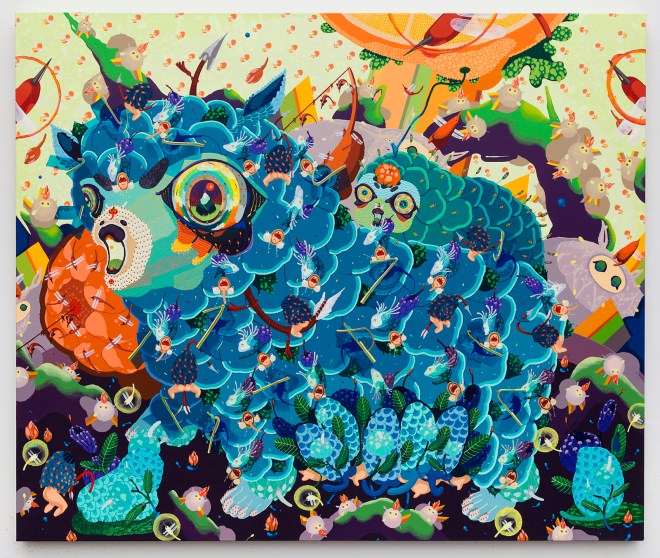
The bottoms of the little creature’s feet were rough, as if they were covered in the tips of hazelnut shells. This was a thing it didn’t much like about itself. If it could have gotten some kind of procedure to fix its feet—surgery, maybe, or even something more temporary like a medical pedicure—it would have done it, but it wasn’t sure that it had time or money and besides, it didn’t even know if such a thing existed. Sometimes, just as it was about to fall asleep, the creature would feel the skin on the soles of its feet catch against the smoothness of its bed sheets (especially if the sheets had just been laundered), and it would wince.

Today, the creature was hurrying to work. As it scurried down the sidewalk, the petals on its back fluttered in the wind. The delicate, podlike lashes around its wide eyes blinked, keeping the debris of the city out of its face. The creature was carrying a stack of important documents. It wore a backpack and a satchel and was almost indistinguishable underneath it all—it must have looked, to passersby, like a worried fire hydrant. It didn’t wear much of anything, being covered in bright, yellow feathers (unlike poor, naked humans) but it wore a pair of dress shoes to the office—not because of its horny soles, but because it was afraid of the condensed exhaust and glass dust on the streets around its place of business. These dress shoes protruded from the bottom of the moving stack of bags, papers, and glittery fluff that was the little creature.

Rounding a corner, the creature caught a man staring at it. It was aware of its unusual appearance—how could it not be—but sometimes, it also caught people staring deeply into its eyes, which were a swirling, flaming mash of reds, like the palette of an indecisive stop sign. When the creature looked deeply into another person’s eyes, it could see an awe and an uneasiness there that made it think that it might be more powerful than it itself suspected. It wondered what this power could do. Sometimes it felt that, being an extraordinary creature, it should be trying to do more interesting things with its life. It knew, at the very least, that it should be asking for a raise.

The creature was so distracted by the staring man and its own racing thoughts that it didn’t see the bicycle coming around the corner. It was knocked onto its back, violently. Its papers were scattered through the intersection. As it went flying inconveniently through the air, it heard a small child on the sidewalk yell, “Mommy, what is it?” As it landed, it heard the cyclist yell, “Oh shit!” It could see the reds of its own eyes. It hoped to God it didn’t die before it had the chance to do something about its feet.   

word “More Interesting Things,” by Charlotte Joyce Kidd

colour, “Lemon Bear,” by Mi Ju

following the toy

badiu 7

As Anne watches the toy spin slowly in the microwave, she thinks about where she and Augie will go. We could go to Vancouver, she thinks. Walk in Stanley Park and sit by the water. She’d been to Vancouver once, before she got married. She watches the toy spin and thinks about the ocean.

*

Their first night at the shelter, Anne woke up wet, Augie pressed into her side. “It’s too dark,” he said. They got up and Anne changed the sheets. She took the toy out of the backpack—it was one of only a couple Augie had been able to bring—and he clutched it to his chest as he fell asleep. Steven had given him the toy, not for a birthday or for Christmas; he just came home with it one day. It had been a good day.

The next morning, she found the tracker in her purse, in one of the side pockets she never opens. It was small, a little bigger than a dollar coin. Steven has touched this, she thought. He bought this little thing and turned it over in his hands and slipped it into her purse when she wasn’t there. She dropped it on the ground and smashed it with the heel of her shoe. She heard it crack, felt it flatten beneath her. She experienced a moment of relief before the panic—if there’s one, there will be others, she thought.

She dreams about the toy, but it looks different than it does in real life. She wakes up wet, with sweat in all the places. Augie is fast asleep beside her, a baby bird in a nest. She sees the toy in his arms and tries to think of how it looked in the dream, but all she can remember is that it wasn’t the same. And that’s the terrifying thing.

*

The fire isn’t huge, but it’s a fire. She thinks about how upset Augie will be. She’ll come up with an excuse. We’ll have to leave again, she thinks. The microwave sits on a wooden table, which is turning black as the flames eat. The microwave door hangs loose on a hinge. We’ll always be leaving, she thinks.

these words by Leah Mol were inspired by the colour of Teodoru Badiu

Love, left

badiu 6

Missed connections. Failed romances. Lost loved ones.

I’ve known too many people who’ve left.

Too many people who have been reduced to nothing but incoherent memories.

I have loved—deeply, intensely, purely;

these loves are now strangers.

the many faces we wear

these words by Fiona Williams were inspired by the colour of Teodoru Badiu

The Accordionist

badiu

            This is the memory: the grandfather sits in a chair in the kitchen, accordion on knee. He shuts his eyes and squeezes the instrument. A foot makes a beat. A crescendo fills the room, reaching for a climax that is always somewhere else. The floors shutter, the foot beats wilder. It is a miracle the chair does not break, that pictures do not fall from their hooks. Around the kitchen people dance and sway and laugh drunken laughs as the old man’s fingers dance an automatic dance upon the keys.

But in the grandson’s memory there is no music. Only a wheezing of air: the accordion desperate for breath, a gasping animal in his grandfather’s hands. Because he can never remember the music, he wonders if his grandfather ever really played the instrument—but the details are clear: the way the floor shook, the way the old man raised his knee, and the way he squeezed his eyes so tight that the unheard music became a thing extracted from the instrument’s wood, leather, and metal. Like a splinter squeezed from a finger. It is the very lucidity of the image that makes him doubt his recollection.

            But that is the memory and this day is the present. And on this day the accordion rests next to the deep freeze, already aware of its ascent into that magical category of things-once-owned-by-people-now-dead. This day: two days after the grandfather’s death. The same house, located at the end of Vicky’s Close, named by the grandfather in memory of his mother. The dead remembering the dead.

            The grandmother sits in the kitchen and the shadows of people enter and depart, wishing her well, bringing her food, offering condolences like cheese on a platter. She clutches a cane with knobby hands. She is 92 and she will be dead in eight months. She is thinking about the price of bread at the Co-Op, the way shadows have their own moods, and how violent men seem to love their mothers so.

            And the grandson thinks about how violence expresses itself in the most mundane of actions. He thinks of how when he was young he sat in the chestnut tree outside and watched his grandfather close the curtains and turn all the taps on so that from outside the house rumbled with the gushing of water through pipes, concealing the echoing thud of belt against skin, a sound innocently mistaken for the swatting of flies. Later he will associate running faucets and the shadows of mid-afternoon with his grandmother’s bloodshot eyes and tension-stooped back. Blood and screams and broken bodies are banal compared to a tap left running, to an elongation of shadow on a kitchen floor.

            The grandmother stares at the accordion and at the grandson and they both wonder if any music ever came from that instrument or if it really was just a wheezing, gasping bag all along. She thinks about a previous self, one vaguely resembling her own, and a black pit of seven decades opens up between that self and this one. She gasps and her face crumples and this loss of control lasts for two and a half seconds, but it is long enough for the shadows to notice. They think she is missing him and they offer more embraces.

            ‘Open the curtains,’ she says, ‘It’s a shame to waste such light.’

these words by Michael Warford were inspired by the colour of Teodoru Badiu