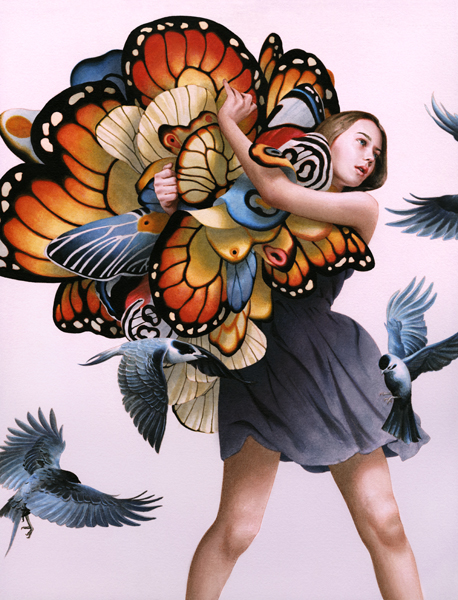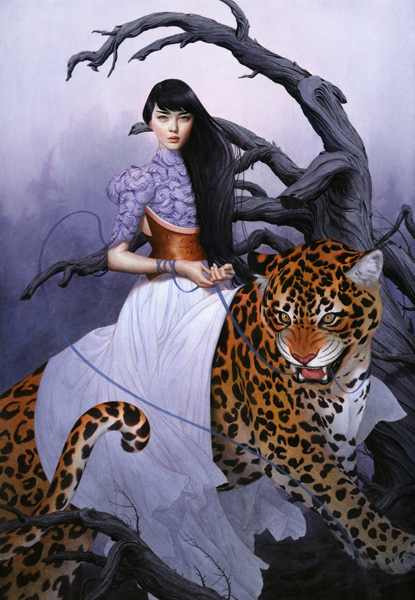
on self-harm: “other bodies”

owen gent 5

TW: Self-harm

The feeling that precedes it is a quiet panic: the sense that she is not feeling enough, or feeling too much the wrong way.

Safety pins and tacks do the job sometimes. The marks they leave are an irritated red. They heal like cat scratches, but too straight to fit the lie. It takes a lot of pressure to draw blood.

Sometimes, she can stave off the urge with the drag of her thumbnail down her forearm, or the center of her throat. This leaves a mark, too, but it’s faint enough that people don’t ask.

Sometimes other people’s bodies will do the job. His fingers are clumsy, floundering. She wakes up in a panic the next morning when she remembers what she’s done but not what his name is. She regains the knowledge via text from a friend: Hudson, like the Bay.

His fingers are slick when he enters her. He puts them in his mouth and sucks on them first, maintaining eye contact the entire time. His fingers jab into her in the general direction of where they both assume her g-spot is. They are rigid and insistent, maintaining the ruthless pace of a second-hand jackhammer.

Metal is different. When she uses scissors — knives and razors seem too dangerous — she expects to see the flesh part red and wet, revealing complex patterns inside, like a pomegranate, or the little teardrops inside an orange slice.

(She looks them up later: they are called vesicles. She repeats the word to herself: vesicles.)

Instead, there is just blood. Not a lot of blood. She thinks there are some major veins on the inside of your thighs or something; she keeps this in mind when she drags the scissor blade over the muscle there, flinching. The metal is not the problem: it is her own wavering grip, too afraid to push too deep, of blooming more pain than she’s bargained for. She knows people have cut through muscles down to the bone. She knows people who have ended up in the hospital for it. She knows she is supposed to feel comforted that she’s not part of this dysfunctional elite, but mostly the knowledge makes her feel like she’s not trying hard enough.

She tries to keep them even in length and depth. They never are. The blood pools in straight lines. She wipes it away; it blossoms again, a thin line interrupted by sluggish beads, a delicate filament made of nothing but her.

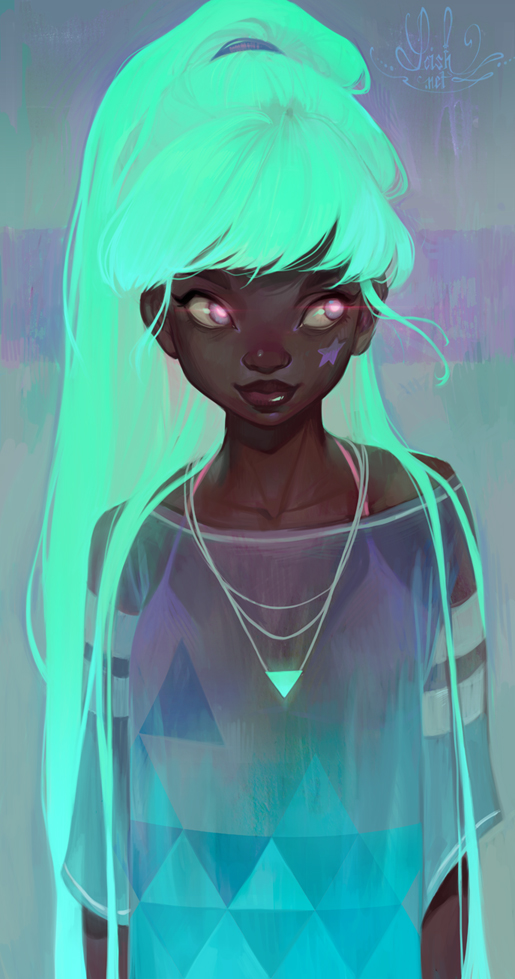
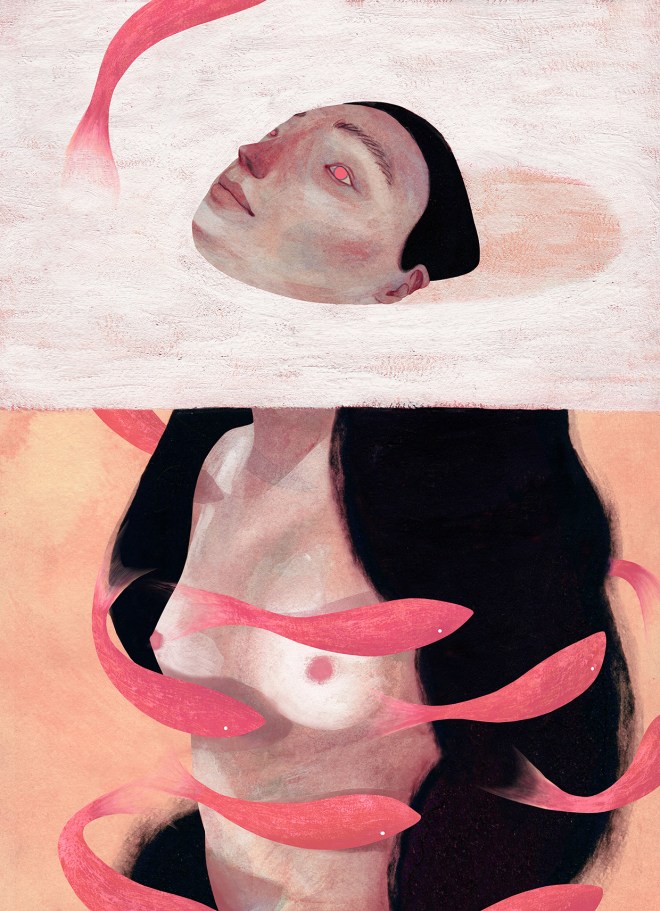
When she was little, she always ran her baths too hot. She would sit on the edge, naked flesh pricked with goosebumps, running cold water in and stirring it, flinching at the hot current that made her hand flush. She acclimatized to heat in increments, trained herself over time to embrace water that makes her feel raw all over, makes her body breathe plumes of steam when she rises.

these words by Caitlyn Spencer were inspired by the colour of Owen Gent 


Countdown to flight


tran nguyen 2

  1. Nineteen thirty-seven was Icarus in seamed stockings. My grandmother spent nights praying for the blanched bones of Amelia Earhart, femur and sacrum floating somewhere in a blackened sea. Gravity could kill a gal. Now, Google tells me that my fear of flying is an inherited nervousness, a bred-in-the-bone type of thing.
  1. WebMD prescribes knowledge. I learn about Harriet Quimby and Queen Bessie Coleman, early female pilots. Dead in their thirties, cockpits exploding without warning. I imagine a lone parachute floating out of the wreckage, silken and monarch-like in the sky.
  1. In the garden, Sasha tells me she is happy I get some time off. She makes it sound like a vacation, but I am obligated to fly. When she asks me what’s wrong I can only water the plants. People are so comfortable on planes they’ve made a whole club out of fucking miles-high. I am ashamed of my ridiculousness. But later, I tell her the truth when we are wrist-deep in the earth.
  1. “Fear of flying,” the webpage psychologist writes, “is a couched fear of relinquishing control.” As if letting go of all that bodily warning is easy. I read about aerodynamics, the structure of Boeing 747s, the years of pilots’ training. It isn’t enough. And I caution myself against equating education with trustworthiness.
  1. I read the article about the flight attendant and the pilot. How he’ll only be criminally charged if he returns to the island where he attacked her: palm trees, hotel layover, her heels kicking frantically into his flesh. I picture her dressing in the company’s colours, returning to the cabin, repeating the spiel about emergency exits as the earth gives way.
  1. It is still so far away, and then it is tomorrow. The night before, I dream of the ghost of my grandmother, her body bruised in a sea of crushed metal, a sea of blue birds and  bones. I dream of ghostly women plied open, their organs airborne. I dream of dangerous engines, a lathe of waves, winglessness.
  1. I stand in line at midnight, clutching my passport. The red-eye was cheapest. Sasha has loaned me her gray silk dress, and this alone keeps me calm: the fabric extravagant against my skin and the faint familiar smell of her, soil and strawberry leaves. This dress, her shared self, deserves to fly. If I plummet to death in a fiery crash, I tell myself, at least I will go out in style.
  1. On the plane, I have a window seat. It is dark and plotted evenly, like a little grave.

The man beside me asks, “Business or pleasure?” When I don’t reply, he laughs and   tells me I need to relax. I don’t know how to relax, so I open the in-flight magazine. I   hope this is a good way to end a conversation.

  1. A woman puckers her lips from the pages. She is surrounded by feathers and the engine underneath me starts shaking. “You’re a very interesting, mysterious girl,” the man continues, but his words are liquified by the engine’s shuddering so I can only hear  — you’re a girl. Then we are moving and it is all really happening so fast.
  1. This is the feeling of surrendering your centre of gravity. As I watch the city shrink beneath me I feel my body become weightless and irrelevant, strapped into an altitude I can’t adjust. I am only anchored by the things I’ve buried, all the things other women have carefully buried inside me. In my mouth, vomit blossoms like a flower.


these words by Sarah Christina Brown were inspired by the art of Tran Nguyen

On Kink Dynamics: “Holding the reins”

tran nguyen 3

My lower vertebrae clutch and seize in towards centre, bringing my back to sway, chest thrown open. The muscles along my inner thighs grip, and I sense your body surge under me, releasing. That familiar flush of lavender spreads across the temples: I enter the state that lets me unleash my strength on you. This armour is a lie, but it is mine. The taste of metal in my mouth as I plunge into the folds of your body shields me and offers resilience. I do want to reveal myself to you, but slowly.

First, I want you to want me. Tell me over and over how good it is, how nobody has understood your body like I do. I shut my eyes out and feel you. It is not calculated, it is how I have learned to protect myself. I still don’t know how to ask for precisely what I want, while your desire is bare under me.

What I don’t tell you is how much I need this: not just to please you. I am not that generous. Your moans awaken a power in me that I cannot access alone.

The thought of you is not enough: I need to have you breathing against my skin, to feel your heat, to hear you say Please. I am not just doing this for you.

You tell me not to ask permission and I take this in, swallow it, find other ways of asking. I watch the arch of your back, listen for the depth of your breath, testing.

The lift of your pelvis instructs my mouth to move and you tell me not to be careful. You sense my fear and I say, Yes, because we are treading a thin edge. The structure slips, you taste my tears on your face, wrap my limbs around yours. Still trembling I gather strength and move into you. Each tug elicits the sound of more, the scrape of your claws on my thighs, your pulse beneath my teeth.

We catch each other over and over again.


These words by Alisha Mascarenhas were inspired by the art by Tran Nguyen,

and are also a response to Xan West’s “I’m not just doing it for you” 

From the author: “I wrote this in response to Xan West’s article on myths about “topping” in kink dynamics. West’s piece suggests some of the ways in which tops/dominants tend to be seen as selflessly offering an experience to bottoms/submissives, obfuscating the top’s own pleasures and desires. The physicality of Tran Nguyen’s piece evoked a sense of mutuality within an image that might presuppose power being held by the person holding the reins. I must be dead clear that I am not likening bottoms to animals being ridden (which would further exacerbate existing dichotomies between masculine/feminine and civilized/savage). I am, rather, drawing from the implicit, dynamic power relationship and vulnerabilities being represented through this visual.”


On Running Away: “Jack-o’-lantern”

SW 4

        Big city at last. Buildings, cement, a few trees. Some birds tweeting the fall of dusk. I’d hitched in. Now what? I must have had a lost look on my face because a van pulled up and drove alongside me, matching my pace.

         “Hello there!” called the driver.

         “Hi,” I said.

          He stopped the car and got out. Introduced himself as Norbert.

         “What’s your take on the problems of this country?” he said.

         “I don’t know,” I said.

         “Feel like talking about it?” he said.

         “Sure.”

         “Feel like having a free dinner?” he said.

         “Alright,” I said. He opened the back of the van. There was a young woman in there.

         “That’s Sarah,” Norbert said. I got in. Norbert shut the doors and the van took off. 

        I talked with Sarah. Another runaway picked up off the street. Where the hell were we going? Can’t be any worse than where we came from, we both laughed. She took my hand in hers as we bumped along.

         The van came to a stop. Norbert opened the back. I heard cicadas.

        “Come on, you two,” said. Sarah pulled up her tights and we followed him onto some sprawling estate and into a red brick country home. The cooking aromas were scintillating. I had not eaten all day.

        “Help yourselves,” he said. “After that we’ll have a little presentation.”

        The food was laid out buffet style in the dining area. Stacks of clean plates, plastic cups, a pitcher of water with lemon slices in it. There were six or seven dishes to choose from. Some other young people joined us. They were all quiet and respectful. The food was vegetarian, cooked to perfection, completely satisfying.

      “We’ll begin the presentation whenever you’re ready,” said Norbert. There were about ten cheap plastic chairs unfolded in the salon, but only Sarah and I sat. It was a slideshow. Norbert used a pointer as he clicked from slide to slide. The world was in crisis, he said. It was up to us to fix it.

        I raised my hand. “Is this a cult?” I said. Not that I really minded if it was.

        Norbert laughed. “We are called a cult by the mainstream. But we think the mainstream is a cult.”

       In my mind’s eye I saw a generic house, some generic suburbs. The home I’d bolted from. The home my father came to at dusk, exhausted, complaining. Ugly mood. Hating his job, his colleagues, his family. Yet, judging the fools who did not live their lives as he did.

       Good Riddance, he’d have said Mom. The only way we let her back is if she cries and begs and apologizes. Otherwise she does not set foot in this house again. Is that clear? 

         Mom would nod, her head down, hands folded, like a statue.

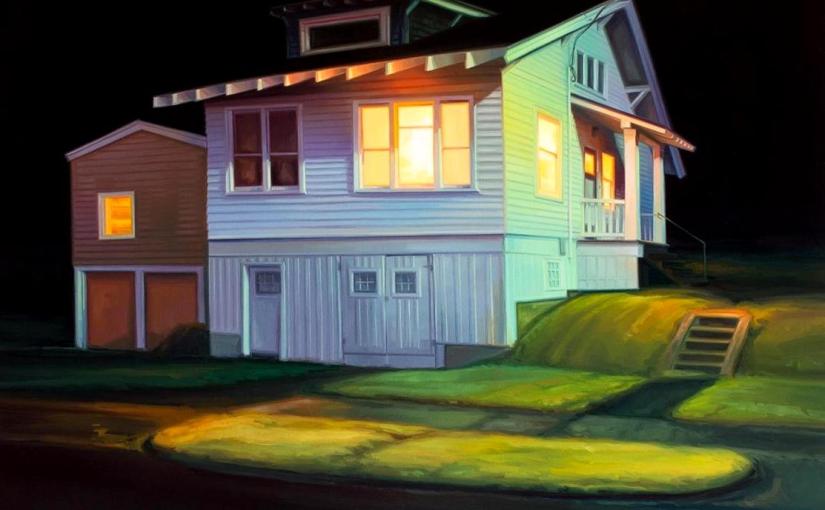
       He’d sleep. She would not. The light would be on all night. The house like a Jack-o’-lantern. My mother at the kitchen table, begging me to call, to let her talk to me one last time, so she could beg me to grovel before the old man like she did.

these words by Alden Chorush were inspired by the colour of Sarah Williams

these words by Alden Chorush were inspired by the colour of Sarah Williams


On Male Entitlement: “Water”

SW 2

In the southern suburbs of Manhattan you’ll find these immense water towers. They hover above the rest of the city, providing high-pressure to showers and sinks across the Island with water that, allegedly, contains high levels of estrogen, but as anyone on the North Shore will tell you, there’s a filter for that.

It’s winter; one of those nights the snow is frozen solid to the ground and darkness spreads across the city at 4pm. We’re all inside Murphy’s—the place you find yourself when you get out of work late and you’re too tired to stay in The City. It’s a full house tonight; there’s this Guthrie-esque musician, he’s playing something John Mayer and we sway either because it’s nostalgic or from too much mulled wine.

Sylvie and I are plotting the matriarchy when Ben approaches. He’s tall, got this shaggy yellow hair and the forming of a goatee. He takes a seat, Budweiser in hand.

“How’s life treating ya, gals?” It’s been two years. He’s aged but in a sad way.

“What have you been up to?” I ask him.

“Been working lights at Rosie’s.”

“Any good shows this season?”

He scoffed. “Oklahoma again.”

“Cheers to that,” we drain our glasses together, old times, and Sylvie goes to the bar for another round. Ben turns to me, tilting his head in her direction.

“Damn, is she seeing anyone?” I can’t help but smile.

“Yeah, we’re together.” Beat. He snaps his head towards me.

“What? Like, you two?”

“Mhmm.”

“Is that even…possible?”

“It sure is.”

He considers it, takes a swig. “I could be into that, I guess.”

No one fucking asked you, Ben.

Sylvie comes back with two beers. I wrap my arm around her waist to make my point. Ben can’t decide if he’s disgusted or turned on.

“Whose place are we going to?” He asks. Sylvie shrugs. It’s like this: they always feel entitled to a space in your bed.

***

These words by Annie Rubin were inspired by the colour of Sarah Williams 


On the Invisibility of Mental Illness

0373312716084.560145db8a3cf

“When Surviving Is Too Difficult”

They say that genius and madness are two sides of the same coin.

Well, my genius is elusive—I am descending into madness.

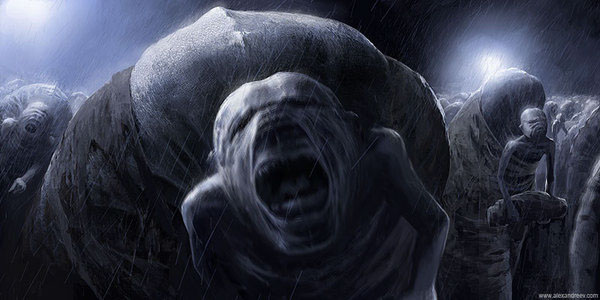
I feel crazy. Genuinely crazy.  I feel as if an intangible, impregnable, unidentifiable force is weighing down on me, is clouding my mind.

It limits my judgement and tests my patience. I am struggling to break free from my own self-imposed shackles.

It is difficult to be strong when I feel so mentally and physically weak.

The bones in my body are frail, my sanity is fragile. The bones in my body do not form a skeleton—they form a carcass.

I am carcass.

Inside this carcass is emptiness, but the emptiness has a heaviness of its own.

I am a victim of my insecurities.
I am overwhelmed by my shortcomings.
I am burdened by my expectations.

For some of us, surviving is too difficult. I am tired of battling against my own mind.

I am tired. I am tired. I am tired.

My mind is an incredible thing, its capacity is endless; yet it continues to torment me.

these words by Fiona Williams were inspired by the colour of Alex Andreev

On Advertising and Chips: “Crusading”

lumen_by_loish-d8zmpov

“Crusading”

word by Jacob Goldberg

colour by Loish 

Elias’ bag of chips had gone missing. He was walking around the classroom searching for his bag of chips. He brandished his lunch box at Mr. Epplin, telling him that they were there this morning. He asked Mr. Epplin where they had gone. Meanwhile Mr. Epplin hadn’t even asked him a question. He had been standing at the chalkboard writing the Fundamental Theorem of Calculus. And he looked to everyone to be terribly confused, like someone who had just been told that in fact Santa did exist. Elias didn’t care. He wanted to know where was his bag of chips. LAYS. Bag made of 70% reusable goods. The bag doesn’t mention where the last 30% came from. Elias speculates that it came from non-reusable goods. This is what Mr. Epplin calls an educated guess. 

Several minutes had elapsed since class began but this class seemed to be a lost cause. Of course, it could be have been recovered, had Mr. Epplin had ambitions to resume. But he didn’t. Mr. Epplin was looking for Elias’ chips. In fact, everyone was. Elias had corralled all of his classmates and his teacher into searching for his chips.

Elias asked every one of his classmates to empty their bags on their desks. He asked them to examine their belongings for his chips. He told them that they might have forgotten what you put in their bags. Sometimes, Elias said, he could overhear Mom whisper to Dad at Olive Garden that she’d forgotten something and now there was in issue underneath the table. This issue was her period. But dad would find a tampon in her purse. Elias said that the moral of the story was that you sometimes forget what you put in your bag. 

Mr. Epplin totally understood what Elias was getting at. He exclaimed to the class that he would be their father and inspect their bags for them. One girl, Eve, wondered whether this proclamation was grounds for terminating Mr. Epplin’s career as a teacher, but God intervened. He said to her, “Your namesake ate the apple: Don’t be the second Eve to fuck it up.” She wasn’t sure how to take this advice.  

When Ms. Chu, the biology teacher, appeared at the door with her students, Mr. Epplin, frisking Joseph, told her that he could arrest her if he wanted. He removed a pair of handcuffs from his breast-pocket and said don’t test me.   

Elias had removed the axe from the In-Case-Of-Emergency box and began to hack at the room’s infrastructure. One student had removed a wok from his backpack, another dry ice. Several students in the room were smoking cigarettes. Ms. Chu asked a student for one. The student said no. Ms. Chu and Mr. Epplin were holding hands. There was much excitement. Yes. Yes yes yes.

With the floorboards uprooted, the desks overturned, the windows kristallnachted, and the wallpaper peeled, Elias sadly decided that his chips were not in the room.

The next step was to set off the fire alarm. Elias’ thinking was: chips are denser than water, so they’ll sink in the rising water. Yes, Ms. Chu, the science teacher agreed. They emerged from the classroom, all attached to toddler leash.

The day would end soon, and Elias would go home hungry and chipless. All of Wilmington High would soon be on the Crusade for the Chips. Here, there is separateness in the togetherness, loneliness in the community. This crowd grows, and they are not alone, warding day and death away. 

word by Jacob Goldberg

“I was thinking about what it means to be a member of a group, to be driven by an idea, buying stuff, and how advertising can compel us to do things.  The girl in the picture seems like she could inspire such a crowd.”

see more colour by Loish 

We asked for flowers and they gave us flying cars.

40a66ff499f49f7ed4305c2a654d2ad7-d6mrpg2

word by Josh Elyea 

colour by Garry Tugwell Smith

    Untether yourself from the Earth, they’d said. Man was born to fly.

                When I was a little kid, I’d run through the meadow behind our house with my arms waist-high. I’d convince myself that the gentle touch of the high grass against my fingers was exactly what a cloud might feel like, if you could reach out and grab it. I still think about that meadow as I run my hands through the greasy droplets of moisture that cloud the air as I drive to work. Clouds aren’t quite as majestic as my formative self liked to believe.

                It’s easy to look at a flying car and be impressed. It’s easy to look at it and think, we’re going in the right direction.

                Now, we look to the things that grow for sanctuary. We look for the things that hold fast to the Earth, that dig their roots deep and growl at the bastards who’d dare to try and dig those roots out, to inspire us, just as we once looked to our superheroes as they streaked across the sky. Now, we see heroism in every tree that dares to grow, in every flower that dares to bloom. We recognize the bravery in their determination, in their resolve. How hard it must be to be green in a grey world.

                To my left, a massive building hovers in the fog, beyond definition. Concrete but fluid, the building lurks as lights signal to oncoming traffic which sections of the sky to avoid. Strange to think that the sky, once so spectacular in its refusal to be defined, has now been mapped, separated into imaginary but all-too-real geometric spaces given a name and correlating number based on their geographic location (and in this process, had the entirety of its mystery stripped away, like a bad movie that foreshadows too heavily its own ending).

                The lights on the building pulse in the morning haze, and as the faint sun begins  to strike the windows of the tower, it seems for a moment to resemble a large flower unfolding as the day breaks. Is it possible that skyscrapers too have roots, dug deep into the concrete that has increasingly replaced the Earth?

 read more words by Josh Elyea 

see more colour by Garry Tugwell Smith

Finding Who You Aren’t At The Party

62ef0626526103.563568816f94b
word by Sam Fresco 
colour by Burkhard Müller

Chet looked down at the bushy red fox. The fox looked back.
burkhard müller 
You have to get home, Chet – you don’t belong here, said the fox.
burkhard müller 
Chet stumbled back: his head was spinning. He ducked out of the crowd, standing over him. He ran past the counter and into the lift. 
burkhard müller 
The doors closed. No buttons. It started going up – the lights above the doors showing it near the roof. 39, 40, 41, 42. 
burkhard müller 
As he came out on the roof, a man in an ill-fitting brown suit was panting, hands on knees. 
burkhard müller 
Celeste, where the hell have you been?
burkhard müller 
Why do people keep calling me that, he thought. 
burkhard müller 
Here now. 
burkhard müller 
The small man lit a cigarette and offered one out. Chet hesitated because he didn’t smoke.
burkhard müller 
Johnny, come on, what’s the matter?
burkhard müller 
And Johnny now? 
burkhard müller 
He took a cigarette although he felt he had never smoked before.
burkhard müller 
OK, so we got your little shit. Now you just, y’know, you beat him around a little and we’re all down here. OK?
burkhard müller 
He looked down to the short and balding man. No: a teenager
burkhard müller 
A man held red gloves to Chet. He took them. The teenager spat out a tooth with a clump of blood. He couldn’t help feeling that he himself looked a lot like the teenager.*
word by Sam Fresco 
colour by Burkhard Müller

On unrequited love: “Turning Around Her”

unnamed (5)
I wasn’t sure what direction things were taking. I was having trouble sleeping, trouble concentrating and for the first time in a long time I didn’t know what my next step was.
 
I wasn’t myself. I used to be methodical, to a fault. I planned everything: my schedule, my goals and pursuits… so this was well beyond my capacity to deal with. I started running to clear my head, I tried to exhaust myself to sleep each night but nothing could clear the soundtrack of self-doubt and indecisiveness that invaded my mind.
 
She was beautiful and so uninterested in me and all the things I thought I had to offer. I didn’t exist in her world. I mean she was thick and curvy, soft with the hardest edge and sharpest wit. She didn’t let you get away with anything; called you out on every disingenuous gesture or colloquialism and demanded that you be nothing but one hundred percent real all the time. She wore black denim like it was her uniform and her long box-braids were always tied back. You sensed her presence before you even saw her enter the room; her misshapen silver bangles adorned each of her forearms and she smelled of menthol cigarettes and cherry cola. Make-up never touched her densely freckled face and her ears were never without the small diamond stud earrings her father gave her before he passed.

“She was beautiful and so uninterested in me and all the things I thought I had to offer. I didn’t exist in her world.”

She talked to me about it only once in the 17 years that I’ve known her. She said things were dark for a long time, she was angry, she lashed out and hurt some people she loved. I was in love with her, but I was scared of her. I’d seen her gnaw away at the affection that others so easily bestowed upon her. Despite the edge, the anger and her demanding nature, you couldn’t help but want to be near her. There was an enigmatic energy that orbited around her and she unwittingly drew people close to her but she never let them in. When I came out five years ago she was fiercely loyal, almost stiflingly protective. I realize now that I didn’t know her back then, I probably still don’t. I guess I thought that the experience had bonded us, that my sharing this part of my life with her made us closer. I thought we were friends but she had her own thing going on; so I silently pined from a distance and grew sick over unrequited feelings while she pursued other phenomenal women like herself only to chew them up and spit them out soon after, leaving husk where there was once plenty.
It was only getting worse for me. I was barely functioning. And I couldn’t tell her. Clearly I wasn’t a contender, I wasn’t worthy of her affection and I would not succeed where others far better than me had failed. I was drowning in the throngs of a relationship that existed only in my mind. I didn’t know which way to turn. 

colour by Hey Studio

“Hey is a graphic design studio based in Barcelona, Spain.
We specialise in brand identity, editorial design and illustration.
We love geometry, color and direct typography.
This is the essence of who we are.
We take care of every single step of the design process and we always work closely with our clients, big or small, in one-to-one relationships.

We also undertake side projects. These activities aim to play with new ideas, push our creative boundaries and develop a passion that is then injected into client’s work.

In 2014, we opened an online shop, a place to share our passion for typography, illustration and bold graphics.

Hey was founded in 2007 with the idea of transforming ideas into communicative graphics.
Here is a selected list of projects crafted for our clients.
We would love to hear from you. Say hi here.”