We asked for flowers and they gave us flying cars.

40a66ff499f49f7ed4305c2a654d2ad7-d6mrpg2

word by Josh Elyea 

colour by Garry Tugwell Smith

    Untether yourself from the Earth, they’d said. Man was born to fly.

                When I was a little kid, I’d run through the meadow behind our house with my arms waist-high. I’d convince myself that the gentle touch of the high grass against my fingers was exactly what a cloud might feel like, if you could reach out and grab it. I still think about that meadow as I run my hands through the greasy droplets of moisture that cloud the air as I drive to work. Clouds aren’t quite as majestic as my formative self liked to believe.

                It’s easy to look at a flying car and be impressed. It’s easy to look at it and think, we’re going in the right direction.

                Now, we look to the things that grow for sanctuary. We look for the things that hold fast to the Earth, that dig their roots deep and growl at the bastards who’d dare to try and dig those roots out, to inspire us, just as we once looked to our superheroes as they streaked across the sky. Now, we see heroism in every tree that dares to grow, in every flower that dares to bloom. We recognize the bravery in their determination, in their resolve. How hard it must be to be green in a grey world.

                To my left, a massive building hovers in the fog, beyond definition. Concrete but fluid, the building lurks as lights signal to oncoming traffic which sections of the sky to avoid. Strange to think that the sky, once so spectacular in its refusal to be defined, has now been mapped, separated into imaginary but all-too-real geometric spaces given a name and correlating number based on their geographic location (and in this process, had the entirety of its mystery stripped away, like a bad movie that foreshadows too heavily its own ending).

                The lights on the building pulse in the morning haze, and as the faint sun begins  to strike the windows of the tower, it seems for a moment to resemble a large flower unfolding as the day breaks. Is it possible that skyscrapers too have roots, dug deep into the concrete that has increasingly replaced the Earth?

 read more words by Josh Elyea 

see more colour by Garry Tugwell Smith

Depersonalization and the Effects of Medication

explorers_of_the_new_frontier_by_garryts-d9l17wz

word by Annie Rubin 

colour by Garry Tugwell Smith

She’s flying. In wisps of purple clouds, planets whizzing by, spinning and floating and falling. It was this chalky white pill, that kind of separated reality from the extra terrestrial. Worlds weaving in and out, setting apart the frenzied train ride from this spontaneous trip in vibrant flashes.

        The notion of the free-fall makes her jump with eyes fixated on the green circles of the metro line, they’re reading something altogether different than the weightlessness of her stomach or her fingers pressing onto what could only be hundreds of pins or the tightness in her chest: rising and falling in bursts of colour.

        The same five senses designed to orient are skewed. The scent of the subway, the burn of the wheels against the hot metal tracks, and the chorus of echoing voice, chanting something painfully inaccessible are present, distant.

        Fighting to define the boundaries of sobriety, she pieces together the images. There’s an empty seat beside her, she tries to listen to the silence. Wanting simultaneously to lie down and to break through the window of the train. 

        She’s watching herself hover above ground as the medication kicks in. Limbs go numb and the colours fade to a gentle hum of grey. Mood has been stabilized. The subway lurches to a stop and in the mass of bodies collecting at the doors, she makes her way onto the crowded street where her feet plant firmly into the concrete and her head feels lighter, less explosive.

        What is left to believe when perception becomes unreliable?*

From the author: “This futuristic image depicts outer-worldly colours and objects. It inspired a piece that confronts mental health topics of perception, depersonalization and the effects of medication. The mixture of sensations represents the profundity of mental illness in its capacity to debilitate a person throughout daily life and the idiosyncratic experiences of depersonalization in a mental health crisis.”


Read more of Rubin’s words on mental health

See more of Smith’s colour

How We Deal With Trauma

wreck_of_the_shuttle_peredur_by_garryts-d9gn02a

word by Keah Hansen

colour by Garry Tugwell Smith

content warning: violence

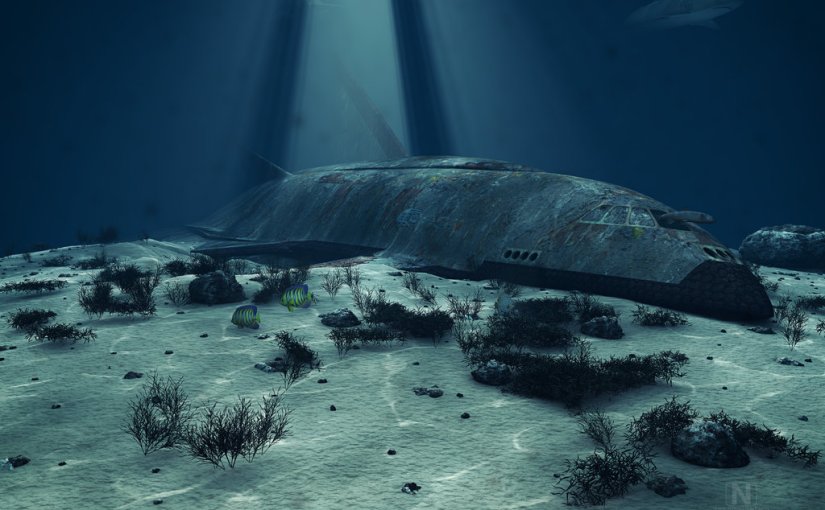
Her steel flanks glisten under a sordid sun. Scream white when sparring with that heady fire which scalds and percolates. Steam abates and disappears under the softer consciousness of the moon. In a world of duality we see seek healing our gendered symbols. We trail our fingers with alacrity over constellations of great queens. Bury our toes in the soil of wildflowers.  In a world of gender, the male deftly danced us to the mantelpiece and left us there to sweep and decorate and gaze about winsomely. Coddling the hearth with a dainty steel prong. Another wary night- the room is aflame as steel and her fire twirl and jest.

At the present moment we find our battleship sinking into black waters. She heeded caution and wore her armour willingly, heaving bells of alarm when the first missile singed her pristine sides.  In that vast ocean of a house, the cries besides the mantelpiece dissolved at the mudroom, unheard by the neighbours outside. Dashed twice on the rocks; a champagne flute smote under his gaze; the fire burned the scented candle wax and the moon waned to hide the rosy cheeks of the slipping ship.

Watch her picking ash off her skirt. Laundering out the lingering smoke of last night. Watch him watching her as they resume position- his fire rising out of that chimney and filling the world with another declaration of maleness. The delicate steel prong with flower etchings rests mutely by morning, like the battleship that poises leaden on the ocean floor. Salty water urges rust to spread up her shoulders and into the newly formed cavities.

This water mutes and oppresses. It won’t offer rebirth to she who has so many others to birth and support. Her body is a symbol of victory for patriarchy- the self-effacing female imprinted onto the minds of millions like a postcard of a battleship at rest. A war song rolls over the banks, prettying words of chauvinism.

For now, we pour our healing and ourselves into smaller symbols of identity. The ocean will someday offer its support– after countless battleships have chipped away and yielded to the currents- then women too will claim this territory as reverential. The mythic female will nest in these digressive and mysterious tides and the battleship will morph into a chanting pacifist baring flowers and peasant skirts. Identity is formed by such symbols- the kind that animates and roars and threatens to enflame a house with words.*

From the author:

“As I started writing this piece, I was inspired by the symbolism of the sunken warship resting on a seabed, and reflected on the processes of healing for different types of people, honing in on women in particular. However, these musings inspired a digression on the symbolic as a catalyst for growth and as a figurative location for anchoring, which unleashed a self-reflexive essay on the transience of the meanings behind symbols and the potency in claiming symbols for tangible social change.”

Read more words on mental health by Keah Hansen

See more colour by Garry Tugwell Smith

We love to point out shadows in the dark / But do we illuminate the monsters?

Print

“Illuminated Monsters”

word by Sean Hogan

colour by Giordani Poloni

More philosopher than centerfold,

She stops and stares at men who don’t care,

Beneath breasts beats more than fool’s gold,

Still, eyes linger where they wish she’d bare,


Fit to raise our youth and clean,

To buy and cook the food we eat,

Never heard and seldom seen,

Her labored fruits made bitter sweet,


The sliding scale of value froze

Needle pausing under half

Youthful beauty no longer shows

Her age screwed up the math.


At forty-five she “wastes away”,

Unmarried, unfortunate maid,

A gringo sitcom worn cliché,

To live, you must get paid,


She is only one example

One in all the many forms

A gender bent and trampled

Weathered leather in the storm


If a woman’s words fall on deaf ears,

Did they emerge or make a sound?

Do they possess so much to fear,

To keep the cycle spinning round?


Over half the population,

Trapped in shades of subjugation,

In every continent and nation,

In fear of pain, of death, invasion,


Is it not enough their body’s not their own,

That we wear and tear their very souls?

Teach girls to fear being alone,

To never take direct routes home?


We love to point out shadows in the dark,

But do we illuminate the monsters?

Trembling fingers hold no spark,

Steady hands, both shame and flaunt her

word by Sean Hogan

colour by Giordani Poloni

I didn’t miscarry her. I held her with so much love.

PONZI 2 copy

word by Cora-Lee Conway

colour by Giordano Poloni

I wanted to be a part of a club but I couldn’t talk about it. There is no evidence of my membership.

A mother in the making? In waiting? For a time? Am I a mother without a child?

I didn’t miscarry her. I held her with so much love. I took all the care I could. I dreamt of her future and loved her before I knew her.

I had cravings and I was tired. I was sick in the morning, noon and night. And I felt the weight in my soul and in my belly. And the lightness in my heart of knowing that you were getting all you needed from me.

So when I pass you by, group of dedicated warrior mothers, tending to your young like they are little birds, I ache.

I’d like to think I know where you are, that it wasn’t my fault that you are not here. I’d like to think that you are my first and that I won’t ever forget the short time that I held you, on the inside.

Am I a mother in the making? In waiting? For a time? Am I a mother without a child?

word by Cora-Lee Conway

colour by Giordano Poloni

Who Was He Under The Lights?

Stampa

word by Kate Shaw

colour by Giordano Poloni

He was tired, sullen, overweight, but he talked fast. His tongue had become only more capable as the rest of his body (and personality) steadily deteriorated. Sitting in that armchair – indiscernible among the puckered, fading cushions if you just took a quick glance – he looked utterly defeated.

But you could never have reached this conclusion from listening to his show. The voice that danced through the crackles and pops of 880 AM had more vitality than a sugar-stuffed toddler, twisting and bending at the will of the emotions his characters were feeling. Perhaps his voice had sucked all the energy from the rest of him.

Every Tuesday morning he sat in that chair, broadcasting the next segment of his show for the listeners who’d been loyal and invested for years. They couldn’t imagine the wasteland he’d become.

There was a time when Adam was okay. It didn’t make up the majority of his thirty-four years, nor was it an era he particularly benefited from, but it’s something worth noting. He found a niche right after graduating.

Adam had a socially unsuccessful time of the points in his life that were supposed to make that sort of thing easy: high school and college. When everyone in high school subscribed to the highly specified doctrines of various cliques, he couldn’t even make it with the Weird Kids. At the start of the “Best Years Of Your Life!” period – freshman year of college – he and his roommate immediately fell into a pattern of double-edged apathy, neglecting even to acknowledge one another after the first week of classes, and from there Adam went on to seek singles in the dorms on campus. By that point, he’d developed the assumption that he simply was not a social creature.

That’s not to say he didn’t enjoy those times, necessarily. As stated, he dubbed himself an introvert and (almost) never looked back. He’d spent his whole childhood taking things in stride; he was trained in the art of Moving On.

But in college, he discovered that, behind a guise of sorts, he was capable of masquerading as a people person. In other words, people liked him when they didn’t know who “he” was. He could bark and whisper and chortle life into archetypes that listeners rapidly began to follow, and for a while Adam was able to bask in the love directed toward his characters; he was a surrogate.

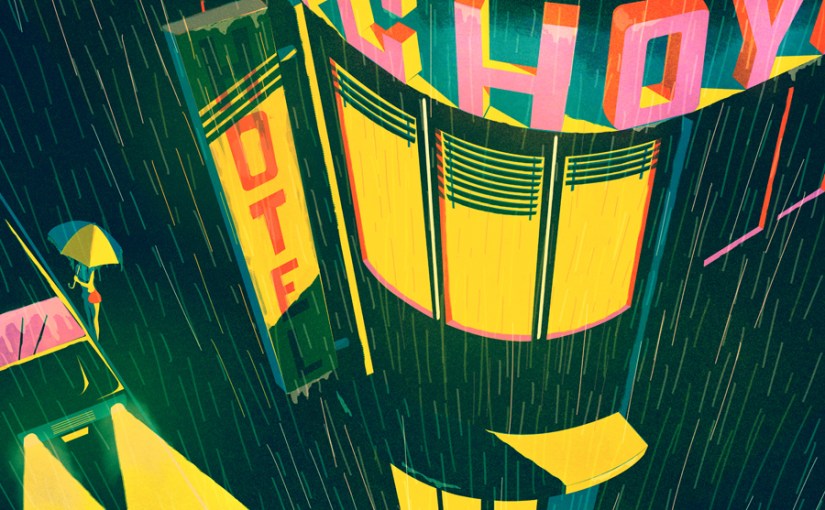
But the faded, flickering neon signage of the local hotel always cut through any self-acceptance he’d mustered up. He always found himself back, lingering awkwardly in the vestibule while the latest half-hearted hour-long partner ducked out of the rain and into a taxi. Harsh, gaudy lights formed a spotlight, inescapable, revealing to him the only truth he knew: he had no one.*

From the author: “The rain in this art piece was the first aspect to set a negative tone for my writing, but I quickly realized that the bright, garish shade of the light seemed to echo the idea of imperfections revealed by fluorescent lighting. From there Adam was born, struggling not to see his own self-proclaimed identity as a “loner” or “introvert”, but failing under the inescapable lights of the hotel.”

Escaping Loneliness As A Millenial

“In The Kingdom of a Star”

word by Jacob Goldberg 

colour by Mojo Wang

98545430822179.56340f6b63ee1

Hot sand and waters blue unfurled before us. The ground was very warm beneath our feet and our heads hung loose and insecure atop our necks. We wore caps to shield ourselves from the white sun. And below, the beach stretched on. I did not know how long we had to go or how far we had come. Beside us, the rim of the sea surged and retreated rhythmically. It cooled the sizzling sand and left foam upon it. The water washed high onto the shore and sent from itself no longer wanted. Its castoffs were shells and weeds, rocks and jellyfish. 

There was a wonderfully shaded cove, I was told by a neighbor, not a mile or two beyond our lodging. There, we could swim and repose by the waves. If we got there during daytime we could bathe in it untroubled by the locals, who camp there by night. We had set out midday, so we could return by nightfall for dinner and evening prayer.

But each step toward it hurt. I was concerned for my boy, who had not drunk since we had left our cabana. And I was unsure of how much time had passed since then. As the sun continued to climb above us, my only ambitions were for him to be out of its domain.

I had not known it to be this hot. The sun was unforgiving. I stumbled in the sand and looked at my boy. He let out a laugh and I followed. We remarked to another that it was hot. He ran out to the surf and lay in the water. When he stood, his swimming trunks slipped and made his khaki buttocks bare. His exposed back was a deep merlot. I was wearing a shirt that I removed and asked him to put on. 

“I am too hot,” I said. 

“Me, too,” he said.

“But you should wear it.  Drape it about your shoulders, boy,” I said.

“I don’t want to.” He put his hand on his waistline and smeared some blood from his cracked skin. “Pa, I’m bleeding.”

“Oh, that’s nothing, son.  Let me clean it up for you.” I wiped it off.

“I feel tired.”

“We’ll be to the cove soon, and there you’ll rest.”

“I am hot.”

“That is only your imagination, boy.”

I turned around to measure how far we’d come. My son mimicked me. I squinted but could not make out our cabana in the distance. I pressed my hand to my side and when I removed it my boy said he could see my hand as if it were still there. I shifted my gaze toward where I thought the cove was, but as if I were a reflective surface, this direction appeared the same. I did not know where we were and I felt as if cooked. 

“If only it were hotter, then I would be more comfortable,” I told my boy.

“I wish it were hotter, dad,” he said, drooping.

“Me, too.”

I picked him up and we marched toward the cove. The sand blanched my feet. I grew more tired and weak. He twisted in my arms. One or two times, I fell to a knee and dumped him to the sand, smiling at him. I told him I was playing a game, but he did not respond. His squirming had subdued and he slackened amply in my arms. To my left and to my right, behind us and before us, in every tense, I saw the same beach and the same sea, the same earth and the same sky. I walked on in the heat.* 


From the author, Jacob Goldberg:

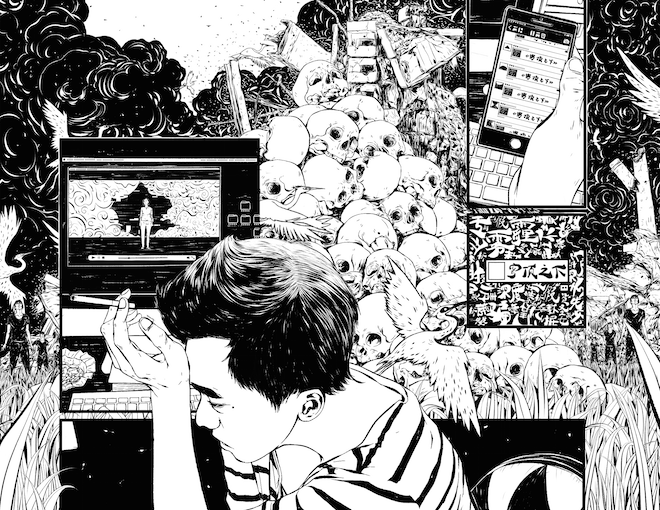
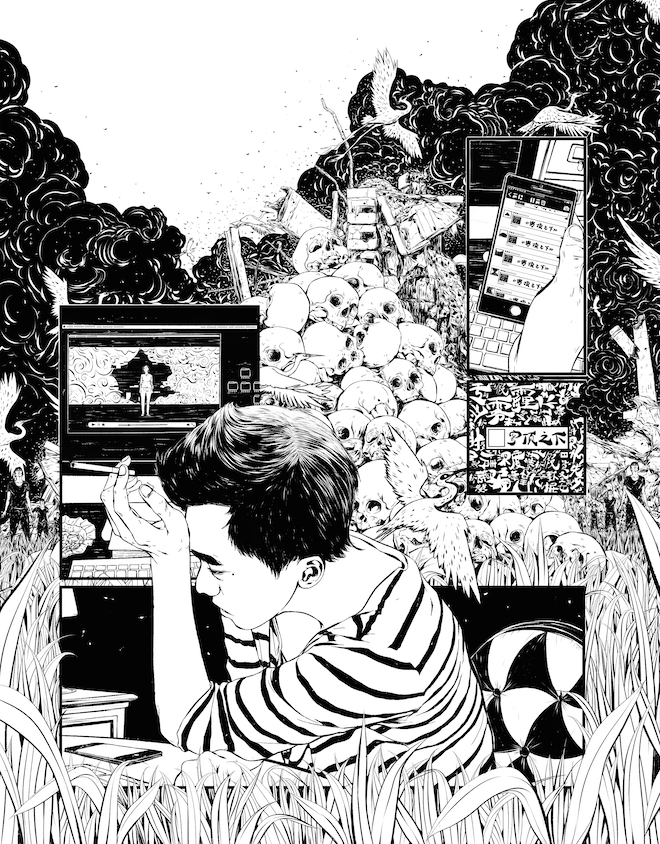
“The man in the image seems plagued with ennui or Weltschmerz.  He’s a millennial; he’s also alone, and there are skulls around him. He looks aimless and appears to have lost something but he doesn’t even know what that thing is or where he should look for it. Interestingly, he’s surrounded by technology. This story is about trying to disengage oneself from the loneliness of the modern world; it’s an attempt to articulate what that thing is that we’ve misplaced.” 

See more colour by Mojo Wang

Finding Who You Aren’t At The Party

62ef0626526103.563568816f94b
word by Sam Fresco 
colour by Burkhard Müller

Chet looked down at the bushy red fox. The fox looked back.
burkhard müller 
You have to get home, Chet – you don’t belong here, said the fox.
burkhard müller 
Chet stumbled back: his head was spinning. He ducked out of the crowd, standing over him. He ran past the counter and into the lift. 
burkhard müller 
The doors closed. No buttons. It started going up – the lights above the doors showing it near the roof. 39, 40, 41, 42. 
burkhard müller 
As he came out on the roof, a man in an ill-fitting brown suit was panting, hands on knees. 
burkhard müller 
Celeste, where the hell have you been?
burkhard müller 
Why do people keep calling me that, he thought. 
burkhard müller 
Here now. 
burkhard müller 
The small man lit a cigarette and offered one out. Chet hesitated because he didn’t smoke.
burkhard müller 
Johnny, come on, what’s the matter?
burkhard müller 
And Johnny now? 
burkhard müller 
He took a cigarette although he felt he had never smoked before.
burkhard müller 
OK, so we got your little shit. Now you just, y’know, you beat him around a little and we’re all down here. OK?
burkhard müller 
He looked down to the short and balding man. No: a teenager
burkhard müller 
A man held red gloves to Chet. He took them. The teenager spat out a tooth with a clump of blood. He couldn’t help feeling that he himself looked a lot like the teenager.*
word by Sam Fresco 
colour by Burkhard Müller

Lines & Anemones


word by Charlotte Joyce Kidd

colour by Burkhard ller 

Every day that I leave the house I feel that I am leaving it wearing a sign (or maybe an expression? An outfit?) that says “here I am, world. Have at me.” I feel this way even though – when I do leave the house – I leave it also wearing the cozy winter coat of privilege, not to mention an actual, real winter coat. I can’t imagine how hard it must be without these things.

There are these little lines in between everyone’s lives, aren’t there? There’s this space in between everyone and it’s like we’re all just extending these tiny tendrils across it, these little, feeble gooey white groping things with suction cups on the ends, and sometimes we meet someone and we manage to say things that make sense and actually express anything that we really feel or mean, and if they do too and enough of our tendrils stick to enough of theirs, then we feel better for a bit, like someone actually knows us. But even if you do that for your whole life, your whole life with the same person (and that’s problematic, too, let’s talk about that) how many of your little limbs could you extend? How many of theirs could you touch?

I got on the streetcar after spending the night with a boy and on a cold corner I saw a couple walking by and I thought about how he would react if I suggested that we spend an entire day walking around and telling each other every single thing that passed through our minds. We could take turns, do an hour each and then switch. He’d told me in words that were decisive and made sense that we could never understand each other completely, because I’m white and he’s not and I’m a woman and he’s not. I agree. There’s something noble in the futility of trying to understand, though, isn’t there? There’s something beautiful about learning to replace understanding with empathy, about reaching out and touching the tendril even though you can’t stick to it.

Sometimes there are chasms between people. Sometimes the lines yawn. Sometimes two people have pushed enough times that their plates push further and further apart, sometimes one person has made a moat around themselves because of something that happened. Sometimes that moat is not a bad thing, sometimes it is not wrong to require someone to have very long limbs before we let them reach us. 

So we’re all alone, playing a giant game of tic tac toe, reaching out from our separate boxes with words written or spoken or felt, or with devices, these electronic arms with which we send cries into the ether and hope for ethereal responses, echoes in the chasm. And maybe some people are closer to the edges of their boxes than others. It’s all very lonely and very hopeful.*

word by Charlotte Joyce Kidd

colour by Burkhard ller 

Incline

03f8b926526103.56356881684c7

word by David Fleming

colour by Burkhard ller 

On the metro delivering the girls to my ex in a mall.

A young woman close by waves to them. She smiles her surprise at the sight of a man with children. I smile back, upholding her fantasy.

It’s alarming how the mechanics of a city collide and separate us. On the teeth of the upward escalator, I am holding my three year old. Her big sister wraps her limbs around my leg like a koala. I’m a little escalator, here for them to ride up and down.

Down a hallway, another escalator. I am sweating in rush hour.

I wonder how Sam’s managing. Trying to remember if I left her, or if she left us, and who the kids think left whom, and who they feel is still fully present.


Daddy, I STEAL YOUR NOSE! says the girl in my arms as she swats at my face.


Down a yellow hallway, offices curve into their little corners. We are in the space where underground becomes above-ground, where I sometimes feel myself gasping for air.

Don’t know why she wanted to meet here, this week.

A memory: eating in the food-court up the next escalator. J’adore la poutine? or la cheeseburger? I always goofed her with my fast food Franglish. 

Again, we escalate quietly, a few impatient people pass to the left. For some reason, the toddler shrieks Mommy’s house! in my ear.

A crazy idea: I could ask Sam to have dinner in the food-court. Family hour. Our future, joined somehow, could be pleasant. We’d exchange small talk, remind the girls to sit and eat. We could be like coworkers, sitting in a lunchroom, rolling our eyes at the orthodontist bill.

Can’t you love a person the same from a different building, a different room?

An excited shout from my side.


Jess!


Sam’s best friend. When we met in college, I liked her first, though she was always mean. I told her once, years later, when we were alone, in a season when we were getting along.

Wearing gym clothes, her hair in a tight bun, her glare scolds and scalds me.

I remember, now, Jess moved into a condo in this building last year, when it was ending.


Where’s Sam? I ask. I was hoping to speak with her.

She wanted me to pick them up today.

Oh, I said quietly. What’s she up to?

It’s not important. I’m in a rush, though.

I have some things to discuss with her, maybe I’ll just call.


A huff over her shoulder.


Look, I don’t know what you have in mind, but Sam’s busy.


She takes the girls, one on her hip, one by the hand, and gets on the elevator which, presumably, leads to her home.

Before the doors close, she leans forward intently.


Your choice, she whispers. Your choice.*

word by David Fleming

colour by Burkhard Müller