Who Was He Under The Lights?

Stampa

word by Kate Shaw

colour by Giordano Poloni

He was tired, sullen, overweight, but he talked fast. His tongue had become only more capable as the rest of his body (and personality) steadily deteriorated. Sitting in that armchair – indiscernible among the puckered, fading cushions if you just took a quick glance – he looked utterly defeated.

But you could never have reached this conclusion from listening to his show. The voice that danced through the crackles and pops of 880 AM had more vitality than a sugar-stuffed toddler, twisting and bending at the will of the emotions his characters were feeling. Perhaps his voice had sucked all the energy from the rest of him.

Every Tuesday morning he sat in that chair, broadcasting the next segment of his show for the listeners who’d been loyal and invested for years. They couldn’t imagine the wasteland he’d become.

There was a time when Adam was okay. It didn’t make up the majority of his thirty-four years, nor was it an era he particularly benefited from, but it’s something worth noting. He found a niche right after graduating.

Adam had a socially unsuccessful time of the points in his life that were supposed to make that sort of thing easy: high school and college. When everyone in high school subscribed to the highly specified doctrines of various cliques, he couldn’t even make it with the Weird Kids. At the start of the “Best Years Of Your Life!” period – freshman year of college – he and his roommate immediately fell into a pattern of double-edged apathy, neglecting even to acknowledge one another after the first week of classes, and from there Adam went on to seek singles in the dorms on campus. By that point, he’d developed the assumption that he simply was not a social creature.

That’s not to say he didn’t enjoy those times, necessarily. As stated, he dubbed himself an introvert and (almost) never looked back. He’d spent his whole childhood taking things in stride; he was trained in the art of Moving On.

But in college, he discovered that, behind a guise of sorts, he was capable of masquerading as a people person. In other words, people liked him when they didn’t know who “he” was. He could bark and whisper and chortle life into archetypes that listeners rapidly began to follow, and for a while Adam was able to bask in the love directed toward his characters; he was a surrogate.

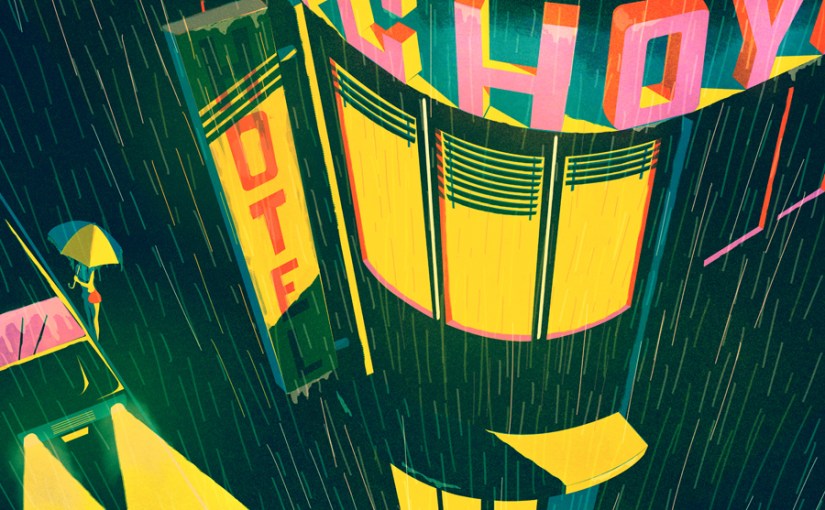
But the faded, flickering neon signage of the local hotel always cut through any self-acceptance he’d mustered up. He always found himself back, lingering awkwardly in the vestibule while the latest half-hearted hour-long partner ducked out of the rain and into a taxi. Harsh, gaudy lights formed a spotlight, inescapable, revealing to him the only truth he knew: he had no one.*

From the author: “The rain in this art piece was the first aspect to set a negative tone for my writing, but I quickly realized that the bright, garish shade of the light seemed to echo the idea of imperfections revealed by fluorescent lighting. From there Adam was born, struggling not to see his own self-proclaimed identity as a “loner” or “introvert”, but failing under the inescapable lights of the hotel.”
Escaping Loneliness As A Millenial

“In The Kingdom of a Star”

word by Jacob Goldberg 

colour by Mojo Wang

98545430822179.56340f6b63ee1

Hot sand and waters blue unfurled before us. The ground was very warm beneath our feet and our heads hung loose and insecure atop our necks. We wore caps to shield ourselves from the white sun. And below, the beach stretched on. I did not know how long we had to go or how far we had come. Beside us, the rim of the sea surged and retreated rhythmically. It cooled the sizzling sand and left foam upon it. The water washed high onto the shore and sent from itself no longer wanted. Its castoffs were shells and weeds, rocks and jellyfish. 

There was a wonderfully shaded cove, I was told by a neighbor, not a mile or two beyond our lodging. There, we could swim and repose by the waves. If we got there during daytime we could bathe in it untroubled by the locals, who camp there by night. We had set out midday, so we could return by nightfall for dinner and evening prayer.

But each step toward it hurt. I was concerned for my boy, who had not drunk since we had left our cabana. And I was unsure of how much time had passed since then. As the sun continued to climb above us, my only ambitions were for him to be out of its domain.

I had not known it to be this hot. The sun was unforgiving. I stumbled in the sand and looked at my boy. He let out a laugh and I followed. We remarked to another that it was hot. He ran out to the surf and lay in the water. When he stood, his swimming trunks slipped and made his khaki buttocks bare. His exposed back was a deep merlot. I was wearing a shirt that I removed and asked him to put on. 

“I am too hot,” I said. 

“Me, too,” he said.

“But you should wear it.  Drape it about your shoulders, boy,” I said.

“I don’t want to.” He put his hand on his waistline and smeared some blood from his cracked skin. “Pa, I’m bleeding.”

“Oh, that’s nothing, son.  Let me clean it up for you.” I wiped it off.

“I feel tired.”

“We’ll be to the cove soon, and there you’ll rest.”

“I am hot.”

“That is only your imagination, boy.”

I turned around to measure how far we’d come. My son mimicked me. I squinted but could not make out our cabana in the distance. I pressed my hand to my side and when I removed it my boy said he could see my hand as if it were still there. I shifted my gaze toward where I thought the cove was, but as if I were a reflective surface, this direction appeared the same. I did not know where we were and I felt as if cooked. 

“If only it were hotter, then I would be more comfortable,” I told my boy.

“I wish it were hotter, dad,” he said, drooping.

“Me, too.”

I picked him up and we marched toward the cove. The sand blanched my feet. I grew more tired and weak. He twisted in my arms. One or two times, I fell to a knee and dumped him to the sand, smiling at him. I told him I was playing a game, but he did not respond. His squirming had subdued and he slackened amply in my arms. To my left and to my right, behind us and before us, in every tense, I saw the same beach and the same sea, the same earth and the same sky. I walked on in the heat.* 


From the author, Jacob Goldberg:

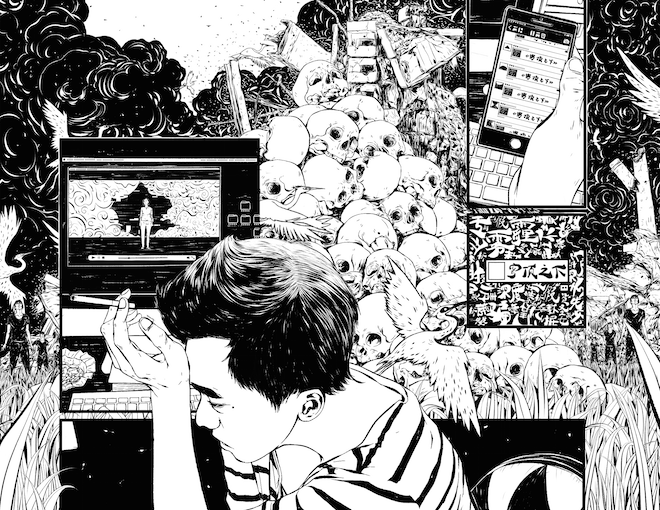
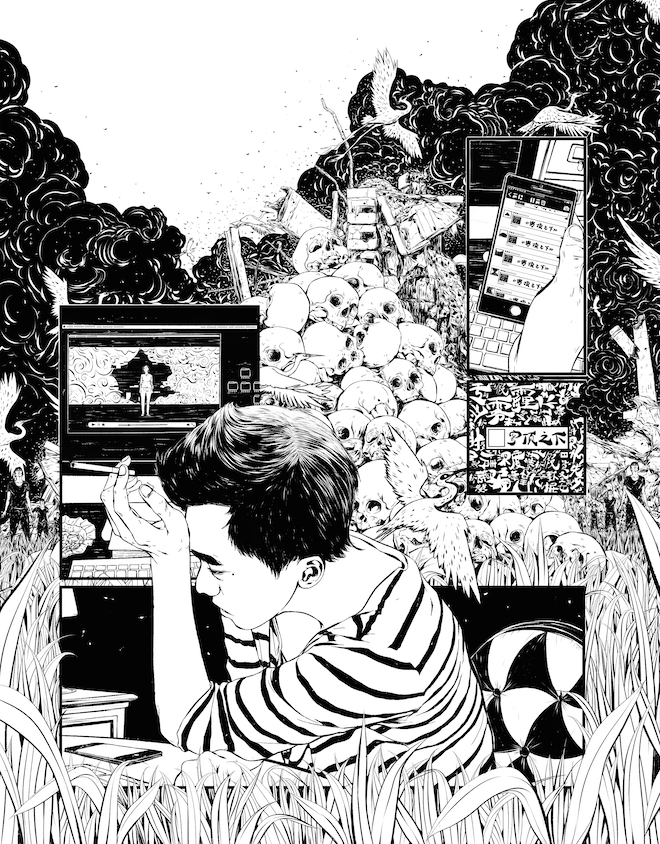
“The man in the image seems plagued with ennui or Weltschmerz.  He’s a millennial; he’s also alone, and there are skulls around him. He looks aimless and appears to have lost something but he doesn’t even know what that thing is or where he should look for it. Interestingly, he’s surrounded by technology. This story is about trying to disengage oneself from the loneliness of the modern world; it’s an attempt to articulate what that thing is that we’ve misplaced.” 

See more colour by Mojo Wang

Finding Who You Aren’t At The Party

62ef0626526103.563568816f94b
word by Sam Fresco 
colour by Burkhard Müller

Chet looked down at the bushy red fox. The fox looked back.
burkhard müller 
You have to get home, Chet – you don’t belong here, said the fox.
burkhard müller 
Chet stumbled back: his head was spinning. He ducked out of the crowd, standing over him. He ran past the counter and into the lift. 
burkhard müller 
The doors closed. No buttons. It started going up – the lights above the doors showing it near the roof. 39, 40, 41, 42. 
burkhard müller 
As he came out on the roof, a man in an ill-fitting brown suit was panting, hands on knees. 
burkhard müller 
Celeste, where the hell have you been?
burkhard müller 
Why do people keep calling me that, he thought. 
burkhard müller 
Here now. 
burkhard müller 
The small man lit a cigarette and offered one out. Chet hesitated because he didn’t smoke.
burkhard müller 
Johnny, come on, what’s the matter?
burkhard müller 
And Johnny now? 
burkhard müller 
He took a cigarette although he felt he had never smoked before.
burkhard müller 
OK, so we got your little shit. Now you just, y’know, you beat him around a little and we’re all down here. OK?
burkhard müller 
He looked down to the short and balding man. No: a teenager
burkhard müller 
A man held red gloves to Chet. He took them. The teenager spat out a tooth with a clump of blood. He couldn’t help feeling that he himself looked a lot like the teenager.*
word by Sam Fresco 
colour by Burkhard Müller

Lines & Anemones


word by Charlotte Joyce Kidd

colour by Burkhard ller 

Every day that I leave the house I feel that I am leaving it wearing a sign (or maybe an expression? An outfit?) that says “here I am, world. Have at me.” I feel this way even though – when I do leave the house – I leave it also wearing the cozy winter coat of privilege, not to mention an actual, real winter coat. I can’t imagine how hard it must be without these things.

There are these little lines in between everyone’s lives, aren’t there? There’s this space in between everyone and it’s like we’re all just extending these tiny tendrils across it, these little, feeble gooey white groping things with suction cups on the ends, and sometimes we meet someone and we manage to say things that make sense and actually express anything that we really feel or mean, and if they do too and enough of our tendrils stick to enough of theirs, then we feel better for a bit, like someone actually knows us. But even if you do that for your whole life, your whole life with the same person (and that’s problematic, too, let’s talk about that) how many of your little limbs could you extend? How many of theirs could you touch?

I got on the streetcar after spending the night with a boy and on a cold corner I saw a couple walking by and I thought about how he would react if I suggested that we spend an entire day walking around and telling each other every single thing that passed through our minds. We could take turns, do an hour each and then switch. He’d told me in words that were decisive and made sense that we could never understand each other completely, because I’m white and he’s not and I’m a woman and he’s not. I agree. There’s something noble in the futility of trying to understand, though, isn’t there? There’s something beautiful about learning to replace understanding with empathy, about reaching out and touching the tendril even though you can’t stick to it.

Sometimes there are chasms between people. Sometimes the lines yawn. Sometimes two people have pushed enough times that their plates push further and further apart, sometimes one person has made a moat around themselves because of something that happened. Sometimes that moat is not a bad thing, sometimes it is not wrong to require someone to have very long limbs before we let them reach us. 

So we’re all alone, playing a giant game of tic tac toe, reaching out from our separate boxes with words written or spoken or felt, or with devices, these electronic arms with which we send cries into the ether and hope for ethereal responses, echoes in the chasm. And maybe some people are closer to the edges of their boxes than others. It’s all very lonely and very hopeful.*

word by Charlotte Joyce Kidd

colour by Burkhard ller 

Incline

03f8b926526103.56356881684c7

word by David Fleming

colour by Burkhard ller 

On the metro delivering the girls to my ex in a mall.

A young woman close by waves to them. She smiles her surprise at the sight of a man with children. I smile back, upholding her fantasy.

It’s alarming how the mechanics of a city collide and separate us. On the teeth of the upward escalator, I am holding my three year old. Her big sister wraps her limbs around my leg like a koala. I’m a little escalator, here for them to ride up and down.

Down a hallway, another escalator. I am sweating in rush hour.

I wonder how Sam’s managing. Trying to remember if I left her, or if she left us, and who the kids think left whom, and who they feel is still fully present.


Daddy, I STEAL YOUR NOSE! says the girl in my arms as she swats at my face.


Down a yellow hallway, offices curve into their little corners. We are in the space where underground becomes above-ground, where I sometimes feel myself gasping for air.

Don’t know why she wanted to meet here, this week.

A memory: eating in the food-court up the next escalator. J’adore la poutine? or la cheeseburger? I always goofed her with my fast food Franglish. 

Again, we escalate quietly, a few impatient people pass to the left. For some reason, the toddler shrieks Mommy’s house! in my ear.

A crazy idea: I could ask Sam to have dinner in the food-court. Family hour. Our future, joined somehow, could be pleasant. We’d exchange small talk, remind the girls to sit and eat. We could be like coworkers, sitting in a lunchroom, rolling our eyes at the orthodontist bill.

Can’t you love a person the same from a different building, a different room?

An excited shout from my side.


Jess!


Sam’s best friend. When we met in college, I liked her first, though she was always mean. I told her once, years later, when we were alone, in a season when we were getting along.

Wearing gym clothes, her hair in a tight bun, her glare scolds and scalds me.

I remember, now, Jess moved into a condo in this building last year, when it was ending.


Where’s Sam? I ask. I was hoping to speak with her.

She wanted me to pick them up today.

Oh, I said quietly. What’s she up to?

It’s not important. I’m in a rush, though.

I have some things to discuss with her, maybe I’ll just call.


A huff over her shoulder.


Look, I don’t know what you have in mind, but Sam’s busy.


She takes the girls, one on her hip, one by the hand, and gets on the elevator which, presumably, leads to her home.

Before the doors close, she leans forward intently.


Your choice, she whispers. Your choice.*

word by David Fleming

colour by Burkhard Müller 


On Motivation: “Here’s to the underdogs”

1

Here’s to the underdogs,

The ones who have learned from the mistakes of those before them.

The ones who have summoned their feisty inner Judith.

The ones who have embraced bloodthirsty David in the fight against their own Goliath.

Here’s to the underdogs,

The ones unfairly perceived to be one card short of a deck.

The ones with the stone-cold poker face undeterred by rebuttal.

The ones with the cards up their sleeves and the wind in their hair.

Here’s to the underdogs,

The ones who march to the front lines even when the cards are eagerly stacked against them.

The ones who steal those coveted crowns.

The ones who scream “no dice” at the top of their bloodied lungs and at edge of their fraying wits.

Here’s to the underdogs:

This game is yours.

word by Hannah Beach

colour by Andre Barnwell 

Andre Barnwell was born July 7th, 1984 and raised in Toronto but currently resides in Vancouver. Ever since moving out west in 2013, Andre has been inspired by the city’s art community and motivated by the accessibility to the tools he needs to pursue his artistic passion and desires. Graduated as an animator from Ontario’s Sheridan College he was exposed to various styles and media to create art even though he prefers to use digital as a means to an artistic end. Fascinated by the human face, most of work is portrait based ranging in different colour schemes, particularly his blue and red monochromatic digital studies.

Outside of portrait work and digital sketches, he enjoys music, film, travelling, and building his brand, Sex N Sandwiches. He looks forward to collaborating with artists such as sculptors, photographers and musicians for future projects. With the world getting smaller with the help of technology, he implores artists and art lovers to follow his growth via social networks and eventually to international stages.

Keep it growing!

Professional Contact: 
Email: andrebarnwell@gmail.com

Social Contact:
Twitter: @AndreBarnwell77
Instagram: AndreBarnwell77

The author’s words do not necessarily represent the views of the artist.

floating downstream

randeecrudo

There was a creek behind the house, and there she dropped the pillow and the blanket and the little stuffed tiger into the water and watched them wash downstream until the world closed in over them. She let go of the things that had happened and the ones that she’d hoped for that hadn’t. She left and grew up.

She ran down the sidewalk on all fours, roaring. She didn’t stop for anything. A beetle got in her way and was splashed onto the pavement. Bubblegum and tar stuck to her palms and knees. She roared past two of the neighbourhood boys and they laughed at her from the lawn. She felt shame burn in her but she did not stop.

She remembered excitement, excitement so deep that it kept her from sleeping. She remembered jealousy, so rabid that it made her wish harm on people who owed her nothing. She remembered fear, so terrible that it could only be forgotten for moments at a time. She could label all of these feelings and put pins through them like a catalogue of butterflies.

She used to cry at weddings, as a little girl. She saw the shining eyes under the lifted veil and thought that the bride was crying because she had lost everything: adventures and backyards and sleepovers and staying up all night to read and her mother’s arms whenever she needed them. That, she assumed, was why everyone was crying.

She tried to do things, to see if she could feel something again. She tried to have her heart broken. She tried to win a competition. She tried to go to school and become interested in politics. She tried self-righteousness. She toyed with the idea of religion.

Finally, she went back to the empty house and threw out her old things, the tools of childhood. She watched them float downstream and wondered what she’d lost.

word by Charlotte Joyce Kidd 

colour by Randee Crudo

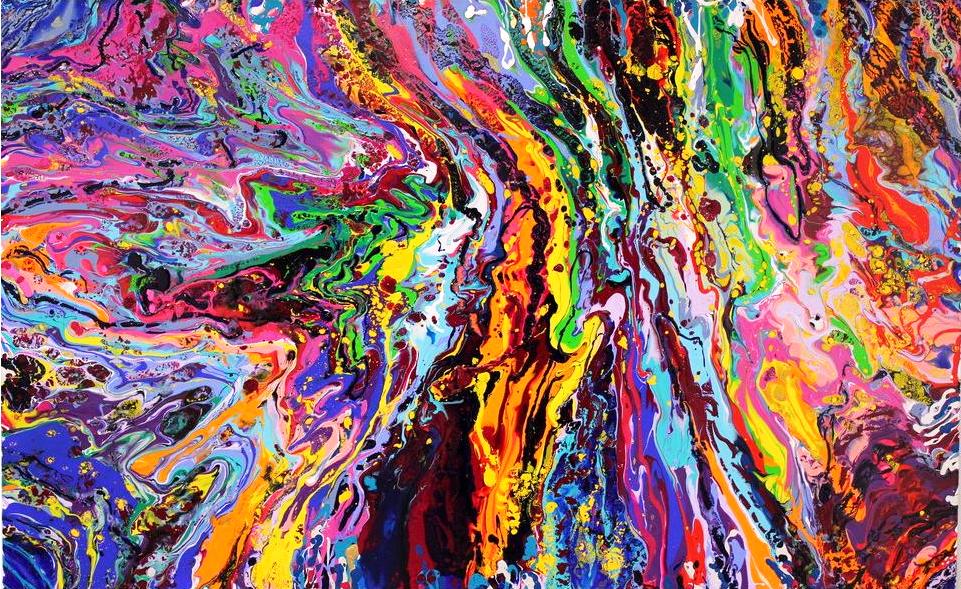
“Randee Crudo is a Montreal based artist born in 1986. Randee has been developing a distinct style over the past six years in which she experiments with the fluidity of the paint and the interplay of colours.
While having always been a creative person, it was only in 2009, when Randee graduated in Art History from McGill University that she decided to embark on her own creative journey. With no formal training, Randee has taken a different route, using non-traditional methods and non-traditional tools to create her paintings.

Randee was drawn immediately to the abstract. The ability to express herself freely, without any limitations on her technique, style or choice of colour is what allows Randee to keep growing and creating as an artist.”

On Breakups: “Rome 2.0”

Adriana 1

Fucking Rome. We got to the hotel and she cried.

It was meant to be a four-poster bed, not a four-poled bed. It was meant to be a terrace not the top step an iron staircase. It was meant to my swansong, the trip to show her what she going to fucking miss out on: the thing to remember me by. I wanted her to feel soaked in guilt when the final blow was delivered.

“Hey, come on, it’s not so bad. Let’s go out and grab some food, start looking at the city”

The sobs went from a 6 to a 9. Wails grew and smashed into me, wave after wave.


“Come on. Let’s go. Now please”


My tone had lost it’s grace and just robotically pressed.


The scrunched face emerged, drained with deep black holes for eyes, and we traipsed into silence into the city. My mind flicked through the situation, questioning all reason.


Her birthday, I wanted to impress so I took her away – how could I possibly be in the wrong?


I knew I felt warped and knotted. I flicked off topic and watched the people passing in the street. They all seemed so beautifully ignorant to unhappiness. I tried to add context: where was he off to? What did she do for a living? What does he think when he wakes up in the morning?


“tell me what you’re thinking”


She looked up at me with watery pupils. For a split second I felt for her, then firmly shut that inkling out.


‘well we can’t go on like this’


We walked over a bridge – it was brimming with life. Food, flowers, painters, water. Beautiful when I removed myself from the presence.

There was a warming delicateness to the city’s atmosphere, an over-whelming sensation that right here and now was an immersion in history.

More silence filled space between us.


“do you want to go to the Colosseum?”


“sure”


It’s an odd sensation that the connection between two people who shared a decent chunk of their life together could be actively worse than that of strangers meeting in the street.


Upon entering the Colosseum we both administered the look to walk separate routes in opposite directions around. I felt like the abiding balls of a Newton’s cradle. We passed at the mid-way point.


Rome was the city where I knew for sure I had fallen out of love.


word by Sam Fresco

“Ok, hands up. This was actually not-so-loosely based on personal experiences. The art reminded me of a lot of *that* bridge mentioned in the story so it felt natural for a piece to reflect a snapshot of how I felt in that moment. I wanted to make the experience as visceral as possible, really convey the coldness entangled with the helpless dependency you feel in that moment.”

colour by Adriana Coluccio

Adriana Coluccio is a visual artist based in Montreal. She earned her BFA in 2008 from Concordia University where she studied Studio Art and Film Animation.  In her early years as a multidisciplinary artist, Adriana was initially compelled by video art and experimental film.  After dabbling with these for a few years, she discovered a true affinity for painting.

Adriana’s painting practice is invested in her passion for traditional forms of oil painting, while drawing influence from her explorations in experimental film, video and digital media.  Her paintings are informed by her fascination with the instability of an image and the manner in which images are reproduced or transferred across media. She builds up her canvas with scenes that are potentially on the crux of formation or disintegration.

Adriana exhibits her work extensively in North America , notably in Montreal and New York. Her work can be found in private and public collections, notably in the office of the Deputy of Montreal-North.”

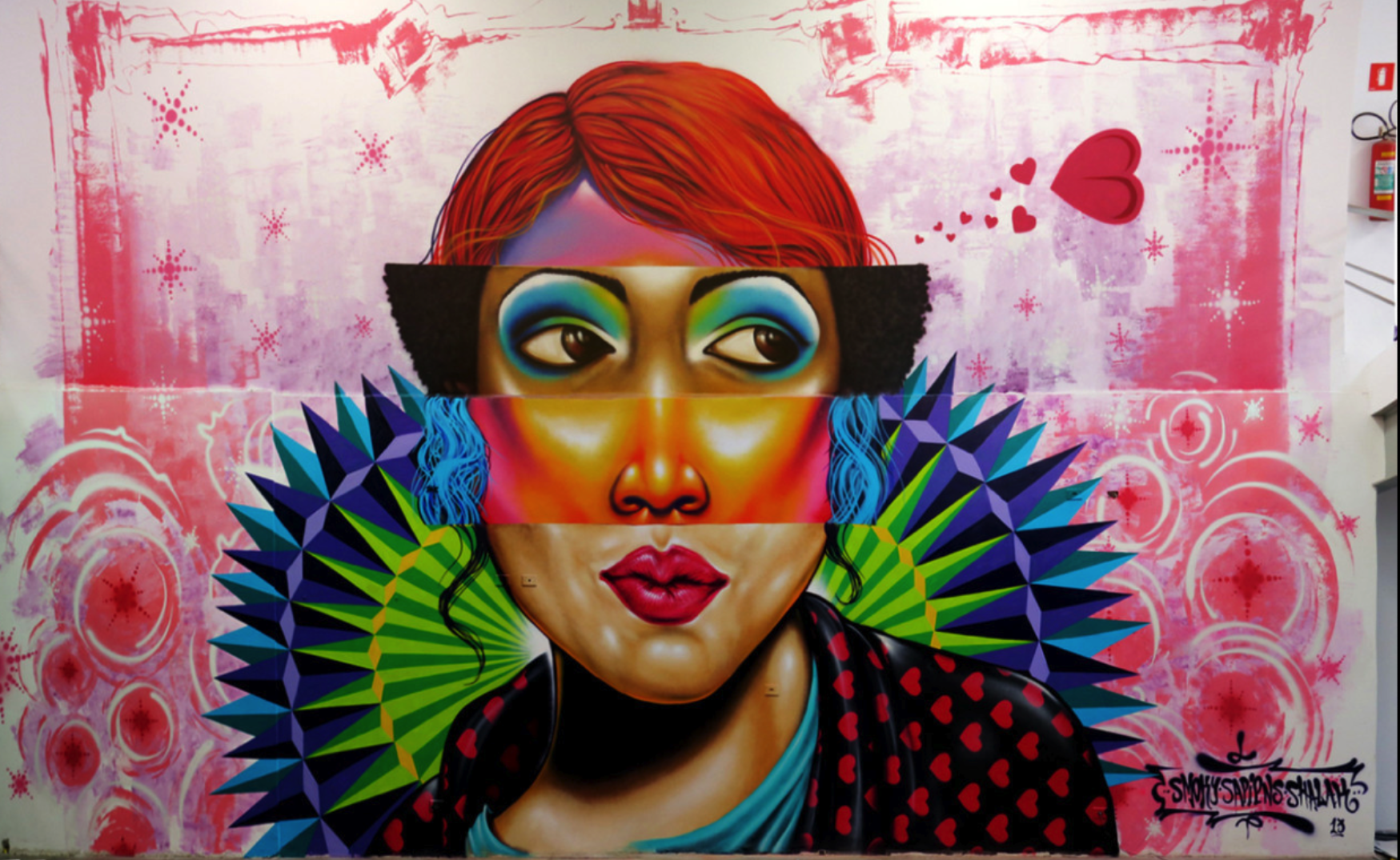
On Identity: “Caroline’s raindrops”

image

Caroline knew the mirror was lying to her and she didn’t know to prove it. She’d tried telling people about it, this changing face of hers.

They all thought she was crazy; some had even told her so.

Nonsense, they said. Everybody has a face, and everybody knows what their face looks like.

You know who you are, they’d say.

She was different, she was them all. She used to think on it more, the horrors of having no self, no I, no face. She used to worry how it might affect her, like, emotionally. Spiritually, even. This sort of stuff used to really weigh on her. That was when she was younger though, when she was afraid of the mirror.

She wasn’t afraid anymore.

Like anything else, not knowing who you are becomes routine. Caroline had wrestled with it, and it kind of made sense. Maybe it’s not as simple as knowing who we are. Maybe some of us aren’t lucky enough to get something stable, a real identity (if there is such a thing). Maybe some of us are stitched together with what’s over from everyone else. And maybe that’s ok…I mean, it has to be, right? Caroline often thinks about all this in the first few moments after she’s woken, when the world feels too quiet and too loud all at once. It’s raining outside, and she wonders if raindrops worry about who they are inside while they hurtle, unsuspecting, towards the ground. She grimaces at the lack of subtlety in her metaphor, but it makes her feel better. It’s alright, little raindrop. It’s alright that you can’t look into the wild infinity of a mirror and be sure it’s you looking back

word by Josh Elyea
colour by Shalak Attack

Support our art event!

11182076_10100949515975075_8917371626465767779_n

Join the rest in helping our art event come true by visiting http://www.kisskissbankbank.com/en/projects/word-and-colour-s-live-art-exhibit/ !