
TW: self-harm, suicide
R: Ok. So, you need to talk to them about your mental illness, right?
Finn: Basically yeah, but I don’t know how. I keep starting but none of it feels right.
D: If you wrote more often, maybe you wouldn’t have that problem.
Finn: I — I know.
R: Well, what do you have so far?
Finn: I started with what I did when I was eleven…
[D scoffs]
[Enter A and SC. Both sit. A fidgets. SC smiles sheepishly and rubs A’s back.]
R: It’s okay. You need to start somewhere, right?
[SC whispers inaudibly]
Finn: Ok.
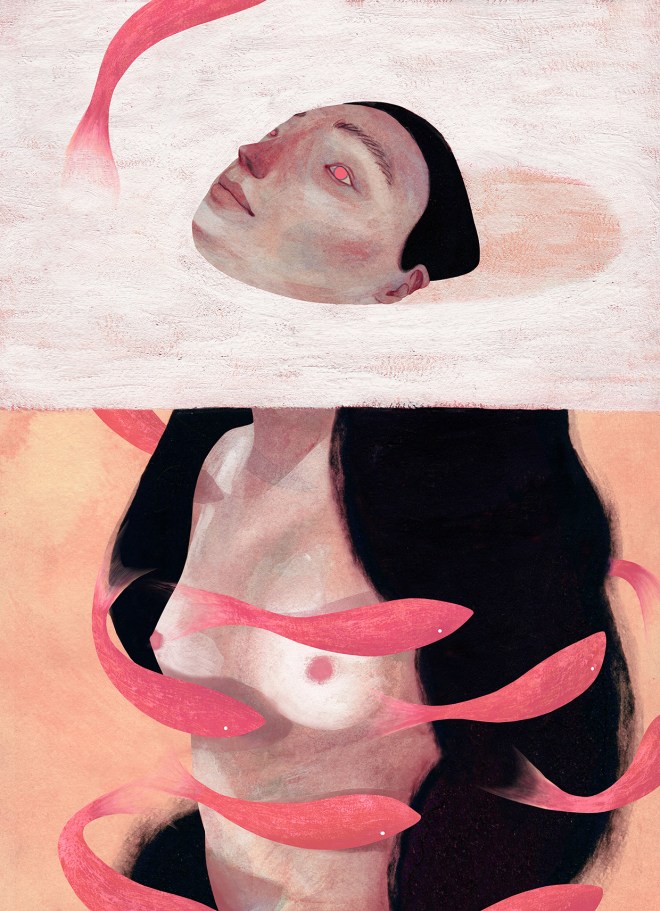
I closed my eyes, held my breath, and submerged myself in the water. It always looked a little gray in the tub. My weak limbs wallowed in the sway. One hand pinched my nostrils closed and the other floated somewhere around my stomach. I stayed this way, swaying, until the pressure pushing against my clavicle and filling my head began to pulse. Each time, I tried to hold it a little longer, savouring the feeling of expanding nothingness as long as possible, before my bodily instincts overrode my desires and I emerged, gasping.
I was 11. I didn’t know what ‘suicide’ meant.
No one ever knew about my bath time game —
A: Are you… are you sure you want to share that? If you tell them about that, they might think you’re weird. Or that you’re making it up. Or that you’re like really messed up. I don’t know. Maybe there’s a better way.
Finn: I know. You already told me that. That’s part of why I stopped.
A: What?! Oh no! You can’t stop! If you stop, you’ll never get it done!
D: Why does Finn not finishing something come as a shock to you?
A: Ok but they have to. They said they would.
R: Ok. Calm down folks. If we devolve into the two of you tugging at each arm again, they’ll never get anything done.
SC: [quietly] Finn, you should listen to R.
Finn: Ok. I’m trying. I promise I’m trying.
SC: I know you are. You’re doing great. I really liked your story.
Finn: Oh. Thanks.
D: I mean, you could have started the story at an even earlier place.
A: No. I don’t want to talk about THAT.
R: I agree with A on this one. I think that story will make a lot of people uncomfortable.
SC: I think Finn can talk about that if they want to but they don’t have to, either.
Finn: Maybe later.
R: Did you have anything to add to what you were saying earlier?
Finn: I mean, I guess. Not really, though.
R: What about what happened the fall before last?
Finn: Yeah. I guess I could start there. It’s kind of a blur, though. I can’t necessarily think of a particular event.
SC: That’s ok. You’ll find one as you go.
Finn: Ok. I guess it started in September. 22 going on 23. I guess by 22 going on 23, I’d accepted my lot, I’d accepted that these damn pills would never work and I’d never really amount to much — just like she said.
A: Please don’t talk about her.
D: Why? She was right.
R: Finn, just keep going.
[SC nods]
Finn: Ok.
It was barely September when the depression started hitting a little harder than usual. The echoes of summer heat reverberated through the window and made me sick. My eyes never quite opened before I dragged myself to the shower. I told myself it was only the newness, the change, moving out, getting used to graduate-level seminars and work. I took my useless pills to ward off the buzzies, the little electric shockwaves running from nerve to nerve when your system hadn’t gotten its juice, and dragged on.
Never take Paxil.
Never Take Paxil.
Never
Take
Paxil
I joined the editing team of a graduate creative journal. I was working as a teaching assistant. I had a research assistantship. Things were okay. I was busy — overworked, maybe — but nothing unexpected for a graduate student.
The exhaustion, however, only got worse. Periods of being suicidal. Waking up wishing I hadn’t. Feeling heavy in a foreign body. The slight relief of vertigo when getting up too fast. Resigning myself to draping my limbs over the side of the bed, letting my weight slowly slip me onto the floor, plopping into a contorted heap. All of these were normal when they took up a couple days here and there every few weeks amidst the lull of monotony, the drag of being. Slowly and all at once, creeping just enough to go unnoticed, a few days became a week, became a month, became my existence. The depression whispered to me that it was my own fault, that I just couldn’t keep up because I wasn’t enough. It almost replaced the voice that had been my mother’s — but this time I couldn’t barricade the doors, couldn’t turn up the music until she removed the fuse. It wasn’t until December that I noticed anything was wrong.
“Hey, boo. I think you should get up now,” Joon coos, sitting at the edge of the bed.
There is a day’s worth of sleep in my eyes; I barely pry them open, groan “hhhhnn.”
They try to smile, curling their lips in and pressing them tight. The pity pools in their eyes and pushes their eyebrows upwards. “Come on, I’ll make you tea.” I bury my face in their hip. One Earl Grey later, I stare out the window. Late afternoon and the day is already dimming. I have work to do. So much work to do. Heartbeat in head, shaking in chest, I am still, I am still, I am still.
Joon, too, is ill. They can’t keep taking care of me and I can’t take care of them. We lack clean dishes. Our only contact is with our pets and the ever-multiplying fruit flies in the kitchen. All our clothes are laundry. Floors no longer exist. I was supposed to have myself together. Not this. One more pill. Tiny oval in my palm. You were supposed to make it better.
They’ve made me worse. I spend a month trying to convince myself to make a doctor’s appointment. My mother’s voice in my head: you’ve cancelled too many appointments. I bet he won’t even see you now. It’s embarrassing.
Too many times. Embarrassing. Phone calls. Can’t.
I don’t make an appointment. I’m going to have to wean myself off these things on my own (always on my own) but I can’t yet. I’m mid-semester and already struggling. A decade of depression has made me a master of deception, bullshitting that I’ve read the things I haven’t. This and natural wit get me through seminar and class each week, and necessity keeps me from skipping them — though a handful, inevitably, are still missed. I slog through spring finals, spring corrections, and I start the weaning process.
R: What was the withdrawal like?
Finn: Hell. You become a different person. At first, it just feels the same as those days where you forget a pill. You think ‘Ok. Buzzies. Dizziness. Anger. Expected,’ but that’s just the beginning.
I started to cut down my dosage in May and the process lasted until the middle of July. What no doctor told me, what I found out through a series of blogs and forums, was that Paxil has some of the worst withdrawal. Heck, it’s been almost a year and sometimes I still find myself wondering if certain behaviors are the residue of my time with Paxil.
That first day in May, I sat down with a steak knife and cut several of my 30 mg Paxil pills down by about a sixth — making them 25mg — and put them into my little weekly pill case. After about three days, all I felt was a little nausea and a little spacey so I cut my next pill down by another sixth. I immediately felt the way I usually would on days when I’d forgotten to take my pill on time. I figured maybe, like the various blogs had told me, it was just a temporary drop and it would level out. It didn’t.
You wake up with a film of sweat peeling your arms from the bed. Your head is heavy and sagging with emptiness. You are a bundle of exposed wires. Every movement zaps you from your temple to your fingertips. You are seeing everything as if through a mirror. You can push yourself right up against the glass and still never touch the other side. You are sensitive. You laugh until you cry and then you hate yourself for crying. Your partner isn’t listening so you collapse to the floor in despair. Somewhere between the red pulsing in your fists and finding a clear spot on your sweater to wipe the snot, you realize how tough this withdrawal really is.
Every few days to a week, you cut back by a couple more milligrams. You go from feeling like shit to feeling dead, slowly working your way back to feeling like shit and cutting back again. This goes on for two and a half months. Two and a half months. About ten weeks. About a quarter of a year. A season. The season of withdrawal. You try to get some work done for your research assistantship when you can but it’s mostly futile. You know you’re lucky, living off the remainder of the money you earned as a teaching assistant and loans from the government. Sometimes, you’re afraid Quebec would take it all back if they looked at your file and saw how useless you were or that your langue maternelle and chosen area of study were their enemy.
D: Who are you talking to? Who is this you?
Finn: Sorry. I meant me. It wasn’t a real you. I just wanted them to feel it, if they could.
A: Do you really think that’s a good idea? People might think you’re directing them too much, and if it’s not done well enough —
D: It won’t be.
A: — if it’s not, then people might get angry or think your withdrawal wasn’t a big deal or not get it.
Finn: Ok. Yeah. I’m sorry. I’ll stick to myself. I won’t try to write for anyone else.
Anyway. After two and a half months of withdrawal — and yes, I likely went through it a lot faster than I was supposed to — after that time, I slept for what felt like weeks. I still oversleep way more than I ever did before. By the end of July, though, the withdrawal storm had mostly passed and I was excited to go back to the regular amount of depression I’d always had. I was excited for things to get a little better.
D: But things didn’t actually get better.
Finn: …No, they didn’t.
[Finn shifts. A shifts]
A: Hey, um you’ve spent a really long time on that. Maybe you should try something else. Maybe people want to hear more about how to get better. You’ve been dealing with this forever. Why don’t you give them a list of resources or something?
D: Yeah. That’d be useful, at least. Better than listening to any of us.
Finn: Ok. Yeah. I can do that. There are a couple of apps and things that have helped me over time. I’ll list a few that are easier to access, I guess.
Booster Buddy — This is an app where you emotionally check in each morning and complete a couple little self-care tasks related to whatever you’re struggling with. Doing so helps wake up your animal buddy who then thanks you and gives you motivational quotes. Also, as you complete tasks, you get points that unlock ‘levels’ that let you give your buddy cute accessories. It also keeps track of your mood, medications, and addictions if you have any. It’s a really useful and quick tool to get you in the habit of minor self-care and mood tracking.
Stop, Breathe, Think — Simple, straightforward, as-of-yet-in-my-experience not offensive or appropriative guided meditations. Select your feelings from a wide array (they separate the feelings into various categories and you can select up to five) and the app will present a series of guided meditations for you that are appropriate to whatever you’re feeling.
You Feel Like Shit — The single best interactive self-care tool I’ve ever used. This tool is made with Twine so, depending on what you’re feeling/dealing with, it will lead you on a variety of paths. It also gets you to check in on a variety of self-care things in very gentle ways — it won’t shame you if you eat poorly, for example. It very much lets you feel in control of how you care for yourself while gently nudging you to doing the most positive thing you can do for yourself at the moment, whatever that may be. I feel like it really embodies the spirit of ‘harm-reductive’ which I think is really important.
7cups — I mostly use 7cups for the growth path activities (videos, affirmations, meditations, etc.) that give you healthy reminders to help you improve what you can, as well as accepting yourself and your illnesses and being thankful for what you do have. There is also an abundance of listeners that you can talk to when you’re not doing well and community chat rooms and forums. I’ve had some awkward experiences with community members re: queerness and gender identity but overall it’s been pretty useful.
Rainymood — The sound of rain, various types of rain — it’s calming and helps you sleep.
Passionflower Valerian tea — This tea will help you calm down and help you sleep really well. Notable side effect: ridiculously vivid dreams.
St. John’s Wort & 5-HTP — If you’re not on any medication, these two supplements can be really helpful. 5-HTP is an amino acid and it’s really great for anxiety. St. John’s Wort is a plant that is basically a mild SSRI. It affects your serotonin, which is why you can’t take it if you’re already on an SSRI, because you will get serotonin syndrome and maybe die — no, really. I’m serious. That said, if you aren’t on an SSRI, this does help a bit. It might also be worth it to start taking a daily multivitamin.
(Note: I’m recommending supplements but not foods because let’s be real, if you’re depressed, you likely don’t have the energy to make healthy meals and fresh produce always rots and wilts and slimes away in that bottom back drawer of your fridge — so yeah, don’t worry, I got you.)
Also, the following songs (but also whatever works for you, you know?): “Rise Up” by Andra Day; “Keep Your Head Up” by Ben Howard; “I Wanna Get Better” by Bleachers; “Up We Go” by Lights; “Send Me On My Way” by Rusted Root; “Let the Rain” by Sara Bareilles; “Beautiful Times” by Owl City; “Thrash Unreal” by Against Me!; “Try” by P!nk; “Don’t Be So Hard On Yourself” by Jess Glynne; “Looking Up” by SafetySuit; “Make Them Gold” by CHVRCHES; “Recovery” by James Arthur; “Today Will Be Better, I Swear” by Stars.
SC: Oh! Don’t forget about your own blog, the one with all the affirmations and cute kittens and stuff!
A: No, don’t give them that. That’s too much.
R: You could but I think, for the sake of caution, you should maybe not. It’s really your decision though. Speaking of resources, how have things been going with your therapist?
A: Oh! I know this one. I was with them when they were supposed to have their last appointment. They still didn’t like him so they didn’t go to their last session because they didn’t want to hurt anyone’s feelings or risk an awkward dialogue.
R: That — wasn’t the best plan of action. Finn, is that true?
Finn: Yes. I’m sorry.
A: They didn’t know what to do.
SC: Ok. That’s ok. It would have been better if you had cancelled beforehand but at least now you’ll go request someone new?
Finn: I will. I promise. As soon as I have the time and energy. I just, I haven’t had many great experiences with therapists.
R: Why don’t you talk about that?
Finn: What do you mean?
R: Your experience with therapists.
Finn: Oh, ok. Which one?
R: Why don’t you start with the first one?
Finn: Ok. Let’s see.
Well, it wasn’t until age 14, between covering my clothing with safety pins and darting down halls, earphones in, crawling (in my skin), that I stumbled into therapy. A misunderstanding, really. A survey I thought was for data about teens and school and pressure that landed me in a chair facing a guidance counselor. It was my first time stewing in that silence, darkness filling with a tight-lipped pity. It was nowhere near the last.
And the Counselor says, “So you feel like you want to hurt yourself sometimes? You think about killing yourself?” So blunt, he asks, as they will all ask, even though he already has the answer in front of him. I have yet to understand the sick fascination they have with hearing you say it, hearing you say in one way or another, “Yes, Mr., I want to die.”
I dance around it, as we always dance around it, not wanting to make it a big deal, but wanting to make it maybe just big enough that maybe they’ll be able to help. So, I say, “I guess it’s more that I just want to stop being. Or sleep for a really long time.”
And the Counselor says, “Hmm,” and he nods, as they will all nod. And he will let the silence build again. As though its weight is meant to feel new. In it, I will overthink every possible way that he could be thinking about this encounter, these things I am saying. Am I a liar? Am I broken? Am I not broken enough? Am I just the lazy, never-enough bitch creature my mother always told me I am? Am I manipulating a system meant for real people with real problems?
It is the first time. There will never be a last.
This first time will lead to a call home, a referral to the children’s hospital, my mother, emotional, saying she’ll take care of it, later sternly telling me I should have come to her, me feeling guilty that I hadn’t but knowing that I couldn’t or that in so many ways I had. The first time will lead to a psychologist and an art therapy group, will lead to more silence, not opening up, my mother telling me I’m wasting her money if I’m not speaking one day, telling me not to air our dirty laundry or that it’s all my own fault the next. This will lead to me skipping psych appointments, will lead to more guilt, will lead to more skipping — of school, of social gatherings, of existence, will lead to my extensive knowledge of home decor and home improvement from watching HGTV all day every day laying on the couch, will lead to me scraping my way out of high school. These will lead to more therapists, more skipping out on therapists, and so on.
When I got to university, I never tried to register myself as mentally ill with the center for students with disabilities. I wonder if anyone ever does. Or do you all feel that same complicated dissonance between the fear that the university won’t see your disorder as valid, that maybe they’ll see it as too much, or feeling like maybe it really isn’t valid enough?
[A shifts and starts picking at the skin of their cuticles. D yawns.]
I don’t know. This one doesn’t quite feel right either.
SC: Are you sure?
[Finn nods.]
R: Ok. Were there any other ideas that you had?
Finn: I mean, I thought about looking at one of those posts about ‘habits of happy people’
R: Ok. Maybe try that?
Finn: Ok. I’ve gotta get one though.
Ok. Got one. Here goes.
- Be busy, but not rushed be productive, but not overwhelmed. Fill your time.
The energy it takes just to do taxes is enough to warrant a week of sleep. Keeping Busy may be a distraction but depression is, by definition, lying in bed at 3 pm watching Parks & Rec, hearing the pigeons in the heat, wanting to throw rocks at them, not having the energy, looking at the mountainous terrain of dirty clothes on your floor, the smell of gelatinous tea in mugs, and rolling back over. Depression is not doing the thing until the thing must be done because there is never the energy. Depression can’t make itself busy. Depression is always rushed.
2. Have five close relationships. National surveys find that when someone claims to have five or more friends with whom they can discuss important problems, they are 60% more likely to say they are ‘very happy’
They say. They say like it’s easy, like it’s easy to keep in touch when there are a million other responsibilities you already don’t have the energy for; like they don’t have a voice telling them they’re unworthy, they’re boring, they don’t deserve friends, they’re just annoying; like isolation isn’t the default; like they don’t feel like the longer you wait, the more the anxiety tells you not to bother, the more each unanswered message and cancelled plan makes you feel broken. Ignore it, they say. Do it, do it anyway, they say, no matter how alone you feel regardless. Do it. Then you, too, can be very happy.
3. Exercise. Endorphins, endorphins, endorphins.
Yes, more to ignore. Ignore the inability to get up in the first place. Ignore the exhaustion. Ignore that it takes an hour to look a way you don’t hate and ignore the anxiety of how the exercise will make you look by the end. Ignore the anxiety of exercise in general, of doing it around folks, of not doing it right, ignore the energy spent doing it. Ignore it. Endorphins will solve everything.
4. Spend more money on experiences. Trips! Shows! Doing, not having!
Ignore the correlation between poverty and mental illness. Ignore the fact that we — that I — cannot afford experiences, do not have the luxury to plan such things, to purchase more than the necessity. Ignore the ease of retail therapy on the rare occasion, that less effort can be put in and one comes out with a reusable item that makes them feel good. Ignore the energy it takes to plan trips, the social investment necessary to see shows, and the energy that takes. But most importantly, ignore poverty, ignore it —
D: I don’t think that’s elaborate enough for people to care. There’s no story there.
A: Yeah, I’m not too sure about it, either.
D: You’re not even trying.
Finn: Well, what do you want? There’s no story in any of it. None of them. They’re bits and they’re pieces. They’re not pretty. I’m not articulate. I’m not Plath. My fig tree has been in front of me for years and all the figs have already swollen and fallen and died. I am what I am. I get up every day. Or I don’t. But I try. And I worry. All the time. About everything. This has been my life, my whole life. I am trying to get better but I’m not there yet and I don’t think I ever will be. So, what do they want from me? It’s something that just isn’t there. They want beauty in melancholy. They want that thread of creativity only visible to those who suffer. But I can’t give them that. I don’t have the energy for that. Don’t they see the paradox? Write. About mental illness. As if that could really happen. And how? Where do I even start? Where do they want me to end? It doesn’t end. The silver linings are shards that will come back and slice you up if you don’t hold them carefully. If you rest on them, if you lean the whole story into them, they will shatter and you will bleed. Do you want to bleed?
SC: I’m so sorry, Finn. Why don’t you tell them about what you’ve been doing this past year? What happened after the withdrawal, where you are now?
Finn: This past year? What am I supposed to say? After I went through withdrawal, I took a vacation with my then-partner to the town my grandmother grew up in, the town where I spent all my summers growing up. It was hell. I hadn’t been there in years and I hadn’t realized how oppressive it would be. I mean, I shouldn’t have expected a town of a couple hundred people to respect my pronouns or my visibly queer and interracial relationship, but for some reason I did and I was trapped; Joon was even more trapped. Then, right before the new semester began, my deadbeat dad up and died. Hey, haven’t seen you in ten years but bye forever, here’s tens of thousands of dollars in debt from my coke habit. Have fun with that messy grief and the lengthy, costly legal processes of renouncing succession. And in the midst of that, I started to stand up for myself around my mother, which led to more guilt and gaslighting until I realized I may not be able to have a relationship with her anymore. Then, on New Year’s Day, Joon left me. There were real problems there and I respect that, but it didn’t make it any easier, especially when I found out how immediately (overlap likely) they started dating The Australian. Basically, this last year was hell and I hit the lowest low I’ve yet to hit. And yes, it was around that point, in January, no friends, no family, no nothing, that I realized I needed to just kill myself or dedicate myself to getting better. There was nothing else left.
So I chose to get better. I chose to start contacting people, meditating, learning how to be grateful. I am getting better because I keep trying. But it doesn’t mean I don’t still fall behind, fall apart, and isolate like all hell. It doesn’t even mean that I get up at a regular hour. Half the time, the only things I can list in my gratitude journal are, “I am grateful for the sun. I am grateful I am here.” I am still depressed and I will likely always be depressed. I’m just trying is all. But it’s hard. It’s not a happy ending by any means because it isn’t the end and there will never be an end.
D: Ugh. Now, you’re just monologuing.
Finn: Well, yeah. That’s what I’ve been doing the whole time, isn’t it?
Epilogue [of sorts]
D [Depression]: I guess. That wasn’t very inventive, though. You’re not very good at this, are you?
A [Anxiety]: Are you sure you want to tell them that? Isn’t it better if they find out on their own? Oh, but then again what if they didn’t get it at all. Maybe you should start over. What if they think you’re extra weird for talking to yourself? Can you make it clearer that these are all just things you say to yourself? That you haven’t actually fractured your mind this way? Wait. Did I do it? Is that enough?
R [Reason]: It is what it is. One way or another, you produced something.
You completed the task and that’s enough.
SC [Self-Care]: You did. It doesn’t have to be perfect. The point is that you got it done and you were able to speak, no matter how many times the others interrupted you. You are brilliant. You will keep going. All of us are learning and we are working together to help you. You are helping you. Keep pulling yourself out. Stop when you have to. Rest. But keep going. Keep going. Keep going. You’ve got this.
Finn [Me]: Thanks, I guess. At least it’s a start.
these words by Finn Purcell were inspired by the colour of Owen Gent
SHARE this collaboration!







 wordandcolour
You must be logged in to post a comment.