Kidd & loish: “She had a horrible boss”

1ef01d7b453f93610d45b8aa8759187e-d85e3o9

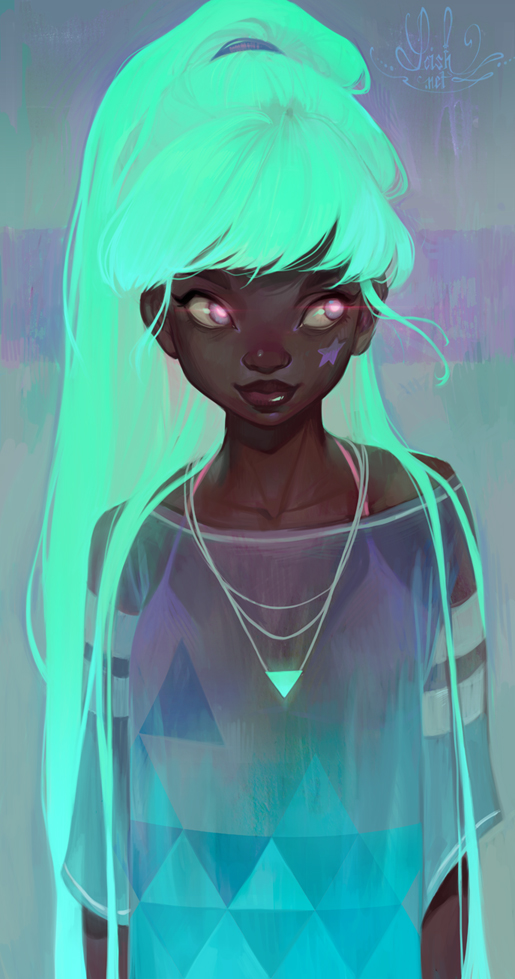
She had a horrible boss. He had, always, a harvest of spittle at the corners of his mouth, and it seemed to her that every particularly horrible man that she’d met in her life had coffee breath and this same sea foam at the edges of his lips. In addition to this chronic hygienic condition, this boss had ghost hands, which was worse even than the spittle. All day, she could feel his ghost hands on the back of her neck and the small of her back and, when she unthinkingly left them untucked from her desk, her kneecaps. As he caressed her invisibly, the boss would sit, legs spread, on the corner of her desk, instructing her condescendingly on how she could advance her career to reach the status that he had achieved, or else telling her about the many gifts he bought his wife. “Swarovski crystals,” he would say, as he ran his disembodied digits over her skin. “Tiffany bracelets. Trips to Hawaii, without the kids.”

She didn’t shudder and she didn’t say anything because she didn’t think HR would know how to deal with her boss projecting his phantom hands into her clothing.

On the day she quit her job, she got dressed and went to work as usual. The boss had fire in his eyes that day, because he’d heard a rumour that one of his rivals was going to be promoted. On her first fifteen minute break of the day, she went out and bought a scone with cream and strawberries on top, which she ate on the way back to her desk.

Going back to her daily tasks, she felt that one of the strawberries had fallen down her shirt and was sitting between her breasts, wet and heavy. She tried to look down her collar to see it, but her shirt was tightly buttoned and she couldn’t see anything at all. She continued to feel it, grainy and soft, as she went about her work. She plotted to go to the washroom as soon as she could. But when she got up to go, the boss blocked her way. He stood in her path, fat hands on wide hips, and started to say, “In business, keep your friends closer and your enemies closer,” and stopped, his spit spilling out, gurgling. She could see, in the soft cavity of his mouth, that his tongue was missing. She stopped and gasped as the strawberry in her bra worked its way down to her belly button.

“I think you have something of mine, sweetheart,” the boss said as he took a step closer, and she gagged as if it were her tongue that had gone wandering, and then the boss thundered, “my pen, where’s my pen,” and she ran out of the office, which she was never to see or hear from again save for a last cheque unceremoniously deposited in her account a week later. On the way home, she shook from relief at the feeling of having nothing but her own body in her shirt.

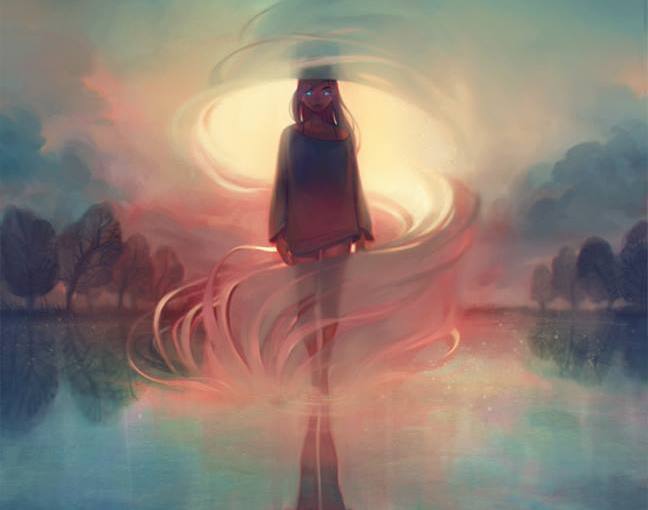
these words by Charlotte Joyce Kidd were inspired by the colour of loish

On Child Abuse: “The Intentions of Wolves”

1948225_10155178767665048_1187957752347932746_n

this piece of art, “breathe,” was created by loish

6. TIN ROOFS SPLIT THE SKY LIKE MOUNTAINS. The spring of a summer door would creak when stretched, as rust spreads when left unchecked. The gap in the wire fence was never discussed

5. Questions from visitors regarding the fence deflated conversations. Topics were then rerouted by the parent, such as an investigation on whose boots had sunk in the mud behind the pines, near a canister of roaches. The children were tense during these reroutes as though a house of cards was shivering with laughter.

4. Others addressed it with polite warning, as when a police officer flashes their lights. The parent would return from these talks to nod at children on staircases, as though the neighbouring guests of the same hotel.

Or, they were picked up.

“I love you, you know that?

3. Morning silences balanced these night enthusiasms. The children were well-aware of the emotional see-saw and did their best to avoid existing as the balance. Gaps in the fence were large enough that you could fit if you got down on your knees or if you were dragged through on your back. Of course visitors with gaps in their fences shared great laughs in our house.

2. Sometimes, deer would approach the back windows that faced the woods. You’d turn from the TV, and there would be two, three deer, spotted white, watching you. They would approach me in the yard. There we’d stand, looking at the other. There was tension in the lines of their muscled haunches. Then the door might creak open and my dog might run them back toward the pines. Their white tails would flip over the field’s weeds, never tripping over objects that were entombed in the grass, close but never caught by the dog.

1. You’d see them on the side of roads, too, with their necks twisted: bodies toward the road, eyes to the trees. In the winter, their blood spattered over snow-covered roads. In the summer, the warm liquid poured out to fill in creases of the cement.

0

1. I lived in this house for ten years. There wasn’t a fence, but the driveway was made of gravel. As many people know, surviving one of these houses often means leaving. The borders of a driveway give promise to understand who one is or can become without the dynamic of the abused and the abuser. Crossing the border at the end of the lane is often complicated by the fact the attacked is told to be lying, where the abusive parent may discount the uncomfortable truths being shared through threats, a defensiveness which underlines their guilt and shock at the inconvenient possibilities of your voice.

2. Yes, the deer would actually come up to our windows. Half of our house faced a forest, and they’d cross the long weeds to stand on our stone patio and look inside our living room.

3. I wonder if a deer’s ears are like a dog’s ears, and if they could hear through the windows.

4. When I’d see one strung up in a friend’s garage, leaking blood into a bucket, I was perhaps more affected, as though I’d lost a witness who could testify in a case I never wanted to attend.

5. Abusers are insulated by the glorification of keeping family secrets and a culture of stoicism in Ontario. My masculinity amplified this silence and abusive power relies on a special status treatment of silence. If attacked on the street, most people would call the police partially to prevent others from being attacked.*

4. I cannot speak for other members of my family. 

3. It is often this inability to share and process trauma with strangers or friends that will prompt people to become violent later on to cope with feelings of vulnerability. The saying goes, “although not all children who were abused grow up to become abusers, the vast majority of those who abuse were abused as children.”My ability to move from that tendency involves a lot of work and privileges.

4. It is the responsibility of the violent to adopt methods of coping with stress or trauma that do not require the destruction of the minds and bodies of those around them. 

3. Processes of accountability with violent parents require the parent to acknowledge that violence occurred. As acknowledging abuse is acknowledging ‘imperfection,’ tactful rearrangements of memory are often made to lighten the case. (See: ‘it wasn’t my intention’ defenses of racism.) 

2. No person should be shamed for choosing to start such a process with someone who has been violent to them. 

1. No person whose survival is in spite of the attempts of a parent should be blamed for walking away from that person. Shaming this individual should be taken as seriously as shaming someone who avoids snakes because they have been bitten by snakes. 

2. No person exists to be the emotional or physical punching bag for another person to deal with their issues, whatever the complex histories of that person.

1. Those who rush to support the ‘loving’ defense of abuse (“but they love them!”) often reveal the blades in their own hands.

2. There is no ‘complete’ escape from the house that influenced so much of who I am and how I’m writing to you today. 

2. You don’t arrive at zero during a process of rewiring. It’s instead some hybrid form which works to pivot from a new set of values. Gravel is not asphalt and even asphalt splits depending on the heat. Delaying the desire for change and accountability makes sense if it is antagonistic to one’s mental health. Neurologist Gabor Maté convincingly argues that rewiring processes can begin at any age, contrary to the whole old dogs saying.

1. Our bedrooms were on the top floor of the log house. Sleeping under a tin roof meant that you could hear every drop of the rain. The thousands of sounds felt like blankets at night, reminding you how close you were to being outside.

The intentions of wolves

From the author:

“The choice to share my story was influenced by a recent reading by poet Jessica Bebenek, as well as a November reading by Kalale Dalton-Lutale.

The piece of art, “breathe,” was created by loish.

*What the criminal justice system chooses to do with violent offenders is certainly in need of radical change, however the existence of the impulse to prevent violence through accountability is significant.

Further reading: Maté, Gabor. In The Realm Of Hungry Ghosts.

Bebenek & Loish: “Selfie”

ambrosial_by_loish-d8habrs

Untitled

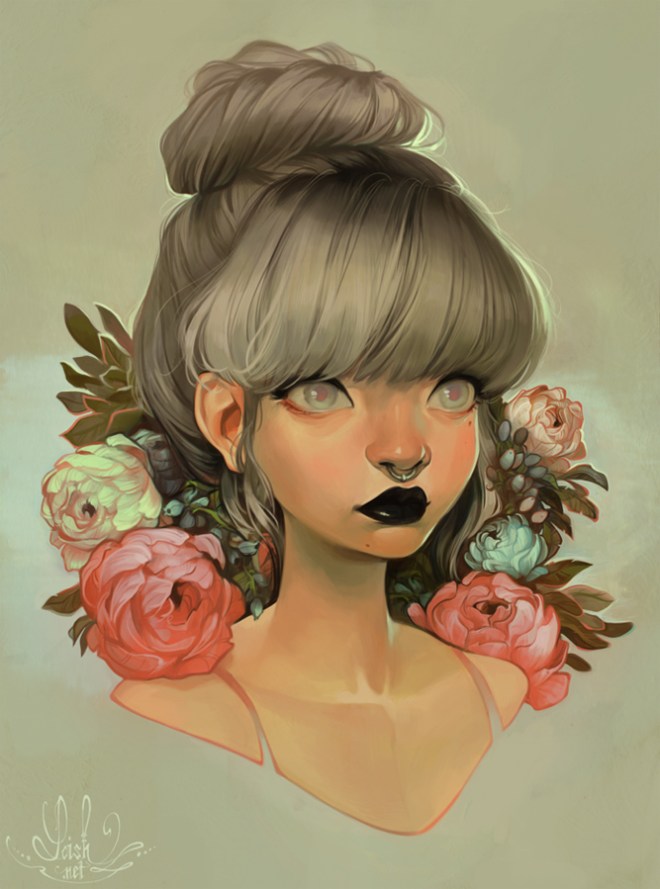
this poem by Jessica Bebenek was inspired by the art of Loish

On Advertising and Chips: “Crusading”

lumen_by_loish-d8zmpov

“Crusading”

word by Jacob Goldberg

colour by Loish 

Elias’ bag of chips had gone missing. He was walking around the classroom searching for his bag of chips. He brandished his lunch box at Mr. Epplin, telling him that they were there this morning. He asked Mr. Epplin where they had gone. Meanwhile Mr. Epplin hadn’t even asked him a question. He had been standing at the chalkboard writing the Fundamental Theorem of Calculus. And he looked to everyone to be terribly confused, like someone who had just been told that in fact Santa did exist. Elias didn’t care. He wanted to know where was his bag of chips. LAYS. Bag made of 70% reusable goods. The bag doesn’t mention where the last 30% came from. Elias speculates that it came from non-reusable goods. This is what Mr. Epplin calls an educated guess. 

Several minutes had elapsed since class began but this class seemed to be a lost cause. Of course, it could be have been recovered, had Mr. Epplin had ambitions to resume. But he didn’t. Mr. Epplin was looking for Elias’ chips. In fact, everyone was. Elias had corralled all of his classmates and his teacher into searching for his chips.

Elias asked every one of his classmates to empty their bags on their desks. He asked them to examine their belongings for his chips. He told them that they might have forgotten what you put in their bags. Sometimes, Elias said, he could overhear Mom whisper to Dad at Olive Garden that she’d forgotten something and now there was in issue underneath the table. This issue was her period. But dad would find a tampon in her purse. Elias said that the moral of the story was that you sometimes forget what you put in your bag. 

Mr. Epplin totally understood what Elias was getting at. He exclaimed to the class that he would be their father and inspect their bags for them. One girl, Eve, wondered whether this proclamation was grounds for terminating Mr. Epplin’s career as a teacher, but God intervened. He said to her, “Your namesake ate the apple: Don’t be the second Eve to fuck it up.” She wasn’t sure how to take this advice.  

When Ms. Chu, the biology teacher, appeared at the door with her students, Mr. Epplin, frisking Joseph, told her that he could arrest her if he wanted. He removed a pair of handcuffs from his breast-pocket and said don’t test me.   

Elias had removed the axe from the In-Case-Of-Emergency box and began to hack at the room’s infrastructure. One student had removed a wok from his backpack, another dry ice. Several students in the room were smoking cigarettes. Ms. Chu asked a student for one. The student said no. Ms. Chu and Mr. Epplin were holding hands. There was much excitement. Yes. Yes yes yes.

With the floorboards uprooted, the desks overturned, the windows kristallnachted, and the wallpaper peeled, Elias sadly decided that his chips were not in the room.

The next step was to set off the fire alarm. Elias’ thinking was: chips are denser than water, so they’ll sink in the rising water. Yes, Ms. Chu, the science teacher agreed. They emerged from the classroom, all attached to toddler leash.

The day would end soon, and Elias would go home hungry and chipless. All of Wilmington High would soon be on the Crusade for the Chips. Here, there is separateness in the togetherness, loneliness in the community. This crowd grows, and they are not alone, warding day and death away. 

word by Jacob Goldberg

“I was thinking about what it means to be a member of a group, to be driven by an idea, buying stuff, and how advertising can compel us to do things.  The girl in the picture seems like she could inspire such a crowd.”

see more colour by Loish 

This home will be home again

e26a9632907573.5697fdf1d1b92 (1)

word by Boris But 

colour by Alex Andreev

The obsidian titan looms from

Below, a weary vision bestowed

On the fallow dreamer dreary-

Minded by the sea.

st-petersburg montreal

Your quiet eyes pace through

My possessions: strangling rope,

Brine-soaked pages, symbols of the

Lost hope of an exiled meanderer.

st-petersburg montreal

Dear stranger, learn of home

And sing of it. When us strangers

Gather on stranger seas, we

Recall a home we never see.

st-petersburg montreal

Tale by tale you regale of the forgotten,

The sea-tossed bottle lost in tribal

Misunderstanding, a tongue

Lashing at hollow space,

st-petersburg montreal

Our anguish laid bare in mutual

Vulnerability, pyrobabble in place

Of a strange silence. Your eyes

Glimmer beneath a buried quaver,

st-petersburg montreal

A ripple pulsing from an unknown

Provenance ripping apart

In a fear or pain

Lost to a generation unto me.

st-petersburg montreal

My adrifted mind scrambles for some

Consolation of storied survivors or

A measure of a distinguished nature, blessed

By the godliness of constellations above,

st-petersburg montreal

The mortal shipwrecked sands below.

But let me rot here with you

Borne in eternal entropy,

Born to be forever forgotten.

st-petersburg montreal

Do dead men cry? Do words die?

Who swims and who sinks in your currents?

This home will be home again. Welcome,

Old friend, and dare not stay silent.

st-petersburg montreal

word by Boris But 

“What stranger does not first appear to be alien? Inspired by Alex Andreev’s masterful piece and anguished by the refugee crises and the oft-overlooked diaspora of vagrants everywhere, I crafted a poem about two strangers, perhaps parallel images, making a common home. What estranges people is the failure to recognize humanity in what we find unfamiliar. Stories imbue us with a transcendental magic, building homes where nothing should be.”

colour by Alex Andreev

“Alex Andreev lives in St. Petersburg, Russian Federation.
He’s been drawing, painting and doing graphic design over last 20 years.
He works as art-director in advertising agency and as senior concept artist for movie and game production. Born in 1972, Russia”

We asked for flowers and they gave us flying cars.

40a66ff499f49f7ed4305c2a654d2ad7-d6mrpg2

word by Josh Elyea 

colour by Garry Tugwell Smith

    Untether yourself from the Earth, they’d said. Man was born to fly.

                When I was a little kid, I’d run through the meadow behind our house with my arms waist-high. I’d convince myself that the gentle touch of the high grass against my fingers was exactly what a cloud might feel like, if you could reach out and grab it. I still think about that meadow as I run my hands through the greasy droplets of moisture that cloud the air as I drive to work. Clouds aren’t quite as majestic as my formative self liked to believe.

                It’s easy to look at a flying car and be impressed. It’s easy to look at it and think, we’re going in the right direction.

                Now, we look to the things that grow for sanctuary. We look for the things that hold fast to the Earth, that dig their roots deep and growl at the bastards who’d dare to try and dig those roots out, to inspire us, just as we once looked to our superheroes as they streaked across the sky. Now, we see heroism in every tree that dares to grow, in every flower that dares to bloom. We recognize the bravery in their determination, in their resolve. How hard it must be to be green in a grey world.

                To my left, a massive building hovers in the fog, beyond definition. Concrete but fluid, the building lurks as lights signal to oncoming traffic which sections of the sky to avoid. Strange to think that the sky, once so spectacular in its refusal to be defined, has now been mapped, separated into imaginary but all-too-real geometric spaces given a name and correlating number based on their geographic location (and in this process, had the entirety of its mystery stripped away, like a bad movie that foreshadows too heavily its own ending).

                The lights on the building pulse in the morning haze, and as the faint sun begins  to strike the windows of the tower, it seems for a moment to resemble a large flower unfolding as the day breaks. Is it possible that skyscrapers too have roots, dug deep into the concrete that has increasingly replaced the Earth?

 read more words by Josh Elyea 

see more colour by Garry Tugwell Smith

Depersonalization and the Effects of Medication

explorers_of_the_new_frontier_by_garryts-d9l17wz

word by Annie Rubin 

colour by Garry Tugwell Smith

She’s flying. In wisps of purple clouds, planets whizzing by, spinning and floating and falling. It was this chalky white pill, that kind of separated reality from the extra terrestrial. Worlds weaving in and out, setting apart the frenzied train ride from this spontaneous trip in vibrant flashes.

        The notion of the free-fall makes her jump with eyes fixated on the green circles of the metro line, they’re reading something altogether different than the weightlessness of her stomach or her fingers pressing onto what could only be hundreds of pins or the tightness in her chest: rising and falling in bursts of colour.

        The same five senses designed to orient are skewed. The scent of the subway, the burn of the wheels against the hot metal tracks, and the chorus of echoing voice, chanting something painfully inaccessible are present, distant.

        Fighting to define the boundaries of sobriety, she pieces together the images. There’s an empty seat beside her, she tries to listen to the silence. Wanting simultaneously to lie down and to break through the window of the train. 

        She’s watching herself hover above ground as the medication kicks in. Limbs go numb and the colours fade to a gentle hum of grey. Mood has been stabilized. The subway lurches to a stop and in the mass of bodies collecting at the doors, she makes her way onto the crowded street where her feet plant firmly into the concrete and her head feels lighter, less explosive.

        What is left to believe when perception becomes unreliable?*

From the author: “This futuristic image depicts outer-worldly colours and objects. It inspired a piece that confronts mental health topics of perception, depersonalization and the effects of medication. The mixture of sensations represents the profundity of mental illness in its capacity to debilitate a person throughout daily life and the idiosyncratic experiences of depersonalization in a mental health crisis.”


Read more of Rubin’s words on mental health

See more of Smith’s colour

How We Deal With Trauma

wreck_of_the_shuttle_peredur_by_garryts-d9gn02a

word by Keah Hansen

colour by Garry Tugwell Smith

content warning: violence

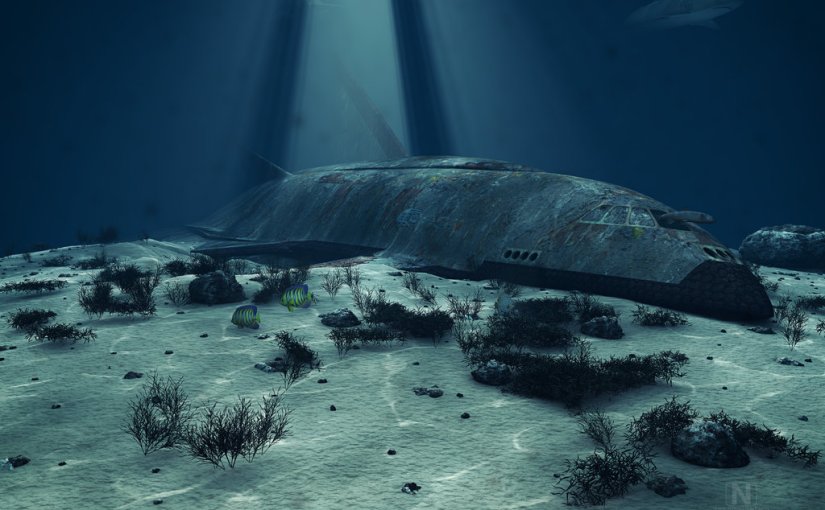
Her steel flanks glisten under a sordid sun. Scream white when sparring with that heady fire which scalds and percolates. Steam abates and disappears under the softer consciousness of the moon. In a world of duality we see seek healing our gendered symbols. We trail our fingers with alacrity over constellations of great queens. Bury our toes in the soil of wildflowers.  In a world of gender, the male deftly danced us to the mantelpiece and left us there to sweep and decorate and gaze about winsomely. Coddling the hearth with a dainty steel prong. Another wary night- the room is aflame as steel and her fire twirl and jest.

At the present moment we find our battleship sinking into black waters. She heeded caution and wore her armour willingly, heaving bells of alarm when the first missile singed her pristine sides.  In that vast ocean of a house, the cries besides the mantelpiece dissolved at the mudroom, unheard by the neighbours outside. Dashed twice on the rocks; a champagne flute smote under his gaze; the fire burned the scented candle wax and the moon waned to hide the rosy cheeks of the slipping ship.

Watch her picking ash off her skirt. Laundering out the lingering smoke of last night. Watch him watching her as they resume position- his fire rising out of that chimney and filling the world with another declaration of maleness. The delicate steel prong with flower etchings rests mutely by morning, like the battleship that poises leaden on the ocean floor. Salty water urges rust to spread up her shoulders and into the newly formed cavities.

This water mutes and oppresses. It won’t offer rebirth to she who has so many others to birth and support. Her body is a symbol of victory for patriarchy- the self-effacing female imprinted onto the minds of millions like a postcard of a battleship at rest. A war song rolls over the banks, prettying words of chauvinism.

For now, we pour our healing and ourselves into smaller symbols of identity. The ocean will someday offer its support– after countless battleships have chipped away and yielded to the currents- then women too will claim this territory as reverential. The mythic female will nest in these digressive and mysterious tides and the battleship will morph into a chanting pacifist baring flowers and peasant skirts. Identity is formed by such symbols- the kind that animates and roars and threatens to enflame a house with words.*

From the author:

“As I started writing this piece, I was inspired by the symbolism of the sunken warship resting on a seabed, and reflected on the processes of healing for different types of people, honing in on women in particular. However, these musings inspired a digression on the symbolic as a catalyst for growth and as a figurative location for anchoring, which unleashed a self-reflexive essay on the transience of the meanings behind symbols and the potency in claiming symbols for tangible social change.”

Read more words on mental health by Keah Hansen

See more colour by Garry Tugwell Smith

We love to point out shadows in the dark / But do we illuminate the monsters?

Print

“Illuminated Monsters”

word by Sean Hogan

colour by Giordani Poloni

More philosopher than centerfold,

She stops and stares at men who don’t care,

Beneath breasts beats more than fool’s gold,

Still, eyes linger where they wish she’d bare,


Fit to raise our youth and clean,

To buy and cook the food we eat,

Never heard and seldom seen,

Her labored fruits made bitter sweet,


The sliding scale of value froze

Needle pausing under half

Youthful beauty no longer shows

Her age screwed up the math.


At forty-five she “wastes away”,

Unmarried, unfortunate maid,

A gringo sitcom worn cliché,

To live, you must get paid,


She is only one example

One in all the many forms

A gender bent and trampled

Weathered leather in the storm


If a woman’s words fall on deaf ears,

Did they emerge or make a sound?

Do they possess so much to fear,

To keep the cycle spinning round?


Over half the population,

Trapped in shades of subjugation,

In every continent and nation,

In fear of pain, of death, invasion,


Is it not enough their body’s not their own,

That we wear and tear their very souls?

Teach girls to fear being alone,

To never take direct routes home?


We love to point out shadows in the dark,

But do we illuminate the monsters?

Trembling fingers hold no spark,

Steady hands, both shame and flaunt her

word by Sean Hogan

colour by Giordani Poloni

I didn’t miscarry her. I held her with so much love.

PONZI 2 copy

word by Cora-Lee Conway

colour by Giordano Poloni

I wanted to be a part of a club but I couldn’t talk about it. There is no evidence of my membership.

A mother in the making? In waiting? For a time? Am I a mother without a child?

I didn’t miscarry her. I held her with so much love. I took all the care I could. I dreamt of her future and loved her before I knew her.

I had cravings and I was tired. I was sick in the morning, noon and night. And I felt the weight in my soul and in my belly. And the lightness in my heart of knowing that you were getting all you needed from me.

So when I pass you by, group of dedicated warrior mothers, tending to your young like they are little birds, I ache.

I’d like to think I know where you are, that it wasn’t my fault that you are not here. I’d like to think that you are my first and that I won’t ever forget the short time that I held you, on the inside.

Am I a mother in the making? In waiting? For a time? Am I a mother without a child?

word by Cora-Lee Conway

colour by Giordano Poloni