colour

nous

Nous croyons dans les gens. Nous croyons que les mots et les couleurs peuvent inspirer de nouvelles manières de repenser le monde, ainsi qu’à élever la conscience populaire vis-à-vis l’injustice.

La formule est simple. Nous envoyons des pièces d’art aux écrivains qui, eux, nous renvoient une histoire inspirée par ce qu’ils ont vu.

Cette histoire est ensuite combinée à la pièce d’art dans le but de promouvoir des histoires qui mènent à penser autrement la société- divorcées des stéréotypes dominants- ou, même, des histoires qui s’attaquent directement à l’oppression vécue.

Nous sommes convaincus que les gens, une fois conscientisés, chercheront à réduire leur participation à la violence.

Nous aimons l’art et nous voulons que vous vous impliquiez.

Vous voulez écrire? Contactez notre éditeur à word@wordandcolour.com

Vous voulez une entrevue? Contactez notre responsable du marketing au marketing@wordandcolour.com

Vous voulez contribuer à l’opération? Contactez notre équipe de business au ambassadors@wordandcolour.com

click here for English

Le théâtre des opprimés

10968503_1590582171177990_5645835069203416747_n

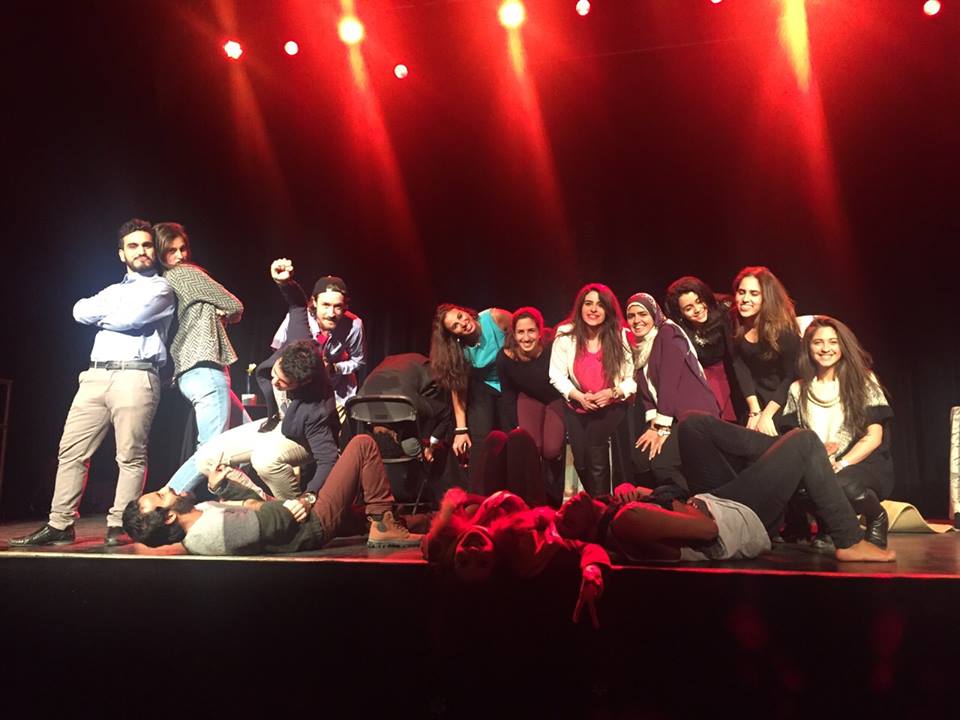
Le théâtre des opprimés, présenté par l’association des étudiants arabes (ASA), est un spectacle en deux actes ayant la fonction de poser d’importantes questions sur les rapports entourant l’oppression – sans toute fois prétendre avoir des réponses. Le spectacle mets en scène oppresseurs et opprimés et vers la fin de la représentation, des spectateurs sont invités à recréer des scènes en tentant d’améliorer le sort des personnages opprimés.

Cette technique interactive – développée en 1971 par l’activiste Augusto Boal – mis de la fébrilité dans l’air, le public ayant eu l’impression que ses interventions pouvaient avoir un fort impact sur la manière d’aborder le rôle des genres dans la famille, du profilage racial ou du harcèlement public au coeur des scènes.

Les membres du public trouvèrent de nouvelles façons d’interpréter les scènes du point de vue des opprimés sans toutefois changer radicalement les traitements prodigués par les oppresseurs. Les harceleurs publics continuèrent d’harceler leurs victimes malgré les réponses renouvelées de ces dernières et un officier de police qu’on confronta à la présence possible de motifs raciaux derrière l’exécution de sa fouille répondit:

“Et alors?”

11081047_1608204596082414_887284934734218877_n

La décision de l’Association des étudiants arabes de rendre chaque personnage multiple est intéressante. Tous tentent vivement de trouver la paix tant dans leur vie privée que leur vie en société, mais n’y arrivent pas toujours. Ce qui pose plusieurs questions: est-ce que l’oppression entoure seulement l’existence des oppressés mêmes ou en sommes-nous socialisés pour en être tous porteurs?

Comment réduire la souffrance lors de situations oppressantes lorsque l’oppresseur semble insensible aux appels de l’opprimé?

Bien que le rôle du Théâtre des opprimés n’était pas d’apporter des réponses concrètes, l’expérience qui se veut une opportunité d’humaniser l’humanité a su soulever des questions majeures.  L’association fait du travail important à Montréal et nous attendons leur prochain événement avec impatience.

Laurence Dauphinais – Montréal

click here for English

On Body Image and Norms

untitled“The little skeleton girl”

She was born without flesh.

It was just one of those things that happened sometimes: there was nothing anyone could have done about it and it was a blessing that it hadn’t been worse.

Her mother sat her down the day before the first day of school, tickled each vertebra in her back and said, “You have a spine.”

She knocked her knee caps and said, “You have good, strong legs.”

She stroked the underside of the girl’s flappy, yappy jaw and said, “You have a mouth, and a heart and a brain. You’ll be just fine.”

The little girl was late to school because a small, straw-y twig got stuck in her rib cage and it tripped her up. All the other kids knew each other already.

The girl had a crush on someone. She asked him to be her boyfriend. He held out his hand in her face and she didn’t know what it meant so she grabbed it with her bony claws and kissed it with her lips that weren’t lips. She felt something go from his palm to her mouth and it dodged past her vigilant tongue and slithered down, down, down into her stomach where it sat like a thumbtack in an airless balloon. He had shoved a tiny stone into her mouth to see if it would break her bones and though it was the most that anyone had ever hurt her, she did not cry but rather looked at the boy with a look of understanding that said that she saw that it was the worst thing he would ever do and that it would haunt him always and be the last thing he thought of before he fell asleep for a long time. Maybe it hadn’t been true before , but that look scared him so much that after it, the boy never did do anything worse, even when he was a man and there were many things he could have done.

The little skeleton girl, though, was pretty much done with the world after that, and she retreated to her room, where she wrote very very sad poems that hardly anyone understood. She did that for nearly the rest of her life.

word by Charlotte Joyce Kidd

colour by Andy Rofles

Review: ASA’s Theatre of The Oppressed

10968503_1590582171177990_5645835069203416747_n

The Theatre of The Oppressed, put on by the Arab Students’ Association, was a two act show that served to ask important questions about interactions on oppression – without claiming to have the answers. The performance intertwined lives of the oppressed and their oppressors in an interactive way: upon closing, members of the audience were invited to recreate scenes where they felt harm could have been reduced by taking the place of an oppressed character.

The innovative technique – developed in 1971 by activist Augusto Boal – brought tangible excitement to the audience. The feeling seemed that these new interventions would make a significant change in the scenes on gender roles in the family, racial profiling, and street harassment.

Audience members brought new ways of interpreting the scene from the oppressed, although bringing little change to the treatment by the oppressor: street harassers went on harassing, regardless of new responses from the harassed. A police officer was confronted on the racial motives of a search. The officer’s response?

“So what?”

11081047_1608204596082414_887284934734218877_n

Valuable lessons come from the ASA’s decision to portray all characters in a multifacted perspective, each struggling to find a balance of peace in their home and public lives, raising many questions: is oppression simply ‘around’ the oppressed, or is everyone born with it? How do we reduce harm in oppressive situations, when it seems that, however the oppressed responds, the same treatment seems to occur?

As the group proposed, the Theatre of The Oppressed was not to provide prescriptive solutions for change, but rather to raise awareness and pose questions while ‘humanizing humanity.’ An important group doing important work in Montréal – we look forward to their next event.

Allison Kutcher, 23 March 2015, Montréal

Image credits: Arab Student Association of McGill

politics of the locust pose

aaaaaaaaa

There was, of course, Joan.

It was Tuesday, and it was drizzling out of a low sky. The clouds looked preoccupied. Elijah’s 1900h yoga class was held in a studio on Delancey St. between Ludlow and Broome. Joan was one of the regulars. And on that Tuesday, she, Elijah, and I were the only ones who showed. The studio probably used to be a smoking room in one of the tenements, given the smell. Certainly the most curious item in there was a folding screen.

Tuesdays are my busiest day: I leave for work at 0630h, arrive at around 0800h, work until 1700h, whereupon I return to the lower east side for therapy, leaving me about ten minutes to get to yoga, which is thankfully three blocks from my house. As we waited for Joan, I considered the unpalatable pathos involved in paying someone to listen to your thoughts for a given amount of time. I am likely to discontinue therapy.

When Joan arrived she used a tissue to dab at the corner of her right nostril, which wasn’t leaking any material as far as I could see. She looked like a walking Nike advertisement and unrolled her yoga matt at about ping-pong distance from me. I have been doing yoga for four years.

Elijah began the session. He reminded us that no one was to speak. That this was an advanced class. I had done yoga with Joan for three of those years. A white noise machine hummed along outside the studio. Yoga has taught me many unexpectedly sexy facts. One is that if enough of the people in a room are quiet, you can hear the sound of perspiration. Another is that some people have the capacity to flex any combination of their abdominal “packs,” whenever they choose. And as I sank into locust pose, we sank into the quiet.

The session ended earlier than usual. Joan used one of the gratuitous Clorox wipes that Elijah leaves out to wipe the sweat off of her mat. When we leave the tenement, Joan asked if she could use the bathroom at my house because she lives back in Brooklyn, and my house was on her way to the F train. The air had the texture of a peach. It still rained. A picture falls out of Joan’s wallet; I pick it up.  Fog collects on the windows of every apartment. It was then that I learned that Joan is the type of woman who keeps a picture of her chiropractor in her wallet.

When we entered the house, I removed my shirt, soaked as it was from the rain. Joan found the bathroom easily enough. And I was slicing carrots for dinner when I heard the bathroom door open behind me. Joan said, Thanks partner. And as I began to turn, I felt her naked breasts drag across my back. My temple popped like a chicken you’ve left in the microwave too long.

word by Jacob Goldberg

colour by Andy Rofles 

From the author: “The chief thematic concern of this story is the nature of people beneath the masks that they sport everyday – and Joan is wrestling with trying to take hers off; she is trying to be human.”

Am I an anyday person?

datum-illustration-energy-power

When I lived in a tiny balloon, I did not know someone had the scissors. I thought the world was rubbery and hermetic, the way it feels when you read inside a moving car. Every day, every teacher, every traffic jam assured me that things were meant to repeat themselves – I thought that was the deal. Do what you are expected to do and everything stays in place. I paid a tax for every missed thank you – I got cornered through every lie. Parents, family, society, looking out for my way of doing things, holding me accountable for the perpetuation of our good values.

Us, we lived high on helium, so their tactics of masks and deceit stayed far. We kept them at bay with bunkers of reeky diaries, Michael Jackson shreeks and daily marble tournaments. I gave the fuzzy stickers to my best pals only, and together we read about species going extinct which we would grow up to save. We knew some were out to wreck it all with their boredom, and we were eager for our turn to come. We would make things right. We would melt the herd of frowns and expose raw beauty. It would shine invincibly.

Did we implode or were we severed?

Was it all planned or did it fester until it could no longer handle us inside?

One day, something cut the cord, broke the diving bell, and young oxygen became stale.

In some parts of the world, they train children to carry guns. In other parts, they train them to carry mortgages. In both, the key is to begin infiltrating the mind before it has the chance to form itself around the body that holds it.

This way, kids become anyone.

An anyday person among anyday people.

The last plane crashed inside because it wanted to die innocent. And then we popped: we stayed stuck in the free-fall for a long time, before there were ever any followers or any marginals. We used to be on the same page before they enlisted some on the front, others on the back, and crumpled and twisted us against one another.

I keep shards of childhood tucked beneath my veins, so that I don’t forget we all come from the land which growing-up destroys. I carry stickers that I give out to my best pals only. They read, “Do Not Ever Grow Extinct.”

word by Hoda Adra 

colour by Strautniekas

From the author: “The artwork inspired thoughts about childhood as a homeland, and how we might go through personal acts of resistance when faced with the pressure of belonging to the dangerous adult world.”

datum-illustration-2

taking control of the layers

untitled

Dissension oozed thick, coloured with every shade of emotion; everyone could see that she was loosing form. The angles and contours of her performance were obscured – all precision to the approach had been abandoned. All that was left was a covering-over of that which was covered-over. Her sharp words now muffled and barely audible over the noise of what could be clearly seen as an implosion come undone.

I closed my eyes and put my fingers to my temples and awaited the barrier of silence I had built in my mind to be shattered by the sound of her cries. As her father I had become accustomed to reading the signs and positioning myself to be at the ready should she need me. I primped and prepped and practiced alongside her, but once she stepped out on that stage she was entirely on her own. And here she was, melting into a puddle of pastel-coloured mess, centre-stage, harsh lights ablaze. I sensed amusement on the lips of those around me, and full-bellied brawling laughter was just moments away. I sensed the horror on the faces of the four perfectly coiffed has-beens who spent their every weekend judging the misguided proclivities of young girls whose burgeoning self-worth would be inextricably tied to their looks.

I prepared myself for the unwonted stares, pitiful glances and murmurs of judgment but instead as I made my way towards the stage I found an impressive showing of ingenuity. In what appeared to be the beginning stages of a meltdown, profuse dissension had resolved itself into abundant honesty, a truth so pure that it lacked its typical bite.

Inside the dingy low-budget hotel conference room, in front of pageant parents, child contestants and jaded judges, Noelle begun to confidently rip long pieces of fabric off her dress, and stick them into the spaces between her still first set of teeth. She took the heels of her palms and expertly smeared eye make-up down her face. She ripped her tights, undid her hair and ran around the stage fully committed to portraying the mythical creature in her favourite bedtime tale. In one beautiful act of childhood defiance, Noelle played and pretended, sang and cooed, delivering gibberish prose with Shakespearian gravitas. Laughter escaped the tightly pursed and botoxed lips of the former beauty queen judges and childhood chatter echoed off the walls and lurid drapes.

I was once beyond resentful of spending my every other weekend with the insipid pageant folks, practicing routines and applying fake lashes, but that was all that I could get, so I took it. And Noelle was a wonder on that stage, consistently low-scoring but persistent. And after years of attempted conformity an apparent meltdown unleashed a cacophony of colour and sound, my beautiful girl.

word by Cora-Lee Conway

colour by Zutto

From the author: “A thick, sweet, melt like a human ice cream cone; I kept thinking about the upside to a meltdown… Perhaps also inspired by my location as I write this sitting on the beach in Cuba, melting in the best way.”

zuttto

zuttto33

sounds from the future

zzz

Jimmy was a prick for bringing me here. I don’t frequent these sorts of places, at least not since the end of the 21st century when jazz made a big comeback with the space-faring folk. Something about trumpets and saxophones helps when you’re staring out into all that black. It ain’t for me though, jazz- cramped venues that reek of cigar. Charlie Parker aside, whose work any semi-intelligent individual should be intimately familiar with, I hate jazz.

Jimmy kept going on and on about this woman, a jazz singer, and I had to see her.

       That’s what they’ve got holographics for, my man, I said. Wear a pin, stream me in.

       No way, he says. It’s gotta be live.

Left me drinking Jameson at the bar, listening to jazz, and it ain’t all that bad. The band’s minimal, a real stripped back affair. Ivory and vocals. The singer’s got this retro style that reminds me of the post-postmodern infusion of underground Japanese disco into the Can-American consciousness. Lollipop chic. Real big circa 2025, before I left the Rock. It’s the hair, I think: styled, but not overly so. It’s got that outside-the-asteroid belt attitude – think glam-rock meets two months on a space freighter. Works for her.

Wearing one hell of a dress too, a swanky number that looks like it’s patterned after those pre-revolution flapper girls you see on OWC (the Old World Channel). It all adds up to a spectacular sort of woman, one who projects this sultry voice right into my whiskey-soaked skull. Real stellar eyes too… all sorts of devastating, like second-hand smoke, purple, and heavy, and deadly to breathe in. Stardust on her eyelids… listening to her sing, maybe space isn’t a wasteland. Don’t make ’em like this back on the Rock, you know?

I’m staring – she notices.

I hear her speak, a voice smouldering like the sun outside the tinted window.

What’re you looking at, Earthling?

word by Josh Elyea

colour by Zutto

From the author: “”When I was writing this piece, I couldn’t move past the eyes. They’re captivating, and I imagine I could’ve spent the entire piece talking about them…what you’re left with is a vignette about a man in space who finds himself head over heels for a jazz singer from Jupiter.”

Ken

floating-away_650 (1)

Ken and Mavis lived at number 9 Flosstooth Avenue. Ken loved Mavis like a dog loves its favourite bone—he would chew on her every now and then to remind himself what true gristle could taste like, but then he would bury her, and all that she meant, and would wait for weeks or months until he dug her up to gnaw at her all over again. That way it was special, and that way Ken knew he would never get bored of his favourite bone. Mavis didn’t like being gnawed at every few months; she told him just before she asked him to leave that she expected constant gnawing. He hadn’t realised that, and offered to never bury her again, but by then it was far too late.

The summer before the end, the neighbours on the side with the dead rose bush that looked like a mutant spider moved out. A few weeks later a dual-cab UTE was parked in the driveway when Ken got home from work, and after some careful investigating from the kitchen window through Mavis’s homemade gauze curtains, Ken gathered that their new neighbour had moved in, and that he was a tall, broad-chested man, with the necessary bulges to wear only a singlet as he loped from his UTE to the door with boxes and bags. Ken saw that the man with the necessary bulges had two lean and hefty dogs. Ken was terrified of dogs, ever since he had been chased by a pack of gnashing greyhounds up and over the slide in the playground one afternoon when his father had forgotten to pick him up from school. He felt trapped in the house, and told Mavis about it when she came home weary from the salon, but she didn’t seem to be listening, and just stood and watched out the window until the sun went down and there was nothing to see anymore.

A couple of months later on a Friday Ken decided to leave work early. He arrived home to see that Mavis was already there, and though he called out for her in every room in the house but he couldn’t find her. Mavis didn’t like to walk anywhere; if her car was there, she had to be too. Ken poured the tap for the kettle and as he poured he looked through the gauze straight into the man with the bulges’ living room. There he saw Mavis, completely naked and dancing around the room with the man with the necessary bulges.

Ken hadn’t wanted to leave, even after watching Mavis and the man with the bulges in a variety of positions all over the living room that made him begin to sweat under his arms and in between his elbow creases. When she came home that night, crumpled and smelling of dog food, he had offered to stay in the spare bedroom. That she simply agreed, and didn’t seem to need to ask him why, told Ken that he would never unearth his favourite bone again.

word by Laura Mcphee-Browne

colour by Ilya Shipkin

From the author: “When I first saw this illustration by Ilya Shkipin, I saw the man and the dogs he was feeding as dangerous, as hostile. As I came back to look at the illustration again and again, I began to feel that there was a special relationship between the man and the dogs; that they knew each other well, and perhaps looked after each other.

My story, ‘Ken’ is about a man who does not feel comfortable in his own skin like the man in this illustration surely does. It is about the threat that confidence and mystery can be to a flailing relationship.”

my atlas

2 - Leah

I have to confess to being an absolute intolerable lay-about for the past twelve weeks. Never before has so many eggs on toast been consecutively imbibed. But after week twelve, something changed. You see, I began being able to read the brightness of other people’s souls.

Now – bear with.

I would never lie to you, my reader. A few nights ago, I was watching the box and I could see and feel the density and energy in the souls on screen, you see.

Imagine a sort of X-ray sense, an unlocked potential from partially losing my vision. Not better hearing but a heightened instinct for character.

Quite quickly I’m proud to say I started spotting a pattern. It wasn’t to do with how ‘famous’ or how ‘good’ humans they were, nothing as crude as that, it was to do with their real actions in our little society, you see: watching the whitest ones shine darkest.

The real problem whirs in our nightmarish collective of unhappiness and inequality… while the rich get richer, they stamp up the prices of opportunity and education. Meritocracy?

Bullshit, I’ve always said, only difference is that it’s now in my face, glowing from the screen. Can’t ignore it anymore.

As I watch the oozing blackness pulsate around every orifice of the spiffingly rich and white, I begin to realign where I stand in this mess of a melting pot.

I’m now the guardian of the gates, the one thing that has the god-given ability to grab the status quo by the horns and flip it on its head.

I can physically suck out their prejudices…

I can cure them of their illness.

word by Sam Fresco

colour by el Decertor