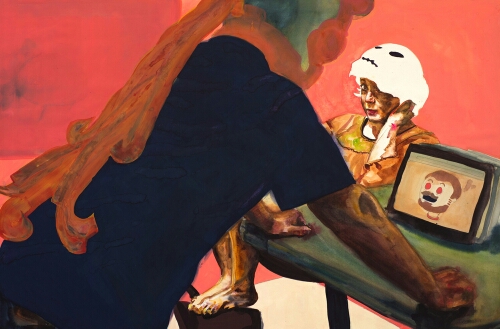
On memory: “self and other”

image

Despondent at the sight of her, waxing caramel and silk, bruising blue from apathy. Who it is I am looking for in the shape of her, the curve and weight of her bones. The scrutiny of this survey has everything to do with consumption. Mass of flesh, scent of jasmine, soap, talcum powder.

I become suddenly thirsty and my legs fold in like a hand. From every angle calls some small adjustment, something not quite in place, not quite concealed. I remember the shirts I wore in highschool, carefully selected from your laundry pile and big enough for my body to move beneath them unnoticed.

Meanwhile she moved with such a lightness I had never been empty enough to feel, spread her toes across the bathroom counter smoothing lotion into her calves; she had six children for the institutions of God and marriage. What I saw for the sake of this story was the width of her waist on an inhale, saw her spinning across the living room floor. She praised my poetry then stopped calling altogether.

Of course I never expected she would, and this is not really about her, or the blue light of my new apartment where no one eats and everything is covered with a film of dust and the smell of smoke. I blink into the mirror and take a sip from a white, enamel cup stained with her lipstick. I know that I will see her in the kitchen and she will have cut her hair again. She will be quietly frantic, pouring cream in her coffee and letting the filter drip. The garbage can is full of dust and the ends of her cigarettes stained with lipstick.

If the weight of my bones were a little less dense. If I did not bruise under the touch of her fingertips. I could step into this room unfeeling, dressed in animal prints and steel, chewing a stick of gum.

word by Alisha Mascarenhas
colour by Gan Chin Lee 

Job opening: Head Of Colour

cropped-wqwww1.jpg

Job opening: Head of Colour

Word and Colour

Reports to Editor

The Art Director will curate the art for upcoming features at the magazine. After contacting artists, the Art Director will inform the Editor of upcoming features with all required information. Certain events in Montréal may require the attendance of the editor to represent our brand, and the Editor may also select artists to feature.

*An awareness or openness to social justice politics is essential as a representative of the Word and Colour brand. Word and Colour is a creative Non-Profit Organization of volunteers. This position will be paid when revenue streams are implemented according to workload, and requires minimal hours of commitment.

Our Ideal Candidate:

Reliable, organized, proactive

Education / Experience with visual art

Knowledge of social justice issues

Responsibilities:

Contacts artists for weekly features

Represents Word and Colour at art events

Responds to e-mail within the day

Is available for monthly meetings in Montréal


Please read over our mission statement before applying!

Application deadline:  Friday, May 1, 2015

Send CV to word@wordandcolour.com

On Consumption as Religion: “Print Nation”

7032525_orig

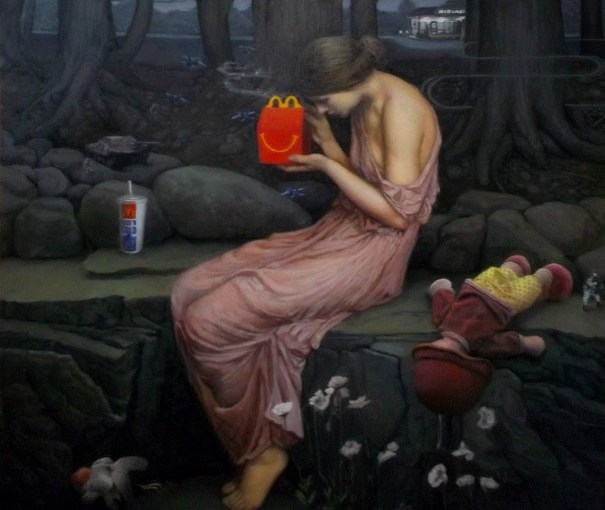
Print Nation

1

Oona was woken with a shove of the alarm. Thrust out from blissful nothingness through ever-lighter hoops, consciousness clicking its groove to bring a bleary world into focus. She passed the morning broadcaster in room 117B, tuning in to the daily download.

         … another day of fantastic performance with the corporation hitting total sales of 68 million yesterday – over target but as always, room for improvement…

Her crisp striped dress, fresh from the delivery draw, she filled her mind with the days work – excited as always.

          … and with 17 new opens yesterday and another 1300 upcoming until the end of this quarter we have plenty to get on with, it’s booming business as usual!’

Oona picked up the final piece of uniform, moved towards the sink; once again it captured her attention.

2

She observed the tiny dark red patch amongst otherwise perfect chrome tubing. The tiny rust that had evolved into a tiny leak with a tiny drip. The tiny puddle in the nook of the room.

“Did you find it?” said her sister.

Greta’s mousey brown eyes, squared and neat, glimmered like fish scales under the mirror light.

“Oona, you have to promise me this will be just ours. A bond between two chamber sisters.”

Oona knew that when she had to pray at day recap to MOD that evening, the Almighty One would know this memory.

“Block this out at prayer, it’s possible, I’ve done it.”

Greta’s fingers dove into the crack in the concrete where the puddle had been building, tearing out a piece. She scraped the dust away gently so they could see it.

 3

 Small green straw with two small green spoons.

“Oona Forty-Three of Chamber 117B, do you know what this is? This is what the Customers call, a plant.”

 4

The buzzer sounded for check-in. Greta covered up the corner with the dust then concrete and they grabbed their headphones before walking out the chamber.

The morning download finished.

        …And remember folks, one day we will get to the Golden Gates and that day we will all be rewarded by MOD.

Briskly they headed out before parting ways –Greta assigned to Food Print and Oona to Physical Server.

The shutters pulled up and in walked the first of the days Customers.

“Welcome to McDonalds, how can I help?”

word by Sam Fresco

From the author: “Once I received this image, I looked up some facts on McDonalds and was stunned to find the following:

  • McDonald’s feeds 68 million people per day – about 1 percent of the world’s population (and more than the population of the UK; twice the amount of Canada)
  • 1 in every 8 Americans has worked in a McDonald’s
  • McDonald’s’ $27 billion in revenue makes it the 90th-largest economy in the world.
  • On average, McDonald’s opens a new branch every 14.5 hours
  • A recent study by Scholosser (2002) found that the Golden Arch’s were more recognizable than the cross. 

So it got me thinking: what if it printed food took it one step further and printed its staff? In that case, where’s the line between a corporation and a religion- a CEO and a God?

colour by Kojiro Ankan Takakuwa

On Family: “Bug”

152251_orig (1)

Bug

when Benny was 1 and I was 7, I took him down to the park near our place on the lane named after Shakespeare

he’d been at the pool with Mum all morning, tucked behind the blue walls on Alexandra Parade, and his tuft of soft hair was still wet

he nestled into my arm as we walked along the cooking bitumen, and when I crooked my arm to let him in, he cooed like a bird would, if a bird was Benny

at the park I climbed us up the ladder of the slide and put his bum on the cool grey top of it

he giggled as I backed down the rungs one by one and as I walked away from him and the slide and the sand and the dog poo, I felt my heart get bigger slowly like a blowing up balloon

my heart kept getting bigger and bigger as I walked down the street towards the milk bar, and as I was paying for my lemonade icy-pole it burst

Benny was wailing when I got back

I told him I’d just gone to get us an icy pole and he didn’t have to be sad

he was choking on his tears but then the tears slowed to hiccups and then the hiccups slowed to snot and I told him he’d crawled into my heart like a funny little bug, and it was just as well you can’t spray bug-spray near your heart

word by Laura McPhee-Browne

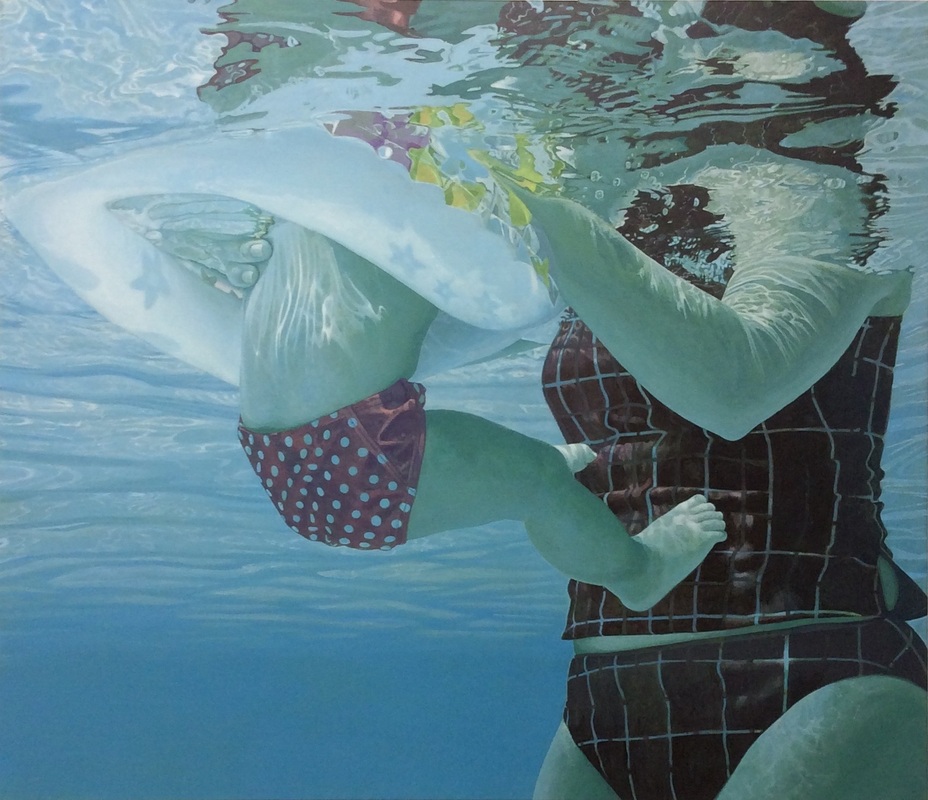
“This painting is beautiful, and reminded me of familial love. 

It reminded about how it for me was when my brother was a baby, and how older siblings often experience a cacophony of emotions when they are confronted with siblings, emotions that are strong and fierce and both negative and positive.” 

colour by Kojiro Ankan Takakuwa

On Masculinity: “Her lipstick”

10675542_10205668266971916_2726513934329467292_n

Content Warning: misogyny, violence

“She looks like a whore,” I say, covering my mouth with my hand in case the lady can read lips. I lean back against the wall, hiding my unlit cig behind me.

“It’s her lipstick,” says Danny. “Nobody’s wife wears that colour lipstick. It makes her mouth look like a pussy.”

Danny pulls a cig out of his pocket and lights it right there in front of the lady sitting in the car. He doesn’t care who sees him. Danny takes another cig out of his pocket and hands it to Albert, who’s sitting on the curb. Albert is my little brother. He’s in a school for kids who are slow because he doesn’t know how to read. Danny hands Albert his naked lady zippo and Albert lights up, just like Danny.

Albert holds the zippo out to me, looking at me like I’m a pussy.

The alley behind the gas station is where we always come to smoke. Danny steals cigs from the bag his dad keeps in the freezer. We come here because there’s never anyone here, but today there was the lady in the car. She’s just sitting in the passenger seat staring out the side window. I’ve never smoked in front of someone older than me before.
“She doesn’t give a shit, Thomas,” Danny says. He says it like he doesn’t want me to embarrass him. He waves at the lady but she doesn’t move; she just keeps staring, looking past us at the wall, maybe even past the wall.

“I know,” I say. I take the zippo from Albert but I leave the cig behind my back. Danny’s zippo has a hula dancer on it and when you flick the cap open her head comes off. Mine just has my grandad’s initials on it.

“She looks kinda like Ms. Glover,” Danny says. “Ms. Glover was a babe. Remember last year when she left school and Mr. Plummer got arrested?”

Everyone remembers when Ms. Glover left school. The lady in the car does look like Ms. Glover, except for the lipstick.

I take the cig out from behind my back and flick off the hula girl’s head. I run it along my jeans and it lights the first time. When I was 10 like Albert, I thought you were supposed to swallow the smoke and I’d cough every time, but I’m better at it now. I was scared of sea monsters and boogeymen; I was scared of the dark. Now that I’m 12, I’m not afraid of anything.

Albert flicks his cig out into the alley. “She’s trying not to cry,” he says.

word by Leah Mol

colour by Luis Sipion

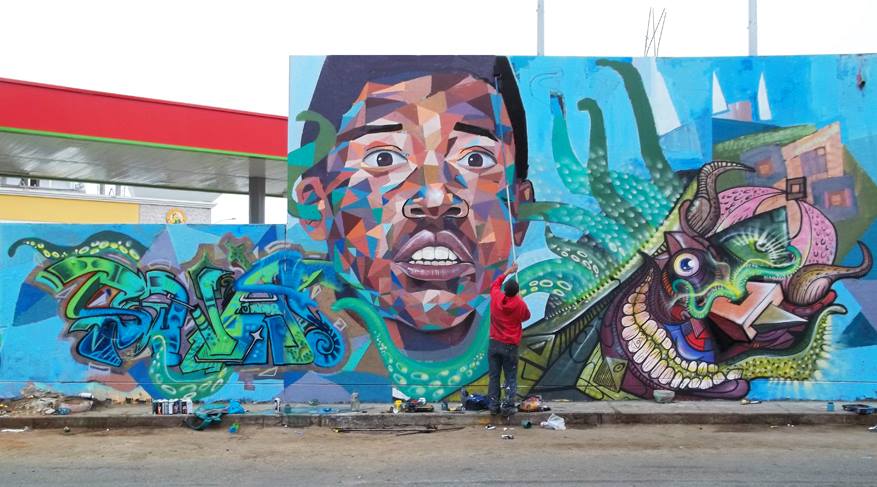
From the author: “Youth is a time of naked tribalism, a time when language and behaviours stand as shibboleths. In this story, boys are pretending to be men in order to fit in, but they believe part of being a man is oppressing others. Thomas doesn’t want the lady to see him use the word whore, but he also doesn’t understand the weight that word carries with it. Danny brings up Ms. Glover and hints at the reason she left school, but they don’t explore the importance of that.

This story is about fear and reactions to fear. Fears of children vs. fears of adults. Fears of women vs. fears of men. Fears of imagined monsters, of not fitting in, of getting caught somewhere you shouldn’t be. And fears of the very real monsters that make people cry every day.”

nous

Nous croyons dans les gens. Nous croyons que les mots et les couleurs peuvent inspirer de nouvelles manières de repenser le monde, ainsi qu’à élever la conscience populaire vis-à-vis l’injustice.

La formule est simple. Nous envoyons des pièces d’art aux écrivains qui, eux, nous renvoient une histoire inspirée par ce qu’ils ont vu.

Cette histoire est ensuite combinée à la pièce d’art dans le but de promouvoir des histoires qui mènent à penser autrement la société- divorcées des stéréotypes dominants- ou, même, des histoires qui s’attaquent directement à l’oppression vécue.

Nous sommes convaincus que les gens, une fois conscientisés, chercheront à réduire leur participation à la violence.

Nous aimons l’art et nous voulons que vous vous impliquiez.

Vous voulez écrire? Contactez notre éditeur à word@wordandcolour.com

Vous voulez une entrevue? Contactez notre responsable du marketing au marketing@wordandcolour.com

Vous voulez contribuer à l’opération? Contactez notre équipe de business au ambassadors@wordandcolour.com

click here for English

Le théâtre des opprimés

10968503_1590582171177990_5645835069203416747_n

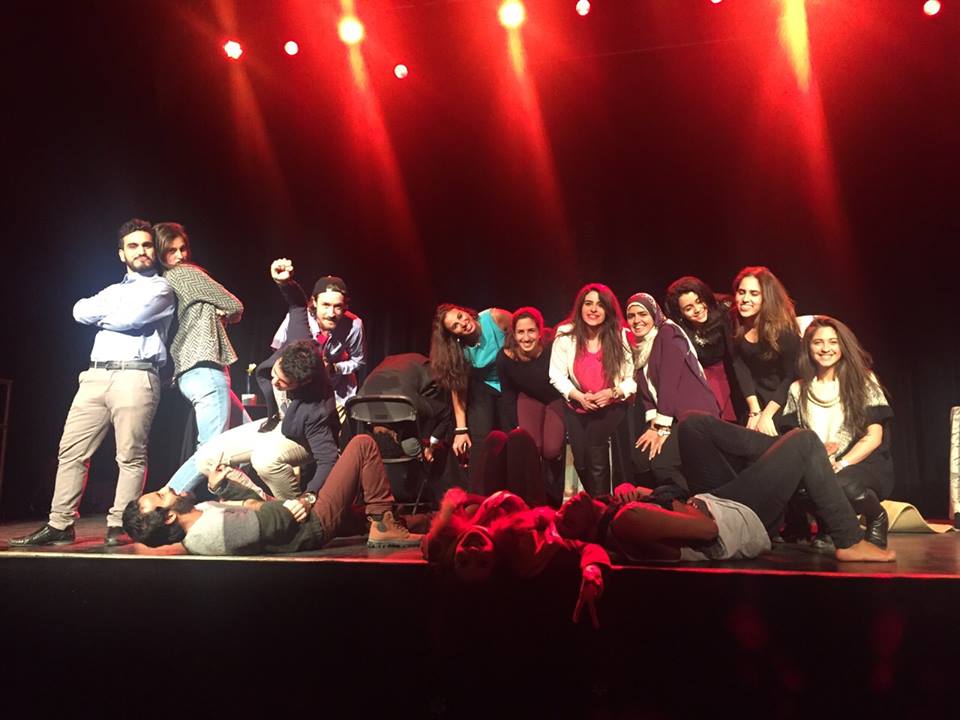
Le théâtre des opprimés, présenté par l’association des étudiants arabes (ASA), est un spectacle en deux actes ayant la fonction de poser d’importantes questions sur les rapports entourant l’oppression – sans toute fois prétendre avoir des réponses. Le spectacle mets en scène oppresseurs et opprimés et vers la fin de la représentation, des spectateurs sont invités à recréer des scènes en tentant d’améliorer le sort des personnages opprimés.

Cette technique interactive – développée en 1971 par l’activiste Augusto Boal – mis de la fébrilité dans l’air, le public ayant eu l’impression que ses interventions pouvaient avoir un fort impact sur la manière d’aborder le rôle des genres dans la famille, du profilage racial ou du harcèlement public au coeur des scènes.

Les membres du public trouvèrent de nouvelles façons d’interpréter les scènes du point de vue des opprimés sans toutefois changer radicalement les traitements prodigués par les oppresseurs. Les harceleurs publics continuèrent d’harceler leurs victimes malgré les réponses renouvelées de ces dernières et un officier de police qu’on confronta à la présence possible de motifs raciaux derrière l’exécution de sa fouille répondit:

“Et alors?”

11081047_1608204596082414_887284934734218877_n

La décision de l’Association des étudiants arabes de rendre chaque personnage multiple est intéressante. Tous tentent vivement de trouver la paix tant dans leur vie privée que leur vie en société, mais n’y arrivent pas toujours. Ce qui pose plusieurs questions: est-ce que l’oppression entoure seulement l’existence des oppressés mêmes ou en sommes-nous socialisés pour en être tous porteurs?

Comment réduire la souffrance lors de situations oppressantes lorsque l’oppresseur semble insensible aux appels de l’opprimé?

Bien que le rôle du Théâtre des opprimés n’était pas d’apporter des réponses concrètes, l’expérience qui se veut une opportunité d’humaniser l’humanité a su soulever des questions majeures.  L’association fait du travail important à Montréal et nous attendons leur prochain événement avec impatience.

Laurence Dauphinais – Montréal

click here for English

On Body Image and Norms

untitled“The little skeleton girl”

She was born without flesh.

It was just one of those things that happened sometimes: there was nothing anyone could have done about it and it was a blessing that it hadn’t been worse.

Her mother sat her down the day before the first day of school, tickled each vertebra in her back and said, “You have a spine.”

She knocked her knee caps and said, “You have good, strong legs.”

She stroked the underside of the girl’s flappy, yappy jaw and said, “You have a mouth, and a heart and a brain. You’ll be just fine.”

The little girl was late to school because a small, straw-y twig got stuck in her rib cage and it tripped her up. All the other kids knew each other already.

The girl had a crush on someone. She asked him to be her boyfriend. He held out his hand in her face and she didn’t know what it meant so she grabbed it with her bony claws and kissed it with her lips that weren’t lips. She felt something go from his palm to her mouth and it dodged past her vigilant tongue and slithered down, down, down into her stomach where it sat like a thumbtack in an airless balloon. He had shoved a tiny stone into her mouth to see if it would break her bones and though it was the most that anyone had ever hurt her, she did not cry but rather looked at the boy with a look of understanding that said that she saw that it was the worst thing he would ever do and that it would haunt him always and be the last thing he thought of before he fell asleep for a long time. Maybe it hadn’t been true before , but that look scared him so much that after it, the boy never did do anything worse, even when he was a man and there were many things he could have done.

The little skeleton girl, though, was pretty much done with the world after that, and she retreated to her room, where she wrote very very sad poems that hardly anyone understood. She did that for nearly the rest of her life.

word by Charlotte Joyce Kidd

colour by Andy Rofles

Review: ASA’s Theatre of The Oppressed

10968503_1590582171177990_5645835069203416747_n

The Theatre of The Oppressed, put on by the Arab Students’ Association, was a two act show that served to ask important questions about interactions on oppression – without claiming to have the answers. The performance intertwined lives of the oppressed and their oppressors in an interactive way: upon closing, members of the audience were invited to recreate scenes where they felt harm could have been reduced by taking the place of an oppressed character.

The innovative technique – developed in 1971 by activist Augusto Boal – brought tangible excitement to the audience. The feeling seemed that these new interventions would make a significant change in the scenes on gender roles in the family, racial profiling, and street harassment.

Audience members brought new ways of interpreting the scene from the oppressed, although bringing little change to the treatment by the oppressor: street harassers went on harassing, regardless of new responses from the harassed. A police officer was confronted on the racial motives of a search. The officer’s response?

“So what?”

11081047_1608204596082414_887284934734218877_n

Valuable lessons come from the ASA’s decision to portray all characters in a multifacted perspective, each struggling to find a balance of peace in their home and public lives, raising many questions: is oppression simply ‘around’ the oppressed, or is everyone born with it? How do we reduce harm in oppressive situations, when it seems that, however the oppressed responds, the same treatment seems to occur?

As the group proposed, the Theatre of The Oppressed was not to provide prescriptive solutions for change, but rather to raise awareness and pose questions while ‘humanizing humanity.’ An important group doing important work in Montréal – we look forward to their next event.

Allison Kutcher, 23 March 2015, Montréal

Image credits: Arab Student Association of McGill

politics of the locust pose

aaaaaaaaa

There was, of course, Joan.

It was Tuesday, and it was drizzling out of a low sky. The clouds looked preoccupied. Elijah’s 1900h yoga class was held in a studio on Delancey St. between Ludlow and Broome. Joan was one of the regulars. And on that Tuesday, she, Elijah, and I were the only ones who showed. The studio probably used to be a smoking room in one of the tenements, given the smell. Certainly the most curious item in there was a folding screen.

Tuesdays are my busiest day: I leave for work at 0630h, arrive at around 0800h, work until 1700h, whereupon I return to the lower east side for therapy, leaving me about ten minutes to get to yoga, which is thankfully three blocks from my house. As we waited for Joan, I considered the unpalatable pathos involved in paying someone to listen to your thoughts for a given amount of time. I am likely to discontinue therapy.

When Joan arrived she used a tissue to dab at the corner of her right nostril, which wasn’t leaking any material as far as I could see. She looked like a walking Nike advertisement and unrolled her yoga matt at about ping-pong distance from me. I have been doing yoga for four years.

Elijah began the session. He reminded us that no one was to speak. That this was an advanced class. I had done yoga with Joan for three of those years. A white noise machine hummed along outside the studio. Yoga has taught me many unexpectedly sexy facts. One is that if enough of the people in a room are quiet, you can hear the sound of perspiration. Another is that some people have the capacity to flex any combination of their abdominal “packs,” whenever they choose. And as I sank into locust pose, we sank into the quiet.

The session ended earlier than usual. Joan used one of the gratuitous Clorox wipes that Elijah leaves out to wipe the sweat off of her mat. When we leave the tenement, Joan asked if she could use the bathroom at my house because she lives back in Brooklyn, and my house was on her way to the F train. The air had the texture of a peach. It still rained. A picture falls out of Joan’s wallet; I pick it up.  Fog collects on the windows of every apartment. It was then that I learned that Joan is the type of woman who keeps a picture of her chiropractor in her wallet.

When we entered the house, I removed my shirt, soaked as it was from the rain. Joan found the bathroom easily enough. And I was slicing carrots for dinner when I heard the bathroom door open behind me. Joan said, Thanks partner. And as I began to turn, I felt her naked breasts drag across my back. My temple popped like a chicken you’ve left in the microwave too long.

word by Jacob Goldberg

colour by Andy Rofles 

From the author: “The chief thematic concern of this story is the nature of people beneath the masks that they sport everyday – and Joan is wrestling with trying to take hers off; she is trying to be human.”