On Homelessness: “Walking past”

Shalak3

“Look. I know. But I’m telling you, we, like, run in the same circles or something.”

“Which fucking circles are you running in?”

“I dunno, man, just…I’m telling you, I see him everywhere.”

“Give him some cash, man, he’ll leave you alone.”

“I dunno. Do you think he, like, stalks me?”

“Who knows, man. You know what he’s after.”

“Think he can hear us?”

“Probably. Keep looking forward don’t want to give him the wrong idea.”

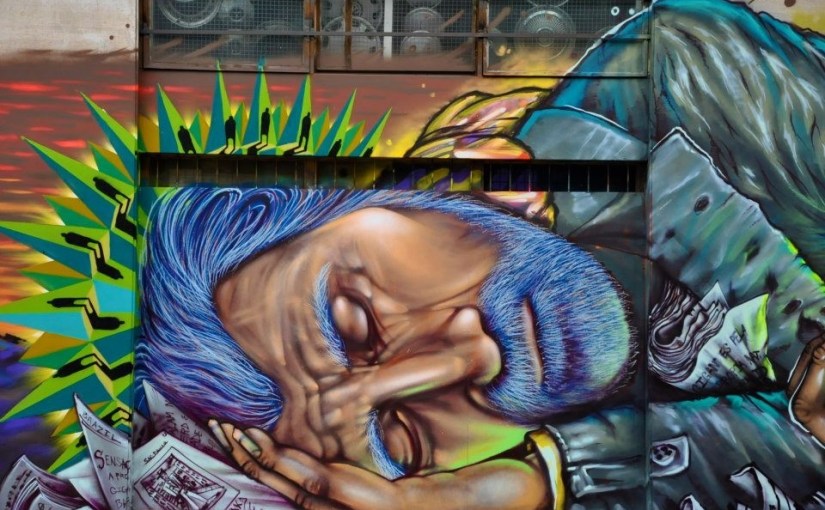
The subject of their intrigue happened to be a well-recognized face on this street. His salt-and-pepper beard perpetually caked in sweat, eyes bloodshot, if ever opened, fingernails speckled with dirt.

When he wasn’t pacing the corner of the main street, he would lie curled on the ground, enveloped in a makeshift bed, a mattress formed from warped cardboard and a newspaper pillow.

A Styrofoam coffee cup rest at his feet to collect spare change—its position was far enough from his person so as not to elicit too intimate an interaction between hopeful donors and himself, yet close enough to grasp in the case of a thief lurking uncomfortably nearby. This was his domain.

The men who passed him daily found themselves split between curiosity and repulsion as they, in American Apparel, wondered how one could end up on the streets, and why the man couldn’t pull himself up by the bootstraps “and just find a job,” as they all had done for themselves.

The day he disappeared, those who questioned his absence primarily didn’t know who to confront with their concern, or why they felt they needed an answer in the first place, and never did anything about it.

word by Annie Rubin

“With such ease, passersby devalue or dehumanize the lives of homeless people. This story’s focus on the interactions of one man tries to demonstrate a lack of compassion and emphasize the societal conditioning that our culture perpetuates towards those who are not able to work or find a home.”

colour by Shalak Attack

“Shalak Attack is a Canadian-Chilean visual artist dedicated to painting, muralism, graffiti urban art, and canvases. Shalak  has manifested her artistic expression on urban walls across the world.  Shalak is a co-founder and member of the international art collectives “Essencia”, the “Bruxas”, and the “Clandestinos”. 

Shalak also works with several other mixed media approaches such as tattoo art, jewelery, illustration, installation, sound, and video making. In the past ten years, she has participated in numerous artistic projects and exhibitions in Canada, Chile, Brazil, Mexico, Palestine, Jordan, Isreal, France, Belgium, Spain, Argentina, Venezuela, the Dominican Republic, Senegal and recently in Sweden for the Artscape Mural Festival. 

Shalak shares her passion for freedom of expression, and has facilitated visual art workshops to youth of under-privileged communities and prisoners in various countries across the Americas, Europe, the Middle East and in Africa.  Her artistic work and community art-reach is rooted in the social and cultural values she received from her family growing up across Canada.  Since then, her most impacting education has been learning from different communities around the world. Public walls has become her favourite place to paint, she uses graffiti as an art form to create accessibility to culture for diverse communities.” 

Is Mural Fest an Art Festival?

Montreal hosted its third annual Mural Festival this year on Saint Laurent Boulevard; lasting 11 days and featured 20 different artists from all over the world.

This year’s murals, in addition to the final products of the 2013 and 2014 festivals, certainly leave a feeling of awe – but street art does far more than add colour to a neighbourhood.

Most artists don’t create for the sake of creating.

The very nature of street art is accessible to all by being outdoors, free, and easy to appreciate, and there is a strong belief amid the street artist community that there is a certain degree of responsibility to criticize, to create debate, or to denounce injustice through murals and street art.

Namely, Spanish-American Axel Void is known for acting as a witness in depicting the homeless and the persecuted in order to create relatable symbols out of people who are generally discounted by the rest of society. As a part of his series titled “Nadie”, Axel Void painted a homeless man he met on Boulevard St. Laurent. The mural is calledPersonne, and the man in question is at first glance easy to miss, almost concealed, behind the white letters stamped over his face. His mural is a testimony and a criticism to the fact that itinerants are often seen as invisible in society.

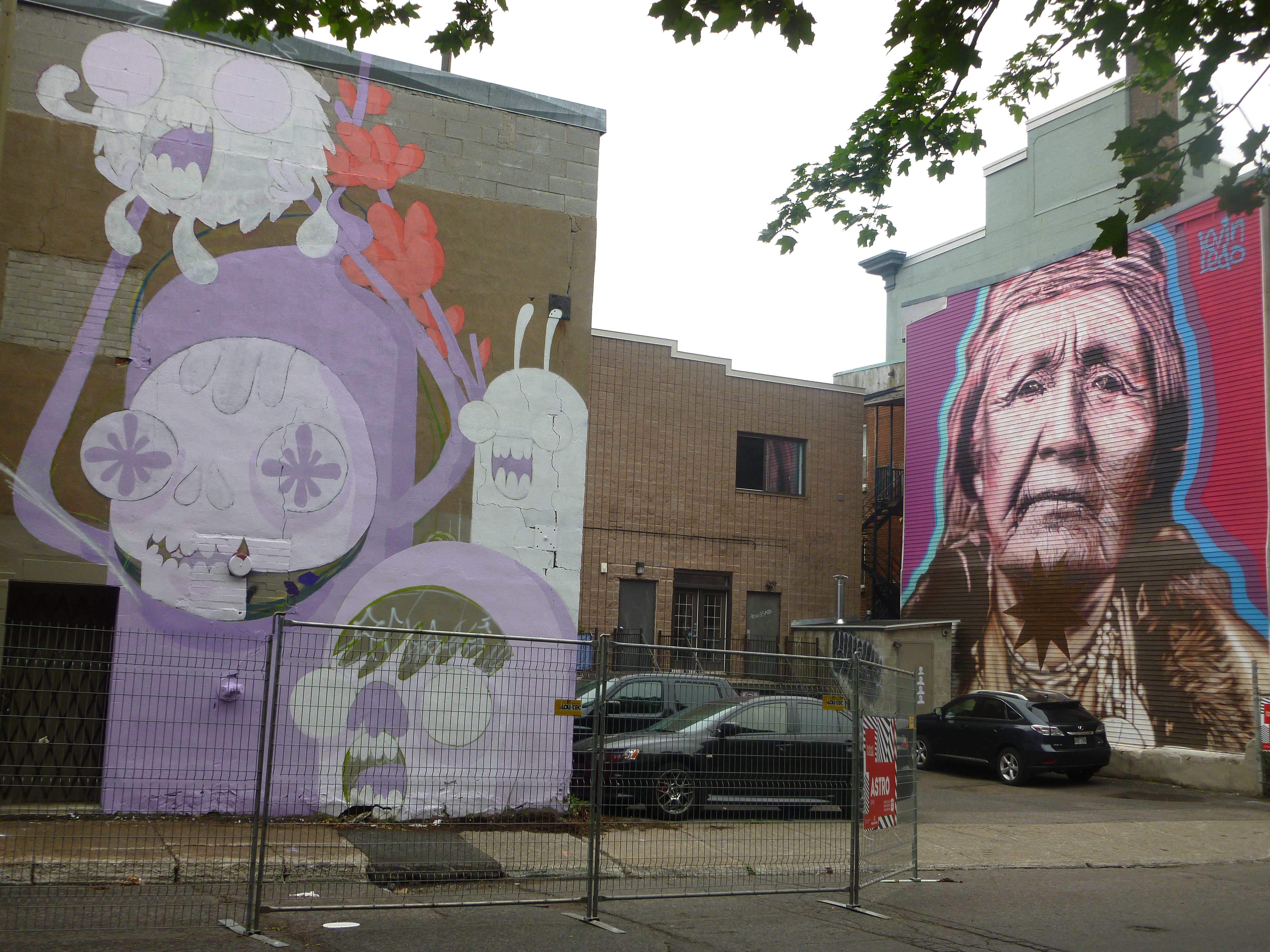
P1060999Mural by Canada’s ASTRO

Mexico city based Curiot is known for blending animal forms in creations inspired by Aztec art and Mexican traditions. His Montreal mural is no exception, and his chalk looking figures call for a heightened connection to nature and between human beings and animals.
P1070002

Austria’s NYCHOS- read his Word and Colour collaboration 

Argentinian Jaz is known for his political graffiti, often depicting scenes of conflict, confrontations, or combats. In his contribution to this year’s Mural Festival, he created a scene depicting cultural and identity clashes between two bulls with human bodies. The bulls are covered in tattoos of maple leaves, fleur de lys, and other Canadian and Québecois symbols.

Another interesting facet of street art is in its reflection of globalization. In addition to their murals in Montreal, you can find Reka One’s aboriginal inspired art in Australia, Italy and Austria, Seth‘s outward looking children in France, Tahiti and China; Etam Cru’s scenes of young girls in Poland, Germany and the United States.

If the artists strive to denounce inequality or injustice through their murals, the process of commercializing said art may strip it of its very purpose.
P1070006A mural by Brazil’s Bicleta Sem Freio 

The nomadic nature of street art allows for a presence of these recognizable characters all over the world. This creates a certain “fil d’attache” between street artists and enthusiasts, as well as between different countries, each faced by their own societal issues.

While Inti‘s mural in Montreal warns that our greed in exploiting Canada’s natural resources will in turn leave us waterless, his mural in Istanbul, Turkey encourages resistance to the government’s austere policies in solidarity with the 2013 Gezi protests. Through their murals, street artists encourage global solidarity in facing world issues.
And yet, when artists are commissioned into creating murals during a festival that clearly has commercial goals – commercial goals that became quite obvious through the street shopping component of the festival – we are called to question the subversive impact of the presence of capitalism in such a festival. Can art be critical of capitalism if it is created by and for capitalism?

P1070001

Moreover, many artists criticize capitalism through their work, but also struggle to pay for the materials necessary to create their works of art. Benjamin Moore sponsored most of the paint used by the artists during Mural Festival. Does art play the same role and have the same mission when its creator was sponsored, or commissioned, by commercial entities?

Though the muralists themselves may want to create art that criticizes capitalism, injustice or austerity, the fact that there was no platform to for them to discuss such themes with the public testifies to the fact that the organizers of the festival are perhaps not as concerned by activism as they are by capital.

In response to the commercialization of art within Mural Festival, the Anticolonial Street Artists Convergence has created a grassroots festival promoting anti-capitalist street art; Unceded Voices will take place from August 14 to 23 with the goal of sharing anticolonial values and indigenous resistance. Unceded Voices brings attention to the fact that Mural Festival takes place on unceded Kanien’kéhá:ka and Algonquin territories.

Contrary to Mural Festival, Unceded Voices will create spaces for artists and members of the community to discuss political issues and how art can act as a platform for such debate.

Check out the murals on St. Laurent, and support Unceded Voices this August.

word by Jiliane Golczyk

Montreal’s Tam Tams Is Textbook Cultural Appropriation

Montreal is known for its summer festivals, such as the weekly drum circle around Sir George-Étienne Cartier’s Monument that occurs every Sunday. Thousands of people gather on the park’s lawns to listen and dance to the rhythm of the hundreds of Tam Tam players gathering to form an incredible drum circle.

Drum circles have shamanic origins, and have been used for centuries by aboriginal peoples around the world in order to celebrate their connections with each other and the Earth.

The nature of the drum circle, with no head or tail, suggests inclusivity.

To witness the Tam Tam festival in Mont-Royal Park is to see solidarity within a group that in appearance has little in common, yet that has the desire to share rhythm and create a collective sound.

However, the fact that this circle takes place on unseeded Kanien’kéa:ka and Algonquin nations territory reminds us of the colonial components of the current festival.

Cultural appropriation takes place when a group of people belonging to a dominant culture adopts the traditions of a historically oppressed culture.

Though the participation of settlers in a drum circle or a potlatch may at first glance seem inoffensive, one must take note that these very traditions were outlawed by the Canadian government not so long ago in an effort to suppress the existence of aboriginal culture.

The appropriation of the drum circle by settlers is confirmation that colonization is an ongoing process in Canada. Attempting to conceive of white Europeans as apolitical participants in colonialist practices is impossible. Choosing to ignore settler impact mirrors the logic behind colorblind racism: ‘Race doesn’t matter, because thinking about my privilege makes me uncomfortable.’

Failing to recognize the appropriation of aboriginal culture during the weekly Tams festival is proof of the persistence of the settler colonization mentality – the same mentality that refuses to recognize the residential school system as a genocide.

Wayside crosses, like the one on Mont-Royal, are an important component of settler heritage: there are more than 3000 in the province. These crosses are not only proof of a material culture symbolizing religious belonging, but evidence of the first colonial occupations by the French, starting with the first cross planted by Jacques Cartier in 1534 – who was the first European to climb Mount-Royal and give it its name. Tams’ drum circles take place in a park footed by this cross.

Settler colonialism in Canada originates with the very same Jacques Cartier, who, in one of his most infamous interactions with the aboriginal peoples, went so far as to ruse and abduct Iroquoian Chief Donnacona and his sons, bringing them to France to serve as circus attractions.

The juxtaposition of the Mont-Royal’s wayside cross, a symbol directly linked to Jacques Cartier, above a dancing group that is formed by a majority of settlers is a textbook case for cultural appropriation in North America. If you are a settler show your solidarity by not participating in the drum circles at Tam Tams.* 

Jiliane Golczyk is originally from Red Deer, Alberta, but has lived in Belgium, Chile and Turkey. She will be beginning her Master’s in International Affairs at Sciences Po this fall. 

More: 

http://www.lemontroyal.qc.ca/en/learn-about-mount-royal/short-history-of-mount-royal.sn

http://www.lemontroyal.qc.ca/carte/fr/html/La-croix-du-mont-Royal-42.html

http://www.winnipegfreepress.com/opinion/analysis/will-truth-set-us-free-306094501.html

http://racerelations.about.com/od/diversitymatters/fl/What-Is-Cultural-Appropriation-and-Why-Is-It-Wrong.htm

http://mycultureisnotatrend.tumblr.com/

http://www.thecanadianencyclopedia.ca/en/article/donnacona/

http://www.umista.org/masks_story/en/ht/potlatch02.html

Support our art event!

11182076_10100949515975075_8917371626465767779_n

Join the rest in helping our art event come true by visiting http://www.kisskissbankbank.com/en/projects/word-and-colour-s-live-art-exhibit/ !

sleeping over

pix

A prickling sensation creeps from the bottoms of her feet up the backs of her calves and thighs. The silkiness of the satin sheets underneath fades to cold cement ground. His left leg is sprawled just below her knees, occasionally twitching with the rhythmic echoes of his snore-embedded breaths. She doesn’t move it. Her legs can do the sleeping tonight. They can have the pins and needles. Since she too, with eyes wide open, is on pins and needles.

          When will he be gone?

Just like all the other ones.

That’s all she can think about.

College girls always joke about fears of waking up with a stranger in bed Saturday morning.

Her biggest fear on the other hand,

Is waking up without the stranger Saturday morning.

        “Don’t leave me tonight, okay?”

        “Okay.”

Honestly, it’s not because she cares about them (at least she tries not to). It’s not the who, but the what, that breaks her every time. It’s the reminder that to these thirsty bodies, she’s esteemed for nothing more than the vacant space inside her (and every other female). She’s a Marlboro. Lit up. Inhaled. Exhaled. Until the last bit of romanticism and hope is sucked out and released; foul and toxic secondhand smoke that pleads to be appreciated one last time before evaporating and losing all evidence of existence. Then disposed of. If she’s lucky, she burns out before they’re done (at least she’s left with some dignity). If she’s not, they’re done before she burns out. And she gets stepped on. With a little extra pressure in the toe box, just in case she’s not out with the first step.

Nothing more than a butt.

That’s what she is to them.

Why does she still do it?

Some presume she’s masochistic.

Some think she’s outright stupid.

However the rare few, like the one sleeping beside her right now, knows otherwise. He knows that behind her indifferent eyes, hidden emotions and sarcastic comebacks:

She’s been hurt, deceived, and mistreated.

She’s tired of clubs, parties and alcohol.

She hates empty words, hookups and promises.

She sleeps with both eyes open, because she’s reluctant to yet again lose this game that she thinks she finally knows the rules to.

She’s still hopeful.

What she doesn’t know, is that she has finally found someone, who feels the exact same.

Someone who is determined to dismantle her walls.

Someone who plans to patch her wounds with his own skin.

Someone who sees her not as a cigarette, but as a cup of coffee.

The Americano with a spoonful of sugar that he can’t start a morning without.

word by Eleanor Tsang

colour Pixel Pancho

breaking news in montreal

city_by_evluk-d5998pi

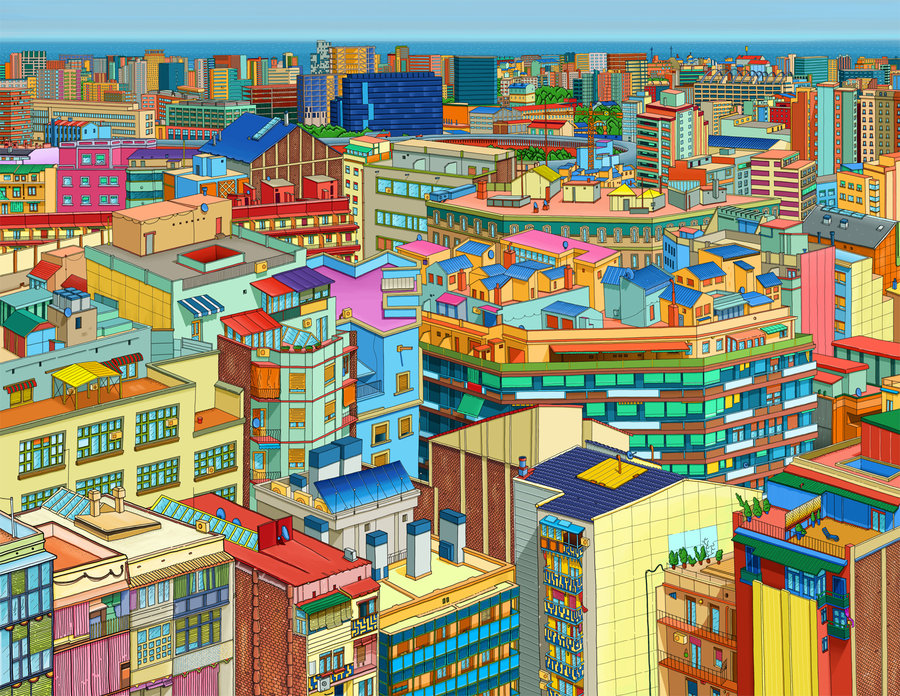
BREAKING NEWS IN MONTREAL: Woman thrown off balcony is pronounced dead at the scene – in other news one million, six hundred thousand and ninety four people not thrown off an astounding amount of balconies

(young artists in denial that they don’t own the mansions depicted in Renaissance paintings grow up to paint mansions; where are apartment building entrances with those random titles on glass doors- The Benmore, The Stallion, L’étranger- in front of heavily stickered mailboxes with variations of, NO FLYERS, NON, and POR FAVOR, HOMBRE, beside faux-marble stairs; we don’t need any more accidental replicas of Atwater’s informally-gated streets; where is Parc X; where are the apartment buildings with balconies of lone chairs and plastic wrap around iron, with shirtless men in sunglasses, surveilling the garbage-bag-placing-process of his neighbours, every Tuesday; where are the buildings with nice lobbies and average apartments; where is cote-des-neiges; where are our bicycles and lines waiting for the bus; where are paintings that embrace the lack of space, not 4 humans to 2 acres but 50 in 2, no wasted space when you connect, right?)

BREAKING NEWS IN MONTREAL: Middle-Eastern man deported for terrorism charges, born in Canada we’re still undecided where to send him – in other news three hundred and twenty thousand middle-eastern-Québecois not charged, although suspected, said to all continue lives in Montréal

(at what point does the state say, alright, busted, we don’t know how to feel like we’re needed when we don’t have a group to protect you from, we just want to feel valued, if you have any suggestions we’re feeling kind of vulnerable, please send them our way, this shit is getting old, we love you)

BREAKING NEWS IN MONTREAL: Black male suspected in armed robbery is presumed guilty – in other news five hundred thousand, three-hundred and twenty four people of colour will continue to live lives in Montréal, despite also being presumed guilty

(Montréal, listen: We love you. We know you can’t really afford to buy us that last round, but don’t worry: My brother is visiting from Toronto. JK 😉 We know you’re the uncle who gave us our first beer, and we get how you’re keeping strong in your middle-age with the festivals, trying to keep the bars open till 6, etc., and, I agree, let’s not talk about the financial district, the disappearing suits thing – it’s cool… We know our neighbourhoods aren’t 100% everyone hanging out together, hamburger, falafel and miso soup picnics, sure, our ethnicities do not interact like they do in the cartoons of our high school textbooks, under “Multiculturalism in Canada,” (or, in the least, white anglos with white francos) but, uh, could we have a festival based on the merit of the musicians, and not Officially Sponsored segregation?) 

BREAKING NEWS IN MONTREAL: Alcohol may have been a factor in Tuesday’s fatal crash on the 40, not the congestion – in other news literally millions of cars who have passed that spot on road have been pretty okay since : There is a 0.000001 chance that you will die on the 40 today

(cue the commercial that generally says, hey, death is less fun but buy this car and you’ll have friends and you’ll all laugh to somewhere vaguely rural like past Laval and drink on a dock, even if it isn’t your dock, or look a rock, and uh yeah we paid someone to shoot here, but there are so many docks and so much space away from the city, you can escape all your neighbours!)

BREAKING NEWS IN MONTREAL: Concordia survey finds female students more likely to judge self-worth by appearance than male counterparts – in other news when you force a mold on liquid chocolate it will likely harden into that mold more times than not

(Montréal, honey, we love you, tell your police officers we know that they are good people, tell your protesters that everything will be alright, even if it won’t, let’s hold hands and change the way that we train our police, let’s change the way that our classes get treated by the system that values money, even if it’s tough to insert a heart on our coloured currency, because, baby, we just want to share a Boréale Rousse with you by the canal, come feed me curd while I read you French translations of Richler)


word by Liam Lachance

colour by Evluk

police

07-27-2011_n1_900


The police officer is circulating the metro station. Escalator teeth sink into tiles, reminding you of waves, disappearing in the floor. Your feeling is that, as the metal step dissolves, it is gone, like the wave. The police officer is sitting beside you. Plastic boxes for the fluorescent lights, above, hold dirt, and bugs, and you only notice it for the first time, now, bored enough to examine the details of the station. The police officer is sharing your view. For better or worse the dirt of these lights and the teeth of this escalator are part of the cities’ landscape, and we notice them as much as the country kid notices squirrels in branches. One step is one step – one wave is one wave… It’s more beneficial to have a thousand individuals walking around a metro station than a thousand people who know each other, who can empathize and learn from each other – individuals need to Find Their Selves in products or political movements, vote for us, we aren’t those old bastards, you’re a rebel if you buy this thing – you will end up with this white woman, and look at these jets bro! The police officer is asking you a question. You answer: Waiting. Another stair sinks into the tile. The impression is that the wave is separate from the ocean: It is never that the ocean is touching the beach- slapping it, really. Life is always one piece splitting away, independent. The police officer is asking you another question. When you entered the metro you paid for your individual ticket and placed it in the turnstile. The machine clicked after you pushed the metal bar so that the person behind you knew this stranger had passed through and it was their turn to enter. It’s easier to control a shape if you tell each electron they are the most important, you can be a nucleus someday if you work hard enough, don’t mind all those others – you have nothing in common. The police officer is circulating the metro station. The same piece of gum keeps on coming up on this same stair.      


word by Liam Lachance

colour by Agilmore